The ARRL Solar Update
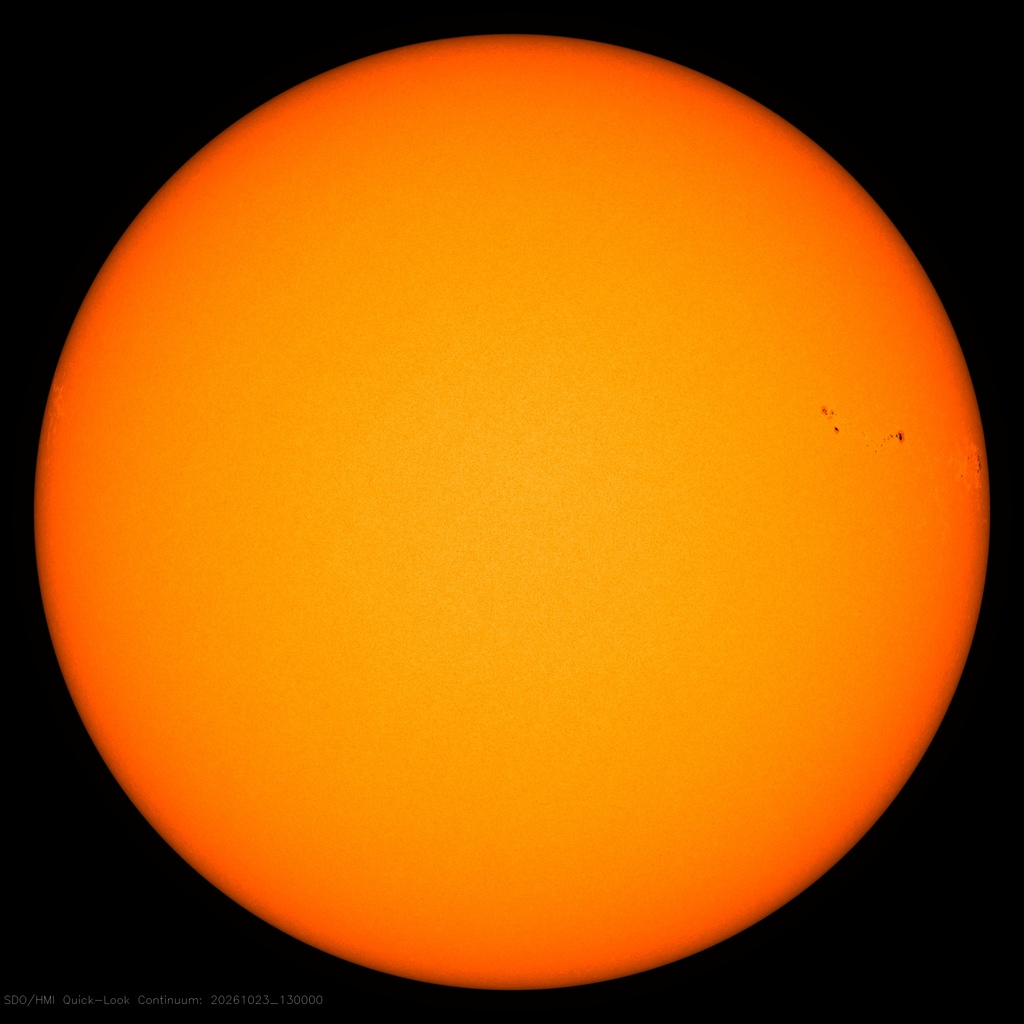
The active sunspot region that has been giving us improved
propagation over the past several days will be rotating away
from Earth’s view today, but conditions on most of the HF
amateur bands should remain pretty decent in the days ahead,
as the 10.7-centimeter radio flux remains right around 100.
However, NOAA’s Space Weather Prediction Center (SWPC) says
the geomagnetic field could become unsettled to active heading
into the weekend as a negative polarity coronal hole high-speed
stream (CHHSS) heads toward Earth.
The Australian Space Weather Forecasting Centre predicts
mostly normal HF propagation conditions worldwide.
The W3LPL Propagation Forecast from the Daily DX is predicting
a dropoff in DX openings on 10 and 12 meters as the active
sunspot region rotates away from Earth and the solar cycle
continues its decline. However, good conditions are expected
to continue on 15, 17, and 20 meters, with the lower HF bands
(30, 40 and 80 meters) providing excellent long distance
nighttime propagation.
This weekend is the CQ World Wide SSB DX Contest (0000Z
October 24 through 2359 Z October 25). It’s often said that
this contest makes its own propagation, most likely because
there are stations active to take advantage of unanticipated
openings, even on the higher HF bands. So keep listening for
calls from faraway stations.
Weekly Commentary on the Sun, the Magnetosphere, and the
Earth's Ionosphere, October 22, 2026, by F. K. Janda, OK1HH:
Solar activity is gradually declining in the second half of
October, as expected. The decline will continue into early
November, with Class C solar flares still occurring
infrequently. Class M flares may continue to occur on rare
occasions.
The next increase in solar activity is not expected until the
second half of November. In the meantime, there will continue
to be isolated and generally brief spikes in geomagnetic
activity, which will be difficult to predict with precision.
The Predicted Planetary A Index for October 23 to October 29
is 5, 15, 8, 5, 5, 5, and 5 with a mean of 6.9. The Predicted
Planetary K Index is 2, 4, 3, 2, 2, 2, and 2 with a mean of
2.4. 10.7 centimeter flux is 100, 95, 95, 95, 100, 105, and
105 with a mean of 99.3.
For more information concerning shortwave radio propagation, see
http://www.arrl.org/propagation and the ARRL Technical Information
Service web page at, http://arrl.org/propagation-of-rf-signals. For
an explanation of numbers used in this bulletin, see
http://arrl.org/the-sun-the-earth-the-ionosphere . Information and
tutorials on propagation can be found at, http://k9la.us/ .
Also, check this:
https://bit.ly/3Rc8Njt
"Understanding Solar Indices" from September 2002 QST.
Photo Gallery
-
 Photo Courtesy of...
Back


