The ARRL Solar Update
Solar activity has been at low levels, with occasional B-class flaring and isolated low-level C-class flares observed. The largest event of the period was a C1.6/Sf flare on August 5 from Region 4502.
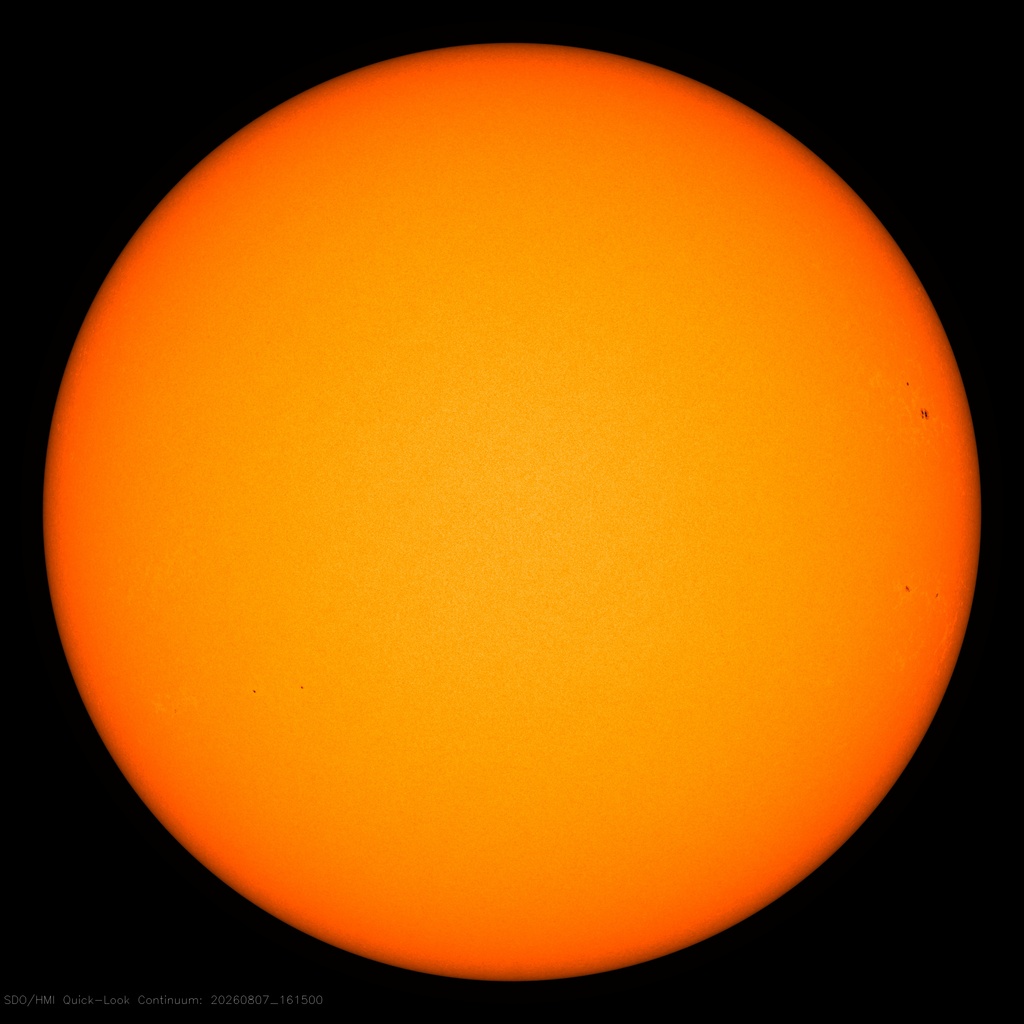
The six numbered sunspot regions on the visible disk are mostly stable or in varying stages of decay. Region 4498 showed a slight decrease in penumbral extent. Region 4499 declined in length and area, though limb foreshortening hindered complete characterization of its magnetic structure. Region 4500 weakened in its leading spot. Region 4501 lost its trailing spots, decaying into a unipolar group.
Region 4502 exhibited consolidation across both magnetic poles. Region 4503 was limited by foreshortening near the southeast limb, but appeared to show modest new flux emergence in its trailing spots to become a bipolar group.
No Earth-directed coronal mass ejections (CMEs) were observed in available coronagraph imagery.
With ongoing region decay and several active regions in the western hemisphere expected to rotate off the disk over the coming days, there is a decreasing chance for M-class (R1-R2/minor-moderate) flares August 6. Current Solar Orbiter Helioseismic and Magnetic Imager (HMI) imagery suggests no significant returning regions during the forecast period.
Solar wind parameters remained at quiet, ambient, levels throughout the period. Solar wind speeds reflected a slow wind regime, gradually declining from early values near 400 km/s down to approximately 345 km/s late in the period. The phi angle remained predominantly in the positive (away from the Sun) sector.
Solar wind parameters are expected to remain in a slow wind regime through early August 7. Later in the day, enhancements are anticipated to begin due to the arrival of CMEs that departed the Sun on August 3. These CME enhancements may persist into August 8, alongside potential weak influences from a negative polarity coronal hole high-speed stream (-CH HSS) that is likely too far south to become significantly geoeffective.
Weekly Commentary on the Sun, the Magnetosphere, and the Earth's Ionosphere, August 6, 2026, by F. K. Janda, OK1HH:
The effects of the expected decline in solar activity (within the context of the 27-day cycle), which began before the end of July, were exacerbated by the geomagnetic disturbance that occurred on August 2 3. The effects of this decline will still be felt in the ionosphere during the first third of August. The second third of the month will bring an improvement. Then, in the final third, when solar radiation levels will once again be elevated, the approaching fall will also have a noticeable and positive effect on the ionosphere.
The Predicted Planetary A Index for August 7 to August 13 is 5, 5, 5, 5, 8, 8, and 5 with a mean of 5.9. The Predicted Planetary K Index is 2, 2, 2, 2, 3, 3, and 2 with a mean of 2.3. Predicted 10.7 centimeter flux is 110, 105, 105, 105, 105, 105, and 110 with a mean of 106.4.
For more information concerning shortwave radio propagation, see
http://www.arrl.org/propagation and the ARRL Technical Information
Service web page at, http://arrl.org/propagation-of-rf-signals. For
an explanation of numbers used in this bulletin, see
http://arrl.org/the-sun-the-earth-the-ionosphere . Information and
tutorials on propagation can be found at, http://k9la.us/ .
Also, check this:
https://bit.ly/3Rc8Njt
"Understanding Solar Indices" from September 2002 QST.
Photo Gallery
-
 Photo Courtesy of...
Back


