ARRL Audio News
| · | To subscribe, unsubscribe, or change your e-mail delivery address: see How to Get The ARRL Letter, below |
| · | Delivery problems (ARRL member direct delivery only!): letter-dlvy@arrl.org |
| · | Editorial questions or comments: Rick Lindquist, N1RL, rlindquist@arrl.org |
| · | ARRL Audio News: http://www.arrl.org/arrlletter/audio/ or call 860-594-0384 |
| · | The ARRLWeb Extra: http://www.arrl.org/members-only/extra |
IN THIS EDITION:
- + FCC audits South Carolina exam session
- + FCC dismisses ham-band broadcasting permission
- + New AMRAD LF beacon activated
- + Teacher survey yields new insights
- + Elser-Mathes Cup awaits extraterrestrial QSO
- FAR offers scholarships
- Solar update
- In Brief:This weekend on the radio; New section managers take office January 1; ULS processing new club applications; Coast Guard clarifies Amateur Radio assistance call; Young ham on Red Cross errand when killed; Maine hams help in search; New 47-GHz North American distance record claimed; QST Cover Plaque Award
+Available on ARRL Audio News
Editor's note: Because of the Christmas holiday, next week's editions of The ARRL Letter and ARRL Audio News will be distributed a day early, on Thursday, December 23. These will be the final editions for 1999. The ARRL Letter and ARRL Audio News resume weekly distribution Friday, January 7. Important late-breaking news will be announced via W1AW bulletin and/or in The ARRLWeb Extra on the members only Web page. Best wishes for a safe and happy holiday season.--Rick Lindquist, N1RL
FCC AUDITS SOUTH CAROLINA EXAM SESSION:
Following up on allegations of irregularities, the FCC is auditing a July 14 W5YI-VEC Amateur Radio examination session in Clemson, South Carolina. FCC Special Counsel for Amateur Radio Enforcement Riley Hollingsworth this month sent inquiries to several individuals said to have been involved with the session, including four W5YI-VEC Volunteer Examiners. Several licensees who took and passed examinations at the session also were designated for retesting.
"We had some very serious allegations from some of the examiners that their signature appeared on the 610 forms as well as the manifest for the exam and they weren't present," Hollingsworth said this week. "We have some other evidence that we're not revealing at this time, but we're just auditing the Clemson exam and we'll be looking at some other tests as part of this same investigation."
At the core of the issue is an examination "sub-session" arranged following a regularly scheduled test session the same day in Clemson. The W5YI-VEC, which has cooperated with the FCC in the investigation, says there's reason to believe that VEC paperwork may have been forged, some of the alleged volunteer examiners actually were impostors, and one examiner also was an examinee.
Hollingsworth has written volunteer examiners Eugene D. Watring, AF4DB; "Dale" Martin, KT4NY; Grady P. Robinson, AK4N; and Mikel T. Blackwell, N4OPD, asking each if he signed the manifest or any Forms 610 or authorized anyone to sign on his behalf; if he was present for the exam session or any part of it, and, if so, the time and location; the nature of his involvement, if any, in the July 14 examination session, and, if he were not present, how he became aware that "your purported signature appeared" on the exam session documents.
In a prepared statement, Fred Maia, W5YI, said the FCC is especially interested in the circumstances of the upgrade of William J. Browning, AB4BB (ex-AF4PJ and KE4BWS), from General to Amateur Extra. Maia says Browning "upgraded his General class license at a second session held after he acted as team leader at his regular examination session held the same day at the same location." Maia says the second exam session appears to be "a concocted session to upgrade a specific licensee."
Maia says Browning asked Watring to assist in both examination sessions, and Watring served as team leader at the second one. He says that when Watring showed up to help monitor the second session "he was introduced to other VEs whom he did not know." The other VEs-- Blackwell, Martin and Robinson--furnished signed letters to the W5YI-VEC stating they did not participate in either examination session. "It appears that Watring, Blackwell, Martin and Robinson may be totally innocent,." Maia said.
Robinson and Blackwell are shown as VEs on Browning's application as well on those of examinees Frank D. Cox, KF4UJQ; Joseph A. Cox, KF4RMH; and James F. Chambers, KF4PWF. The FCC has requested that Browning, Frank Cox, Joseph Cox, and Chambers retake their Amateur Radio examinations before January 31, 2000.
Following up on an audit of a May 2, 1999, examination session in Yonkers, New York, Hollingsworth also posed similar questions to ARRL-VEC volunteer examiner James Bonnett, KA2ZSA. Hollingsworth asked Bonnett on December 8 if he actually signed Form 610s for two examinees at the session or authorized anyone to sign for him; the nature of his involvement, if any, in the May 2 session; and if he was not present how he came to know that his "purported signature" appeared on the forms. Hollingsworth also asked if Bonnett had applied any of the marks found on answer sheets from the session.
Hollingsworth also wrote to session examinee Winston Tulloch, KC2ALN, who had attempted to upgrade from General to Advanced at the session. The FCC subsequently dismissed applications from Tulloch and others because of alleged irregularities and put a cloud over their future amateur applications.
In his December 8 letter, Hollingsworth encouraged Tulloch to retake the examination and said his application "would be processed routinely." Alleged irregularities at the session, Hollingsworth told Tulloch, "were not your fault and in no way reflect adversely on your qualifications to be a licensee."
FCC TURNS AWAY HAM-BAND BROADCASTING PETITION:
The FCC has turned down a request by Michael R. Reynolds, W0KIE, to permit amateurs to make one-way transmissions intended for reception by the general public on Amateur Service frequencies above 420 MHz. Reynolds had said that, if adopted, his proposal would provide new opportunities for noncommercial, community-oriented radio and additional diversity on the radio dial. He also asserted that Amateur Service frequencies above 420 MHz are "seriously underutilized."
The FCC dismissed the petition November 18, apparently without ever assigning it a rulemaking number or soliciting comments. In dismissing the petition, the FCC said that the Amateur Service was not intended to be used for broadcasting, that authorizing broadcasting in the 420-450 MHz band could cause harmful interference to other stations that share the band with amateurs, that the band is well-populated with repeaters, and that 420 MHz is the lowest amateur frequency available for spread spectrum and ATV. The FCC also noted the pending petition to create a low-power FM broadcasting service.--W5YI Report
NEW AMRAD LF BEACON ACTIVATED:
A second experimental low-frequency beacon is on the air from Northern Virginia. The WA2XTF/12 beacon on 136.745 kHz is a part of the Amateur Radio Research and Development Corporation's experiments to gain LF experience in anticipation that the FCC may allocate an amateur band at 136 kHz.
In October 1998, the ARRL petitioned the FCC to create two amateur LF allocations at 135.7-137.8 kHz and 160-190 kHz. Its petition was designated RM-9404. The FCC has not yet acted on the request.
The new beacon at the QTH of Ted Seely, AA4GM, near Front Royal, Virginia--one of 12 WA2XTF sites--features a 175 W transmitter feeding a 1600-foot horizontal antenna. It transmits a continuous CW message at 5 WPM. The AMRAD project's first beacon WA2XTF/6, on 136.75 kHz, was shut down temporarily to eliminate the potential for interference.
Project participant André Kesteloot, N4ICK, says the WA2XTF/12 beacon setup employs an "Earth bipole" style antenna that's grounded at both ends. The shorter leg consists of 100 feet of wire grounded to a 250-foot deep well casing. The longer leg is some 1500 feet of wire stretched horizontally about 20 feet above the ground, "strung from one tree to another, like a telegraph wire," Kesteloot says. The far end of the longer leg is connected to a rod inserted into a pond. He said two large coils were inserted in series with the longer wire--one at the transmitter end, the other near the pond end--to bring the antenna into resonance at 136.750 kHz.
As AMRAD President (and ARRL Technical Relations Manager) Paul Rinaldo, W4RI, tells it, installation of the huge antenna earlier this fall was one of the more challenging aspects of the project. "When we got to the end of the run, we were greeted by more than 20 cows," he said. "At first, we were open to the thought that they were interested in Amateur Radio antenna experimentation. But the more likely story was that they thought it was feeding time."
Kesteloot reports the WA2XTF/12 transmitter was fired up on November 14. AMRAD is seeking additional reports. Reception reports may be sent via e-mail to André Kesteloot, N4ICK, n4ick@amrad.org. Further information concerning the LF experiments is available at http://www.amrad.org.
TEACHER SURVEY YIELDS NEW INSIGHTS:
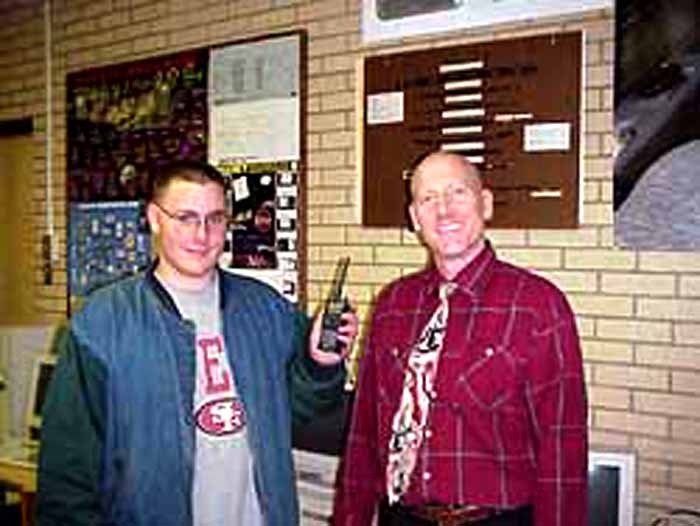
Ian Snell, KD7EPH (left), a member of the Payson High School ARC with Reed Thompson, N7YVJ, a faculty member. Snell got his ticket through a class at the school taught by Robert Strange, K7VVU. [Courtesy of Robert Strange, K7VVU] |
In October, ARRL Field and Educational Services polled 30 specially selected active teachers and instructors about their Amateur Radio instructional efforts and experiences. The group surveyed included those who have been likely to respond to earlier surveys, have had a high level of classroom activity and success, and have used innovative teaching techniques.
Questions included student ages, school or club group composition, numbers of successful licensees, and types of operating activities students liked best. The questionnaire--compiled and distributed by Field & Educational Services Correspondent Dan Miller, K3UFG--specifically asked for details about what made an Amateur Radio program successful with students--the hits and misses.
The overwhelming majority of those responding expressed optimism about the future of ham radio and its special attraction for young people. A few students also shared their experiences.
All teachers surveyed agreed that getting someone licensed was only the beginning. While they felt that it was their responsibility to prepare students to get on the air, involvement with a local club was seen to be of equal importance since a club can offer support, guidance, and answers to questions.
Miller agrees. "In our fast changing technology, the need for continuing education in the hobby has never been greater," he says. "Membership in a club allows us to learn and develop our interests, while serving the community in which we live."
Those involved in an instructional program who would would like to contribute to the survey may contact Dan Miller at dmiller@arrl.org for a questionnaire. Complete survey results will appear in early 2000.--Mary E. Lau, N7IAL
ELSER-MATHES CUP AWAITS EXTRATERRESTRIAL QSO:

Elser-Mathes Cup. |
The story of the Elser-Mathes cup appeared in the November 1969 issue of QST. In his article, "That Planet Mars QSO Cup," Col Fred Johnson Elser, W6FB, recalled meeting League founder Hiram Percy Maxim, W1AW, in the 1920s. He learned that Maxim had an interest in Mars and even owned a globe of "The Red Planet." Later, back in The Philippines--in 1928 under US jurisdiction--Elser was inspired by a visit with Philippines SCM Lt Cmdr Stanley Mathes, K1CY, to offer "a unique trophy" for the first two-way communication with Maxim's "pet planet," Mars.
The actual trophy selected by Elser and Mathes during a trip to Baguio is an example of Igorot native woodcarving. "The base symbolizes Earth and the seated figures are its inhabitants," Elser explained in QST. "The bowl is Mars, and the standing men are the amateurs who bridge the gap of space." The plate fastened to the cup includes space for the names and call signs of those who will one day fulfill the cups eventual destiny. (In the meantime, if you'd like to send your name to Mars, visit http://spacekids.hq.nasa.gov/2001/).
FAR OFFERS SCHOLARSHIPS:
The nonprofit Foundation for Amateur Radio Inc--an ARRL-affiliated federation of more than 75 Amateur Radio clubs in the Washington, DC, area--plans to administer 73 scholarships for the 2000-2001 academic year to assist eligible radio amateurs with post-secondary education. The Foundation fully funds 10 of the scholarships with income from grants and from its annual hamfest. FAR administers the remaining 63 scholarships at no cost to the donors.
Amateur Radio licensees are eligible to compete for these awards if they plan to pursue a full-time course of study beyond high school and are enrolled in or have been accepted at an accredited university, college, or technical school. Awards range from $500 to $2500. In some cases, preference goes to those pursuing certain courses of study or to residents of specific geographical areas. FAR encourages all clubs--especially those in Delaware, Florida, Maryland, Ohio, Pennsylvania, Texas, Virginia, and Wisconsin--to spread the word on the availability of these scholarships at meetings, in newsletters, during training classes, on their nets, and on their Web sites.
Application forms and additional information are available by letter or QSL postmarked prior to April 30, 2000, from FAR Scholarships, PO Box 831, Riverdale, MD 20738. Contributions to FAR are tax-deductible.
SOLAR UPDATE:
Solar flux and sunspot numbers rose over the past week after declining for the previous few weeks. Average solar flux was up over 14 points compared to the previous week, and average sunspot numbers were up nearly 34 points. The only unstable geomagnetic day was Monday, December 13, when the planetary A index was 26. The K index was four or five for most of the day. In Alaska, the higher latitude College A index was 43, and the K index reached six over several three-hour periods.
On Wednesday and Thursday, December 15 and 16--just before this bulletin was written--the solar flux was still rising. Three solar flux readings are taken every day at the Penticton, British Columbia observatory, but the noon value is the one that is reported as the official number for the day. The thrice-daily values for both days were 174.9, 178.7, 182.3, 191.6, 194, and 195.
This weekend, December 18-19, look for the flux to peak, with Friday through Sunday values around 200, 210 and 195. Geomagnetic conditions should be stable, with planetary A indices around 5, 8 and 10.
Sunspot numbers for December 9 through 15 were 132, 130, 134, 97, 147, 139 and 148 with a mean of 132.4. The 10.7-cm flux was 156.2, 164.4, 159.1, 159.2, 166.1, 168.4 and 178.7, with a mean of 164.6. The estimated planetary A indices were 12, 7, 7, 9, 26, 3 and 4, with a mean of 9.7.
In Brief:
- This weekend on the radio: The OK DX RTTY Contest, the Croatian CW Contest, the Stew Perry Top Band Distance Challenge, the RAC Winter Contest, and the International Naval Contest are the weekend of December 18-19. Just ahead: ARRL Straight Key Night and the 14th Internet CW Sprint are December 31-January 1. Also, the PSK31 Millennium Contest, the SARTG New Year RTTY Contest, and the Y2K QRP Contest are January 1-2. See December QST, page 88, and January QST, page 100, for details.
- New section managers take office January 1: Three new ARRL section managers will take office at the start of the new year. In East Bay, Andy Oppel, KF6RCO, of Alameda, California, has been appointed to replace Bob Vallio, W6RGG. Vallio was elected in November as Vice Director of the Pacific Division but may not hold both offices. His resignation is effective January 1, 2000. In Western New York, Scott Bauer, W2LC, has been appointed to fill out the remaining term of veteran SM Bill Thompson, W2MTA, who retires January 1 after many years of service. Thompson will remain active in the National Traffic System. In Alaska, Kent Petty, KL5T, of Anchorage recently defeated incumbent David Stevens, KL7EB, to become the new SM there. Incumbent SMs in eight other ARRL sections also begin new terms on January 1.
- ULS processing new club applications: While the FCC continues to work out a few bugs in the Universal Licensing System, the ULS Task Force reports it expects to complete processing its backlog of new club station applications filed over the past four months. The ULS is not yet processing club station modification applications via the Universal Licensing System, but that could happen next week. Applications for new or modified club station licenses still must be filed on FCC Form 610B. Prior to filing a new or modified club station application, applicants must obtain an Assigned Taxpayer Identification Number from FCC Technical Support, 202-414-1250.--ARRL
- Coast Guard clarifies Amateur Radio assistance call: The US Coast Guard has asked the Amateur Radio community to help during what it calls "the Y2K event"--defined as from 1700 UTC December 31, 1999, until 2400 UTC on January 2, 2000. If a Y2K-related outage disrupts normal reporting methods, the Coast Guard requests that hams accept any reports destined for its National Response Center and forward them to respective state Emergency Operations Centers (EOCs) via "RACES/ARES or other available methods." The Coast Guard says hams should follow "established reporting procedures for their respective jurisdictions." Hams will forward any appropriate reports via established Amateur Radio nets, expected to be in operation during the Y2K time frame. The National Response Center is the sole national point of contact for reports of oil, chemical, and other spills or releases into the environment in the US and its territories. The state EOC will relay reports received to the Coast Guard via telephone, the Internet or FEMA's HF radio network. For more information on the NRC, visit http://www.nrc.uscg.mil .--US Coast Guard bulletin
- Young ham on Red Cross errand when killed: A popular and promising young Connecticut amateur was on an errand for the American Red Cross when he died in an automobile wreck December 6, a Greenwich newspaper reports. John E. Schmeltzer IV, N1ZKF, of Greenwich was a volunteer in the Red Cross' Communications Division. He was 16. He and his best friend Dwight H. Renfrew III--also 16 and an ARC volunteer--were killed when Schmeltzer's car went out of control and struck a tree off a rain-slicked highway. Both youths died at the scene. Students at Greenwich High School, where both were juniors, were released from classes to attend separate services for the two. Hundreds of mourners packed St Michael Church for Schmeltzer's service on December 9. Schmeltzer was an active member of the Greater Norwalk Amateur Radio Club. A Technician licensee and an ARRL member, Schmeltzer also was active as a SKYWARN spotter. "John was always present at Field Day and contributed much to our score and our morale with his ever-present smile," said an obituary notice on the GNARC Web page, http://www.norwalk.com/gnarc/ .--GNARC; The Greenwich Time
- Maine hams help in search: Hams in Central Maine recently helped in the search for a missing person. On December 7, a search was begun for a young woman missing since the early morning hours in the woods and near a lake where she was last seen. A newcomer to the Pine Tree State, Maurice Dandeneau, K1STB, reports the search was in his neighborhood in Winthrop, and police were doing a door to door canvass. "Naturally I offered the services of the ARES and got on the 146.88 machine in Winthrop and received help from several hams," he reports. Those included N1GZB, who volunteered help from Oxford county ARES and put Dandeneau in contact with N1REX, president of the Augusta Radio Club and fire chief in nearby Togus. The young woman was found that afternoon in good condition about four miles from her home. "This area of Maine has a great bunch of hams, well-trained and ready to provide when needed," K1STB said.--Maurice Dandeneau, K1STB
- New 47-GHz North American distance record claimed: KF6KVG and W0EOM are claiming a new North American distance record on 47 GHz. On December 8, after some testing and waiting for the right day, W0EOM went to Mt Vaca, (CM88WJ) near Vacaville, California, and KF6KVG went to Loma Prieta Mountain (CM97BC), south of San Jose. They calculate the distance to be 137 km. At about 2:15 PM they acquired signals about 1 S-unit out of noise. Approximately 10 min later, KF6KVG found he was on a side lobe, and signals jumped up to S8 on both ends. Both used 23-inch dishes. Weather was 50 degrees, humidity about 60 percent, and high clouds.
- QST Cover Plaque Award: The winner of the QST Cover Plaque Award for November was Evhen Tupis, W2EV, for his article, "An Automated Meteor-Scatter Station." Congratulations, Ev!