ARRL Audio News
| · | To subscribe, unsubscribe, or change your e-mail delivery address: see How to Get The ARRL Letter, below |
| · | Delivery problems (ARRL member direct delivery only!): letter-dlvy@arrl.org |
| · | Editorial questions or comments: Rick Lindquist, N1RL, rlindquist@arrl.org |
| · | ARRL Audio News: http://www.arrl.org/arrlletter/audio/ or call 860-594-0384 |
| · | The ARRLWeb Extra: http://www.arrl.org/members-only/extra |
IN THIS EDITION:
- +ULS is out of the gate
- +SATERN handling earthquake traffic
- +Top Band opens at high noon during eclipse
- +Arizona tax law benefits school ham clubs
- Solar update
- In Brief: This weekend on the radio; Follow the light; Colorado 14er radio event set; Vanity update; AMSAT symposium set; GPS week rollover looms; Myron Hexter, W9FKC, SK; Ness nominated for another term; SBE announces award winners; Hatfield addresses IEEE; QST Cover Plaque Award
+Available on ARRL Audio News
ULS FOR HAMS ENDURES FIRST-WEEK JITTERS
The FCC's Universal Licensing System is up and running for the Amateur Service, although it didn't happen without a few wrinkles and some frustration on the part of hams trying to register or use the system. At one point on August 16--the first day the ULS was available to hams--no one could access the system, even for registration. But the downtime lasted less than an hour, according to an FCC spokesperson. "The system itself has been running smoothly," he said. The system also was down briefly on Wednesday and Thursday.
Some hams reported slow response times in accessing the ULS to register or search the existing database information. Others found themselves confounded by the new system.
ARRL New England Director Tom Frenaye, K1KI, used the ULS this week to renew his license. "It wasn't a pleasant experience," he remarked, citing the complexity of configuring the dial-up connection required. "It's nice to renew on-line, but I'm glad I won't have to do it for another ten years." A Midwest ham equipped with a cable modem at first had decided he'd rather file a paper application than to take a step backward in technology. But he managed the dial-up connection and gave the ULS a tentative thumbs up. "It's certainly a snap once you've done it once, but I'm afraid the dial-up aspect will scare off most folks," he said.
The FCC has disabled the former on-line vanity Form 610V and renewal Form 900 applications and redirected all amateur applicants to the ULS page.
Even though all amateurs already are in the FCC database as licensees, ULS registration is a must--before filing an application, renewing or modifying a license, or applying for a vanity call sign. Applications filed through a VEC automatically register the applicant in ULS, as do paper applications mailed to FCC that include the applicant's Social Security Number. Applications filed on-line by anyone not registered in the ULS will be dismissed. Registration requires first providing your Social Security Number or other Taxpayer Identification Number, then registering your call sign.
To register electronically, visit http://www.fcc.gov/wtb/uls/ and click on "TIN/Call Sign Registration." A paper Form 606 (TIN Registration Form) that can be mailed to the FCC is available at http://www.fcc.gov/formpage.html or from the FCC's Forms Distribution Center, 800-418-FORM (3676). Paper forms may be faxed (717-338-2693) or mailed to the FCC, 1270 Fairfield Rd, Gettysburg, PA 17325-7245.
While amateurs can use a Web network connection to register or to search the ULS for individual call signs or application status, applicants must use a toll-free telephone connection to the FCC's Wide Area Network in order to actually file an application on the new ULS Form 605. Complete connection instructions are on the FCC's ULS home page, http://www.fcc.gov/wtb/uls, under "Connecting to ULS." Connecting to the ULS requires Netscape 4.5 or higher.
The ULS phase-in has created a backlog of new amateur applications at Volunteer Examiner Coordinators. ARRL-VEC Manager Bart Jahnke, W9JJ, said that while the FCC has begun accepting some data from VECs, the quantity allowed to be submitted has been very low--10-20 applications per VEC were accepted the first three days after ULS went into effect for hams. Not all VECs are set up to file under the new system yet. "To date, only Monday's data appears to have been successfully processed," Jahnke said at week's end. "The ARRL-VEC is ready to transmit nearly 70 test sessions containing more than 150 successful applications, once the FCC gives us the green light."
As a result, applicants for new amateur licenses will have to wait a few more days--perhaps several days--longer before their new call signs are issued by the FCC. In addition, no vanity call sign applications were processed during the ULS phase-in period last week. Once the ULS is working as planned, automated processing of electronically filed applications is supposed to occur nightly each business day, but there will be no weekend processing under the ULS.
The FCC said it expects to tackle the VEC application backlog very soon. It also said it hoped to have the ZIP file available daily for Web call sign servers and others to access.
At this time, the ULS is not accepting any club station applications. Trustees and custodians of club, military recreation, and RACES licenses should continue to use the old Form 610B to file applications for those stations and should not use their personal Social Security Number as the TIN for these licenses. Club station trustees and applicants should contact ULS Technical Support at 202-414-1250 to obtain an Assigned Taxpayer ID Number for each club license and provide it on the Form 610B.
The FCC says that anyone who fails to register in the ULS will be unable to receive services from the FCC. This means the FCC will not process future license grants, upgrades, modifications or renewals for any applicant not registered in the ULS. The FCC recommends that all amateurs register now, even if they have no immediate need to transact business with the FCC.
Amateurs having ULS problems or questions should contact the FCC's ULS Technical Support staff at 202-414-1250.
SALVATION ARMY AMATEUR NET HANDLING EARTHQUAKE TRAFFIC
The Salvation Army Team Emergency Radio Network--SATERN--is running a health-and-welfare traffic operation as a result of requests from individuals in the US seeking information on friends and relatives in earthquake-stricken Turkey. The Salvation Army World Services Office has been receiving requests since the quake hit early yesterday. The earthquake, described as one of the most powerful this century, left upwards of 10,000 people dead, injured many thousands more, and has disrupted normal telecommunication systems. The quake measured 7.4 on the Richter scale.
SATERN reports it will pass traffic on its normal 20-meter net on 14.265 MHz at 1400 UTC. The Salvation Army says that Quent Nelson, WA4BZY, is heading the H&W operation from Covington, Georgia. Amateurs in the US are permitted to handle third-party traffic to and from Turkey.
Those seeking to initiate health-and-welfare requests may visit http://www.angelfire.com/il/satern411/satframe.html or call 773-205-3573 for additional information and assistance. Requests also may be sent via e-mail to qnwa4bzy@mindspring.com.
In Florida, The Martin County Amateur Radio Association has posted additional Web sites and frequencies in use for earthquake-related Amateur Radio traffic at http://shemp.ecqual.net/~millard/emercom.htm. ANTRAK, the Ankara Radio Amateurs Club, TA2KA, says earthquake traffic also is being handled in Turkey on 14.270, 7.092, and 3.777 MHz.--Salvation Army; MCARA
TOP BAND OPENS AT HIGH NOON DURING ECLIPSE
For a few brief hours on Wednesday, August 11, the impossible happened: 160 meters opened to summertime, daylight DX. What made it possible was the total--or nearly total--eclipse of the sun.
The August 11 eclipse was the last total solar eclipse of the 20th century. The trajectory of the moon's shadow carried it across Central Europe, Turkey, the Middle East, Pakistan and India. Scientists had theorized that the absence of sunlight in the ionosphere could affect D-layer propagation. NASA had called on hams and SWLs to monitor shortwave signals from Europe before, during, and after the eclipse and report their findings.
Scientific studies by NASA and others aside, Luis Mansutti, IV3PRK, has ample anecdotal evidence in his logbook that the eclipse did, indeed, enhance D-layer propagation.
"It has been a great experience, enjoying such beautiful conditions at noon in the month of August on 160 meters!" he said in a posting to the Topband and Low Band Monitor reflectors. Mansutti--a DXCC Honor Roll member who now DXes exclusively on 160--reports that the eclipse began at his QTH in JN66ne at 0918 UTC, reached a maximum of 96% of totality at 1042 UTC, and was all over at 1206 UTC.
As the eclipse began, Mansutti started hearing signals from the path of totality. After first working DL1DA in Germany, he started calling CQ and managed more than two dozen stations in 13 countries between 1020 and 1130 UTC. Other stations worked were in the UK, France, Sweden, Romania, and Turkey--the QSO times roughly tracking the path of the eclipse across Europe and into Asia Minor. His best DX was GM3POI, some 1740 km away.
For the record, IV3PRK typically runs 600 W to a shunt-fed 29-meter tower that's top-loaded with beams. He receives on a four-square phased mini-array.
Mansutti says the typical 160-meter summertime noise level began to increase as the eclipse ended.
IV3PRK was philosophical about his "fascinating" experience. "Unfortunately, it will not be possible to do it again," he concluded.
NASA reports that a special broadcast of the BBC World Service on 7.325 MHz was beamed toward the US on August 10 and 11 to test shortwave radio propagation conditions during the eclipse. An eclipse-related anomaly in the radio broadcast appears to have been detected on August 11. On August 10, the day before the eclipse, the BBC signal from Rampisham, England, was undetectable from the Marshall Space Flight Center in Alabama due to D-layer absorption over England and the Atlantic. On August 11--the day of the eclipse--the radio signal came in clearly as the moon's shadow crossed the Atlantic.
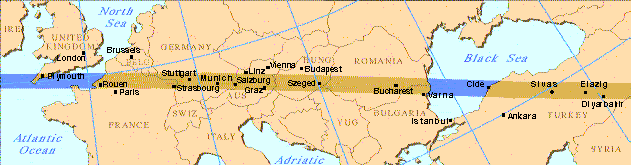 The path of totality of the August 11, 1999, eclipse. [from the Web site of Ted Froberg, http://members.aol.com/tfroberg/eclipse/] |
SCHOOL HAM CLUBS BENEFIT FROM ARIZONA TAX CREDIT
Hams in Arizona have been taking advantage of a provision in that state's tax laws to donate money to schools for Amateur Radio clubs. If you live in Arizona, you can contribute up to $200 toward extracurricular activities at public schools and deduct the entire amount as a tax credit. This means that if an Arizona taxpayer contributes $50 to the Amateur Radio club at the local public school, the taxpayer can--within the provisions of the state law--deduct the same amount from his or her total Arizona state tax liability.
Under the Arizona law, enacted in 1997, taxpayers there may claim the $200 tax credit, in lieu of a deduction, for any fees paid by a taxpayer to a public school for school-sponsored extracurricular activities that require enrolled students to pay a fee in order to participate.
The tax law provision offers new life for activities such as Amateur Radio clubs, providing funds for equipment for a school station, materials for antennas, license study manuals, and similar expenses. Contributions to Arizona schools that meet the law's requirements can be directed specifically to school Amateur Radio clubs and taxpayers will receive a receipt for tax purposes.
"I only became aware of this bill in mid December of 1998," said Lloyd Miller, N7GV, of Green Valley, Arizona. To beat the December 31 deadline, Miller says his Green Valley Amateur Radio Club scurried around and got a letter out to 80 club members who were Arizona residents. "We got a lot of phone calls from members who said it was too good to be true," he said. The net result was gratifying, however: $1900 to the Continental Elementary School Radio Club. The contributions, which surprised school officials who had not even tried to solicit them, wound up being the most collected per pupil of any school in the state.
"We have spent only about $200 so far for instructional materials but intend to spend most of it in the fall for a HF transceiver and antenna," said Miller, who is GVARC's training coordinator. "If the program is still in effect next year, we are thinking of VHF gear and kits the club members can assemble." Miller says three Continental School students have earned their tickets, and his club is working to get other youngsters licensed.
Most states do not yet have similar legislation in place, but certain contributions of this type may be deductible as charitable contributions on your itemized federal income tax return. Check with a tax professional. Hams in Pennsylvania and elsewhere are looking into getting similar laws enacted in their states.
For a copy of the applicable Arizona tax-credit statutes, contact Dan Miller, K3UFG, at k3ufg@arrl.org, or call 860-594-0340.
SOLAR UPDATE
Solar flux and sunspot numbers were down again this week. Average sunspot numbers were down almost 55 points, and average solar flux was off by more than 17 points, when compared to the previous week.
Geomagnetic conditions have been quite stormy over the past few days, with an A index of almost 30 over several days this week. Conditions should settle down over the next few days, with planetary A indices of 20, 15 and 10 August 20-22.
Solar flux has actually been rising this week, and over the weekend it should rise to 140, 145 and 150. Expect continued rising solar flux to hit 180 around August 24, peaking around 190, August 26-29. Predicted unsettled geomagnetic days are August 26-28, September 2-5, and September 11-13.
Sunspot numbers for August 12 through 18 were 100, 82, 79, 87, 71, 67 and 69, with a mean of 79.3. The 10.7-cm flux was 123.1, 126.5, 128.1, 131.1, 131.1, 141 and 130.7, with a mean of 130.2. The estimated planetary A indices were 10, 11, 5, 15, 29, 27 and 26, with a mean of 17.6.
IN BRIEF:
- This weekend on the radio: The North American QSO Party (SSB), the ARRL 10 GHz and Up Cumulative Contest, the SEANET Contest (SSB), the New Jersey QSO Party, the SARTG RTTY Contest, and the KCJ Contest are the weekend of August 21-22.
Just ahead: The TOEC WW Grid Contest (CW), the SCC RTTY Championship, the South Dakota, Hawaii, and Ohio QSO parties, and the BUBBA Summer QRP Sprint are the weekend of August 28-29. See August QST, page 91, for details. - Follow the light: The International Lighthouse/Lightship Weekend is August 21-22 UTC on HF. Stations will operate from lighthouses, lightships, or maritime lights. Contact Mike Dalrymple, GM4SUC, gm4suc@compuserve.com. Details and a list of participants are available on K2JXW's Ham Radio Lighthouse Page at http://www.waterw.com/~weidner/ld.htm. --Mike Dalrymple, GM4SUC
- Colorado 14er radio event set: The 1999 Colorado 14er Radio Event is set for Sunday, August 29, 0300-0600 UTC. During the event, Amateur Radio operators will operate portable from the summits of various 14,000-foot mountains in Colorado. A special event QSL card can be obtained via the mountaintop station's home address. Include an SASE. Most stations will be running low-power hand-held radios. Radio operators with 14er hiking experience who wish to participate or those who desire more information should contact Bob Witte, KB0CY, at kb0cy@arrl.net; 719-448-0942. During the event, local high school students will travel to the top of Mt Evans (ele 14,264 ft.) to operate as part of the International Association for Astronomical Studies. Updated information on the 14ers event is posted at http://members.aol.com/RobtWitte/colo14.html. Stations should coordinate with KB0CY to avoid multiple stations on the same peak. Operation will be on HF, 6 and 2 meters, 70 cm, and 1.2 GHz. Also visit the Colorado Fourteeners Initiative Web site, http://www.coloradofourteeners.org/. --Mike Reed, N7ZEF, via The Hudson Loop
- Vanity update: The FCC did not process amateur vanity call sign applications during the Universal Licensing System phase-in period last week. The ULS became effective August 16. The most recent processing run was August 4. Vanity call sign processing could resume the week of August 23. Amateurs now must use the ULS to file for a vanity call sign. Visit http://www.fcc.gov/wtb/uls/. A reminder: The fee to apply for an Amateur Radio vanity call sign increases from $13 to $14 effective Tuesday, September 14, 1999. --FCC
- AMSAT symposium set: Recent and future development in Amateur Radio satellites will be presented during AMSAT-NA's 17th Space Symposium and AMSAT-NA Annual Meeting this fall, Friday through Sunday, October 8-11, in San Diego, California. AMSAT-NA also will sponsor an Amateur Satellite Workshop for Colleges and Universities Thursday, October 7 in San Diego, aimed at colleges and universities proposing to use the radio spectrum for their small satellite projects. More information on the AMSAT Symposium is available from Duane Naugle, KO6BT, ko6bt@amsat.org. For more information on AMSAT-NA, visit http://www.amsat.org or call 301-589-6062.
- GPS week rollover looms: On August 21 at 2359.47 UTC, the Global Positioning System will switch its timing system back to zero. This so-called "Week Number Rollover Problem" could affect many mostly-older GPS units, and some say it will provide a dress rehearsal for Y2K problems. "We are going to be at a high state of readiness, just as we will be for Y2K," says Dave Roundy of the US Coast Guard. When GPS went on-line in January 1980, it was designed to record time for 1024 weeks (about 20 years). That week is upon us. The satellites can only count to 1023, so they'll reset their week counters to zero on August 21. GPS units not designed to handle the problem could fail or produce incorrect readings. It's estimated that 10%--and possibly more--of GPS receivers could be susceptible to the expected "rollover" problem. Most of these units were manufactured prior to 1994.
- Myron Hexter, W9FKC, SK: Noted veteran DXer Myron "Mike" Hexter, W9FKC, of Highland Park, Illinois, died August 4. He was 91. First licensed at age 15, Hexter was an ARRL member for 62 years and a charter member of W9DXCC. He had 378 DXCC entities confirmed. Hexter also wrote two articles for QST during the 1950s. One described a compact, portable 40-meter transceiver; the other detailed the construction of a set of paddles for an electronic keyer--constructed by mating two straight keys in a vertical orientation. W9FKC was an avid CW operator and a long-time member of the FOC. He was a founding member of a number of Chicago area amateur radio clubs. His wife, Lucille, three daughters, grandchildren and great-grandchildren survive. --thanks to John Swartz, WA9AQN
- Ness nominated for another term: President Clinton has nominated FCC Commissioner Susan Ness for another term on the Federal Communications Commission. Ness--who has served on the FCC since 1994 and has been its senior member since November 1997--said she was "deeply honored" to have been renominated. Ness cited her work to improve children's educational television, promote universal telephone service, connect classrooms and libraries to the Internet, roll out digital television service, introduce new wireless services, expand telephone and video competition, promote efficient spectrum management, open overseas markets, and eliminate unnecessary regulations among her accomplishments during her tenure on the Commission. Ness was the FCC's lead representative at the 1995 and 1997 World Radiocommunication Conferences in Geneva. --press reports
- SBE announces award winners: Three radio amateurs were among the winners of the Society of Broadcast Engineers' annual awards. Named Broadcast Engineer of the Year was Dane Ericksen, N6AJY, of Sonoma, California. A member of the SBE Board of Directors and chairman of its FCC Liaison Committee, Ericksen is a senior engineer for Hammett & Edison Inc. His career experience includes a stint at the FCC's San Francisco field office. Co-named as Educator of the Year were Michael P. Scott, KB7UXU, of Puyallup, Washington, and Bruce Ziemienski, WA6NOV, of Riverside, California. Scott is lead instructor in the communications technologies department of Bates Technical College; Ziemienski--an ARRL member--is director of engineering/operations at Armed Forces Radio and Television Service Broadcast Center. --SBE press release
- Hatfield addresses IEEE: The FCC's Office of Engineering and Technology Chief Dale N. Hatfield, W0IFO, delivered the keynote address at the August 2 meeting of the 1999 IEEE Radio and Wireless Conference in Denver. His remarks, "The Regulatory Challenges of New Wireless Technologies: Ultrawideband and Software Defined Radios," assert the need to establish wireless technologies as full-fledged competitors in providing local telecommunications and make interesting reading for anyone with an eye on the technological horizon. His remarks, as prepared for delivery, are at http://www.rawcon.org/hatfield.html.
- QST Cover Plaque Award: Dwayne L. Kincaid, WD8OYG, won the July QST Cover Plaque Award for his article, "The DWM-4: A Microprocessor-Controlled Multichannel Wattmeter for HF, VHF and UHF." Congratulations, Dwayne!