ARRL Audio News
| · | To subscribe, unsubscribe, or change your e-mail delivery address: see How to Get The ARRL Letter, below |
| · | Delivery problems (ARRL member direct delivery only!): letter-dlvy@arrl.org |
| · | Editorial questions or comments: Rick Lindquist, N1RL, rlindquist@arrl.org |
| · | ARRL Audio News: http://www.arrl.org/arrlletter/audio/ or call 860-594-0384 |
| · | The ARRLWeb Extra: http://www.arrl.org/members-only/extra |
IN THIS EDITION:
- +ULS looms large for amateurs
- +Changes coming to Sweepstakes
- +ARRL comments on Central States petition
- +FCC gives K1MAN more time to reply
- +FCC lays out KV4FZ appeal arguments
- DARA announces scholarship winners
- Solar update
- In Brief: This weekend on the radio; ARRL not in the credit card business; Vanity update; Masami Saito, JH3PJE, SK; 1999 NFCC Election Results; A historic meeting; FW8ZZ log search via e-mail; Kentucky hamfest to feature manmade lightning; NCDXF's W6WX beacon now on 18 and 24 MHz; Outgoing QSL Service handling cards for Congo
+Available on ARRL Audio News
ULS LOOMS LARGE FOR AMATEURS
Say hello to the ULS! Monday, August 16, the FCC's Universal Licensing System becomes a reality for the Amateur Service. The FCC said August 13 that the ULS would be out of service until then to prepare for implementation. This means amateurs will have to wait until the ULS is back up to register.
The ULS ushers in an era of electronic, interactive filing and handling of Amateur Radio applications and marks a major change in the way hams will deal with the FCC. It also means the demise of the familiar paper FCC Form 610 series in favor of the "universal" Form 605--primarily designed for electronic use but also available on paper. Once registered, amateurs filing applications with the FCC under the ULS will use Form 605 for all purposes except--at least for now--club station applications.
The FCC began a weeklong ULS phase-in period for the Amateur Service August 8 and has been converting existing Amateur Radio licensing data into the ULS database. Electronic Amateur Radio license renewal using FCC Form 900 was scheduled to end August 9. Electronic vanity call sign application using Form 610V was to terminate August 13 at 5:30 PM Eastern Time. Hams should not file renewal or vanity applications until the ULS comes up August 16.
Before using the ULS to file an application, renew or modify a license, or apply for a vanity call sign, all amateurs must register. When registering, individuals eligible to hold a Social Security Number must provide this number--which the FCC refers to as a Taxpayer Information Number or TIN. This requirement is a mandate of Congress, not of the FCC. All hams must be registered in the ULS to do business with the FCC.
Applicants use TIN Registration Form 606 for both electronic or manual registration. To register electronically, visit http://www.fcc.gov/wtb/uls/ and click on "TIN/Call Sign Registration." A paper Form 606 is available at http://www.fcc.gov/formpage.html or by calling 800-418-FORM (3676). One big advantage only to on-line registrants is that the ULS application system checks for errors before data are submitted.
Applicants first register their Social Security Number (or TIN), then enter a call sign. Applicants also must select a password to identify themselves in future, private transactions with the FCC database. A valid password can be from 5 to 30 alphanumeric characters and is case-sensitive. For additional security, applicants also specify a personal identifier. The FCC and ARRL recommend that applicants not use their Amateur Radio call signs as a passwords or identifiers.
Registrants receive a nine-character Licensee Identification Number. Amateurs may use this number in place of a Social Security Number in future dealings with the FCC. Those filing a paper ULS Form 606 by mail will not receive an acknowledgement from the FCC. Paper filers can obtain their FCC-generated Licensee ID Number from ULS Technical Support at 202-414-1250.
For now, applications for club, military recreation, and RACES licenses should be filed on the "old" FCC Form 610B. Trustees and custodians of these licenses should not use their personal Social Security Number as the TIN for these applications but should contact ULS Technical Support (202-414-1250) to obtain a FCC-generated identification number for Form 610B. Applications that do not include this number are subject to dismissal.
Applications for new licenses or upgrades will continue to be filed through a Volunteer Examiner Coordinator. VECs will use a special NCVEC Form 605--a variation of Form 605--to file with the FCC for test sessions.
Starting August 16, hams already registered in the ULS may file applications using the new FCC Form 605 electronically at any time of day, seven days a week. FCC Form 605 will be used for license renewals, modifications, cancellations, application withdrawals and amendments, as well as requests for a vanity call sign, duplicate license, change of address or other clerical license modification. Visit the Wireless Telecommunications Bureau ULS page, http://www.fcc.gov/wtb/uls and click "Connecting to ULS" for information on accessing the ULS system. Accessing the ULS database requires a telephone modem. A toll-free number, 800-844-2784, connects users to the FCC's Wide Area Network.
Among other things, the ULS features a renewal reminder sent 90 days prior to a license's expiration date. The ULS also simplifies the process of submitting fees to the FCC. The FCC said it also anticipates that the ULS will be capable of accepting credit card payments on-line "in the near future."
For more information, visit the FCC's ULS page, http://www.fcc.gov/wtb/uls.
CHANGES SWEEPING IN TO NOVEMBER SWEEPSTAKES
Starting this year, the ARRL November Sweepstakes exchange will become a bit more challenging with the addition of three new precedence letters to the list. The change means SS ops will have to be sharper than ever--especially on CW--to make sure they copy the entire exchange correctly. All other elements of the SS exchange will remain the same.
In the past, the precedence--the second element of information stations pass to each other--has consisted of a single letter--A, B, or Q--indicating the station's power level. Starting this fall, the precedence also will indicate the station's entry category, and stations can expect to encounter three new precedence letters: U, M, and S.
Under the revised SS exchange, stations will send "Q" for single operator, QRP (5 W PEP output or less); "A" for single operator, low power (less than 150 W PEP); "B" for single operator, high power (more than 150 W PEP); "U" for single operator, unlimited; "M" for multi-operator; and "S" for school club.
ARRL Contest Branch Manager Dan Henderson, N1ND says the single-op unlimited category lets single operators using packet compete against similar stations instead of against true multi-operator stations where they previously had been listed. There is no power differentiation in the single op, unlimited or for either of the multi-op categories. In another change, the multi-operator category will be allowed unlimited band changes, although it will remain limited to one transmitted signal at any time (ie, single transmitter).
Henderson said all stations using computerized logging now will have to submit their electronic log files, not just a paper file. "Handwritten paper logs are still okay," he said.
The SS rules also will include some changes affecting the school club category. Only current students, faculty, and staff members of an educational institution may participate in a station entering in the school club category.
Henderson said the Contest Branch received more than 3000 SS entries last fall, with slightly more SSB entries than CW and a record number of clean sweeps. "It's the first time we've ever sold out of clean sweep coffee mugs," he said.
The 1999 ARRL November Sweepstakes takes place November 6-8 (CW) and November 20-22 (phone). Complete rules will appear in the October issue of QST. The rules have not been updated on ARRLWeb.
Contact ARRL Contest Branch Manager Dan Henderson, N1ND, at n1nd@arrl.org or 860-594-0232 for more information.
ARRL COMMENTS ON CENTRAL STATES PETITION
In comments to the FCC, the ARRL says it supports the objectives of the Central States VHF Society's recent petition to formally segregate wideband and narrowband modes on VHF and UHF. But, the League says, the Society's petition fails to make a case to implement any new FCC rules. The petition, filed in June, would amend FCC rules to eliminate interference from FM and packet in the so-called weak-signal portions of the 6 meter, 2 meter, 1.25 meter and 70 cm bands. The FCC has assigned RM-9673 to the CSVHFS petition.
In its comments, the League said it generally supports the intent of the petition but "does not support the regulatory relief requested" because the petition doesn't spell out the extent of the interference problem. The League said the number of complaints of harmful interference to narrowband, weak-signal modes it typically sees doesn't justify additional regulation--although the ARRL conceded that the actual number of incidents might be higher than complaints to ARRL HQ would indicate
The League said it prefers "reliance on established voluntary band plans" coupled with "some Commission support" to address the CSVHFS concerns. The ARRL took the opportunity to again call on the FCC to acknowledge "that VHF and UHF operation in accordance with established band plans is 'good amateur practice'" and it urged the Commission to support compliance with band plans to prevent interference to weak-signal operations.
The League said it shares the Society's concerns about wideband FM and packet QRM to weak signal work but suggested that new regulations could stifle flexibility in the Amateur Service rules. The ARRL said it would rather see reliance on "the self-regulatory abilities of the Amateur Service, as reflected in voluntary band plans" than new FCC regulations.
The League suggested educational efforts as an appropriate remedy for newcomers and others unfamiliar with these amateur conventions.
A copy of the League's comments, filed July 28, is available on ARRLWeb at http://www.arrl.org/announce/regulatory/csvhfs.html.
FCC GIVES K1MAN ADDITIONAL TIME TO CLARIFY RESPONSE
The FCC has given Extra class licensee Glenn Baxter, K1MAN, of Belgrade Lakes, Maine, another 20 days to provide additional details about who was running his station on two days in mid-May. FCC personnel monitored and visited Baxter's station on May 14 and 15 but said they failed to find Baxter or anyone else on the premises. The FCC subsequently wrote Baxter to ask for the name and whereabouts of the control operator on the days in question, and Baxter replied July 25.
According to the letter from FCC Attorney Riley Hollingsworth, Baxter had told the FCC that on May 14 and 15 he was "both mobile and portable in the local area." Hollingsworth said the FCC wants Baxter to identify whether it was mobile or portable and at what times and in what specific areas. Hollingsworth also pressed Baxter for more specifics on his station's operating schedule. The FCC also had asked if K1MAN employed station automation equipment and if the station ever was remotely controlled.
According to the FCC, Baxter's reply indicated that his three Collins transmitters were "controlled by two Radio Shack timers." Hollingsworth asked for details and a control circuit configuration "as requested" and for specific information of any remote control operation--including a schematic of the control circuit. He also asked Baxter for information on any automated tape control devices.
The FCC letter cautioned Baxter that "Commission rules require that Amateur stations be under the physical control of a control operator, and that the control operator must ensure the immediate proper operation of the station." The letter cited FCC authority to request the information under §308(b) of the Communications Act and pointed out that the FCC "may revoke the license of a licensee who willfully fails to provide the information or who submits a willfully false or misleading response."
FCC LAYS OUT ARGUMENTS FOR DISMISSAL OF KV4FZ APPEAL
When the fight by Herbert L. Schoenbohm, KV4FZ, to retain his Amateur Radio license reaches federal court this fall, the FCC will argue for an outright dismissal. In its brief in the case--set for oral arguments October 18 before the US Court of Appeals for the District of Columbia Circuit--the FCC maintains that Schoenbohm is asking the court to review an order that's not subject to review.
Following Schoenbohm's 1992 conviction for fraudulently procuring long distance telephone service by using illicitly obtained access codes, the FCC in 1994 designated his Amateur Radio license renewal application for hearing. An Administrative Law Judge denied his renewal application saying that Schoenbohm's felony conviction "reflects adversely on his propensity to obey the law."
The FCC also says that Schoenbohm, now 59, solicited others, using Amateur Radio, to make ex parte presentations on his behalf, in violation of FCC rules and that he subsequently "engaged in misrepresentation and lacked candor" in testifying about his felony fraud conviction and his solicitation of ex parte presentations. The FCC said his behavior, in combination with his fraud conviction, justifies denying his amateur renewal application.
Schoenbohm appealed every step of the administrative process. Last summer, the FCC upheld the supplemental initial decision of an administrative law judge denying Schoenbohm's renewal application. The FCC affirmed that finding last October 6. Schoenbohm has moved the matter into the courts by appealing the FCC order denying his reconsideration petition.
The FCC argues, however, that Schoenbohm--of Kingshill, Virgin Islands--is asking the court "to review an order that is unreviewable." The FCC says the courts have held "that an appeal from an agency order denying reconsideration is not reviewable unless the appeal rests on new evidence or changed circumstances." In its brief, the FCC contends that Schoenbohm's appeal is not based on either, so "his claims are unreviewable."
Following his conviction, Schoenbohm served two months house arrest plus two years of probation and paid a $5000 fine. He maintains that the FCC should renew his license because his conviction was several years ago, his sentence light, and he's had a spotless record and been fully rehabilitated. The FCC disagrees. "Schoenbohm's record since his conviction has not been 'spotless,' but includes testimony before the Commission that was false and lacking in candor," the FCC argues in its appeal brief.
The FCC also says arguments by Schoenbohm that the FCC should have looked into claims concerning improper ex parte presentations by parties opposed to Schoenbohm's license renewal were "based entirely on hearsay, rumor, and innuendo."
A brief filed May 10 on Schoenbohm's behalf by his attorney Lauren A. Colby contends that Schoenbohm did not violate FCC ex parte rules, and that he did not lie to the Commission. Colby asks the court to remand the case to the FCC with instructions to grant the renewal.
Schoenbohm's Amateur Radio license expired in 1995, and his call sign no longer appears in the FCC database. However, he has been allowed to continue operating as KV4FZ until his legal appeals are exhausted.
DARA ANNOUNCES SCHOLARSHIP WINNERS
The Dayton Amateur Radio Association has announced its scholarship winners for 1999. Congratulations and best wishes to these young Amateur Radio scholars:
- Sonya A. Balsky, KB2MVU, (Technician Plus), Rutherford, New Jersey. Sonya has been accepted at Carnegie Mellon University and plans to study biology.
- Michael Gossenauer, N0UNY, (Technician), Aurora, Colorado. Michael will be attending Colorado State University studying chemical engineering. He has been awarded the Frank Schwab Scholarship.
- Beth A. Barlow, KC8EIU, (Technician), Sidney, Ohio. Beth has been accepted at Ohio State University and plans to study animal science/pre-med. Beth has been awarded the L.T. Jones Memorial Scholarship.
- Nick E. Beltramelli, KB9FFS (Novice), Glendale Heights, Illinois. Nick has been accepted at Elmhurst College and plans to study special/elementary education.
- Eian D. Counts, KC8EVP, (Technician Plus), Mt Vernon, Ohio. Eian has been accepted at Mt Vernon Nazarene College and plans to study computer science. He is the recipient of the Dave Beam Memorial Scholarship.
- George M. Hagedon, KF8XZ, (Extra), Englewood, Ohio. George has been accepted at Kettering University and plans to study mechanical and electrical engineering. He has been awarded the Charles G. Fry Memorial Scholarship.
- Melissa Schweikhart, KB8EPO, (Technician), Springboro, Ohio. Melissa is attending Vanderbilt University and plans to major biology and pre-medicine. She has been awarded the John Willig Scholarship.
- Michael S. Schoettinger, KC8LQU, (Technician), Eaton, Ohio. Michael has been accepted at Sinclair Community College and University of Dayton and plans to study electronics engineering technology. He has been awarded the Robert F. Zimmerman Memorial Scholarship.
- Mignon M. Sims, KC5HJU, (Technician), Apache, Oklahoma. Mignon has been accepted at East Central University and plans to study history.
- John L. Walker, N4DMR, (Technician Plus), Cullman, Alabama. John has been accepted at the University of Alabama and plans to study chemical engineering.
--Stanley R. Kuck, NY8F, Scholarship Chairman
SOLAR UPDATE
Sun watcher Tad Cook, K7VVV, Seattle, Washington, reports: Solar flux and sunspot numbers were way down this week, with the average solar flux off almost 60 points and sunspot numbers down by over 85 points compared to last week. This week was probably the low point in activity for the near term.
Currently the forecast for this weekend, August 13-15, shows a predicted solar flux of 120, 124 and 126 and predicted planetary A index of 8, 6 and 6. Friday morning's solar flux reading at Penticton was 128.2, somewhat higher than forecast, so the weekend numbers could be correspondingly higher.
Next week look for flux values to rise to 150 by August 18, 175 around August 21, and peak around 205 from August 26-29. These present some hopeful numbers as we move away from the summer season and toward the fall equinox, always an exciting time for propagation.
This week there were some days with active geomagnetic conditions. The most active was August 9, when the planetary A index was 19 and the K index was 4 during most periods. During these periods the conditions tend to be worse at higher latitudes, and the A index measured in Alaska (the College indices) was 60, with a K index as high as 7. HF operators in the far north must have experienced awful HF conditions, because polar absorption would be so pronounced. At the same time VHF operators at lower latitudes would be enjoying auroral propagation.
The morning of August 13 UTC, the planetary K index was 4, which means that conditions are somewhat disturbed. The forecast for the weekend though is for stable geomagnetic indices.
Over the next few weeks look for moderately unsettled conditions around August 19, 27 and possibly September 4-6. Otherwise, the forecast is for stable conditions.
In last week's bulletin, it was stated that the solar flux should drop to 10 by August 10. The solar flux will never go that low, even with no sunspots. That should have read 130.
Sunspot numbers for August 5 through 11 were 187, 164, 149, 154, 118, 89, and 76, with a mean of 133.9. The 10.7-cm flux was 177, 170.4, 153.3, 137.8, 138.1, 127.3, and 127.9, with a mean of 147.4. The estimated planetary A indices were 11, 13, 11, 7, 19, 7 and 8, with a mean of 10.9.
IN BRIEF:
- This weekend on the radio: The Worked All Europe DX Contest (CW) and the Maryland-DC QSO Party are the weekend of August 14-15.
Just ahead: The North American QSO Party (SSB), the ARRL 10 GHz and Up Cumulative Contest, the SEANET Contest (SSB), the New Jersey QSO Party, the SARTG RTTY Contest, and the KCJ Contest are the weekend of August 21-22. See August QST, page 91, for details. - ARRL not in the credit card business: Some League members recently have reported receiving solicitations from telemarketers for a credit card offering to radio amateurs. The ARRL is not involved with these solicitations nor has the League sold members' names, addresses, or telephone numbers to telemarketing organizations.
- Vanity update: The FCC in Gettysburg reports it has processed vanity call sign applications received through July 22. On Aug 4, the FCC issued 87 grants. Another 107 applications landed in the work-in-process (WIPs) stack. The fee to apply for an Amateur Radio vanity call sign increases from $13 to $14 effective Tuesday, September 14, 1999.--FCC
- Masami Saito, JH3PJE, SK: Past IARU Region 3 Director Masami "Sammy" Saito, JH3PJE, died Aug 9, as a result of an accidental fire at his home. Saito devoted many years to Amateur Radio including a stint as Region 3 Director from 1975 to 1978, an era of development and growth in the region. Services were August 11.--Keigo Komuro, Secretary, IARU Region 3
- 1999 NFCC Election Results: The National Frequency Coordinators' Council completed its third annual National Frequency Coordinators' Board of Directors' election on August 6. There was a field of five candidates. Western Washington NFCC Representative and Board Chairman Clay Freinwald, K7CR, was reelected; Wisconsin NFCC Representative Nels Harvey, WA9JOB, will succeed Whit Brown, WB0CJX, who was not a candidate. The two-year terms begin September 1.--Dick Isely, W9GIG/NFCC
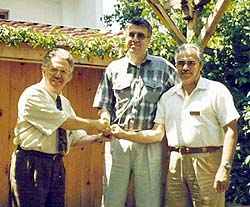
(Left to right) Bahri Kacan, TA2BK, of Turkey; Rumen Getchev, LZ1MS, of Bulgaria; and John Chatzidimitriou, SV1TN, of Greece, shake hands as a symbol of cooperation. [Photo courtesy of Barry Cohen, K2JV]
- A historic meeting: On June 12, 1999, presidents of three Eastern European Amateur Radio societies met in Kazanluk, Bulgaria, and agreed to pursue the establishment of a regional emergency communications system. It's believed to be the first time that high-level representatives of any organization from these three countries have agreed to work toward a common goal. Participants included Bahri Kacan, TA2BK, of the Turkish Radio Amateur Council; Rumen Getchev, LZ1MS, of the Bulgarian Federation of Radio Amateurs; and John Chatzidimitriou, SV1TN, of Radio Amateur Association of Greece. Each organization will appoint a working committee to begin planning the regional system.
- FW8ZZ log search via e-mail: The recent, 70-hour FW8ZZ operation from Wallis Island netted more than 11,000 QSOs. The FW8ZZ e-mail log search is expected to be available within the next few days. Send an e-mail to fw8zz-log@n4gn.com and enter your call sign on the subject line. Search results will be sent to you automatically via return e-mail. The folded QSL card will include a replica of the original 1966 FW8ZZ card. The FW8ZZ DXpedition was dedicated to the memory of the original FW8ZZ team, Ted Thorpe, ZL2AWJ and Chuck Swain, K7LMU, who lost their lives while returning from Wallis Island by boat.
- Kentucky hamfest to feature manmade lightning: Peals of thunder will roll over the audience Sunday, August 15, during the Central Kentucky Amateur Radio and Computer Convention at the National Guard Armory in Lexington. It won't be the weatherman's fault but manmade lightning, part of a demonstration of high-voltage electrical safety. The event is sponsored by the Bluegrass Amateur Radio Society. The huge manmade sparks and accompanying thunder will occur during a morning safety demonstration presented by a team from Kentucky Utilities.--Steve E. McCallum, W2ZBY
- NCDXF's W6WX beacon now on 18 and 24 MHz: Bob Fabry, N6EK, reports that authority for the Northern California DX Foundation's W6WX beacon to operate on 18 and 24 MHz has come through from the FCC, and W6WX now is transmitting on five bands. He reports that the request for the KH6WO Hawaiian beacon to operate on those bands will go to the FCC soon. More information on the beacon system can be found at http://www.ncdxf.org/index.htm. --Bob Fabry--N6EK
- Outgoing QSL Service handling cards for Congo: Effective immediately the ARRL Outgoing QSL Service will forward cards to the Democratic Republic of Congo (9O-9T, formerly Zaire). The new Congo national Amateur Radio society is Association des Radio Amateurs du Congo (ARAC), PO Box 1459, Kinshasa 1, Democratic Republic of Congo. By the way, the Outgoing QSL Service has cleared its backlog. As of the end of July, 1,081,320 cards had been handled (this includes cards going to US incoming QSL bureaus and cards sorted by contractor).