ARRL Audio News
| · | To subscribe, unsubscribe, or change your e-mail delivery address: see How to Get The ARRL Letter, below |
| · | Delivery problems (ARRL member direct delivery only!): letter-dlvy@arrl.org |
| · | Editorial questions or comments: Rick Lindquist, N1RL, rlindquist@arrl.org |
| · | ARRL Audio News: http://www.arrl.org/arrlletter/audio/ or call 860-594-0384 |
| · | The ARRLWeb Extra: http://www.arrl.org/members-only/extra |
IN THIS EDITION:
- +ARRL Board adopts new League identity
- +FCC delays ULS deployment for amateurs
- +Last SAREX mission blasts off
- +ARRL Board announces award winners
- +CQ Editor Alan Dorhoffer, K2EEK, SK
- +WB2OTK turns in his license
- +FCC rescinds license modification
- Solar update
- In Brief: This weekend on the radio; FCC's Hollingsworth draws temporary duty; Field Day pins demand exceeds supply; FCC Enforcement Log available; Louisiana PRB-1 bill signed by governor
+Available on ARRL Audio News
ARRL BOARD ADOPTS NEW LEAGUE IDENTITY
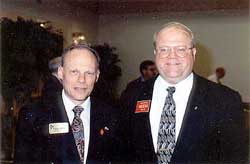
New Radio Amateurs of Canada President Ken Oelke, VE6AFO (left), chats with ARRL Technical Relations Specialist Jon Siverling, WB3ERA. Oelke addressed the ARRL Board. |
The ARRL Board of Directors unanimously has approved the use of a new identity for the League. Meeting July 16-17 in Rocky Hill, Connecticut, the Board accepted the recommendation of the ARRL Executive Committee to emphasize the initials "ARRL" in conjunction with the tag line "The national association for Amateur Radio." The new identity--which is not a legal name change--will appear on League correspondence and publications. The traditional--and legal--name will be retained but de-emphasized; a new ARRL letterhead design includes "American Radio Relay League" at the bottom.
Further discussion of any possible new name for the League has been deferred until the Board meets again in January.
The ARRL Board also approved a proposal to hold a Hiram Percy Maxim 130-year anniversary on-the-air event in September. The event will mark the 130th anniversary of Maxim's birth, September 2, 1869. It will take place September 2-11.
In other matters, the Board unanimously authorized a mail vote of full members in the proposed new West Central Florida Section, which includes nine counties that now are part of the Southern Florida Section. A group calling itself the West Central Florida Section Committee filed a petition with the League earlier this year to create a third section in the Sunshine State.
Ballots will go out within a few weeks to ARRL members in Charlotte, DeSoto, Hardee, Highlands, Hillsborough, Manatee, Pinellas, Polk and Sarasota counties. Results of the balloting will be reported to the Board on a county-by-county basis. The proposed section is home to more than 2500 League members. If a simple majority of eligible members voting approves the change, the Board will review the entire petition file and vote to approve or disapprove the requested change. That decision is final.
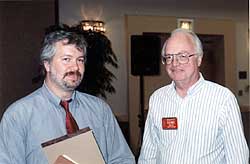
ARRL-VEC Manager Bart Jahnke, W9JJ (left), and Pacific Division Director Brad Wyatt, K6WR, meet during a break in the action. |
The ARRL Board also discussed the recent Petition for Rulemaking filed by the Central States VHF Society and plans to file timely comments on the proposal. The petition would amend FCC rules to formally segregate wideband and narrowband modes on VHF and UHF bands to eliminate interference from FM and packet in the so-called weak-signal portions of 6 and 2 meters and 70 cm. The FCC has assigned RM-9673 to the SCVHFS petition. Comments are due by July 28.
The League's comments will support the intent of the petition, but the Board unanimously agreed that the petition, as submitted, "does not sufficiently establish a basis for the regulatory relief requested." As an alternative to the CSVHFS petition, the League will suggest doing a better job of educating the amateur community about ARRL band plans. The League also plans to again try to get the FCC to acknowledge that VHF and UHF operation in accordance with ARRL band plans is "good amateur practice" and will seek supporting compliance efforts by the FCC.
In other action, the Board
- directed Executive Vice President David Sumner, K1ZZ, to study the development and implementation of electronic QSL submittals for ARRL-sponsored awards.
- directed Sumner to develop and implement strategies to induce developers "and others who have influence in these matters" to relax restrictive covenants pertaining to Amateur Radio and antennas "so that Amateur Radio activities might be broadly accommodated."
- heard "A Vision for Amateur Radio: Progress Report" from Sumner that addresses where Amateur Radio will be in 2010 and the challenges the League and the hobby will face.
- officially recognized "the historic and benevolent contributions of the National Traffic System and its operators to the ARRL and the public service program," on the occasion of NTS's 50th anniversary.
- directed the Headquarters staff to review the effects of contest rules pertaining to rovers and to make recommendations for promoting the participation by rovers.
- presented a National Certificate of Merit to Nate Brightman, K6OSC, "for his dedicated efforts" that have resulted in continuous operation of the W6RO station aboard the Queen Mary by an Amateur Radio staff of more than 100 volunteers.
Additional details and complete minutes of the July Board meeting are posted on ARRLWeb (http://www.arrl.org/announce/board-9907/) and will appear in the September issue of QST.
FCC DELAYS ULS DEPLOYMENT FOR AMATEURS
Ham radio will not become part of the FCC's new Universal Licensing System until August 16. The FCC has postponed ULS deployment for the Amateur Service for two weeks while it deals with several issues raised over the past few weeks by Volunteer Examiner Coordinators and others. "We are going to implement many of your suggestions in ULS prior to the new implementation date," an FCC spokesperson told the ARRL. The FCC had planned to implement ULS for amateurs on August 2.
The FCC also says it's revising its position on making telephone numbers part of the public ULS record. An FCC spokesperson said that any amateur licensee telephone numbers the FCC collects or already has collected will not be made available to the public. Supplying a telephone number, fax number or e-mail address when registering for or using the ULS is optional.
The FCC will issue a Public Notice soon that will outline transition issues, filing instructions and other information.
The FCC already has warned that applicants should anticipate processing delays during the first couple of weeks the ULS is in effect. In addition, daily amateur database updates may not be posted to the Internet until all the kinks are worked out.
The ULS will replace the venerable Form 610 series with a Form 605, primarily an electronic document that also is available on paper from the FCC. Hams may continue to use the paper FCC Form 610 for another six months, but applicants must supply a TIN/SSN by writing it on the form. Hams already registered in the ULS instead can write their FCC-assigned Licensee ID Number on the Form 610 if they choose.
Registration in the ULS is required in order to receive FCC services in the future. Individuals eligible to hold a Social Security Number must provide this number to the FCC in order to be registered in the ULS. To register, visit http://www.fcc.gov/wtb/uls/ and click on "TIN/Call Sign Registration."
For more information and frequently asked questions about the impending ULS, visit http://www.arrl.org/arrlvec/ulstext.html.
LAST SHUTTLE SAREX MISSION IS IN SPACE!
The third time was the charm for shuttle Columbia mission STS-93--the last shuttle that will carry the Space Amateur Radio EXperiment. Future Amateur Radio in space activities will involve the International Space Station.
After a faulty sensor Tuesday and thunderstorms Thursday prevented Columbia from blasting off with Eileen Collins, KD5EDS, at the helm, the shuttle took off early Friday, July 23, but not without a glitch. Collins reported a fuel cell problem nine seconds after liftoff. Some seven hours after launch, the STS-93 crew deployed the world's most powerful X-ray telescope, the Chandra X-Ray Observatory.
Collins is the first woman to lead a US space flight. In addition to Collins, the STS-93 crew includes Pilot Jeffrey Ashby; and Mission Specialists Cady Coleman, KC5ZTH; Steven Hawley; and Michel Tognini, KD5EJZ, a French astronaut.
STS-93 carries the 25th SAREX payload, and students at five US schools in Virginia, Texas, and Florida, have scheduled Amateur Radio QSOs with the astronauts. Earthbound stations may be able to listen to the astronaut side of the QSO on 145.80 MHz FM, but they will not be able to transmit to them. If all goes as planned, students at each school will get a chance to directly interview the astronauts via the SAREX ham radio linkups. Typical passes last approximately 10 minutes.
The crew may have time for some random Amateur Radio contacts as well. This crew prefers voice mode over packet, but the packet robot will be on when the crew is occupied elsewhere. For all voice contacts, stations should listen on the downlink for the crew to call "CQ."
The downlink frequency to listen for the STS-93 crew is 145.80 MHz FM. There are two uplink frequencies--144.47 and 144.45 MHz FM (over Europe, the single uplink frequency is 144.49 MHz). The crew will not favor either uplink frequency.
The packet robot downlink frequency is 145.80 MHz FM, and the uplink is 144.49 MHz FM worldwide. The connect on packet should be to W5RRR-1; stations will get a connect number if they are successful. Stations are asked to make only one packet connect to let other stations have a chance. The robot should never be used to connect to another station. APRS UI frames are welcome. If you send an APRS packet, once you see it digipeated, cancel your request to avoid unnecessary QRM and keep your comments very brief.
The QSL route for random STS-93 SAREX contacts is care of Dan Miller, K3UFG, ATTN: STS-93, ARRL, 225 Main St, Newington, CT 06111. The Dayton Amateur Radio Association has volunteered to handle QSL duties for this mission.
SAREX Principal Investigator Matt Bordelon, KC5BTL, says that future shuttle missions will be "way too busy" to accommodate SAREX. The Amateur Radio on the International Space Station program is working toward establishing a permanent Amateur Radio presence in space aboard the ISS. An interim Amateur Radio station should be operational from the ISS by early next year.
For updated information on STS-93, visit http://garc.gsfc.nasa.gov/~kc6rol/sts93.html.
ARRL BOARD NAMES AWARD WINNERS
Elisabeth Price, KC8ALW, of Worthington, Ohio, is the winner of the Hiram Percy Maxim Memorial Award for 1998. The Maxim Award goes annually to an amateur under age 21 who has demonstrated exemplary ham radio contributions and accomplishments. The selection was approved over the weekend when the ARRL Board of Directors met in Rocky Hill, Connecticut.
Beth, who's 17, has been actively involved in the Central Ohio Amateur Radio Emergency Service and assists with emergency communication at the annual Columbus Marathon. She also is an active member of the Capital City Repeater Association and the Central Ohio Radio Club.
Aside from her operating activities, Beth is an accomplished writer, and her articles promoting Amateur Radio have been published in various newsletters and magazines. Last July, Beth created an interactive Amateur Radio story on the Web at a site known as CyberYarn (http://www.qsl.net/kc8alw).
The ARRL Hiram Percy Maxim Memorial Award carries a $1000 stipend, an engraved plaque and a trip to an ARRL convention for the formal award presentation.
The Board also announced winners of several other ARRL awards. Named as the Herb S. Brier Instructors of the Year were Jerry Paquette, WB8IOW, of West Union, Ohio, and Roland Anders, K3RA, of Elkridge, Maryland. Competition was stiff for this award, and two instructors nominated obtained near-perfect scores from our educational advisors. So the 1998 award was presented to two excellent instructors!
The recipient of the 1998 Excellence in Recruiting Award is David Timoshik, WA6AYI, of Winnetka, California, where he's been recruiting amateurs for 35 years.
Barbara Pederson, KE4JZM, of Chapel Hill, North Carolina, is the winner of the 1998 Professional Educator of the Year Award. Pederson teaches ham radio to her sixth, seventh, and eighth grade students.
Winner of the Philip J. McGan Memorial Silver Antenna Award for 1998 is Peter Coffee, AC6EN, of Torrance, California. As an ARRL Public Information Officer for the Los Angles section, Coffee's public relations activities range from placing stories about Amateur Radio in his local, national and regional press to introducing ham radio to local school students.
Doug Smith, KF6DX, of Sedona, Arizona, was named to receive the ARRL Doug DeMaw, W1FB, Technical Excellence Award. From March to September 1998 QEX, the ARRL forum for communication experimenters, published Smith's series, "Signals, Samples and Stuff: A DSP Tutorial." The series made such an impression that Smith subsequently was named to be the magazine's new editor! By the way, Smith led the team that designed the Kachina 505DSP PC-controlled HF transceiver.
CQ EDITOR ALAN M. DORHOFFER, K2EEK, SK
CQ Editor Alan M. Dorhoffer, K2EEK, died July 19 from complications of cancer surgery. He was 61. Dorhoffer, who'd served as editor of CQ for nearly a quarter-century, had spent his entire professional life at the magazine. He started as an assistant editor in 1964 and become the magazine's tenth editor in 1976. He'd been a co-owner of the magazine since 1979.
A ham since his teenage years, Dorhoffer, who lived in Port Washington, New York, concentrated his activity on his favorite band, 10 meters. At CQ, he tried to focus on the "people" aspects of Amateur Radio. "Ham radio is people interacting with other people," he wrote in the magazine's 50th anniversary issue, and on the things people do with Amateur Radio. "The act of doing, whether it's contests or awards, that's been my outlook."
CQ Publisher Dick Ross, K2MGA, said Dorhoffer had been like a brother to him for more than 42 years. "We'd butt heads from time to time on editorial matters, but that in no way diminished our mutual love and respect," Ross said. "He was always there for everybody."
ARRL Executive Vice President David Sumner, K1ZZ, was among those saddened to learn of Dorhoffer's passing. "He was a respected colleague and well known to all of us who travel the convention and hamfest circuit, he said. "It's difficult to picture the circuit without him."
Dorhoffer's illness was diagnosed only a week or so before he succumbed to it. He was not married at the time of his death and had no children; but he is survived by an "extended family" of more than a million close friends--the world's Amateur Radio community.
Services and committal were July 22. Sumner, ARRL First Vice President Steve Mendelsohn, W2ML, and ARRL Publications Manager and QST Editor Mark Wilson, K1RO, were among those attending.
In lieu of flowers, donations may be made to St Francis Hospital Foundation. Mark donations "in memory of Alan Dorhoffer" and mail to St Francis Hospital, ATTN: Development Office, 100 Port Washington Blvd, Roslyn, NY 11576.--thanks to CQ Communications
CAROLINA HAM REJECTS SANCTION, TURNS IN TICKET
A South Carolina ham who was the target of an FCC enforcement action has turned in his Amateur Radio license rather than accept a license modification that would have kept him off the HF bands for four months.
FCC attorney Riley Hollingsworth, K4ZDH, reports that General class licensee Richard L. Whiten, WB2OTK, of Easley, South Carolina, informed him July 22 via e-mail that he wanted to turn in his ticket. Hollingsworth had no comment on the matter other than to say that WB2OTK's license was submitted for cancellation.
A follow-up letter mailed to Whiten today simply says, "Pursuant to your communication of July 22, 1999, we have accepted your license for cancellation, effective as of the above date, and dismissed the application for call sign W2OTK."
Whiten had applied for the vanity call sign W2OTK, but the FCC had set aside his application pending the outcome of the enforcement action.
Under a license modification imposed June 30, Whiten was to stay off the HF bands until October 25. In return, assuming no further violations, the FCC would clear its books of any outstanding FCC enforcement issues and grant his vanity call sign request. Whiten had been given 30 days to protest the license modification.
WB2OTK has run afoul of the FCC on several accounts. In late January, Hollingsworth and an FCC engineering team visited Whiten's station after what Hollingsworth called "longstanding complaints" about its operation. Whiten reportedly cooperated in the station inspection. The FCC says it's received "numerous complaints" about Whiten "regarding profanity, obscenity, broadcasting extreme racial slurs, deliberate interference and failure to properly identify."
In April, the FCC sent Whiten tape recordings of transmissions from his station made on two occasions in November and asked him to explain their contents. Whiten responded in May. Citing privacy concerns, the FCC has not gone into details about Whiten's explanations for what was on the tapes, but Hollingsworth noted in his June 30 letter ordering the modification that Whiten had apologized for the operation of his station on the dates in question.
FCC RESCINDS LICENSE MODIFICATION
The FCC has changed its mind and decided to rescind a license modification that would have kept David O. Castle, WA9KJI, of Evansville, Indiana, off the HF bands for two years. The FCC notified Castle of its change of heart July 8, but the man who imposed the sanction last May--the FCC's Riley Hollingsworth, K4ZDH--said he's not troubled by the turn of events.
"We have to call 'em as we see 'em," Hollingsworth said this week.
On May 19, Hollingsworth wrote Castle to say the FCC had information that Castle, a General-class licensee, had, on May 1, engaged in "broadcasting and talking to no particular station for over an hour, during which time you prevented the use of the frequencies by others and maliciously interfered with other stations." Hollingsworth's letter had said that Castle had "falsely claimed" to be in contact with another station. As a result of the alleged violations, Castle's privileges below 30 MHz were suspended.
In reviewing Castle's response, however, the FCC reversed its stand and concluded that Castle was--in the words of the FCC's July 8 letter--"not at fault on the evening of May 1, 1999 . . . and further that your transmissions were interfered with by another Amateur Radio operator attempting to call a net into session (known as the 'Liberty Net')."
Castle's reply to the modification notice included a tape recording of the relevant time period. Hollingsworth said the FCC also reviewed other information, including a sworn affidavit, furnished by other amateurs who were in contact with Castle at the time of the alleged violations.
Hollingsworth said the FCC is aware of "numerous complaints" about WA9KJI, but in the action at hand, the Commission was only concerned about what happened on the evening of May 1. "Based on the information that we have for May 1, I think he was right--on that evening at that time."
Castle has been the recipient of an FCC warning and an official Notice of Violation for allegedly engaging in malicious interference, and his operating hours have been restricted in the past.
In his letter withdrawing the modification, Hollingsworth reminded Castle of the "numerous allegations of malicious interference" against him. Hollingsworth also said the FCC would continue to keep an ear on the 75-meter frequency in question. "3950 is, unfortunately, a trouble spot," Hollingsworth told the ARRL. "It's one of the sore spots on Amateur Radio, and we're going to be monitoring it very closely from now on."
SOLAR UPDATE
Propagation prognosticator Tad Cook, K7VVV, Seattle, Washington, reports: Solar flux and sunspot numbers were down again this week, with the average sunspot numbers down nearly 60 points and the average solar flux down over 10 points. Conditions are improving though, with the predicted solar flux rising over the next few days to 160, 165 and 170 for Friday through Sunday, July 23-25. Planetary A indices are forecast at 10, 9 and 9 over the same days. Beyond the weekend the solar flux may rise as high as 180 over the next week, then fall to 165 by August 6, 155 around August 9, and 140 around August 12. The current high K and A index values should settle down this weekend.
Sunspot numbers for July 15 through 21 were 109, 97, 97, 119, 126, 115 and 124 with a mean of 112.4. 10.7 cm flux was 129.5, 132, 136.7, 138.2, 141.3, 139.5 and 147.3, with a mean of 137.8, and estimated planetary A indices were 10, 5, 5, 4, 4, 6 and 13, with a mean of 6.7.
In Brief:
- This weekend on the radio: The RSGB Islands-on-the-Air Contest is July 24-25. See July QST, page 88, for more information. Just ahead: The QRP ARCI Summer Daze SSB Sprint and the YO-DX Contest are August 1; the ARRL UHF Contest, the North American QSO Party (CW), the Ten-Ten International Net Summer Phone Contest, and the Boulder Amateur Radio Club Kid's Day event are the weekend of August 7-8. See August QST, page 91, for details.
- FCC's Hollingsworth draws temporary duty: The FCC's Riley Hollingsworth, K4ZDH, has been temporarily assigned to manage the FCC's National Call Center, 888-CALL FCC (225-5322) at the Commission's Gettysburg office. The assignment will continue until October 1 while NCC Director Cynthia Jeffries is detailed to other FCC duties involving the Y2K issue. Hollingsworth says his Amateur Radio enforcement duties will continue and will "in no way" be affected by his additional temporary Call Center responsibilities.
- Field Day pins demand exceeds supply: The ARRL Field Day 1999 pins have proven to be so successful that the initial supplies have been depleted. The original order of 1000 disappeared from ARRL's stockroom before Field Day. Another 500 were snapped right up shortly thereafter. Those who have ordered, but not yet received, one of the attractive FD pins may have a slight wait. The League continues to take orders and will reorder pins after the Field Day log submittal deadline passes on July 27. The pins are $5.
- FCC Enforcement Log available: The FCC Amateur Radio Enforcement Log--a compilation of recent enforcement actions and correspondence from ARRL--now is available on the ARRLWeb (http://www.arrl.org/) by clicking on "News". Then visit "FCC Amateur Radio Enforcement Logs" under "Special Interest Topics." Editions of the FCC Amateur Radio Enforcement Log first appear in The ARRLWeb Extra on the Members Only site, http://www.arrl.org/members-only.
- Louisiana PRB-1 bill signed by governor: Louisiana Gov Mike Foster has signed PRB-1 legislation (House Bill 2088) to limit the control of local jurisdictions to regulate Amateur Radio antennas. The measure takes effect August 15. Louisiana Section Manager Lionel "Al" Oubre, K5DPG, has expressed his thanks and appreciation to all who helped make the bill a reality. It passed both chambers of the legislature unanimously.--thanks to Chris Vincent, W5CTV