ARRL Audio News
| · | To subscribe, unsubscribe, or change your e-mail delivery address: see How to Get The ARRL Letter, below |
| · | Delivery problems (ARRL member direct delivery only!): letter-dlvy@arrl.org |
| · | Editorial questions or comments: Rick Lindquist, N1RL, rlindquist@arrl.org |
| · | ARRL Audio News: http://www.arrl.org/arrlletter/audio/ or call 860-594-0384 |
| · | The ARRLWeb Extra: http://www.arrl.org/members-only/extra |
IN THIS EDITION:
- +ARRL Board meets
- +FCC fines Florida man $20,000
- +October court date set in KV4FZ case
- +ARISS Equipment Takes Another Step Toward ISS
- +AMRAD continues LF experiments
- No joy on two-meter transatlantic attempt
- W1AW takes Tuna Tin 2 on the road
- Solar update
- In Brief: This weekend on the radio; Commenting on the CSVHFS petition; Vanity update; Oregon antenna bill signed into law; STS-93/SAREX information page; Outgoing QSLs top the 1-million mark; New and improved FCC Web site; Ozzie Jaeger, W6AD, SK; Anatoly Moskalenko, UA2AO, SK; QST Cover Plaque Award; Repeating Woodstock Nation
+Available on ARRL Audio News
ARRL BOARD MEETS IN CONNECTICUT
The ARRL Board of Directors gathered Friday and Saturday, July 16-17, in Rocky Hill, Connecticut for its second meeting of the year. Among items expected to come up for discussion was the League's name. Earlier this year, the ARRL Executive Committee recommended emphasizing the abbreviation "ARRL" in conjunction with the tag line "The National Association for Amateur Radio"--in lieu of a legal name change. If accepted by the full Board, the name of the organization would not change but the "ARRL" moniker and tag line would appear on all League correspondence and publications instead of the full name.
Other issues the Board was expected to confront include a request to establish a third ARRL section in Florida. A group calling itself the West Central Florida Section Committee has filed a petition with ARRL Headquarters to create a West Central Florida Section by carving nine counties out of the current Southern Florida Section. The ARRL By-laws provide that a new section may be created from one or more existing sections. At present, there are 70 ARRL sections. The most recent new ARRL section created was Northern New York in 1996.
The Board also planned to discuss the recent Petition for Rulemaking filed by the Central States VHF Society. The petition would amend FCC rules to formally segregate wideband and narrowband modes on VHF and UHF bands to eliminate interference from FM and packet in the so-called weak-signal portions of 6 and 2 meters and 70 cm. The FCC has assigned RM-9673 to the SCVHFS petition. Comments are due on the petition by July 28.
In other business, the Board was expected to review progress on FCC enforcement. Board members also heard reports from committees, HQ management, and individual Board members. New Radio Amateurs of Canada President Ken Oelke, VE6AFO, also was to address the ARRL Board.
Board members arriving at ARRL HQ this week were greeted by a newly redecorated lobby. A display of early receiver technology graces the far wall of the lobby. The refurbished facility also offers a wide selection of ARRL publications for visitors to peruse.
FLORIDA MAN FINED $20,000 IN AMATEUR RADIO-RELATED CASE
The FCC has levied a $20,000 fine on a Florida man for violations stemming from alleged unlicensed operation on Amateur Radio frequencies. The FCC's Tampa Field Office has sent a Notice of Apparent Liability to William Flippo of Jupiter. Flippo is accused of willful operation of an unlicensed radio station on 28.375 MHz, willful and malicious interference with ongoing Amateur Radio communications, and with failing to let FCC representatives inspect his radio equipment. All of the alleged violations are said to have occurred June 8, 1999.
The FCC's Compliance and Information Bureau has been investigating complaints from hams in the Jupiter area for nearly two years. According to the FCC, the hams identified Flippo--a CB operator known as "Rabbit Ears"--as the source of intentional interference to ham communication. One ham in the area says the local amateur community had "for many months" been experiencing deliberate interference problems on 10 meters as well as on a local 2-meter repeater, although the FCC did not cite Flippo for any violations involving 2 meters.
Local hams also provided the Commission with audio tapes and the results of close-in monitoring and direction finding, the FCC said. On the basis of the "evidence at hand," Flippo got an FCC warning last February from the Tampa Field Office, advising him of the allegations and warning that a fine could result. The following month, Flippo "categorically" denied the allegations in the warning letter, but hams in the Jupiter area said the intentional QRMing ceased for a while.
When renewed complaints from hams arose this spring, an FCC agent traveled to Jupiter to investigate. The agent used direction-finding techniques to determine that intentional interference to amateur traffic "was occurring and that the intentional interference was being transmitted from the residence of William Flippo."
The FCC says the agent monitored and heard taped portions of a 2-meter ham radio net earlier that day being replayed on top of amateur communications on 10 meters " in an attempt to intentionally disrupt and interfere with those communications."
The FCC agent, accompanied by a local sheriff's deputy, attempted to inspect the radio equipment at Flippo's residence on June 8, but Flippo reportedly refused to allow the inspection.
Flippo has 30 days to respond to the FCC Notice, sent July 12 by FCC Tampa District Director Ralph M. Barlow.
OCTOBER COURT DATE SET IN KV4FZ RENEWAL CASE
Herbert L. Schoenbohm, KV4FZ, will get his day in court this fall in his fight to retain his Amateur Radio license. Last summer, the FCC upheld the supplemental initial decision of an administrative law judge denying Schoenbohms application to renew his Amateur Radio license. In October, the FCC reaffirmed that finding and denied Schoenbohms petition for reconsideration in the case, which has slogged through the administrative process since 1995. Schoenbohm has appealed.
The next step is oral arguments, set for October 18 in the United States Court of Appeals for the District of Columbia Circuit. That court hears all appeals from federal agencies on adjudicatory matters.
ALJ Edward Luton had found that Schoenbohm, of Kingshill, Virgin Islands, had "engaged in misrepresentation and lacked candor" in testifying about his 1992 felony telephone toll fraud conviction and his solicitation of ex parte presentations. Schoenbohm, now 59, was convicted in federal court in 1992 of fraudulently using a counterfeit access device to obtain long-distance telephone service. He served two months confinement plus two years of probation. The FCC also said he solicited others, using Amateur Radio, to make ex parte presentations on his behalf, in violation of FCC rules. The FCC said his behavior, in combination with his fraud conviction, justified nonrenewal of his ham ticket.
Schoenbohm has been trying to renew his ham ticket for the past four years. He maintains that the FCC should renew his license because his conviction was several years ago, his sentence light, and he's had a spotless record and been fully rehabilitated. The FCC disagrees, however, saying that Schoenbohm "has not demonstrated that he possesses the basic character traits of truthfulness and reliability that are essential to licenseeship."
A brief filed May 10 on Schoenbohm's behalf by his attorney Lauren A. Colby argues that Schoenbohm's criminal conviction does not merit denial of his license renewal, that Schoenbohm did not violate FCC ex parte rules, and that he did not lie to the Commission. Colby asks the court to remand the case to the FCC with instructions to grant the renewal.
The FCC was expected to file its brief in the case July 15.
Schoenbohm's license expired in 1995, and his call sign no longer appears in the FCC database. However, he has been allowed to continue operating as KV4FZ until his administrative and judicial appeals are exhausted.
ARISS EQUIPMENT TAKES ANOTHER STEP TOWARD ISS
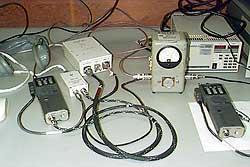
The test bench at Frank Bauer's flight hardware lab at Goddard Space Flight Center. The test setup is for hardware "touch tests," Marchant explained. "This makes sure the external surfaces of the hardware won't get hot enough to harm an astronaut," he said. Standard tests involve keying the gear for a certain period of time and measuring the external temperature of the equipment. The headset at the upper left is a nonflight version of the standard astronaut headset. The smaller white box is the audio-power interconnect. The larger white box is the packet TNC. |
The equipment that will become the first Amateur Radio station on the International Space Station has completed a significant milestone in anticipation of its journey into space later this year. Following exhaustive qualification testing at NASA's Goddard Space Flight Center, the radios, TNC, power supplies, and connecting harnesses for the initial transportable ARISS ham station are on their way to Kennedy Space Center for launch this December during shuttle mission STS-101.
"The first set of flight hardware for Amateur Radio on the International Space Station (ARISS) project has passed all its tests and is on its way to Kennedy Space Center," said Will Marchant, KC6ROL. Marchant credited "a tremendous amount of work by Frank Bauer, KA3HDO, and his team of volunteers at Goddard Space Flight Center" for getting the qualification testing done. Marchant said the hardware was shipped to Kennedy Space Center July 9.
AMSAT President Keith Baker, KB1SF, expressed his thanks and appreciation on behalf of AMSAT for getting the initial ham gear through qualification testing.
The initial ham gear--primarily Ericsson commercial-grade handheld transceivers--will support amateur operation from the ISS on voice and AFSK packet on 2 meters and 70 cm. The equipment package includes one 6 W VHF and one 4 W UHF transceiver plus an interconnecting box to distribute audio and power and a 1200-baud packet TNC. Marchant said the gear will provide the ISS with Amateur Radio capability similar to the voice and packet currently available to cosmonauts aboard the Russian Mir space station.
More sophisticated transportable ham gear will be delivered in late 2000 or early 2001. A rack-mounted permanent station is expected to be launched in 2003 or 2004. An externally mounted "microsatellite-like" station will launch in that time frame as well, Marchant said.
![Frank Bauer, KA3HDO, at the test bench. [Photos courtesy of the Goddard Amateur Radio Club]](/img/newsletter/pre2000/b_071699.jpg)
Frank Bauer, KA3HDO, at the test bench. [Photos courtesy of the Goddard Amateur Radio Club] |
The ARISS external antennas will be mounted on the outside of the ISS Service module during a space walk scheduled for STS-101. Ultimately, four external antennas will be flown to support amateur communication on HF, VHF, UHF, L band (including GPS receive) and S band.
Qualification testing--sometimes called "shake-and-bake testing"--is required of all equipment bound for the ISS or used in manned spaceflight. The detailed, rigorous testing sequences are aimed at ensuring crew safety and minimizing equipment failure.
AMRAD CONTINUES LF EXPERIMENTS
Slow-speed beacon transmissions from the Washington, DC, area at 136.75 kHz under the call sign WA2XTF have been on the air continuously since May from the QTH of WB3KDU in Vienna, Virginia. The activity is being conducted under the Part 5 Experimental License issued to the Amateur Radio Research and Development Corporation to test the waters on 136 kHz. So far, reception reports have been received from amateurs near Washington, DC.
In March, the FCC granted a one-year experimental license to AMRAD to conduct tests using WA2XTF on 136.75 kHz from twelve sites in Northern Virginia. These experiments are to gain experience in anticipation that the FCC may allocate the low-frequency band 135.7-137.8 kHz to the Amateur Radio Service in the US. Several other countries already have an LF allocation at 136 kHz.
Last October, the ARRL petitioned the FCC to create two amateur LF allocations at 135.7-137.8 kHz and 160-190 kHz. The League asked for a 200 W PEP power limit (no more than 2W EIRP) and asked that the new bands be made available to those holding a General class or higher license. The League proposed permitting CW, SSB, RTTY/data, and image emissions. Its petition was designated RM-9404.
The installation at the WB3KDU experimental site has been a team effort using a ROPEX "The First" transmitter, a homebrew antenna system, and bits and pieces from various members' collections. After about a month of operation from this initial station, others authorized under the Part 5 license got serious about gathering the parts to put their own stations on the air. AMRAD participants were able to locate some large inductors and capacitors not normally part of HF/VHF junk boxes during the recent Dayton Hamvention.
While the list of stations is closed and new transmitting stations cannot be added, others are invited to join the project by listening and reporting results. Reception reports should be sent via e-mail to Andre Kesteloot, N4ICK, n4ick@amrad.org. More information is available about this experimental operation at the AMRAD Web site, http://www.amrad.org/.--AMRAD Newsletter
NO JOY ON 2-METER TRANSATLANTIC ATTEMPT
An effort to make the first transatlantic QSO on 2 meters has come up dry. The attempt by teams in Newfoundland and Scotland to confirm a transatlantic contact on 144 MHz and secure the Irish Radio Transmitters Society's Brendan Trophies ended a day early on July 3. The attempts began June 26.
"We operated until Saturday July 3 as the UK team wanted to get their gear down as bad weather was setting in," said Paul Piercey, VO1HE, the leader of the Newfoundland team. "There was nothing heard, but a couple reports of others listening were received." Piercey's group operated from St John's, Newfoundland, using the call sign VO1AA. The station was set up in Cabot Tower, where Marconi received the first transatlantic signal in 1901.
The Scottish group, led by Bill Ward, GM0ICF, operated from Ardnamurchan Lighthouse on Ardnamurchan Point--the most westerly point in the mainland British Isles. The group used the call sign 2S0ICF/P.
The IRTS's Brendan Trophies will be awarded to the first two stations to make a verified contact across the Atlantic Ocean using 144-146 MHz without aid of manmade reflectors, repeaters or moonbounce.
W1AW GOES ON THE ROAD WITH THE TUNA TIN 2
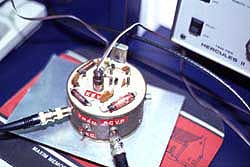
The original Tuna Tin 2 QRP transmitter. |
Every once in a while, W1AW is operated portable at ARRL conventions, and that's about to happen again--with a twist that QRP fans will applaud. W1AW will appear July 23-25 at the ARRL Arizona State Convention at Ft Tuthill, Flagstaff, Arizona (see http://www.hamsrus.com/fttuthill.html).
ARRL Laboratory Supervisor Ed Hare, W1RFI, was especially pleased to have been invited because he's an avid low-power operator--a QRPer--and the annual Ft Tuthill event is the site of a QRP symposium. The symposium, held in conjunction with the convention, is hosted by the Arizona ScQRPions--an Arizona QRP club.
To add some spice to the occasion, Hare will operate from the convention site as W1AW/7/QRP using the recently resurrected original Tuna Tin 2--the famous Doug DeMaw QRP classic rig built and published in the mid 1970s. (see "The Tuna Tin 2 Revival" in The ARRLWeb Extra, June 15, 1999, http://www.arrl.org/members-only/extra/archive/1999/0615.html.)
![The Tuna Tin 2 certificate. [All photos by Rick Lindquist, N1RL]](/img/newsletter/pre2000/d_071699.jpg)
The Tuna Tin 2 certificate. [All photos by Rick Lindquist, N1RL] |
Look for the original Tuna Tin 2 as W1AW/7/QRP near 7040 kHz July 23-25. A QSL and a nice certificate are available for a 9x12 SASE ($0.44 postage required) to all who work the Tuna Tin 2. QSL via ARRL HQ. Convention visitors accompanied by a copy of their ham ticket are invited to stop by the ScQRPions booth and operate the Tuna Tin 2.
Hare plans to operate the Tuna Tin 2 using his own call sign from his hotel after convention hours or from various campsites in the Grand Canyon area July 25-28. Look for W1RFI/QRP near 7040 kHz during the evening hours. For W1RFI contacts, a QSL and certificate will be sent directly by W1RFI.
SOLAR UPDATE
Solar seer Lee Wical, KH6BZF, is filling in for Tad Cook, K7VVV, this week: Average solar flux and sunspot numbers were down this week as compared to last week. But this is not surprising considering last week's higher solar numbers. The average sunspot number dropped, and average solar flux was down as well.
The forecast for Friday through Sunday, July 16-18, is for a solar flux of 130, 140 and possibly 145 and planetary A index of 5 on all three days. Beyond the weekend, look for possibly increasing solar flux levels. Solar flux levels are expected to continue to rise until a cyclic 27.5-day peak centered on/about July 25 around the 200+ level. One forecast earlier this week from the NOAA Space Environment Service Center in Boulder, Colorado, has solar flux peaking around 200 July 22-27, but a later, more liberal, projection suggests a peak above 200 as mentioned above.
With summer conditions prevailing in North America, the 160 and 80-meter bands are noisy because of seasonal atmospherics in the Northern hemisphere due to transcontinental thunderstorms. Twenty meters is open late into the evening and toward sunrise on the eastern end of the east-west DX path. Conditions on 10 and 12 meters will tend to get better for long-distance communication as daylight hours grow shorter.
West Coast stations again have been reporting VHF signals from KH6HME's 50/144/432MHz beacons in Hawaii via tropospheric ducting as recently as July 15. Other 6-meter North America transcontinental reports have been received as well.
The current forecast is for low to moderate levels of solar activity, with some occasional isolated flares. There may be a slight chance of an M-class flare during the next week. However, the geomagnetic field is expected to be at quiet to unsettled levels with a coronal mass ejection (CME) expected at any time! Flux levels are expected to rise this coming week. High to above-normal conditions are expected.
Sunspot numbers for July 8-15 were 143, 170, 174, 202, 199, 188, 120, and 109, with a mean of 163.1. The 10.7-cm flux levels for the same period were 149, 151, 156, 153, 154, 144, 130, and 130, with a mean of 145.8. The estimated planetary A indices were 08, 06, 05, 06, 14, 06, 06 and 10, with a mean of 8.87.
In Brief:
- This weekend on the radio: The Six Club Six Meter Sprint, the Pacific 160 Meter Contest, the North American QSO Party (RTTY), the SEANET Contest (CW), and the Colombian Independence Day Contest are the weekend of July 17-18. Just ahead: The RSGB Islands-on-the-Air Contest is July 24-25. See July QST, page 88, for more information.
- Commenting on the CSVHFS petition: Hams wanting to view the recent Central States VHF Society Petition for Rulemaking--assigned RM-9673--or to comment on it, may use the FCC's Electronic Comment Filing System (ECFS). Comments on this petition are due by July 28, 1999. The FCC then may or may not decide to follow up with a Notice of Proposed Rulemaking, which would initiate another comment period on that specific proposal. Commenters should reference the RM-9673 when filing comments. See http://www.fcc.gov/e-file/ecfs.html for information on electronic filing. (This page also contains a link to view the petition and comments already filed.) For additional information, see http://www.arrl.org/field/regulations/news/filing_hints.html on ARRLWeb. Comments via mail go to Secretary, Federal Communications Commission, 445 12th St SW, Washington DC 20554.
- Vanity update: The FCC in Gettysburg reports it has processed vanity call sign applications received through June 21. On July 9, the FCC issued 200 grants. Another 219 applications landed in the work-in-process (WIPs) stack. During June, the FCC reports it received 1126 applications, all but 131 of them filed electronically.--FCC
- Oregon antenna bill signed into law: Oregon's Governor John Kitzhaber has signed Senate Bill 879 placing PRB-1 language into Oregon's statutes. Oregon's version contains 70-foot minimum height language similar to that of Wyoming's. The Oregon House approved the measure 53 to 3 after the Senate had passed it 26 to 0.--Bob Shelby, W7FPY
- STS-93/SAREX information page: A Web site with information on the next--and last--shuttle mission to carry the Space Amateur Radio Experiment is available at http://garc.gsfc.nasa.gov/~kc6rol/sts93.html, courtesy of Will Marchant, KC6ROL. STS-93, aboard shuttle Columbia, is the 25th SAREX flight. It's scheduled to launch July 20 at 0436 UTC. The year's second space shuttle mission will mark the launch of the first female shuttle commander, Eileen Collins, KD5EDS, and the deployment of the Chandra X-Ray Observatory. QSLs for random SAREX contacts go to Dan Miller, K3UFG, ATTN: STS-93, ARRL, 225 Main St, Newington, CT 06111.--Will Marchant, KC6ROL
- Outgoing QSLs top the 1-million mark: For the first half of 1999, the Outgoing QSL Service has mailed 1,025,390 cards. That's up 162,900--or 18%--from the same date last year.--Martin Cook, N1FOC
- New and improved FCC Web site: The FCC's Web site has a completely new look to go along with its move to The Portals. The new site, still at http://www.fcc.gov, features an image of the FCC's new home and logo and contains more graphics. Current news "headlines" are in a highlighted box that runs down the middle of the home page, while the lefthand part of the screen is devoted mainly to comments (a video clip also is available) by FCC Chairman William Kennard. The righthand side of the screen focuses on "major initiatives," such as the V-chip, area codes, "parents, kids, and communications," and other hot topics. Clicking on the associated image or headline takes you to a page on the subject. Unchanged (so far at least) is the FCC's Amateur Radio page at http://www.fcc.gov/wtb/amateur/. Comments and suggestions on the updated site go to Sheryl Segal, ssegal@fcc.gov.
- Ozzie Jaeger, W6AD, SK: Ozzie Jaeger, W6AD, of Nixa, Missouri, died June 26. He was 79 and had been ill with cancer. He had just recently remarried. Jaeger was associated with Ten-Tec in an unofficial capacity and assisted at the Ten-Tec booth at the 1999 Dayton Hamvention.
- Anatoly Moskalenko, UA2AO, SK: Prominent DXer Anatoly Moskalenko, UA2AO, died June 28 after a long illness. He was a member of the DXCC Honor Roll and well-known as a Russian WW II lend-lease equipment collector.--thanks to Serge N. Mateyev, UA1OSM
- QST Cover Plaque Award: The winner of the QST Cover Plaque Award for June is Kirk Kleinschmidt, NT0Z, for his article, "How to Choose and Use a Portable Power Generator." Congratulations, Kirk!
- Repeating Woodstock Nation: If you're among the 250,000 or so expected to attend the Woodstock '99 concert July 21-25 at Griffiss Park in Rome, New York, you might want to take advantage of the WA2ZXS repeater on 147.285 (+) while you're there. The repeater's owners, the Madison-Oneida Amateur Radio Club, have made it available for all to use. It's accessible with low power and has good coverage of the Central New York area. Other repeaters in the area are on 145.170, 145.45 and 146.88 MHz.--Len Popyack, WF2V