ARRL Audio News
| · | To subscribe, unsubscribe, or change your e-mail delivery address: see How to Get The ARRL Letter, below |
| · | Delivery problems (ARRL member direct delivery only!): letter-dlvy@arrl.org |
| · | Editorial questions or comments: Rick Lindquist, N1RL, rlindquist@arrl.org |
| · | ARRL Audio News: http://www.arrl.org/arrlletter/audio/ or call 860-594-0384 |
| · | The ARRLWeb Extra: http://www.arrl.org/members-only/extra |
IN THIS EDITION:
- +Central States petition causes a stir
- +FCC's Hollingsworth clarifies stand on multiple call signs
- +FCC says telephone numbers optional for ULS
- +FCC suspends Carolina ham's HF privileges
- +FCC inquires about K1MAN control operator
- Hams request new bill targeting illegal CBers
- Ham radio-carrying raft ends on the rocks
- Solar update
- In Brief: This weekend on the radio; W1AW/9 and NU1AW on the air for IARU event; Vanity update; ARRL issuing IARPs; 1999 Ship Museum special event; More special Canadian prefixes
+Available on ARRL Audio News
CENTRAL STATES PETITION CAUSES A STIR
What a difference a couple of words can make. A petition for rulemaking aimed at formally segregating wideband and narrowband modes on VHF and UHF bands has generated a flurry of comments within the Amateur Radio community. But the controversy is due, in part, to the inadvertent absence of some wording in the filing from the Central States VHF Society of Kerrville, Texas.
The FCC has assigned RM-9673 to the CSVHFS petition, which seeks generally more restrictive regulation of the modes used by amateurs in the 6 meter, 2 meter, 1.25 meter and 70 cm bands. Comments are due on the petition by July 28.
"The Central States VHF Society has long been concerned about the increasing encroachment into the so-called weak-signal portions of the bands above 50 MHz by wider-bandwidth modes, such as voice FM and occasionally packet also," said CSVHFS Government Liaison Committee Chairman Bill Tynan, W3XO. "All the Society was trying to do was to codify current practice into regulations so that nobody is confused."
The CSVHFS petition says that band plans such as those promulgated by the ARRL and other organizations "have not proven adequately successful in limiting these wide band modes from the band segments used for weak signal communication."
Tynan compared the petition's goals to the current regulatory situation on 10 meters, where FM is prohibited below 29 MHz. "I think you could see how bad it would sound on 20 meters if people decided they wanted to run FM because it sounded so good," he said. Problems resulting from wideband interference with narrowband--or weak-signal--modes such as CW or SSB are occurring more often, Tynan said, "especially in the larger cities."
Most of the controversy resulted from inadvertent wording in the CSVHFS petition that would have banned packet and APRS from the 2 meter band. "There's no intention of anything like that," Tynan said. "There was an error committed by me in the appendix in terms of not putting down all the modes that are listed in the rules."
Tynan said the petition actually intended no other modifications of authorization for "data" or "test" modes above 50.3, 144.3, or 222.15 MHz and on the portions of the 70 cm band below 431.8 MHz and above 432.5 MHz. "Unfortunately, by the inadvertent omission of 'data' and 'test' from the Appendix, the filing did not properly reflect that intent," he said.
Tynan said the mistake will be corrected when CSVHFS files its own comments on the petition by month's end.
The changes proposed to §97.305 of the FCC rules would have the following effects:
- 50.0-50.1 MHz: Add RTTY and data emissions at up to 1200 bauds (this band segment is now limited to CW only).
- 50.1-50.3 MHz: Delete MCW and data. The band segment would be limited to CW, phone, image, and RTTY, but CSVHFS proposes no maximum symbol rate for RTTY. No wideband FM would be permitted (modulation index would be limited to 1 or less).
- 50.3-54.0 MHz: No changes.
- 144.0-144.1 MHz: Add RTTY and data emissions at up to 1200 bauds (this band segment is now CW only).
- 144.1-144.3 MHz: Delete MCW and data. The band segment would be limited to CW, phone, image, and RTTY, but CSVHFS proposes no maximum symbol rate for RTTY. No wideband FM would be permitted (modulation index would be limited to 1 or less).
- 144.3-148.0 MHz: No changes.
- 222.0-222.15 MHz: Delete MCW, RTTY, data, test (except for brief test transmissions), and wideband FM.
- 222.15-225.0 MHz: No changes.
- 431.8-432.5 MHz: Delete everything but CW and SSB (ie, no wideband FM permitted), and image.
The CSVHFS Board of Directors will formulate its own comments on the petition when it meets in Cedar Rapids, Iowa, July 22-24. The CSVHFS petition also is expected to come up for discussion when the ARRL Board of Directors gathers in mid-July.
FCC'S HOLLINGSWORTH CLARIFIES STAND ON MULTIPLE CALL SIGNS
The FCC's top Amateur Radio enforcer, Riley Hollingsworth, K4ZDH, says the Commission won't be targeting clubs with multiple call signs unless the FCC has reason to believe that there's been abuse of the licensing process. Clubs holding multiple call signs for reasonably legitimate purposes need not worry that the FCC will take back their call signs, he said.
"We're only concerned about abuse of the licensing process," Hollingsworth told the ARRL. "I'm only concerned about those who 'work' the system, eating up keying time with our processors with no apparent purpose other than to squirrel call signs or scarf up vanity call signs." Hollingsworth has said that in an era of tight budgets and smaller staffs, the FCC needs to minimize its administrative workload that sometimes includes manually keying in information for amateur applications.
Hollingsworth concedes that the FCC rules place no upper limit on the number of club station call signs a club may hold.
Some trustees of clubs with multiple call signs for packet nodes or individual repeaters have expressed concerns that their call signs might be the targets of the FCC's recent initiative to reduce what's sometimes called call sign "warehousing" or "hoarding."
Recently, the trustee of some three dozen club station call signs agreed to give up all but one of them. Hollingsworth also has inquired of several other individuals listed as responsible parties for multiple call signs--including several members of the same family in California--and has asked the licensees to justify the grants.
FCC SAYS TELEPHONE NUMBERS OPTIONAL FOR ULS
The FCC has clarified that Amateur Radio applicants using the Universal Licensing System don't have to provide a telephone number or e-mail address as long as they provide a valid US mailing address. But the Commission has yet to provide a convenient way for ULS electronic filers to get around having to supply a telephone number. The clarification was contained in a recent FCC order that addresses various issues for reconsideration in its ULS proceeding. The FCC says it considers it "reasonable" to request telephone numbers and e-mail addresses but that the data will be optional for hams. The question of whether or not telephone numbers that have been provided to the ULS will be made part of the public licensee database is "still being reviewed," an FCC spokesperson said this week.
As currently configured, the ULS still requires applicants to provide a telephone number in order to register, but not an e-mail address. An FCC spokesman told the ARRL recently that applicants lacking a telephone number can use a business telephone, the telephone number of a close friend or relative, or just fill in with zeros.
The FCC order also said that the FCC will continue to issue paper license documents to amateurs.
When the FCC implements the Universal Licensing System for the Amateur Service August 2, registrants will be required to supply a Taxpayer Identification Number (TIN--typically your Social Security Number) in order to register and be asked to supply a telephone number. The paper FCC Form 610--being phased out in favor of the new Form 605--already requests a daytime telephone number.
Current information on the FCC Web site suggests that telephone numbers provided to the ULS will be available in the public ULS records. The FCC's Notice to Individuals declares, "all information provided in this form, except Taxpayer Identification Number, will be available for public inspection." The Notice says that not providing requested information may delay processing of an application or cause it to be returned without action. Some hams have expressed concerns about having to supply unlisted telephone numbers to register in the ULS, only to have them made public by the ULS. Others worry that the system would make their telephone numbers the target of telemarketers.
On a related issue, the FCC still has not decided exactly how FCC-assigned TINs will work for the Amateur Service. The FCC had announced that Assigned TINs would be available to those doing business with the FCC who were ineligible to obtain a Social Security Number. This would include amateur licensees who are not US citizens. So far, no Assigned TINs have been issued to amateurs and none will be until the policy for Amateur Radio is decided. Those seeking an ATIN must supply a reason. The FCC expects to sort out the ATIN issue very soon.
Registration in the ULS is required. Individuals eligible to hold a Social Security Number must provide this number to the FCC in order to be registered in the ULS. To register, visit http://www.fcc.gov/wtb/uls/ and click on "TIN/Call Sign Registration."
FCC SUSPENDS CAROLINA HAM'S HF PRIVILEGES
Unless he decides to protest, a South Carolina ham will spend four months away from the HF bands to clear the books of any outstanding FCC enforcement issues. In a letter June 30, the FCC's Riley Hollingsworth, K4ZDH, said the Commission would modify the license of Richard L. Whiten, WB2OTK, for 120 days to prohibit operation below 30 MHz.
Whiten has 30 days to protest the modification, but if he agrees, Hollingsworth said, "all enforcement issues related to the operation of WB2OTK would be moot and the case terminated" at the end of the suspension October 25. The FCC also said that if there were no violations of the modification order, it would grant Whiten's earlier request--set aside by the FCC earlier this year--for the vanity call sign W2OTK.
Whiten has run afoul of the FCC on several accounts. In late January, Hollingsworth and an FCC engineering team visited Whiten's station after what Hollingsworth called "longstanding complaints" about the operation of Whiten's station. Whiten reportedly cooperated in the station inspection. The FCC says it's received "numerous complaints" about Whiten "regarding profanity, obscenity, broadcasting extreme racial slurs, deliberate interference and failure to properly identify." Hollingsworth also said he'd heard complaints that Whiten had played recordings over the air "for the purpose of harassment or deliberate interference."
In April, the FCC sent Whiten tape recordings of transmissions from his station made on two occasions in November and asked him to explain their contents. Whiten responded in May, but Hollingsworth's June 30 letter does not go into details about Whiten's explanations "in the interests of your privacy."
Hollingsworth noted that he already had spoken with Whiten about the implications of the November transmissions. "However, we have considered your response and your apology for the operation of your station on those dates," Hollingsworth wrote in ordering the modification. Unless Whiten chooses to protest it, the modification would become effective immediately.
FCC QUERIES K1MAN ON CONTROL OP'S WHEREABOUTS
The FCC wants to know who was the control operator and where he or she was when it visited the station of Glenn Baxter, K1MAN, in Belgrade Lakes, Maine, in mid-May and failed to find Baxter or anyone else on the premises. As FCC Attorney for Enforcement Riley Hollingsworth, K4ZDH, announced at the Dayton Hamvention, FCC engineers from the Commission's Boston office unsuccessfully attempted to inspect Baxter's station while it was on the air May 14 and again the following day. They reported that the station was transmitting, but facilities appeared to be locked and no one was around.
Hollingsworth wrote Baxter June 25 to formally inquire into the circumstances of the May visits. He also asked if K1MAN employed station automation equipment and if the station ever was remotely controlled.
The FCC says that during its first attempt to visit K1MAN, on the morning of May 14, 1999, K1MAN was transmitting on 3.975 MHz. FCC personnel say they were unable to find anyone--either at Baxter's station at the tip of Long Point or at his nearby residence--and, according to Hollingsworth's letter, "there were no vehicles on the premises."
"The radio transmissions continued while the FCC personnel went to your residence at Point Road, but there was no one present there either," Hollingsworth wrote. The next day while K1MAN was on the air, Hollingsworth wrote, "FCC personnel again attempted to inspect your station but there was no one present and there were no vehicles."
In addition to the name, address, and telephone number of the control operator on those two occasions, the FCC also wants to find out where the control operator was and at what times, and on what frequencies, K1MAN transmitted on May 14 and 15, 1999.
Hollingsworth also asked Baxter to list the name, address and telephone number of all control operators of K1MAN during the hours of operation listed on Baxter's Web site and in his daily transmissions. He also inquired if any portions of K1MAN transmissions automated, and, if so, to provide details and a copy of the control circuit.
In addition, Hollingsworth asked Baxter to list the programming schedule for K1MAN for the period of January 1, 1998 through June 1, 1999, "and provide the dates, times and frequencies," as well as the name address, and telephone number of the control operator for each of those transmissions.
The FCC also wants to know if automated tape control devices were utilized at K1MAN during the period January 1, 1998 to June 1, 1999, and, if so, on what dates, times, and frequencies.
Hollingsworth's letter also asks Baxter to list all dates, times and frequencies that K1MAN has transmitted without a control operator being present since the inception of the license term on October 17, 1995.
Finally, the FCC said it wants to know if K1MAN has been controlled remotely since the inception of the license term on October 17, 1995, and, if so, on what dates, times, frequencies. Hollingsworth's letter also requested a "detailed schematic of the control circuit configuration."
The FCC letter gave Baxter 30 days to provide the requested information.
HAMS REQUEST NEW BILL TARGETING ILLEGAL CBERS
Legislation to permit local authorities to crack down on illegally amplified CB transmitters is poised for reintroduction in the 106th Congress. According to an early draft of the bill being worked on by Rep Vernon Ehlers of Michigan, the new legislation would permit state or local governments to pass and enforce laws prohibiting unauthorized Citizen Band radio equipment. Direct enforcement of telecommunication matters is usually considered a federal responsibility, and state and local authorities ordinarily don't step in except in particularly serious cases such as interference with aircraft or police and fire communication.
As outlined in Part 95 of Title 47 of the Federal Regulations, illegal equipment would include CB gear that isn't type accepted, that has been internally modified, that exceeds transmitter power output limits, or that is equipped with an external power amplifier.
Ehlers says that he became interested in the issue when a group of amateurs in his district complained to him about CB enthusiasts using transmitters equipped with high-power linear amplifiers. The illegally amplified CB radio signals were interfering with legitimate ham radio gear, as well as with televisions, telephones and other consumer electronics. Ehlers' district is in the Grand Rapids area.
The bill is patterned after S. 608 introduced last session of Congress by Wisconsin Sen Russell Feingold and substantially modified at the ARRL's request to protect law- abiding Amateur Radio operators. The Feingold bill had been introduced at the request of municipal authorities in Beloit, Wisconsin, who had been unable to stop illegal CBers driving Beloit residents crazy with RFI. Ehlers also introduced similar legislation last session.
The new Ehlers bill contains provisions specifying that possession of an FCC license in any service--including the Amateur Service--would preclude action by the state or local government. ARRL originally requested that section be added to the Feingold bill so that hams would not be inadvertently targeted by local authorities lacking the technical expertise to differentiate between amateur and CB gear. ARRL also requested that the bill require the FCC to provide technical guidance to states and municipalities and that it outlines an appeals mechanism for individuals affected by such laws. The ARRL changes were included in a draft of the Ehlers legislation League officials reviewed. --Steve Mansfield, N1MZA
HAM RADIO-CARRYING RAFT EXPEDITION ENDS ON THE ROCKS
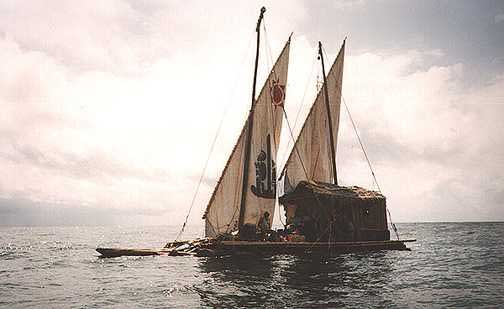 The raft La Mante-a under way in the Pacific.
|

A raft expedition to Hawaii ended July 1 when the raft went aground after it was towed out to sea and was destroyed off the coast of Costa Rica. Expedition leader John Haslett, KC5KHA, of Dallas, Texas, has called off the expedition citing a lack of money and crew scheduling difficulties. The latest balsa raft, dubbed La Endurancia, had been built in Costa Rica after Hasslett's first vessel, the 50-foot balsa log raft La Mante-a, had to be scuttled.
Haslett's wife, Annie, announced the disappointing turn of events July 1. She said La Endurancia was to be towed approximately 20 miles out to sea by a freighter to keep the vessel away from the dangers of the coast. "Unfortunately, the tanker ran out of fuel and let the raft go only four miles from Matapalo, a very rocky shore that has been the scourge of many a ship," she said. "After a night of heavy storms, the raft was forced onto the rocky reef and was destroyed."
Haslett's La Mante-a fell victim to sea worms and storms during the first leg of the educational and research venture. It also had become trapped in the gyre--a large ocean whirlpool--and literally was going in circles under its influence. The vessel, first launched last October, was attempting to retrace the trading routes of ancient Ecuadorian mariners by sailing from Ecuador up the Central American coast to Mexico. After the voyage ran into problems, it had to be scuttled in the Pacific some 160 miles southwest of Costa Rica.
Aboard La Mante-a, Haslett had been maintaining Amateur Radio schedules with schools and other groups in the US and around the world on 20 meter SSB. The expedition also used Amateur Radio for routine communication with the mainland.
Annie Haslett said she expected her husband to return to Texas by week's end. John Haslett plans to write a book on the adventure. For more information, visit the Mante-o Expedition Web site, http://www.balsaraft.com/.
SOLAR UPDATE
Average solar flux and sunspot numbers were down this week compared to last, but this is not surprising considering last week's high numbers. Average sunspot number dropped from 272 to 204, and average solar flux was down nearly 18 points to 180.8. Active geomagnetic days were July 2 and 3, when the planetary A index was 26 and 13.
The forecast for the next three days, July 9-11, is a solar flux of 140, 140 and 135 and planetary A index of seven for all three days. Beyond this weekend look for a declining solar flux to continue around 135 until July 14, then go above 170 after July 19. One forecast earlier this week from the NOAA Space Environment Service Center has solar flux peaking around 200 from July 22 through 27, but a later more conservative projection suggests a peak above 180 from July 24-26.
Under current summer conditions, the 160 and 80 meter bands are noisy because of seasonal atmospherics in the northern hemisphere, while 20 meters is open late into the evening. Conditions on 10 and 12 meters will tend to get better for long distance communications as the days get shorter and we progress toward the fall equinox.
Sunspot numbers for July 1 through 7 were 236, 232, 213, 211, 188, 190 and 158 with a mean of 204. The 10.7-cm flux was 195.4, 187.1, 196.8, 185.6, 174.2, 167.9 and 158.4, with a mean of 180.8. The estimated planetary A indices were 9, 26, 13, 4, 4, 9 and 5, with a mean of 10.
In Brief:
- This weekend on the radio: The IARU HF World Championship, the QRP ARCI Summer Homebrew Sprint, and the CQ WW VHF Contest are July 10-11.
Just ahead: The Six Club Six Meter Sprint, the Pacific 160 Meter Contest, the North American QSO Party (RTTY), the SEANET Contest (CW), and the Colombian Independence Day Contest are the weekend of July 17-18. - W1AW/9 and NU1AW on air for IARU event: The IARU HF World Championship gets under way 1200 UTC Saturday, July 10 and ends 24 hours later. Once again, ARRL HQ's Maxim Memorial Station W1AW will be on the road, operating as W1AW/9 from the station of W0AIH in Wisconsin. The IARU HQ station NU1AW will be on CW and SSB on 160-10 meters from Connecticut. Both stations count as HQ multipliers for the IARU event, as do all other headquarters stations of IARU member societies. Complete rules for the 1999 IARU HF World Championship are in April QST, page 104 and at http://www.arrl.org/contests/announcements/rules-iaru.html.
- Vanity update: The FCC in Gettysburg reports it has processed vanity call sign applications received through June 10. On June 30, the FCC issued 99 grants. Another 110 applications landed in the work-in-process (WIPs) stack. --FCC
- ARRL issuing IARPs: International Amateur Radio Permits (IARPs) for US Amateurs are being issued by the ARRL. The IARP permits US licensees to operate in Argentina, Brazil, Peru, Uruguay, and Venezuela without having to obtain a special license. The IARP is valid in any country that is a signatory to the CITEL Amateur Convention. The Class 1 IARP--available to Tech Plus and higher class licensees--carries all operating privileges. The Class 2 IARP--equivalent to the US Technician ticket--carries all privileges above 30 MHz. An IARP is not a license, but it certifies the existence of a license. Applicants must submit a formal IARP application from ARRLWeb (visit http://www.arrl.org/field/regulations/io/#iarp) or the information the application requests, plus a photo ID, a copy of a current Amateur Radio license, a photo (from 1.0-inch to 1.5-inch square) and a $10 processing fee (for rush delivery add $10 for a total of $20) to ARRL-IARP, 225 Main St, Newington, CT 06111. The IARP is valid for one year or until FCC license expiration, whichever comes first.
- 1999 Ship Museum special event: Amateur Radio stations at nearly 40 museum ships will be active the weekend of July 17-18 for the 1999 Museum Ship Special Event. It gets under way at 2000 UTC on July 17. The USS Salem Radio Club--K1USN--is sponsoring the event. Certificates are available for working five vessels during the weekend. QSL and certificate manager for K1USN is Bob Callahan, W1QWT. Suggested frequencies include (AM) 3885; (SSB) 3930, 7230, 14240, 18.130, 21.330, 24.930, and 28.430; (CW) up 30 kHz from band edges. Operation will include activity on 6 and 2 meters. For more information, visit http://www.ziplink.net/~rcal/salem or e-mail W1QWT at rcal@ziplink.net. --thanks to Pi Pugh, K1RV
- More special Canadian prefixes: The following special prefixes have been authorized by Industry Canada to commemorate the 75th anniversary of the Royal Canadian Air Force: VE=CF; VA=VX; VO=VC; VY=CG. The prefixes will be valid until July 31, 1999. --RAC