ARRL Audio News
| · | To subscribe, unsubscribe, or change your e-mail delivery address: see How to Get The ARRL Letter, below |
| · | Delivery problems (ARRL member direct delivery only!): letter-dlvy@arrl.org |
| · | Editorial questions or comments: Rick Lindquist, N1RL, rlindquist@arrl.org |
| · | ARRL Audio News: http://www.arrl.org/arrlletter/audio/ or call 860-594-0384 |
| · | The ARRLWeb Extra: http://www.arrl.org/members-only/extra |
IN THIS EDITION:
- +Multiple call sign holders could face fines
- +FCC says hams next for ULS
- +NCVEC annual meeting postponed
- +Mobile Amateur Radio museum makes rounds
- +State PRB-1 bills progress
- +Ray Petit, W7GHM, SK
- Solar update
- In Brief: This weekend on the radio; +Vanity update; Corrections, etc; Next SAREX mission to fly July 20; Now in The ARRLWeb Extra; Connecticut, Massachusetts proclaim Amateur Radio Week; CQ seeks back issues of Ham Radio; Jersey hams aid Tour de Cure; Follow the light; ARRL 10 GHz and Up rule change; Friedrichshafen;
MULTIPLE CALL SIGN HOLDERS COULD FACE FINES
The FCC's Riley Hollingsworth, K4ZDH, says the Commission may have to resort to fines to curb the practice of hoarding multiple club station call signs. "The reason we're concerned about this is that we consider it an abuse of our licensing processes," said Hollingsworth, a legal adviser for enforcement in the FCC's Compliance and Information Bureau. "If somebody applies for 30 or 40 licenses over time, it really overloads the staff." Hollingsworth pointed out that the call signs often must be typed in manually.
"If we have continued abuse, we're going to have to levy some forfeitures, which we have done in the past for abuse of Commission processes," he said. "With short staff and budget considerations, we just can't let things like this go on."
Earlier this month, a ham listed as the trustee for more than three dozen club station call signs agreed to give up all but one of them. Motoaki Uotome, JA1GZV, who also holds a US Extra ticket as W9BO, apparently was the trustee of 41 club station call signs. Last month, the FCC set aside 14 recently granted club station call signs and 12 recently granted club vanity call signs he held and asked Uotome to justify the grants.
The US is not the only country in which Uotome has collected a call sign. An Internet search indicates that he also holds one or more Amateur Radio call signs in Australia, Chile, and Uruguay.
Hollingsworth concedes that the FCC rules do not specify an upper limit to the number of call signs an individual may hold, but says "the underpinning of the rules is common sense." He recommended that multiple call sign holders should seriously consider turning in their excess grants before they hear from the FCC, "because we will be pursuing them."
In addition to the Uotome case, the FCC on June 4 wrote Steve Massey, N6TT, of Manhattan Beach, California, to inquire about the one dozen club station call signs it had granted to him. The FCC immediately set aside several call signs and requested that Massey provide justification for having them. In a similar letter on June 7, the FCC also set aside four recently issued club station call signs granted to Steven K. Nace, KN5H, of Chandler, Arizona.
News of the cases already has had an impact. "We're had several others come in on a voluntary basis and turn their excess number in," Hollingsworth said.
The FCC says the two-year rule applies for those seeking to obtain one of the desirable call signs being yielded or called back by the FCC, and Hollingsworth plans to specify a date of cancellation on each letter to a holder so that it will be clear when the two years are up.
"We're also going let them know they can't reclaim any of these call signs under former call sign holder exceptions to the two-year period," he said. Close relatives also would be unable to claim any of the call signs in the future.
FCC SAYS HAMS NEXT IN LINE FOR ULS
The FCC says the Amateur Service is the next in line to be converted to the Universal Licensing System. Amateur Radio is scheduled for ULS "deployment" in August. Most of the remaining wireless services will be converted from their old licensing systems to ULS in phases during the remainder of 1999.
The FCC has adopted a Report and Order to enable public access to application and licensing information in the ULS via the Internet. The FCC says its decision will "significantly enhance the ability of the public to access public record information regarding wireless licensees, at a reduced cost."
The Universal Licensing System will replace the venerable Form 610 series with a new, inclusive electronic document known as Form 605. It also will incorporate the vanity call sign program. The ULS will permit amateurs to file applications, modifications or renewals via the Internet. Individual hams will not be required to file electronically, however. So far, nearly 6000 amateurs have registered with the ULS.
NCVEC ANNUAL MEETING POSTPONED
The annual meeting of the National Conference of Volunteer Examiner Coordinators has been postponed, and a new meeting date likely won't be set until the FCC drops the other shoe on Amateur Radio restructuring. NCVEC members were to meet July 9 in Gettysburg, Pennsylvania. Members were concerned, however, that the FCC has yet to issue its impending Report and Order in WT Docket 98-143, the FCC's Biennial Review of Part 97--better known as Amateur Radio restructuring. The FCC's action is expected to have a substantial impact on the content of amateur examinations.
"The VECs felt it was important to delay any NCVEC meeting until after the restructuring decision had been announced by FCC, rather than prior to its announcement," said Bart Jahnke, W9JJ, of the ARRL-VEC. The FCC has not indicated when it plans to act on the restructuring issue.
MOBILE AMATEUR RADIO MUSEUM MAKING THE ROUNDS
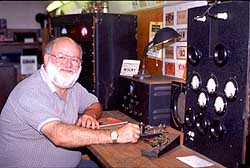 Mobile museum curator John Dilks, K2TQN, at the operating position of his 1933 classic ham station. Dilks is an ARRL Life Member and on the Board of the Antique Wireless Association. |
Like the traveling circus, John Dilks, K2TQN, has taken his show on the road. Ever since he started collecting vintage radio gear back in the 1950s, Dilks, 57, says it's been his desire and goal to have a radio museum. His wife "wasn't too keen" on the idea of his setting up the museum in their New Jersey home, however.
So after a bit of creative thinking, Dilks' decided to house his dream museum in a recreational vehicle--itself a bit of an antique--and his inaugural tour included a stop at ARRL Headquarters June 16.
"There's too many good collections that don't see the light of day," Dilks says. "I believe in sharing it." Dilks says it's also an opportunity to show newer hams the homebrewing techniques of the earlier generations.
Among the more unusual pieces aboard are two early receivers, a Patterson and a Sergeant Model 44 from the late 1930s. "Having the more unusual ones gives visitors a chance to see something they would not normally see," he said. K2TQN's Old Radio Museum contains a few of the old chestnuts as well, including units by Hallicrafters and National SW-3. Also in the lineup are well-preserved homebrew transmitters, including several breadboard-style units. The museum also includes a smattering of vintage tubes and keys, plus two spark transmitters and even crystal sets.
Swaying on two bamboo poles above the R/V's roof is a vintage-style multiwire antenna of the sort that an amateur of the 1920s or 1930s might have used.
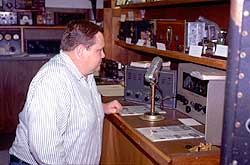 A visitor to ARRL HQ, Dave Brindle, K1WER, of Nashua, New Hampshire, checks out another vintage station in K2TQN's Old Radio Museum. The station includes a Stancor transmitter and a Silvertone receiver. |
But the highlight of the museum-on-wheels is an authentic 1933-style Amateur Radio station. Dilks assembled the station with equipment from several sources. It includes a 1932 Hammarlund Comet Pro receiver, coil box, speaker and QSL card once owned by Dare Aucott, W3CRY, and a homebrew 300-W transmitter built by Joe Hoffman, W2DST, of New York. The table and the 1933 station log book, license, lamp, and chair once were in the shack of Earl Abbott, W2FTT, of Manahawkin, New Jersey. QSL cards of that era line the wall above the station.
A curious historical footnote to the W2DST transmitter: Dilks says Hoffman, who had emigrated to the US from Germany, put away his Amateur Radio gear as World War II was breaking out--lest he be thought a German spy. It remained in an attic for decades. Dilks obtained the transmitter when the house was sold.
Dilks says he hopes to have the station operational from the R/V by next year and plans to have a vintage station on the air next spring from the Dayton Hamvention flea market.
Dilks had to cut short his visit to ARRL HQ after his R/V--a 1973 Dodge-powered unit--developed water pump problems. Once vehicle repairs are complete, Dilks planned to head off to Maryland for Radioactivity '99 in Burtonsville, followed by a stopover for the Rooster Net 3990 picnic at Valley Forge, Pennsylvania. After a break, Dilks' museum will make stops in Pennsylvania and New Jersey before heading off to the big Antique Wireless Association national meet September 1-3 in Rochester, New York.
Dilks remains on the lookout for early amateur gear. "The goal is to change the display once every two years," he said, to keep things fresh for repeat visitors.
For more information, visit the New Jersey Antique Radio Club site, http://www.eht.com/oldradio. Contact Dilks via e-mail at oldradio@worldnet.att.net.
STATE PRB-1 BILLS MAKE PROGRESS
The Louisiana state Senate has passed HB 2088, which limits the control of local jurisdictions to regulate Amateur Radio antennas by incorporating the essence of the limited federal preemption known as PRB-1 into state law. The bill now is on its way to Gov Mike Foster for his signature.
Louisiana Section Manager Lionel "Al" Oubre, K5DPG, expressed his thanks and appreciation to Dan Whelchel, K5IQZ, who spearheaded the Louisiana PRB-1 effort, and to Rep Victor Stelly, who authored the bill. Oubre also thanked the Louisiana hams who contacted state lawmakers urging support of the bill.
Meanwhile, Oregon's PRB-1 bill, Senate Bill 879, has jumped another hurdle in its trip through that state's Legislature. The House Rules Committee approved and sent SB 879 to the House floor with a "Do Pass" recommendation on a unanimous vote. Amateur Radio operators are being encouraged to contact their local representative for their support of the bill. Bob Shelby, W7FPY, ARRL Assistant SM Marshall Johnson, KK7CW, and Sen Lee Beyer appeared on behalf of the bill at the committee hearing and work session.--thanks to Lionel "Al" Oubre, K5DPG and Marshall Johnson, KK7CW
CLOVER INVENTOR RAY PETIT, W7GHM, SK
CLOVER inventor Ray Petit, W7GHM, died June 13, 1999, at his home in Oak Harbor, Washington. He was 55. According to his close friend Ed Bixby, AK0X, Petit suffered a stroke in early March caused by a brain tumor that left him mostly paralyzed. Continuing growth of the tumor resulted in additional strokes that finally took his life.
CLOVER is a digital communications protocol designed for use on the HF bands that's found wide application in commercial and amateur communication.
Petit was well-known and respected within the Amateur Radio digital community. "Ray was a real gentleman and he will be missed," said QST Digital Dimensions Editor Stan Horzepa, WA1LOU. An ARRL member for more than 27 years, Petit had authored several articles for QST and QEX on CLOVER and coherent CW, among other topics.
Petit is survived by his wife, Joyce, two brothers and a sister.--thanks to Ed Bixby, AK0X, and Stan Horzepa, WA1LOU
SOLAR UPDATE
Solar wonk Tad Cook, K7VVV, Seattle, Washington, reports: Average sunspot numbers were up 10 points this week, and average solar flux was down by just two points. A peek at http://www.wm7d.net/hamradio/solar/ shows how the two indices have diverged a bit, with sunspot numbers climbing faster than solar flux.
Solar flux is expected to bottom out at 150 on June 18, then rise over the weekend to 152 and 154. Planetary A index is expected to be 8, 12 and 10 over the same three days. Solar flux should be back to 160 by June 27, and stay around 165 June 28 through July 10. This is based on the previous solar rotation, so we can always hope for new activity to push the numbers higher. But as we approach the summer solstice, even higher solar flux won't make much difference on 10 meters until the fall.
Geomagnetic indices look stable over the next few weeks, with unsettled conditions around July 5.
Sunspot numbers for June 10 through 16 were 214, 211, 233, 211, 210, 240, and 201, with a mean of 217.1. The 10.7-cm flux was 161.1, 164.7, 168, 167.7, 168.2, 158.5, and 152.7, with a mean of 163. The estimated planetary A indices were 7, 6, 7, 6, 4, 8, and 7, with a mean of 6.4.
In Brief:
- This weekend on the radio: The Kid's Day Operating Event, All-Asia DX Contest (CW), the SMIRK QSO Party, and the West Virginia QSO Party are the weekend of June 10-20. See June QST, pages 97-98, for details. Just ahead: Field Day is June 26-27. See May QST, page 95 for the rules.
- Vanity update: The FCC in Gettysburg reports it has processed vanity call sign applications received through May 24. On June 10, the FCC issued 118 grants. Another 160 applications landed in the work-in-process (WIPs) stack. During May, the FCC received 1165 vanity applications, all but 141 of them filed electronically.--FCC
- Corrections, etc: (1) The correct e-mail address for Amateur Radio Direction Finding Team USA is TeamUSA@homingin.com. The address was reported incorrectly in The ARRL Letter, Vol 18, No 24. (2) You can see a good general trend in rising solar flux indices at http://www.dxlc.com/solar/ or at WM7D's solar resource site, http://www.wm7d.net/hamradio/solar/. The WM7D site was deleted from the Solar Update that appeared in The ARRL Letter, Vol 18, No 24, following access problems related to a misconfiguration related to a network move. WM7D apologizes for those who had problems accessing his site.
- Next SAREX mission to fly July 20: Word from NASA is that the next Space Amateur Radio EXperiment mission--and the only one scheduled for 1999--has been scheduled to launch on July 20 at 0436 UTC aboard shuttle Columbia mission STS-93. The shuttle mission, which will carry the Chandra Observatory into orbit, has been delayed several times already. The STS-93 Mission Commander is Eileen M. Collins, KD5EDS. Also aboard will be Mission Specialist Michel Tognini, KD5EJZ, and Mission Specialist Catherine G. Coleman, KC5ZTH. Students at five schools--in Texas, Rhode Island, Virginia, and Florida--are on the list to talk to the STS-93 crew via Amateur Radio.
- Now in The ARRLWeb Extra: Revisit a classic QRP transmitter in "The Tuna Tin 2 Revival," by Ed Hare, W1RFI. Also: "Black Bull"--your Field Day was never this exciting; "QST, Amateur Radio Help Save Owl,"; "Building an Emergency J-Pole," and commentary in "Romie's Ramblings." The FotoGallery features, among others, shots from the AES SuperFest. Check out the W1AW/85 QSL card! Check it out on the ARRLWeb Members Only page, http://www.arrl.org/members-only.
- Connecticut, Massachusetts proclaim Amateur Radio Week: The State of Connecticut and the Commonwealth of Massachusetts have joined other states and communities in recognizing the contributions of Amateur Radio by declaring June 20-27 as Amateur Radio Week. Connecticut Gov John Rowland signed an official statement this week. It recognizes 1999 as the League's 85th anniversary and cites the contribution by hams of "free emergency radio communications." Massachusetts Gov Paul Cellucci signed a similar proclamation--sponsored by the Framingham Amateur Radio Association--on June 10. Among other things, the proclamation cites Amateur Radio's role in providing "vital emergency communication facilities in times of natural disasters, accidents, and other situations." Both proclamations were issued in conjunction with Field Day, the weekend of June 26-27.--thanks to Dick Marshall, K1KTK, and Al Cohen, W1FXQ
- CQ seeks back issues of Ham Radio: CQ Communications Inc is looking for several specific back issues of Ham Radio magazine in good to excellent condition. Issues will not be returned, but owners will be compensated either with a subscription to a CQ publication or cash. Specific issues needed are April, November and December 1968; February 1970; October 1978; February 1980; February 1986; and February 1987. If you can help, contact Rich Moseson, W2VU, w2vu@cq-amateur-radio.com. Include your name, call sign, mailing and e-mail addresses, phone number, and the issue(s) you have available.--CQ Communications via The Hudson Loop
- Jersey hams aid Tour de Cure: New Jersey's Morris Radio Club, along with local hams, provided communications June 5 for the American Diabetes Association's Tour de Cure in Morristown, New Jersey. The communications team covered three separate bike routes of 15, 30 and 65 miles. Six rest stops, three SAG vans, a motorcycle sweep, and a net control station coordinated activities via the NO2EL repeater in Morristown. An ADA official was heard to comment that he did not know what he would do without the radio communication provided by the hams because cell phones just can't do the job. Malcolm Lee, W2MJL, who organized the communication team, extended thanks to all the hams who participated.--Ed Peters, K2EMJ, via The Hudson Loop
- Follow the light: Mike Dalrymple, GM4SUC, reports that 126 stations in 41 countries have announced plans to participate in this year's International Lighthouse/Lightship Weekend August 21-22. Radio amateurs of the world are invited to join us in the fun of the weekend by establishing a station at a lighthouse, lightship, or maritime light. Maritime/marine mobile stations are welcome to participate as long as they are as close as they can get safely to a lighthouse. Contact GM4SUC at gm4suc@compuserve.com. Details of this annual event plus a list of these stations and countries are available on K2JXW's Ham Radio Lighthouse Page at http://www.waterw.com/~weidner/ld.htm.--Mike Dalrymple, GM4SUC
- ARRL 10 GHz and Up rule change: The Awards Committee, acting on a recommendation of the Contest Advisory Committee and with input from a survey of last year's entrants in the ARRL 10 GHz and Up Contest, has announced a change in the operating rules for the annual 10 GHz and Up Contest. Operating times for the contest have been changed to allow participants additional time in the early morning hours. Starting with the 1999 ARRL 10 GHz and Up Contest scheduled for August 21-22 and September 18-19, participants may operate a total of 24 hours each weekend between the starting time of 6 AM local time Saturday morning through 12 midnight local time Sunday evening. Listening time counts as operating time and times off must be clearly indicated in the log. The complete rules for the ARRL 10 GHz and Up Contest will be printed in the June 1999 issue of QST or may be downloaded from the Contest Branch Web Page, http://www.arrl.org/contests/announcements/99/rules-10ghz.html.
- Friedrichshafen: The biggest hamfest in Europe--officially called "Ham Radio" but known best as "Friedrichshafen"--is June 24-26 in Friedrichshafen, Germany on Lake Constance (this is also the 50th year of the Lake Constance Convention of Radio Amateurs, which gave rise to the Ham Radio fair). Some 20,000 or more visitors are expected to turn out for this year's gathering, which includes a flea market and commercial exhibits. The ARRL will be represented at Friedrichshafen. For more information, visit http://www.messe-fn.de/ham/.