ARRL Audio News
| · | To subscribe, unsubscribe, or change your e-mail delivery address: see How to Get The ARRL Letter, below |
| · | Delivery problems (ARRL member direct delivery only!): letter-dlvy@arrl.org |
| · | Editorial questions or comments: Rick Lindquist, N1RL, rlindquist@arrl.org |
| · | ARRL Audio News: http://www.arrl.org/arrlletter/audio/ or call 860-594-0384 |
| · | The ARRLWeb Extra: http://www.arrl.org/members-only/extra |
IN THIS EDITION:
- +Morse debate makes Page 1
- +HQ lobby gets a facelift
- +Maine passes PRB-1 bill with a twist
- +UK announces licensing changes
- Hurricane Watch Net inaugurates 1999 season
- Observatory honors ham satellite pioneer
- Frank Gunther, W2ALS, SK
- Solar update
- In Brief: This weekend on the radio; Vanity update; In The ARRLWeb Extra for June 1; New EMA SM; Next SAREX mission could fly July 22; Amateur Radio at hurricane confab; Free FCC call sign alert service; W1AW Code Practice on the Web; JPS exits Amateur Radio market
+Available on ARRL Audio News
MORSE DEBATE MAKES PAGE 1 OF WALL STREET JOURNAL
Hams checking the prestigious Wall Street Journal for the latest business news and stock quotes June 2 also found some Amateur Radio news--smack in the middle of page 1 and above the fold. A story by Staff Reporter Lee Gomes headlined "TO HAM OPERATORS, MORSE CODE TEST IS LIKE LATIN EXAM; Does It Keep the Barbarians At Bay, or Is It Fueling The Decline of a Culture?" discusses the current code versus no-code debate in Amateur Radio.
"Morse Code is a dying language in the Digital Age, but it's still required reading for amateur radio buffs," Gomes' story begins. His report outlines the broad strokes of the controversy and the impending FCC streamlining that is expected to address future Morse code requirements for amateurs. It also quotes the FCC's Bill Cross, W3TN, as "the FCC's lead staff person on the question," and reports that the FCC "is contemplating relaxing the Morse Code requirement."
Gomes cites Bruce Perens, K6BP, of No Code International, who--in Gomes words--considers Morse code "an antiquated technology" and "a turnoff for young people." "Perens is in the minority," Gomes asserts. "Most licensees don't want any change in the requirement--especially since they have already passed the test themselves."
Taking the opposite viewpoint in Gomes' article is Nancy Kott, WZ8C, of FISTS, which Gomes describes as a "militant pro-Morse group." Gomes says Kott "all but accuses the no-coders of taking bribes from ham radio makers" and claims they want the code requirements dropped to attract more hams and sell more equipment.
Gomes reports that FISTS members fear a lot of bad, on-air behavior "without the screening provided by the Morse Code requirement." Perens, Gomes says, is not concerned about a "post-Morse ham world inhabited by barbarians." Perens points out for the article that applicants still will have to pass "rigorous tests" to get a ticket. Besides, Gomes quotes Perens as saying, "The riffraff have no reason to leave the Internet."
The article is silent on the issue of ITU regulations requiring a demonstration of Morse proficiency for HF operation and on the fact that a codeless class of Amateur Radio license already exists. And, at one point it refers to Morse code as "dits and duhs."
In the course of researching his article, Gomes contacted the ARRL for background information. The complete article is available via the Web for a fee to registered users of the Wall Street Journal's interactive page, http://www.wsj.com.
ARRL HEADQUARTERS LOBBY GETS FULL FACELIFT
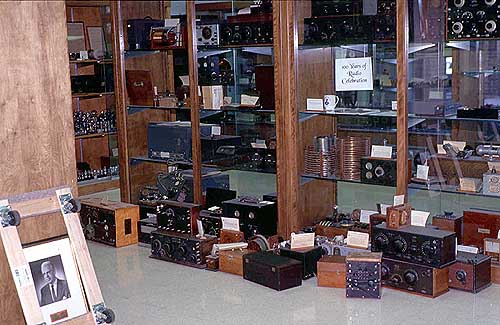 ARRL museum exhibits in the process of cataloguing, prior to storage. The large display cases have dominated the lobby area for many years.
Plastic sheeting lines the access way to offices inside ARRL HQ. The ceiling has since been removed--along with the receptionist's desk. [Rick Lindquist, N1RL] |
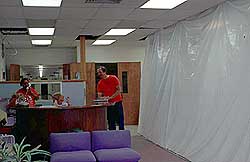
By month's end, visitors to ARRL Headquarters will be greeted by a totally new look. The lobby--long the site of the Headquarters museum of antique and vintage radio and communication paraphernalia--is being completely redone from the ceiling down--including new furniture and carpeting and a reception area.
"First impressions are important," said ARRL Chief Financial Officer and Business Manager Barry J. Shelley, N1VXY. Shelley said the consensus was that that the lobby was sadly in need of modernization as the League approaches the new millennium. "While the existing configuration of this area had served the League well for many years, it simply did not meet the needs currently or those projected for the future."
Gone are the rows of display cases and the radio artifacts they once held. Some of the museum exhibits--and the old display cases--have been adopted by individual departments in the Headquarters building with room to accommodate them. Other former museum items are on display at the Maxim Memorial Station W1AW across the parking lot.
But the bulk of the items that had been on display--including several items related to the early transatlantic tests of the 1920s--has been professionally catalogued and packed away carefully for safekeeping. Plans are being developed to provide some display space for antique and vintage artifacts in the new lobby. But Shelley says the new lobby won't have enough room for historical displays the magnitude of the one now dismantled.
While not a part of the current lobby project, discussions have begun to determine the best way to display the League's sizeable collection of historical items. "An appropriate display of historical artifacts and equipment will require significant funds," Shelley points out. "We're looking at several options."
Redoing the lobby came at the request of the League's Board of Directors, who have discussed the project for some time now. Board members will get their first look at the finished product at their regular July meeting.
Shelley said the new lobby will incorporate flexible display capabilities to allow for presentation of a variety of topics involving Amateur Radio as well as current issues relevant to the ARRL and the International Amateur Radio Union--for which HQ serves as the Secretariat. It also will include a display of ARRL products, as well as provide a point of sale.
"We feel that, upon completion, the ARRL will have a much friendlier and more modern look to present to the public, as well as a much more convenient area to meet the many members and other guests that pass through our doors each year," Shelley said.
Shelley estimated somewhere around 1000 people stop by at Headquarters every year just to visit and to tour the building and W1AW.
MAINE PRB-1 BILL SIGNED BY GOVERNOR
Maine Gov Angus King has signed the latest legislation to incorporate the essence of the limited federal preemption known as PRB-1 into state law, but with a twist. Because of an amendment added in the Maine House, the final version was reworded slightly to automatically include not just PRB-1 but any future FCC regulation or policy affecting local regulation of antennas. King signed the bill, LD-1800, May 27.
Under the measure, local regulations in Maine involving placement, screening, or height of antennas based on health, safety or aesthetic considerations "must be crafted to reasonably accommodate amateur radio communications and to represent the minimum practicable regulation to accomplish the municipalities legitimate purpose."
The prime mover behind the legislation, Bruce Marton, K1XR, got the bill introduced after getting involved in a legal tangle with the town of Ogunquit. Marton is attempting to install four 100-foot towers on 50 acres of property that he owns. He says the town has been trying to revoke his building permit and force him to take down the structures. That dispute continues, but Marton now hopes the fact that King signed the bill last week will help his case. "It couldn't have come at a better time," he said.
Marton worked with State Sen Mark Lawrence to draft the legislation, and Lawrence, who's also Senate President, spoke on the bill's behalf when it was heard at the committee level. The bill was opposed by the Maine Municipal Association, but, by and large, Marton says, the measure sailed through the Maine Legislature, where he says, it had bipartisan support.
Similar PRB-1 legislation is under way or under consideration in several other states.
UK ANNOUNCES LICENSING CHANGES
The Radio Society of Great Britain and the Radiocommunications Agency of the United Kingdom have announced expanded privileges for Novices in the UK. In addition, a new license class is in the works offering full HF at low power with a 5 WPM Morse code test.
Starting sometime this summer, Novice licensees in the UK will be permitted up to 10 W output and access to 2 meters. Novices who have passed the 5 WPM code test also will gain more mode privileges in wider HF segments. Under the expansion, Novice Class A licensees in the UK--who have passed a 5 WPM Morse code test--will be permitted to operate CW, phone, RTTY, and data on 1950-2000 kHz; CW and data on 3550-3600 kHz; CW, phone, and RTTY on 3600-3650 kHz; CW on 10.110-10.140 MHz; CW and phone on 28225-28500 MHz; and CW, RTTY, and data on 21.050-21.149 and 28.050-28.190 MHz.
Currently, no-code Novice B licensees in the UK are restricted to 3 W output (or 5 W input) in the 6 meter and 70 cm, 23 cm, and 3 cm bands. Novice A licensees also enjoy access at the same power level to segments of the 160, 80, 30, 15, and 10 meter bands, including phone on 160 and 10 meters.
In the autumn, the UK will introduce a new class of license called "Full A/B." The written examination will be the same as for the present Class A or B license, but with a 5 WPM code test. In addition to full privileges above 30 MHz, the new license class will convey full frequency and mode privileges below 30 MHz with a maximum output power of 100 W. A new series of M5 prefix call signs will be used.
The move to a Full A/B license follows an announcement last spring that the RSGB would seek such a license as well as reconsideration of the IARU policy supporting mandatory Morse code testing for access to Amateur Radio HF bands. RSGB General Manager Peter Kirby, G0TWW--a former professional CW operator--has said that Morse requirements are hampering growth in the hobby. An RSGB survey released earlier this year indicated 70% support among UK operators for the 5 WPM license proposal, although comments raised paralleled those often heard in the US on the Morse issue. The RSGB says that if the World Radio Conference in 2002 or 2003 agrees to delete requirements to demonstrate Morse proficiency for HF access, the existing UK license structure will be replaced with an incentive-based system.
For many years Great Britain had two classes of amateur license--Class B with privileges above 30 MHz, and Class A with full privileges. The only difference was a 12 WPM Morse code requirement for the Class A ticket. In 1991, Novice licenses with simpler examinations were introduced. With the introduction of Novice licenses, the original Class B and Class A licenses became known as Full B and Full A respectively.
Further details may be found at http://www.rsgb.org/news/extra3.htm. The rules governing amateur operating in the UK are at http://www.open.gov.uk/radiocom/. --David Sumner, K1ZZ
HURRICANE WATCH NET TO PREPARE FOR 1999 SEASON
The National Hurricane Center in Miami, Florida, is inviting amateurs to participate in a communication preparedness exercise this coming weekend to kick off the 1999 hurricane season.
Amateurs are asked to check into the Hurricane Watch Net on 14.325 MHz on Saturday, June 5, 1999, 1800-2000 UTC. Stations are requested to provide a real-time report of their current weather conditions, including wind speed, wind direction, and barometric pressure. Measured conditions are preferred, but estimated wind speeds are acceptable.
These reports will be forwarded to W4EHW at the National Hurricane Center. W4EHW will be on frequency. Stations do not need to continue monitoring the net once their reports have been forwarded to the National Hurricane Center.
The manager of the Hurricane Watch Net Manager is Jerry Herman, N3BDW.
OBSERVATORY TO HONOR HAM SATELLITE PIONEER K2ZRO
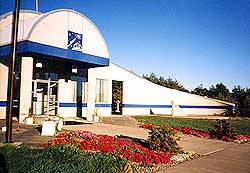 Kopernik Observatory in Vestal, New York. The observatory's mission is to offer astronomy education to the general public, especially for children in kindergarten through grade 12. Last month, the observatory announced a new project, The Kopernik Space Radio 2000 Project, launching the observatory into space at the speed of light. The project will teach students the basics of satellite and radio communications and the laws of physics, using satellites as a fun mode of teaching. The ham station will allow students to talk via Amateur Radio to other students around the world and expose many people to the world of ham radio. [John Kray, KA2CNG] |
The staff of Kopernik Observatory and ham radio volunteers will celebrate the observatory's 25th anniversary June 5 with a special event that also will honor the memory of one of the observatory's founders, Kaz Deskur, K2ZRO, who died in 1984. Amateur Radio club station KB2UYF is located at the observatory, and paperwork has been submitted to the FCC to change the station's call sign to K2ZRO.
Deskur, a satellite pioneer, operated the observatory's Amateur Radio station under his call sign for many years. In the early days of the OSCAR program and AMSAT, K2ZRO was a familiar call sign. Deskur designed the original OSCARLOCATOR, a device used to track satellites before the advent of personal computers.
The observances June 5 will include a formal dedication of the observatory club station, hopefully under its new call sign. Deskur's widow and family will be honored guests, and the keynote speaker will be Dr Joseph Dervay, NASA astronaut-physician.
For many years AMSAT sponsored an engineering award in Kaz Deskur's honor. A native of Poland and an Amateur there during World War II, Deskur fought in the Polish Underground. After the war, he emigrated to the US, where he worked for IBM. A son, Andy, is KA1M.
The Kopernik Observatory is establishing a special "Wall of Honor for Amateur Radio Satellites" to honor Kaz Deskur. All hams that knew or worked with him are invited to send their QSL cards for display on this wall. Send cards in an envelope to Kopernik Space & Science Education Center (KA2CNG-TR), 30 Front St, Binghamton, NY 13905.
Hams at Kopernik also will be active June 19, hoping to make many contacts during Kid's Day (see June QST, page 32, for details), operating through satellites--especially FO-20 and FO-27. --John Kray, KA2CNG
FRANK A. GUNTHER, W2ALS, SK
Communications and FM pioneer Frank Gunther, W2ALS, of Staten Island, New York, died here May 31. He was 91. Gunther was in the vanguard of shortwave, two-way and FM radio system development for military and public service applications.
An ARRL Life Member, Gunther was a past president of the Radio Club of America and was trustee of its club station, W2RCA. He also served from 1974 until 1977 as president of the Quarter Century Wireless Association.
In the mid-1920s, Gunther went to work for Radio Engineering Laboratories in Long Island City, New York, where he served as chief engineer. While there, he built and operated an experimental radio station that was among the first shortwave broadcasting systems.
In 1931, he took part in the first public broadcast from an aircraft and installed one of the first airborne two-way radios the following year. Also in 1932, he built what is believed to be the first two-way mobile radio system for the police department in Bayonne, New Jersey.
Gunther was a long-time associate of the inventor and developer of FM, Maj Edwin H. Armstrong. In the late 1930s and early 1940s, Gunther was involved in the installation of nearly all of the FM-band pioneers. Also in the years before World War II, Gunther designed and manufactured LORAN transmitters used by the Allies.
He became president of REL in 1961 and directed the development of the first tropospheric scatter systems for the military. At the time of his death, he was associated with High Point Tower Technology in Oldsmar, Florida.
Gunther also was a QST author. In 1932, he detailed plans for "A Portable 56-Mc. Transmitter-Receiver" in the May issue of QST. He used the article as a platform to urge greater experimentation on the "ultra-high frequencies" (as they were called then).
SOLAR UPDATE
Solar shaman Tad Cook, K7VVV, Seattle, Washington, reports: Sunspot counts and solar flux rose this past week, with the average daily sunspot number up nearly 46 points and flux values up nearly 19 points, compared to the previous week. The big day was June 2, when the sunspot number was 214, a big jump.
Contesters were elated when the poor conditions predicted for last weekend's WPX contest did not materialize. A coronal mass ejection sent charged particles our way, but they missed Earth, and conditions were excellent last weekend. Instead of a high A index, the planetary A index for Saturday and Sunday was only six and five, and the mid-latitude numbers, which affect most of the readers of this bulletin, were even better at three and three. In the mid-latitudes, there were many periods when the K index was zero, which is very stable.
Expect more good conditions this weekend, with solar flux June 4-6 predicted at 175, 170 and 170, and the planetary A index at 8, 7 and 7.
Beyond the weekend look for solar flux to drift down to 150 by June 10, bottom out around 140 from June 18-20, then rise to 165 toward the end of June. Unsettled geomagnetic conditions could return on June 9, with active conditions June 14, and unsettled to active conditions around June 21.
Earlier in the week there were several wire service stories about the predicted peak of solar cycle 23 next year, and how solar flares could disrupt various communication systems and even the power grid. One article quoted Richard Altrock of the Air Force Research Laboratory in Sunspot, New Mexico, saying that this cycle should peak between January and April of next year. He also said that the number of sunspots at the peak should roughly equal the activity during the peaks of the two previous cycles.
Sunspot numbers for May 27 through June 2 were 154, 146, 151, 169, 157, 190 and 214 with a mean of 168.7. The 10.7 cm flux was 155.2, 152.1, 148.6, 156.8, 165.4, 176 and 173.1, with a mean of 161. The estimated planetary A indices were 10, 9, 6, 5, 4, 8 and 11, with a mean of 7.6.
IN BRIEF:
- This weekend on the radio: The QRP TACtical Contest is June 5.
Just ahead: The ARRL June VHF QSO Party is June 12-14. See June QST for details. - Vanity update: The FCC in Gettysburg reports it has processed vanity call sign applications received through May 17. On June 2, the FCC issued 167 grants. Another 215 applications landed in the work-in-process (WIPs) stack.--FCC
- In The ARRLWeb Extra for June 1: "Ham Radio Rides Again on the Great Circus Train," "RadioHead" with John Hansen, W2FS, the "Ultimate DXpedition" and "PRB-1 Success--Texas Style." First Looks checks out the Elecraft K2, and FotoGallery offers up some Dayton Faces. Check it out on the ARRLWeb Members Only page, http://www.arrl.org/members-only.
- New EMA SM: The Eastern Massachusetts Section has a new section manager. He's Joel M. Magid, WU1F, of Groton. Magid replaces Larry Ober, W1MW, who stepped down due to personal and business schedule conflicts. The change was effective June 2.
- Next SAREX mission could fly July 22: The next Space Amateur Radio EXperiment mission--and the only one scheduled for 1999--could launch July 22 aboard shuttle mission STS-93. However, that date is said to be still "under review." STS-93, which will carry the Chandra Observatory into orbit, has been delayed several times already. The STS-93 Mission Commander is Eileen M. Collins, KD5EDS. Also aboard will be Mission Specialist Michel Tognini, KD5EJZ, and Mission Specialist Catherine G. Coleman, KC5ZTH. Students at five schools--in Texas, Rhode Island, Virginia, and Florida--are on the list to talk to the STS-93 crew via Amateur Radio.
- Amateur Radio at hurricane confab: Amateur Radio will be included in the 13th annual Florida Governor's Hurricane Conference at the Tampa Convention Center. The Amateur Radio session will be held Tuesday, June 8, 8:30 AM-noon (Room 16). ARRL Northern and Southern Florida section officials plan to be on hand. The agenda calls for a review of the past year, what worked, what didn't and what's being done to make improvements across the state; a look at new technologies including coming weather warning capabilities in APRS; and a discussion of amateur radio's involvement in emergency response in the future. Those who attending only the ARES/RACES session will not have to pay the training session fees.--Gary Arnold, WB2WPA
- Free FCC call sign alert service: Chris Davis, KB0WWP, offers a new free service via his Web site that will automatically alert users that a pending FCC Amateur Radio transaction has occurred. It's at http://davisfamily.nu/hamcalls/mailinst.htm. Instructions are on the page. Say you just passed your Amateur Radio examination or put in for a vanity call sign and are waiting for that brand new call sign to pop out of the hopper at the FCC. Register and you'll be alerted by e-mail when it happens. Users also can register via e-mail to be notified, so Web access is not a necessity. To register, provide the following six lines of information in the body of a message to hamcalls@davisfamily.nu: e-mail address; last name; first name; city; two-letter USPS state abbreviation, five-digit ZIP code. Davis says e-mails will be kept private, are not used for any mailings, and will be deleted after the transaction occurs or after 60 days. --Chris Davis, KB0WWP
- W1AW Code Practice on the Web: Now you can access W1AW Morse code practice via ARRLWeb using RealAudio files. Visit http://www.arrl.org/w1aw/morse.html. A single click on a file name starts the practice. You'll need RealAudio (available free at http://www.real.com) to listen to these files. The practice files include the same text used for W1AW's regular code practice transmissions. The files are updated after W1AW broadcasts them. The Standard method is used for code speeds above 18 WPM. For code speeds below 18 WPM, Farnsworth method is used. The Web Morse practice follows the same format used by W1AW code practice transmissions. The practice text comes from QST. --Joe Carcia, NJ1Q
- JPS exits Amateur Radio market: JPS Communications Inc of Raleigh, North Carolina, has announced it plans to leave the ham radio equipment market by the end of 1999. The company will cease manufacture and sales of all of its Amateur Radio products, including the popular NIR-12 DSP box and ANC-4 noise canceller. JPS says it plans to focus its future efforts on its land mobile and HF product lines. JPS says ham product sales have fallen to a level where manufacturing and selling them is no longer viable for the company. JPS says it will continue to offer product service and support. It's also offering a last-time opportunity to buy either the NIR-12 and ANC-4 and says it will make the designs of these two products available at "reasonable cost" to an organization that might want to continue manufacturing them. For more information, visit http://www.jps.com; jps@jps.com.