ARRL Audio News
| · | To subscribe, unsubscribe, or change your e-mail delivery address: see How to Get The ARRL Letter, below |
| · | Delivery problems (ARRL member direct delivery only!): letter-dlvy@arrl.org |
| · | Editorial questions or comments: Rick Lindquist, N1RL, rlindquist@arrl.org |
| · | ARRL Audio News: http://www.arrl.org/arrlletter/audio/ or call 860-594-0384 |
| · | The ARRLWeb Extra: http://www.arrl.org/members-only/extra |
IN THIS EDITION:
- +FCC acts against Grizzly Peak "regulars"
- +FCC clears Delaware ham but suspends, cancels other licenses
- +Hams wrap up Oklahoma tornado duty
- +1999 ARRL/TAPR digital confab set
- FCC's Hollingsworth questions Liberty Net
- Terrestrial SAREX contact a success
- Solar update
- In Brief: This weekend on the radio; Vanity update; The answer is out there; PRB-1 bills active in several states; FCC turns down W2CC's special event call sign reconsideration petition; 76 GHz is alive and well in the US; Antique Wireless Association is on line
+Available on ARRL Audio News
FCC ACTS AGAINST GRIZZLY PEAK "REGULARS"
In the wake of a recent negotiated settlement, the K7IJ Grizzly Peak repeaters in the San Francisco Bay area are back on the air, and on-air behavior is said to be in compliance with the rules. Now, the FCC is turning its attention to cases involving individuals who once frequented those repeaters before they were shut down by the Commission in early March. This week, FCC suspended VHF privileges in one case involving a K7IJ "regular" and dismissed a pending Amateur Radio application and issued a stern warning in another.
In its strongest action yet in the K7IJ case, the FCC dismissed the pending Amateur Radio application of James C. Walker, formerly KF6VAA, of Oakland. In conjunction with the K7IJ repeater shutdown, the FCC had set aside Walker's Technician class grant in February, alleging that Walker had transmitted on the K7IJ repeater before getting his amateur license. In a letter to Walker May 26, FCC Legal Adviser Riley Hollingsworth, K4ZDH, dismissed Walker's still-pending Technician application.
Hollingsworth's letter said the Commission had evidence that, despite the setaside, Walker had continued to transmit on amateur frequencies using KF6VAA and had been operating on the WA6SEK 145.21 MHz repeater in the Stockton, California, area. Walker was warned May 20 about that operation. Hollingsworth issued a second warning notice for unlicensed radio operation in his May 26 letter. He said that if Walker later reapplies for an amateur license, he would have to attest that he had ceased unlicensed operation. Hollingsworth also said that the FCC wants to resolve issues related to Walker's operation on the K7IJ and WA6SEK repeaters before it entertains another amateur application from Walker.
"This may require an evidentiary hearing before an Administrative Law Judge," Hollingsworth said, adding that Walker could face criminal prosecution if he operates radio transmitting equipment again without a license.
In another Grizzly Peak-related case, the FCC suspended the VHF/UHF privileges of Timmy O. Sheen, N6MZA, a Tech Plus licensee, by modifying his license. Sheen already has been called in by the FCC for retesting; he has until June 30 to appear or his license will be canceled. In a May 26 letter, Hollingsworth said the FCC had information that Sheen also had been on the WA6SEK 145.21 MHz repeater "broadcasting, playing music and deliberately interfering with repeater operations for several hours." Sheen had been warned in February about similar operation on the K7IJ repeaters, and Hollingsworth said Sheen had been in touch with him to say other stations had interfered with him and to apologize for events leading up to the more recent allegations.
"Retaliation cannot be accepted as an excuse for deliberate or malicious interference or broadcasting," Hollingsworth said, adding "this fact has been explained to you in the past." Sheen has 30 days to protest the action.
In another case related to the WA6SEK repeater, the FCC this week modified the license of Technician licensee William B. Gifford, KF6URY, of Stockton to prohibit VHF/UHF operation for 90 days. The FCC alleged that Gifford was "broadcasting and deliberately interfering" with operations on the WA6SEK 145.21 MHz repeater for several hours. Gifford also has 30 days to protest the modification.
THE FCC GIVETH, TAKETH AWAY
The FCC's Riley Hollingsworth, K4ZDH, says that a Delaware ham required by the FCC to retake her Amateur Extra class exam has successfully retested and is "off the hook" with the FCC. The FCC requested in February that Sheila Bowden, N3QQS, of Millsboro, retake her examinations by March 19. Bowden showed up at a March 13 ARRL-VEC testing session where she retook and passed the written exam.
"We are accepting Sheila Bowden's successful retest for the Extra class license, and accepting the doctor's certificate exempting her from the code test," Hollingsworth said May 27, adding that he was happy about the outcome. "Any time you audit a program, it's always better to have happy news than it is to have disappointing news," he said. Hollingsworth said it took until now to clear the case from his books because the FCC wanted to further investigate the physician's waiver that Bowden had submitted in lieu of taking a Morse code examination.
Hollingsworth said, however, that he was "not in a position to recommend to the W5YI-VEC" that Sheila Bowden be allowed to administer amateur exams again, mainly due to what he called "unresolved questions" about Bowden's husband, Wayne.
Wayne Bowden has not been so lucky in his dealings with the FCC. Earlier this year, the FCC dismissed the Extra class license he formerly held, AA3RT, after the Commission discovered "irregularities in the administration of the examination by the Volunteer Examiners." Wayne Bowden took the complete Amateur Radio examination series at an October 4 W5YI-VEC session. He had not held an amateur license before then. An FCC probe continues into alleged testing irregularities at Pennsylvania W5YI-VEC sessions October 4 and 6, including allegations that examinees might have been coached or given test answers.
Hollingsworth said he has been unsuccessful in his efforts to contact Wayne Bowden, despite several attempts. He said that Sheila Bowden had written him a letter on her husband's behalf, but that he had needed to hear from the licensee directly.
In other action, the FCC has modified the General class license of David O. Castle, WA9KJI, of Evansville, Indiana, to prohibit HF operation for two years. Hollingsworth said in a letter May 19 that the FCC had information that Castle had operated on 3950 kHz "contrary to the Amateur Radio Service rules" by causing malicious interference and broadcasting.
Hollingsworth said that on May 1, Castle was heard "broadcasting and talking to no particular station for over an hour, during which time you prevented the use of the frequencies by others and maliciously interfered with other stations." Hollingsworth's letter said that Castle had "falsely claimed" to be in contact with another station. As a result of the alleged violations, the FCC suspended Castle's privileges to operate below 30 MHz. Hollingsworth had warned Castle in January regarding such operation. Last September, the FCC restricted Castle's operating hours for allegedly engaging in the same type of conduct. Castle has 30 days to protest the latest license modification.
The FCC has cancelled the licenses of several individuals who failed to appear after being called in for retesting. The FCC lifted the Technician class license of Joseph P. Santini, N2RGZ, of Belleville, New Jersey, after he failed to appear to retake his Amateur Radio examinations. Santini had until May 10 to retake his tests. FCC Legal Adviser for Enforcement Riley Hollingsworth had sent Santini a Warning Notice April 5 alleging that the FCC had evidence that Santini had been maliciously interfering with VHF repeater operations.
HAMS WRAP UP OKLAHOMA TORNADO DUTY
Hams in Oklahoma stood down at mid-month following several days of volunteering to provide emergency communication after severe tornadoes devastated entire communities May 3. The Oklahoma storms left dozens dead, hundreds injured, and thousands homeless. Meteorologists now say the worst tornadoes were F5 storms packing record-breaking winds of 318 mph!
"It's like a nuclear bomb went off," said ARRL Public Information Coordinator Tom Webb, WA9AFM. Webb was among the hams assisting Red Cross teams with damage assessment following the storm.
Hams got initial word of the tornadoes to the National Weather Service. "The first reports of tornado development came to our forecast office through ham radio," said Dennis McCarthy, KC5EVH, the meteorologist in charge of the NWS Forecast Office in Norman, Oklahoma.
The Salvation Army's Frank McCollum, N5FM, coordinated Amateur Radio activities on behalf of his organization. McCollum, who also organized the Salvation Army's Amateur Radio efforts in the wake of the Oklahoma City federal building bombing, said that ham radio remained "critical" until cellular telephone service was restored. Ham volunteers subsequently were assigned to handle transport for meals. Some even volunteered to load and unload trucks and delivery vehicles. "We did good!" McCollum exulted.
Jim Volner, WA1VIB, reports that hams aided volunteers using heavy equipment to remove storm debris in the heavily-damaged village of Bridge Creek, 20 miles south of Oklahoma City. "I was very proud to be part of the situation where ham radio operators and the community all came together to provide a vital service," said Volner, a New Hampshire State Police retiree.
By mid-May, Oklahoma Section Manager Charlie Calhoun, K5TTT, reported that Amateur Radio efforts were officially wrapped up. "Many times we think of those who helped after the incident, but I would also like to thank the weather spotters who helped warn on this storm" Calhoun said, "If it were not for them, we could have lost many more lives." For more Oklahoma tornado information and photos, visit http://www.hamsnet.net/kc5trr/oklahoma_disaster.htm
1999 ARRL/TAPR DIGITAL COMMUNICATIONS CONFERENCE
Digital "movers and shakers" from all over the world will be on hand in Phoenix September 24-26 for the 18th annual ARRL and TAPR Digital Communications Conference. TAPR's Greg Jones, WD5IVD, will chair this year's conference.
The ARRL and TAPR Digital Communications Conference is an international forum for radio amateurs in digital communications, networking, and related technologies to meet, publish their work, and present new ideas and techniques for discussion. Presenters and attendees will have the opportunity to exchange ideas and learn about recent hardware and software advances, theories, experimental results, and practical applications. The conference is not just for the digital expert, but for digitally-oriented amateurs of all levels of experience.
Conference highlights include a full day of papers, breakout sessions, and selected topics on Saturday for the beginner to advanced amateur digital enthusiast; three seminars/symposia, including the third annual APRS National Symposium, moderated by Steve Dimse, K4HG, and featuring Bob Bruninga, WB4APR, Keith Sproul, WU2Z, Mark Sproul, KB2ICI, and Brent Hildebrand, KH2Z, plus a PIC development, design, and programming seminar on Sunday. The Saturday banquet will feature Geoff Baehr, N6LXZ, Sun Microsystems chief network officer as guest speaker.
Papers are due by August 9, 1999, and should be submitted to Maty Weinberg, ARRL, 225 Main St, Newington, CT 06111; lweinberg@arrl.org. Submission guidelines are available on-line at http://www.tapr.org/dcc.
Full information on the conference and hotel accommodations are available from Tucson Amateur Packet Radio, 8987-309 E Tanque Verde Rd #337, Tucson, AZ 85749-9399; tel 940-383-0000, fax 940-566-2544; tapr@tapr.org; http://www.tapr.org/dcc.
FCC'S HOLLINGSWORTH QUESTIONS LIBERTY NET
The FCC has asked a net control station of the Liberty Net on 3950 kHz to justify the net's use of Amateur Radio frequencies. Via Certified Mail May 7 to Extra class licensee Victor A. Misek, W1WCR, FCC Legal Adviser Riley Hollingsworth said monitoring on May 1 indicated that Misek's station and members of the group for which he was acting as net control "began transmitting on top of existing Amateur communications that were already in progress." Hollingsworth said that such operation "is considered deliberate interference and cannot be tolerated on the Amateur frequencies."
Hollingsworth also pointed out that Congress has authorized the FCC to seek information to enable it to determine the qualifications of a licensee or applicant. "We are so far unable to determine how the transmissions of this group meet the standards of, or contribute to the purposes of, the allocation of frequencies for the Amateur Radio Service," Hollingsworth wrote.
Hollingsworth alluded to The Liberty Net in comments during an FCC forum at the Dayton Hamvention, openly questioning the behavior of net participants. "I don't get the connection yet" between what Liberty Net participants do on the air and the basis and purpose of Amateur Radio, he said.
In his letter to Misek, Hollingsworth suggested The Liberty Net explore operation on the Internet or seek a low-power FM broadcast grant if that service is authorized. Hollingsworth reminded Misek that Part 97 "prohibits communications on the Amateur frequencies that, on a regular basis, 'could reasonably be furnished alternatively through other services.'" He also pointed out that Part 97 prohibits broadcasting. Hollingsworth invited Misek to contact him to discuss the matter.
TERRESTRIAL SAREX CONTACT A SUCCESS
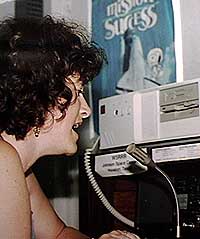 Astronaut Dr Laurel Clark, KC5ZSU, speaks with students at Holloman Middle School in New Mexico from W5RRR at Johnson Space Center in Texas. [Dale Martin, KG5U] |
What's it like to travel in space? How does one become an astronaut? Does food taste different in space? That's what students from Holloman Middle School wanted to know when they spoke via Amateur Radio on May 24 with astronaut Dr Laurel Clark, KC5ZSU. The 20-meter contact between W5RRR at Johnson Space Center in Texas and the Alamogordo Amateur Radio Club's K5LRW lasted approximately 45 minutes.
"The students asked very thought-provoking questions," said Clark. Those questions included some she wasn't expecting. The students, who attend school on Holloman Air Force Base, were intrigued by her military experience and how it related to her astronaut career.
During the contact, Clark compared life on a space station to life on a submarine. The students asked questions about short-term and long-term effects of spaceflight, a particular interest of Clark, a medical doctor. The students wondered about the psychological aspects of being away on long missions--the effects on both the astronauts and their families. She discussed the impact to her family life and how it was similar to military missions and mentioned the risks involved in any job and everyday life.
During the QSO, Clark talked about the training she received since becoming an astronaut and the fact that training "never stops." She talked about her experiences as a Navy scuba diver and how that will help with future space walks.
Clark concluded the contact by encouraging the students to study hard and focus on what they like to do. "There are many opportunities out there," she said. "There is no one profession or course of study that guarantees one to become an astronaut. Few are picked." She urged the students to "choose a profession that you enjoy" because people tend to excel in the things they like.
This marked the second school contact of a new NASA educational outreach program that evolved from the Space Amateur Radio EXperiment. The project began in response to the overwhelming popularity of the SAREX project. With a shortage of new shuttle flights available to fly SAREX--only one SAREX mission is scheduled for 1999--a number of schools have been waiting a long time for a school contact. This project has advantages at both ends of the contact. It not only helps to alleviate the long wait for a SAREX-type contact, it also provides training for future crews of the International Space Station. The next contact, with Harbor View Elementary School in Newport Beach, California, is scheduled for the first week of June. --thanks to Matt Bordelon, KC5BTL
SOLAR UPDATE
Solar savant Tad Cook, K7VVV, Seattle, Washington, reports: Solar flux and sunspot numbers were down slightly from last week. Average flux was down less than three points, and average sunspot numbers were down about 14 points from the week previous. Geomagnetic disturbances were down also, but only by a little. The most active day was May 25, when the planetary A index was 19 and the planetary K index was as high as five.
For the CQ Worldwide WPX CW Contest this weekend, the predicted solar flux for Friday through Sunday, May 28-30, is 155, 165 and 165, which is good. Unfortunately there was a coronal mass ejection on the sun which may cause a planetary A index of 12, 25 and 20 for those same three days. Saturday, May 29, could be difficult for the contest.
Beyond the weekend, the solar flux should reach 175 by June 7 or 8, then drop to 150 around June 11, 140 by June 16, and 130 around June 21. June 14 could be bad for HF because of geomagnetic disturbances caused by coronal hole effects.
Sunspot numbers for May 20 through 26 were 121, 128, 121, 104, 104, 130 and 152 with a mean of 122.9. The 10.7-cm flux was 142.5, 140.3, 140.2, 140.7, 136.9, 143.1 and 152.6, with a mean of 142.3. The estimated planetary A indices were 10, 7, 5, 10, 11, 19 and 8, with a mean of 10.
IN BRIEF:
- This weekend on the radio: The CQ WW WPX Contest (CW), the ARCI QRP Hoot Owl Sprint (CW), and the Memorial Day CW Sprint are the weekend of May 29-30.
Just ahead: The QRP TACtical Contest is June 5. The ARRL June VHF QSO Party is June 12-14. The CQ WW WPX rules are in March QST, page 96; see May and June QST for details on other events. - Vanity update: The FCC in Gettysburg reports it has processed vanity call sign applications received through May 7. On May 26, the FCC issued 187 grants. Another 269 applications landed in the work-in-process (WIPs) stack. The FCC received 1431 vanity applications during the month of April, 1276 of them electronically filed.--FCC
- The answer is out there: Interested in the search for extraterrestrial intelligence (SETI)? Have a computer in your shack? Then perhaps you might be willing to give up some CPU cycles to participate in the SETI@Home project. The idea is this: You download a client application from the SETI@Home Web site, http://setiathome.ssl.berkeley.edu/, and after a little configuration, your computer is analyzing 2 MHz of radio spectrum that was recorded at Arecibo. The best part is that you can configure the application to run only when your system is idle. You can also interrupt the application at any time, and it will pick up where it left off the next time you start it. Who knows? Perhaps your computer will be the one that detects the signal that confirms the presence of other intelligent life in our universe.--Mark Downing, WM7D
- PRB-1 bills active in several states: Bills to incorporate the essence of the limited federal preemption known as PRB-1 into state law are active in several states. A bill in Maine has just been signed by the Governor there. Oregon's PRB-1 bill, Senate Bill 879, just cleared the state Senate by a 26 to 3 margin and has been sent on to the House of Representatives for action. Oregon hams are being urged to contact the Chair of the House Rules, Elections and Public Affairs Committee and their own Representatives to urge speedy and positive action on the measure. In Louisiana, HB 2088 has passed the House is headed for the Senate. It would limit the authority of local governing bodies to regulate amateur radio antennas. Wisconsin, Idaho, Kansas, Minnesota, and Mississippi are in the planning stages of similar measures. States that already have this type of legislation include Texas, New Hampshire, Florida, Massachusetts, Wyoming, Virginia and Washington.
- FCC turns down W2CC's special event call sign reconsideration petition: The FCC has turned down a petition for reconsideration from David B. Popkin, W2CC, of Englewood, New Jersey, to make changes to the special event call sign system. Popkin had asked that the FCC require operators using special event call signs to identify with an assigned call sign at the end of a continuous series of transmissions, limit the use of a special event call sign to 15 days, and provide a 30-day interval between successive assignments of the same special event call sign. The FCC now requires stations using the self-assigned special event call signs to identify hourly with an FCC-assigned call sign. Popkin also had asked that the FCC make special event call signs available on a first-come, first-served nondiscriminatory basis at no charge or profit. The FCC pointed out in its denial that this already is being done by the entities that administer the special event call sign program.--FCC
- 76 GHz is alive and well in the US: Brian Justin, WA1ZMS, and Doug Sharp, K2AD, have completed the first-ever VUCC on 76 GHz. The QSOs were made between the summit of Mount Greylock in Western Massachusetts and locations in five different grids. Just over a year ago, the same operators completed VUCC on 47 GHz (see "47 GHz VUCC No 1 Yields New North American Distance Record," The ARRL Letter, Vol 17, No 22).--Joel Harrison, W5ZN
- Antique Wireless Association is on line: The Antique Wireless Association now publishes an on-line edition of The Old Timers Bulletin. OTB On Line Edition includes selections from the print version, including classified ads. It's available at http://www.antiquewireless.org/. By the way, The AWA Review, Vol 11, now is available. It includes the story of the E.H. Scott Radio Laboratories among other articles. It's $20 postpaid from Ed Gable, K2MP, AWA Museum Curator, 187 Lighthouse Rd, Hilton, NY 14468. --AWA OTB