ARRL Audio News
| · | To subscribe, unsubscribe, or change your e-mail delivery address: see How to Get The ARRL Letter, below |
| · | Delivery problems (ARRL member direct delivery only!): letter-dlvy@arrl.org |
| · | Editorial questions or comments: Rick Lindquist, N1RL, rlindquist@arrl.org |
| · | ARRL Audio News: http://www.arrl.org/arrlletter/audio/ or call 860-594-0384 |
| · | The ARRLWeb Extra: http://www.arrl.org/members-only/extra |
| NOTE: Because ARRL HQ is closed on Friday, April 2, this week's editions of The ARRL Letter and ARRL Audio News are being posted one day early. We wish you all a safe and enjoyable holiday weekend.--Rick Lindquist, N1RL |
IN THIS EDITION:
- +FCC says reciprocal permits now "paperless"
- +ARRL rebuts late-filed arguments in LF proceeding
- +AMSAT-France distances itself from Sputnik project
- +HAARP listening tests go off with a hitch
- Second annual CQ VHF National Foxhunting Weekend
- Submarines on the air
- Solar update
- In Brief: This weekend on the radio; Vanity update; Joe Walsh to entertain at Dayton; Texas PRB-1 bill gets Senate sponsor, hearing; Virginia issues special Amateur Radio ID cards; BY1DX is on the air
+Available on ARRL Audio News
FCC SAYS RECIPROCAL PERMITS NOW "PAPERLESS"
The FCC is advising applicants for reciprocal operating permits that an application is no longer required. Under new ULS rules that took effect February 12, the FCC Form 610A has passed into history. The new rules also will pave the way for US hams to more easily operate in most of Europe. The FCC is expected to issue a Public Notice in the near future that will spell out the details.
Alien visitors to the US holding an amateur license issued by their home country may operate in the US without submitting any FCC paperwork--provided that a reciprocal operating agreement is in effect between the two countries. The only documentation required is proof of citizenship and an Amateur Radio license issued by the country of citizenship. These arrangements are similar to longstanding arrangements between the US and Canada.
The new rules move the US a step closer to participation in the licensing arrangements of CEPT, the European Conference of Postal and Telecommunications Administrations. The US State Department applied for US participation in 1997, and the request was approved in early 1998. Completion of the final steps to make this a reality is understood to be imminent. These include formal US notification to the European Radiocommunications Office that it is prepared to carry out its responsibilities under CEPT Recommendation T/R 61-01, and the issuance of a Public Notice in English, French and German.
Under the CEPT arrangements, a US Technician licensee will be recognized as holding the equivalent of a CEPT Class 2 (VHF-only) license. Holders of Tech Plus through Extra tickets will have the full HF and VHF privileges of a CEPT Class 1 license. Novice licensees will not be eligible.
Additionally, the ARRL has informed the US State Department that it plans to go forward in April with arrangements to issue International Amateur Radio Permits to US hams in accordance with the CITEL Amateur Convention, signed by several countries in the Americas. The League has offered its services to issue IARPs to US hams. An IARP is not a license, but it certifies the existence of a license.
The new rules will not change the procedures for US hams wishing to operate overseas in countries that are not CEPT members or CITEL Amateur Convention signatories.
ARRL REBUTS LATE-FILED ARGUMENTS IN LF PROCEEDING
The ARRL has rebutted assertions that amateur LF allocations at 136 and 160 kHz could lead to interference with utility-operated power line carrier (PLC) systems. The unallocated and unlicensed Part 15 PLC systems are used by electric utilities to send control signals, data and voice. At the same time, the League urged the FCC to issue a Notice of Proposed Rulemaking to open the LF bands up to amateurs.
Last October, the League petitioned the FCC to create low-frequency Amateur Radio allocations at 135.7 to 137.8 kHz and 160 to 190 kHz. The ARRL proposed a maximum power level of 2 W effective isotropic radiated power. The utilities' PLCs operate between 10 and 490 kHz.
The comments in question--from four parties including Commonwealth Edison and ComEd employee Mark Simon--arrived at the FCC well beyond the December 23, 1998, comment and the January 7, 1999, reply comment deadlines. They also appear to be the only comments filed on behalf of the power industry.
The League has requested that the FCC strike the late-filed comments from the official record. But the ARRL also rebutted their substance in the event the FCC decides to accept them anyway.
The League debunked Simon's suggestion that ham interference could lead to dire consequences to unlicensed PLC systems and even lead to power outages. The League said Simon fails to explain why a marginal-level amateur signal would cause problems "where loud static crashes in the same bands do not." The League said PLC systems already have been shown to operate effectively "in an environment of extremely high power government stations using thousands of watts of EIRP."
The League also took ComEd to task for suggesting that hams be obliged to protect PLC systems against interference. The ARRL pointed out that PLCs have "no incumbent allocation status" and are not entitled to protection from licensed systems. An ARRL technical analysis submitted last fall indicated that that amateur interference to PLCs was unlikely.
The League suggested that the utilities make available an industry database of PLC operating parameters that hams could consult as a guide to avoid interference and said it remains willing to address any interference cases that might arise. The ARRL urged the FCC to issue a Notice of Proposed Rulemaking on the ARRL's request "without further delay."
AMSAT-FRANCE DISTANCES ITSELF FROM LATEST MINI-SPUTNIK
AMSAT-France wants to put some distance between itself and the latest, soon-to-be-launched mini-Sputnik satellite, which reportedly will transmit messages on behalf of a Swiss watchmaker. In a statement March 29, AMSAT-France President Bernard Pidoux, F6BVP, also called off future involvement with Russia in the educational venture.
At the center of the controversy is the nature of the messages that AMSAT-France says that Russian space authorities programmed on the satellite, expected to be launched sometime this month during a space walk by Mir cosmonauts. AMSAT-France's Gerard Auvray, F6FAO, says the new Sputnik-99 satellite will carry a 100-mW transmitter and have an expected battery life of 30 days. It will be able to transmit up to 10 different voice messages in addition to digital messages and telemetry. Data will include battery voltage and internal temperature.
AMSAT-Russia, with help from the Russian Space Flight Control Center (SCSC), had contracted with AMSAT-France last December to design and fabricate an RF module and electronics for another mini-Sputnik similar to the RS-17 and RS-18 satellites. Under the agreement, AMSAT-Russia was responsible for building the satellite frame, integrating the electronics, and programming the messages the satellite would transmit, Pidoux said.
Pidoux said AMSAT-France later found out that the SCSC had made a separate commercial contract with the Swatch watch company to put its messages on the satellite. AMSAT-France protested, citing contract provisions prohibiting "direct advertising" on the air.
"This company wanted to call the satellite 'Beatnik' and to send voice and HTML messages about Internet Beat time," Pidoux said in a posting to the AMSAT reflector. Swatch has been soliciting product-related voice and text messages via its Web site for a so-called "Beatnik Mission" satellite. The company says that, once in orbit the satellite will transmit a selection of these messages "to a worldwide audience (and beyond . . .)" between 145.800 and 146 MHz.
Pidoux said AMSAT-France was unsuccessful in breaking the agreement and subsequently made good on its part of the contract, to avoid a lawsuit.
Pidoux apologized for the situation and called on AMSAT organizations to refrain from describing the contents of the satellite's messages and to discourage listening "to this nonamateur-compliant satellite using our amateur band." He also asked that the Keplerian elements not be published by AMSAT. He said AMSAT-France is developing its own educational amateur satellite project with the help of French schools.
HAARP LISTENING TESTS GO OFF WITH A HITCH
HAARP was heard round the world the last weekend in March, but a few glitches injected a little intrigue to the research facility's 1999 listening test. The test on 6.99 and 3.39 MHz from the High Frequency Active Auroral Research Facility in Gakona, Alaska, was conducted March 26 and 27. Those who tuned in the first day to copy the test signals and CW message encountered what sounded like either severe multipathing or deliberate interference. Some listeners were convinced that another station was sending CW right on top of the HAARP signal.
It proved to be a false alarm, however. The first-day "interference" turned out to be largely related to apparent technical problems with a little multipathing thrown in, according to HAARP Technical Manager Ed Kennedy, K3NS. HAARP is still looking into the matter, but Kennedy said it now appears that while some transmitters were being keyed properly, others were not being keyed at all. "The net effect was not only a change in transmitted power between on and off, but also a pattern change," Kennedy explained.
Kennedy said the keying problem combined with auroral multipath to produce CW that was intelligible to some listeners and with quite a bit of multipath to others. The problem seemed to be most severe for stations in the Northeast. Some stations in the western US were able to copy the complete CW message. On the March 27 test, the same situation existed during the 6.99 MHz call-up only, Kennedy said, but it was corrected immediately.
The announced plan also had called for some antenna-pattern "tapering" during the carrier signal-measurement periods on 6.99 MHz. It appears that might not have happened on the first day either. This also was fixed on Day 2, Kennedy says.
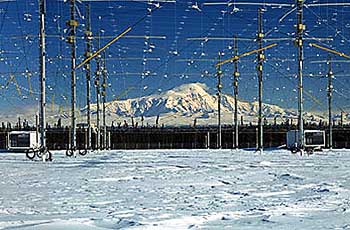 Part of the HAARP facility showing a section of the antenna array
and two of the transmitter buildings. In the background is Mt
Sanford. At 16,237 feet, it's one of the highest mountains in
North America. It's about 30 miles from the site in the Wrangell-St
Elias National Park.
Part of the HAARP facility showing a section of the antenna array
and two of the transmitter buildings. In the background is Mt
Sanford. At 16,237 feet, it's one of the highest mountains in
North America. It's about 30 miles from the site in the Wrangell-St
Elias National Park. |
HAARP's plan had called for directing the array's main lobe vertically, which meant that anyone outside of Alaska heard the HAARP transmissions by virtue of one of the antenna pattern's sidelobes. Just which pattern or patterns were employed is not yet clear, and not all listeners noticed the tapering effects, although some reported dramatic differences in signal strength. Total power output was in the vicinity of 400 kW, about half-power for the present HAARP facility.
Kennedy says HAARP is still analyzing the results and reports that he plans to post some "quite detailed measurements" on the HAARP 1999 Listening Test Results Web site.
HAARP's huge signals literally were heard on the other side of the world. "Your signal on 3390 was very weak, and I had to use a narrow filter to be able to read your carrier and signals," reported Tony Magon, VK2IC, in Sydney, Australia. Stateside reports--many from hams--flowed in from Arizona, Michigan, Connecticut, Florida, Missouri, Maryland, and elsewhere.
Reception reports for the 1999 test are welcome. HAARP will provide an attractive QSL card only in response to listener reports mailed to High Frequency Active Auroral Research Facility, PO Box 271, Gakona, AK 99586.
HAARP is managed by the US Air Force and the US Navy. For more information, see "The High Frequency Active Auroral Research Program" (QST, Sep 1996, p 33) or visit the HAARP Web site.
SECOND ANNUAL CQ VHF NATIONAL FOXHUNTING WEEKEND
CQ VHF magazine has announced the second annual National Foxhunting Weekend, April 17-18. The magazine is encouraging radio clubs and other groups to conduct "foxhunts" during that weekend--or another convenient weekend in April--and to report their results.
"There are no mandatory time periods, no universal rules and no log sheets," writes event coordinator and foxhunting veteran Joe Moell, K0OV in the April issue of CQ VHF. "It's just a weekend to set aside for your club, school or Scout group to try this exciting aspect of ham radio." Moell points out that foxhunters don't even have to have a ham ticket "since they will be receiving, not transmitting."
Foxhunting may be done by car or on foot, and the magazine is encouraging ham groups to use either one or both during the National Foxhunting Weekend. "Foxhunting is certainly fun and a competitive challenge," says CQ VHF Editor Rich Moseson, W2VU, "but it also teaches important direction-finding skills that may be called upon in searching for a downed airplane or lost hiker using an Emergency Locator Transmitter, or for tracking down sources of interference."
Moell, who is also the ARRL ARDF Coordinator, notes that the first International Amateur Radio Union Region 2 ARDF Championships will be held this August in Portland, Oregon, as part of the sixth biennial Friendship Radiosports Games.
Groups participating in the CQ VHF National Foxhunting Weekend are encouraged to send reports of their activity directly to Joe Moell, K0OV, at PO Box 2508, Fullerton, CA 92837, or via e-mail to foxhunt@cq-vhf.com. For more information on foxhunting techniques and equipment, visit Moell's Web site.--CQ VHF
SUBMARINES ON THE AIR
The Submarine Veterans Amateur Radio Association will activate submarine radio rooms in late April to commemorate the anniversary of the submarine service. Upwards of 20 museum submarines in the US and overseas will be on the air the weekend of April 24-25 with volunteer operators. "Some of the museum boats have the radio rooms restored and operable with the original equipment," said Carl Raish, KG0HS, of the SVARA.
Stations will operate on or around 3943, 7243, 14,243, 21,313, and 28,343 kHz. A certificate of participation is available for those obtaining at least four QSLs from submarines worked. The Submarine Veterans meet on the air daily except Sundays. Raish says the most popular on-air gathering is Saturdays, 1700 UTC on 14,243 kHz. This net was started about 25 years ago by World War II submarine veterans as a means of keeping in touch, and it has remained active ever since.
For a certificate, send copies of at least four cards from submarines worked to Jim Flanders, W0OOG, 1539 California Tr, Plano, TX 75023-4300; jaf@sprintmail.com. For more information, contact Flanders or Carl Raish, 1873 S Tennyson St, Denver, CO 80219; kg0hs@juno.com, or visit http://www.flash.net/~jflandrs/index.html. (A list of participating museum submarines is available in The ARRLWeb Extra news section on the ARRLWeb Members Only site.)
SOLAR UPDATE
Sun watcher Tad Cook, K7VVV, Seattle, Washington, reports: Solar activity has been in the doldrums again recently. This past week the average solar flux was over 20 points lower than the previous week, and average sunspot numbers were over 40 points lower. The average weekly sunspot number reported in this bulletin has not been this low since February 4-10 of this year, and the average solar flux hasn't been this low since June 18-24 or last year. The only bright spot has been the season, with early spring being a good time for HF propagation.
The average solar flux for March was only 126.3, much lower than the 142 average for February, 142.4 for January, and 150.1 for December. This solar cycle is supposed to peak next year at much higher levels than it is running right now, yet it seems to be in decline. The average flux for the first quarter of 1999 is 136.7, which is very close to the 135.4 average for the last quarter of 1998 and not much higher than the 129.2 average for the third quarter of last year. Not very encouraging, is it?
For the next few days, April 1-3, expect solar flux around 105, 110 and 110, and a planetary A index around 15, indicating unsettled to active geomagnetic conditions. After April 3 look for a rising solar flux, reaching 130 by April 5, 140 by April 8, and peaking around 150 for April 10-13. Unless some new activity appears on the sun, flux levels may be back to where they are now after April 20. Look for unsettled geomagnetic conditions around April 10-11 and active conditions around April 25.
Sunspot numbers for March 25 through 31 were 48, 33, 45, 65, 63, 72, and 70, with a mean of 56.6. The 10.7-cm flux was 107, 103.6, 104.5, 103, 104.2, 104.7, and 102.4, with a mean of 104.2. The estimated planetary A indices were 8, 6, 4, 6, 24, 18 and 14, with a mean of 11.4.
In Brief:
- This weekend on the radio: The EA RTTY Contest and the SP DX Contest are April 3-4; the Low Power Spring Sprint is April 5. Just ahead: The Japan International DX Contest CW, the Elettra Marconi Contest, the His Majesty the King of Spain Contest, and the QRP ARCI Spring QSO Party (CW) are the weekend of April 9-11. See April QST, page 100, for details.
- Vanity update: The FCC in Gettysburg reports it has processed vanity call sign applications received through March 5. On March 25, the FCC issued 176 grants. Another 230 applications landed in the work-in-process (WIPs) stack. All WIPs have been processed.--FCC
- Joe Walsh to entertain at Dayton: The Dayton Hamvention '99 Awards and Banquet Committee has announced that Joe Walsh, WB6ACU, and his band will entertain at the Hamvention 1999 banquet May 15. The Richens/Timm Irish Dancers will open for Walsh, former lead guitarist for the Eagles and a member of The James Gang.--Cathi Hoskins, N8ZCQ
- Texas PRB-1 bill gets Senate sponsor, hearing: The Texas Amateur Radio tower bill, HB-1345, has a Senate sponsor, Sen Mike Jackson. Karl Silverman, N0WWK, who's been a prime mover behind the legislation, says the bill will be heard by the Senate Committee on Intergovernmental Relations on the morning of April 7. Silverman is seeking a show of support from Texas hams, but no additional speakers are needed. Those who can't show up are being asked to contact their state senators urging support.--Karl Silverman, N0WWK
- Virginia issues special Amateur Radio ID cards: Qualified Virginia Amateur Radio operators now can obtain Department of Emergency Services photo identification cards and license plates bearing the RACES logo through the Virginia Division of Motor Vehicles. Registered members of Virginia ARES or RACES who meet stringent requirements may be issued the new photo ID and RACES-logo plates (ARES members, by formal agreement, are also RACES when activated by a governmental entity). Virginia State RACES Officer Frank Mackey, K4EC, says "law enforcement, emergency management officials and security professionals have become more concerned about who is allowed to enter secure areas during times of emergencies." The standardized, high-security ID will be easily recognized by authorities in charge of disaster and emergency situations. The plates and ID cost $15 for a two-year term (renewable). Applications and further information are available at http://aresva.org/news/news.html (click on the Virginia RACES ID Cards Information link).--Martin Gary, W2MG; Frank Mackey, K4EC
- BY1DX is on the air: The Beijing-Chaoyang-Nokia Amateur Radio Club, BY1DX, is on the air. With support from Finnish cellular-telephone maker Nokia, the club, located in Beijing's business district in a tall building that overlooks the city, is the first-ever foreign corporate-sponsored Amateur Radio club in China. The station master is Chen Jia Zhuang, BG1CJZ. Martti Laine, OH2BH handles QSLs to his home address: OH2BH, Nuottaniementie 3D20, 02230 Espoo, Finland.--Tim Totten, N4GN