ARRL Audio News
| · | To subscribe, unsubscribe, or change your e-mail delivery address: see How to Get The ARRL Letter, below |
| · | Delivery problems (ARRL member direct delivery only!): letter-dlvy@arrl.org |
| · | Editorial questions or comments: Rick Lindquist, N1RL, rlindquist@arrl.org |
| · | ARRL Audio News: http://www.arrl.org/arrlletter/audio/ or call 860-594-0384 |
| · | The ARRLWeb Extra: http://www.arrl.org/members-only/extra |
IN THIS EDITION:
- +"Riley the Enforcer" visits ARRL
- +New IARU leadership team chosen
- +APRS emergency call brings help
- +Goldwater antennas dismantled, sold
- +First SUNSAT voice contact a success
- Texas weather emergency prompts FCC declaration
- Solar update
- In Brief: This weekend on the radio; Vanity update; FCC sets aside New Yorker's ticket; Michigan ham called for retesting; Texas PRB-1 bill update; Ham radio, Great Circus Train back on track; Ham Trader Yellow Sheets QRT; IARU world telegraphy championship; W7HF honored; Special Canadian call sign; VY0 becomes effective April 1
+Available on ARRL Audio News
FCC'S RILEY HOLLINGSWORTH VISITS ARRL HQ
After six months as the FCC's top Amateur Radio enforcer, Riley Hollingsworth, K4ZDH, says he's pleased with the progress he's made and the support he's received from the amateur community. "I though it would take a year or two years to be at this point," he told ARRL staff members March 17 during a visit to ARRL Headquarters. "We've had some very good enforcement luck." Amateur Radio enforcement has been "one of the few victories the Commission has been having these days," Hollingsworth said, and he doesn't expect the impending FCC restructuring--including creation of a new Enforcement Bureau--to affect its course or momentum. At the same time, Hollingsworth expressed some concern that his efforts not be perceived as the FCC "gone crazy" on Amateur Radio enforcement. "I don't want people saying, 'This is too much government,'" he said. Hollingsworth said that enthusiasm for amateur enforcement has even spread to FCC field personnel, some of whom are hams and who now ask to be included in amateur cases. He pointed to a recent case of interference to a Pennsylvania repeater system that came out of an investigation at the field-office level. Calling Amateur Radio "a great natural resource," Hollingsworth said he felt privileged to be in his current enforcement role and was enjoying his work immensely. At this stage in the FCC's latest enforcement initiative, Hollingsworth says he's still making up for the FCC's "long period of neglect" of amateur enforcement. But he said he also looks forward to the day when he's no longer needed. He also said he can appreciate the frustrations of the Amateur Auxiliary during the years of FCC enforcement neglect and he welcomes their cooperation in the future. In the weeks ahead, Hollingsworth said he hopes to turn his attention to such problems as the incursion of unlicensed operators on 10 meters--the so-called "freebanders" who often stray onto amateur frequencies--as well as the improper marketing of equipment to unlicensed individuals and examination fraud cases. He also plans to add some casual monitoring capabilities at his Gettysburg office. "If they know that we're out there bandsurfing, it will help," he said. Hollingsworth said he's currently working about a month behind in replying and advised those contacting him to use either a letter or e-mail (rholling@fcc.gov) instead of the telephone. ARRL officials and staff members were quick to praise Hollingsworth's successes as well as his approach, which has been a combination of stern sanctions and "jawboning" with alleged offenders to resolve enforcement issues. As a result, he has not had to designate any amateur cases for hearings. "Few hams have the ability to change the hobby radically," ARRL First Vice President Steve Mendelsohn, W2ML, told Hollingsworth. "We're real fond of you." ARRL Educational Services Manager Rosalie White, WA1STO, called Hollingsworth "a huge breath of fresh air" for ham radio. During his visit, Hollingsworth made a quick contact with an acquaintance on 20 meters from W1AW. He also had the rare opportunity to wield the original Wouff Hong and Rettysnitch--the traditional symbols manufactured and invoked by "The Old Man" during the early years of the hobby to combat poor operating practices. League officials expressed the hope that the experience would provide an additional boost to Hollingsworth's present-day enforcement efforts. |
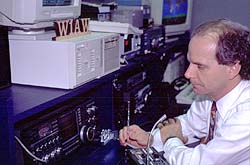 The FCC's Riley Hollingsworth chats on 20 meters from W1AW during a visit on St Patrick's Day. [Rick Lindquist, N1RL]
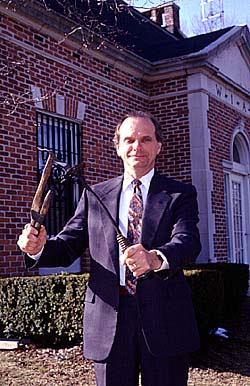 Standing in front of W1AW, "Riley The Enforcer" wields the venerable and traditional Wouff Hong (left) and Rettysnitch
(right) as adjunct weapons against operators who break the rules.
The Wouff Hong and the Rettysnitch were products of the creative
mind and hand of "The Old Man," none other than ARRL
co-founder Hiram Percy Maxim, W1AW, who occasionally invoked their
specter in his QST editorials about "rotten QRM"
and poor operating practices. [Rick Lindquist, N1RL]
Standing in front of W1AW, "Riley The Enforcer" wields the venerable and traditional Wouff Hong (left) and Rettysnitch
(right) as adjunct weapons against operators who break the rules.
The Wouff Hong and the Rettysnitch were products of the creative
mind and hand of "The Old Man," none other than ARRL
co-founder Hiram Percy Maxim, W1AW, who occasionally invoked their
specter in his QST editorials about "rotten QRM"
and poor operating practices. [Rick Lindquist, N1RL]
NEW IARU LEADERSHIP TEAM CHOSEN
For the first time in a decade, the International Amateur Radio Union is about to experience a change in its top leadership. In voting completed March 12, IARU member-societies overwhelmingly ratified the election of Larry E. Price, W4RA, as president, and David A. Wardlaw, VK3ADW, as vice president. Price received 80 votes for election, with one abstention and one nay vote, while Wardlaw got 79 votes, with two abstentions and one nay vote. A former ARRL president, Price succeeds Richard L. Baldwin, W1RU, who has served as IARU President since 1982. Wardlaw succeeds Michael J. Owen, VK3KI, who served as vice president from 1989. Price and Wardlaw begin five-year terms on May 9. Price's replacement as IARU secretary will be designated prior to that date. First licensed in 1951 at the age of 16, Price has held elected offices in the American Radio Relay League continuously over the past 27 years. He served as ARRL president from 1984 until 1992. Price was IARU vice president in 1983-84 and has been IARU secretary since 1989. He's attended 13 IARU regional conferences and has served as an IARU delegate at every ITU World Radiocommunication and Telecommunication Development Conference since 1992 as well as at numerous other ITU meetings. Wardlaw, a dental surgeon in Melbourne, Australia, joined the Wireless Institute of Australia in 1947 and was first licensed in 1948. While living overseas in the 1960s held the call signs G3RYW (still current) and VE3CAY. He has served in numerous WIA posts, including two stints as president. Wardlaw has twice served as IARU Region 3 Director, 1988-1994 and 1997-present, and has attended six meetings of the IARU Administrative Council as well as regional conferences. Since 1978, he's also attended numerous ITU meetings and conferences as a member of the Australian delegation or as an appointed ITU expert. |
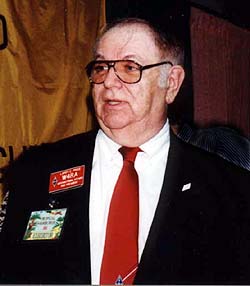 Larry Price, W4RA [Rick Lindquist, N1RL]
APRS EMERGENCY CALL BRINGS HELP
When Scott Ratchford, KC5JGV, witnessed a bad accident during a snowstorm on Pennsylvania's I-76 recently, he immediately grabbed his cell phone and called 911. When that--and several other possible combinations--failed, he tried an emergency call on 2-meters. Again, no luck. Two people were trapped inside an overturned vehicle, and Ratchford was getting desperate. "Here I am in the middle of who knows where, a huge snowstorm, a serious accident, folks needing help, no one answering on .52!" he said in a March 8 posting about the incident on the APRS Special Interest Group. "So, I switch the MIC-E to 7, and hit the button." This sent an emergency mike-encoder signal out over the Automatic Position Reporting System.
Ratchford's emergency beacon was spotted by several stations who immediately contacted the Pennsylvania State Police. But the cops "don't do latitude and longitude," said Dan Velez, W4DJV, in Virginia, one of the stations monitoring the call. Clay Owen, AA3JY, in Pennsylvania, had better luck. He also called the state police and was able to give them references to exits and route numbers, thanks to APRS+ and the Delorme Street Atlas. "I also gave them the name of the individual to be contacted, thanks to QRZ built into this program," he reported.
APRS developer Bob Bruninga, WB4APR, was among those noting the emergency call in the Pennsylvania-Maryland-New Jersey area. Bruninga notes that APRS-DOS will display the nearest mile marker on interstates but "apparently I missed I-76 in the database."
Unknown to Ratchford, the message was received and understood. "Little did I know that the APRS message was received, as a trooper had arrived within minutes of my transmission," he said. Only when the trooper asked for him by name as he was about to leave did Ratchford learn that APRS had delivered the message and that someone had called the police. "I left the scene feeling very happy about our hobby and especially our interest in APRS," he said.
K7UGA ANTENNAS DISMANTLED, SOLD
The Amateur Radio antenna system that the late Sen Barry Goldwater, K7UGA, used to complete thousands of phone patch messages for troops during the Vietnam War now is history. Five members of Goldwater's club, the Central Arizona DX Association, recently dismantled the K7UGA antenna system. "It took us about five hours to remove them from the 77-foot rotating mast," said club member Mike Bill, N7MB. Bill said the antennas have been sold.
Goldwater died last May 29. Bill says Goldwater's widow, Susan, recently asked the club members for assistance in taking down the antennas at the Goldwaters' Paradise Valley, Arizona, home. Goldwater used a Hy-Gain RP-75H rotating pole assembly turned by a ¼-HP electric motor. The antennas were Hy-Gain LongJohns for 10, 15, and 20 meters as well as a 3-element 40-meter array, "very big and very heavy," Bill said. The system had been installed in the mid-1960s to support Goldwater's extensive phone-patch activities on MARS.
Others on the antenna-removal crew included Paul Nyland, K7PN, Paul Playford, W8AEF, Rod O'Connor, W7EKV, and Mike Fulcher, KC7V. Bill says the buyer of the K7UGA antennas wishes to remain anonymous. The sale price was not revealed. For more information, visit http://www.azhub.com/goldwater/listings.html
ZR1AFH AND ZS5AKV COMPLETE FIRST SUNSAT VOICE CONTACT
A successful voice contact has been made via the new SUNSAT SO-35 satellite. The new satellite represents a first for South Africa and the African continent. SUNSAT Project Leader Garth Milne, ZR1AFH, and SA-AMSAT President Hans van de Groenendaal, ZS5AKV, completed SUNSAT's first-ever voice contact March 14, according to a report on the AMSAT reflector. The satellite still is a few weeks away from general amateur use, however.
The stations used a VHF uplink and a UHF downlink for the contact. Voice quality was said to be excellent and signals strong for the QSO, even when the satellite approached the horizon. SUNSAT was launched February 23 from California's Vandenberg Air Force base.
"It was rewarding for the first test voice contact to be made by the radio amateurs who have been involved from the outset of the project 10 years ago," said van de Groenendaal, who also serves as IARU Satellite Advisor. "SUNSAT will play an important part in bringing Amateur Radio into the classroom as part of the Amateur Radio in South African Schools (ARISAS) program." ARISAS will use Amateur Radio in the classroom to expand the teaching of science and technology.
Since its launch, SUNSAT has been undergoing extensive testing by the ground control team at the University of Stellenbosch in South Africa. The March 14 voice contact, to test the SUNSAT transponders, was part of the preparations that will continue for several more weeks.
Milne said SUNSAT will provide a boost to South Africa's burgeoning electronics industry. "South Africa has an innovative electronics industry that wishes to benefit from new opportunities," he said. "It also needs competent technically trained people to establish and operate systems." More than 50 students involved in the SUNSAT program have received graduate degrees in engineering.
The SUNSAT package includes digital store-and-forward capability and a voice "parrot" repeater that will be used primarily for educational demonstrations. The unit has two VHF and two UHF transmit-receive systems. In addition to Amateur Radio and school science payloads, SUNSAT carries two NASA experiments and an experimental pushbroom imager capable of taking pictures of Earth. The high-resolution imager, providing 50x50 km coverage, will operate in real time on S band. These images also can be stored in the RAM disk and portions can be downloaded at lower speeds (9600 baud) for retrieval by hams and schools.
SUNSAT ground control expects the satellite's Amateur Radio payloads to be fully commissioned by mid-April. For more information on SUNSAT, visit http://sunsat.ee.sun.ac.za.--AMSAT BBS; SUNSAT Web site
TEXAS WEATHER EMERGENCY PROMPTS FCC DECLARATION
At the request of South Texas Section Manager Ray Taylor, N5NAV, the FCC ordered all but emergency traffic cleared from 3873 and 7290 kHz for several hours March 12 and 13, because of a weather emergency. Taylor reports the New Braunfels weather station alerted him to severe weather on March 12, and SKYWARN nets were activated on VHF and, later, on HF because of the wide area involved.
"We had large golf ball size hail, and nine confirmed tornadoes touched down," Taylor said, adding that some property damage as well as phone and power outages occurred, but no injuries. Flash flood warnings were issued as a result of the violent and slow-moving storms. He said the HF circuits worked fine until malicious interference erupted, and he contacted the FCC on behalf of the Texas Emergency Net. Based on the circumstances, the FCC resident agent in Houston supported the issuance of a declaration.
"The Net tried working without the declared emergency but received intentional interference and requested FCC assistance," said the FCC's Jim Laraway. "We assisted." Taylor said that once the FCC issued its declaration--which was disseminated via a W1AW bulletin--the interference problems disappeared.
More than 150 hams in Texas, Louisiana, Oklahoma, and Arkansas participated in the emergency nets. The FCC declaration expired at sunset March 13.--Ray Taylor, N5NAV
SOLAR UPDATE
Solar activity was up slightly this week. Although average sunspot numbers were about the same, average solar flux was up about 12 points over last week. Expect solar activity to go lower in the near future. For March 19-21, flux values are expected at 145, 135 and 130, and Planetary A index should be 10, 8 and 7.
Beyond the weekend look for solar flux to drop to around 125 next week, and then begin to rise around the end of the month. Watch out for recurring geomagnetic disturbances around March 28, and a slowly rising solar flux to reach 150 around April 10.
Sunspot numbers for March 11 through 17 were 95, 98, 107, 131, 126, 134, and 131, with a mean of 117.4. The 10.7-cm flux was 137, 140.3, 144.4, 150.4, 150.1, 155.7, and 154.5, with a mean of 147.5. The estimated planetary A indices were 13, 10, 7, 13, 16, 4 and 5, with a mean of 9.7.
In Brief:
- This weekend on the radio: The Alaska QSO Party, the Virginia QSO Party, the Ohio Winter QSO Party, and the Bermuda Contest are the weekend of March 20-22. Just ahead: The CQ WW WPX Contest is the weekend of March 28-29. See March QST, page 96, for details on these events.
- Vanity update: The FCC in Gettysburg reports it has processed vanity call sign applications received through February 26. On March 17, the FCC issued 104 grants. Another 125 applications landed in the work-in-process (WIPs) stack. The FCC reports it received 1447 vanity call sign applications during February, the vast majority of them filed electronically via the Internet.--FCC
- FCC sets aside New Yorker's ticket: The FCC has set aside a new Technician grant to Raymond S. Graham, KC2EQQ, of Bronx, New York, while it evaluates allegations of earlier unlicensed radio operation. A letter to Graham March 11 from the FCC's Riley Hollingsworth noted that Graham had been formally warned about unlicensed operation on January 6. Graham's Technician license was issued February 17.--FCC
- Michigan ham called for retesting: The FCC has asked Joseph Walker, W8JCW, of Gaylord, Michigan, to retake his General and Advanced class amateur examinations under an ARRL-VE team. Walker must complete the retest by May 15. The FCC said that if he fails to appear for retesting, his license will be canceled.--FCC
- Texas PRB-1 bill update: The Texas amateur antennas bill, HB 1345, has been approved by the Texas House of Representatives. An amendment concerning historical preservation was added to the bill. The amendment would add language stating that the measure would "not prohibit an architectural or historical district established under law from taking any action that the district may take under law." The bill was officially received by the Texas state Senate on March 18. Supporters have been seeking support for the measure in the state Senate. As yet, the bill has no Senate sponsor.--thanks to Tom Blackwell, N5GAR and Ray Taylor, N5NAV
- Ham radio, Great Circus Train back on track: Amateur Radio will be back on board when the Great Circus Train makes its annual run between Baraboo and Milwaukee, Wisconsin, this summer. Last summer, the hams were left at the station after the circus train's sponsor, Circus World Museum, cited "severe space limitations" and opted to accept an offer of communication services from a cellular provider. This year, special event station W9R will operate on HF from aboard the train during its annual journey, July 2-5. Current plans call for operation on 40, 20, and 15-meter SSB. Members of the West Allis Radio Amateur Club will operate special event station W9C from the show grounds once the train reaches Milwaukee. Ham radio first rode the rails with the circus train in 1965. ARES members aboard help handle communication along the route and, once in Milwaukee, at the show grounds and for the circus parade.--thanks to Jim Romelfanger, K9ZZ
- Ham Trader Yellow Sheets QRT: After 38 years in business, the Ham Trader Yellow Sheets will cease publication. The twice-monthly classified publication is being absorbed into the Amateur Radio Trader, according to an announcement in the last edition of the Yellow Sheets. "It has been increasingly difficult to continue to provide the reliability and low cost that we always have in the past," said a statement from Founder and Editor Al Brand, and Publishers Dave and Barbara Brand Wixon. Yellow Sheets subscribers will automatically get an Amateur Radio Trader subscription, while the subscriptions of ART subscribers who also subscribed to the Yellow Sheets will be extended. Amateur Radio Trader of Crossville, Tennessee, is published by TAP Publishing.
- IARU world telegraphy championship: The Third IARU High Speed Telegraphy World Championship in takes place April 28-May 2 in Pordenone, Italy. Additional applicants are still being accepted. If you'd like to compete, e-mail IARU organizer Laci Weisz, HA3NU, jozsi@kvantum.hu. Visit http://www.dipole.com for more information.--thanks to Lali Laki, VA3RU
- W7HF honored: On March 14, the town fathers of Aberdeen, Washington, joined friends and neighbors of George "Dewey" Wilson, W7HF, to celebrate his 100 years as a town resident. Wilson, who turns 102 later this year, is an active ARRL and QCWA member. He's a member of the Grays Harbor Amateur Radio Club. Born November 1, 1897, Wilson was first licensed in 1913 (although he admits to a little bootlegging before that time). He renewed his driver's license in time for his 100th birthday but says he's not driving much anymore--just "around town." ARRL Executive Vice President David Sumner, K1ZZ, sent a congratulatory letter to Wilson when he turned 100 in 1997.--thanks to Harry Lewis, W7JWJ
- Special Canadian call sign: The call sign XL3D has been assigned for use on the 25th anniversary of the Ontario DX Association for the period March 25 to April 25, 1999.--RAC
- VY0 becomes effective April 1: The new Canadian Territory of Nunavut, VY0, comes into effect on April 1, 1999. To reflect this new addition, Nunavut will become a separate multiplier in the two RAC Contests, commencing with the RAC Canada Day Contest on July 1, 1999.--RAC