ARRL Audio News
| · | To subscribe, unsubscribe, or change your e-mail delivery address: see How to Get The ARRL Letter, below |
| · | Delivery problems (ARRL member direct delivery only!): letter-dlvy@arrl.org |
| · | Editorial questions or comments: Rick Lindquist, N1RL, rlindquist@arrl.org |
| · | ARRL Audio News: http://www.arrl.org/arrlletter/audio/ or call 860-594-0384 |
| · | The ARRLWeb Extra: http://www.arrl.org/members-only/extra |
IN THIS EDITION:
- +King Hussein, JY1, SK
- +Wireless Privacy bill reintroduced
- +Hams help at Colombian relief call center
- +FCC cites illegal shortwave broadcasters
- +PSK31 gets raves
- Solar update
- "Doc" Gmelin, W6ZRJ, SK
- In Brief: This weekend on the radio; FISTS Novice Roundup; Guides on the Air event; Vanity update; Morse featured on NPR talk program; FCC closes unlicensed Florida radio station; HAARP listening test set; Changes at Agrelo
+Available on ARRL Audio News
KING HUSSEIN, JY1, SK
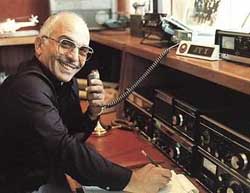 King Hussein, JY1, in his ham shack.
 |
Radio amateurs around the world joined in mourning the recent death of Jordan's King Hussein, JY1. Hussein, 63, died February 7. The Middle East's longest-reigning ruler, he'd been Jordan's king for 47 years, taking the throne when he was just a teenager. His son, Abdullah, 37, succeeds him.
Hussein had earned a reputation as a catalyst for peace and as a conciliator in the Middle East. President Clinton was among the heads of state from around the globe who gathered in Jordan February 8 for Hussein's funeral.
Hussein had been active in recent months from the US while seeking cancer treatment at Minnesota's Mayo Clinic. A QSO with JY1 was considered by many hams to be both an honor and a privilege. His elegant QSL card was prized.
Hussein was a life member of the ARRL. ARRL Executive Vice President David Sumner, K1ZZ, called him "an enthusiastic radio amateur whose support was invaluable to us in obtaining new amateur bands at the 1979 World Administrative Radio Conference." Sumner recalled that in May 1979, International Amateur Radio Union President Noel Eaton, VE3CJ, was invited to Amman to meet with King Hussein.
"Jordan's support of the Amateur Service was much in evidence at the conference that fall, and was a crucial element in our success," Sumner said. The WARC-79 resulted in Amateur Radio's gaining the 30, 17, and 12-meter bands. That same year, JY1 was featured in the film, "The World of Amateur Radio." Hussein regarded his 1983 contact with Owen Garriott, W5LFL, on board the Space Shuttle Columbia, as a high point in his Amateur Radio activity.
King Hussein also participated in the historic 1995 joint Israel-Jordan JY74X operation on Mt Nebo, where hams from both countries participated in a Field Day-like operation. The King put in appearances both on the air and in person, much to the delight of the participants and those waiting to work him and JY74X.
Hussein's friend Bruce "Blackie" Blackburn, W4TA/JY9BB, of St Petersburg, Florida, called him "one of the world's most respected amateurs" and recounted many stories about King Hussein as a person and an avid Amateur Radio operator. Blackburn said King Hussein "promoted Amateur Radio to the hilt in Jordan" and saw to it that Amateur Radio classes were instituted in elementary schools. King Hussein also dropped in on meetings of the Royal Jordanian Radio Amateur Society in Amman. King Hussein also was involved with the early satellite experiments.
Former US Ambassador to Lebanon and Iran Armin Meyer, W3ACE, also recalled Hussein February 8 in a letter to The Washington Post. Meyer said JY1 "has for decades been promoting peace and good will among quite ordinary people." As Meyer put it: "For the king, ham radio was a different world, a community of diverse people."
All members of the Jordanian royal family automatically have Amateur Radio privileges in Jordan. Although the new king does not appear to have a call sign, King Hussein's widow--the American-born Queen Noor--is JY1NH. King Hussein's brother, the former Crown Prince Hassan, is JY2HT, while his cousin, Prince Raad, JY2RZ, is chairman of the Royal Jordanian Radio Amateur Society.--Jennifer Gagne, N1TDY, supplied information for this report
WIRELESS PRIVACY BILL REINTRODUCED
The Wireless Privacy Enhancement Act of 1999, HR514, has been introduced by Rep Heather Wilson of New Mexico. The measure is aimed at amending the Communications Act of 1934 "to strengthen and clarify prohibitions on electronic eavesdropping, and for other purposes.""HR514 is identical to the amended version of HR2369 that passed the House on a 414-to-1 vote during the last session," said ARRL Legislative and Public Affairs Manager Steve Mansfield, N1MZA. The Senate did not act on that measure.
The original bill, HR2369, would have banned most types of scanners and scanner listening; however, the bill's sponsor, Rep Billy Tauzin, worked with the ARRL and representatives of manufacturers, public service organizations, and scanner enthusiasts to redraft the bill top to bottom.
HR514 forbids manufacturing or modifying scanners to receive cellular, PCS, or "protected" paging service frequencies. The bill also forbids receiving, divulging, publicizing, or utilizing such communication. The measure is part of a package of legislation introduced early in the session in the expectation that it will pass quickly and help restore Congressional momentum.
Mansfield says, however, that the Senate prospects for HR514 remain murky.
While Amateur Radio appears to be unaffected by the new bill, the League is on record as opposing the expansion of prohibitions on radio monitoring beyond those that now exist to protect the privacy of services that interface with wireline networks.
The bipartisan list of co-sponsors of HR514 includes Reps Tauzin of Louisiana; Markey of Massachusetts; Oxley of Ohio; Eshoo and Rogan of California; Deal of Georgia; Wynn of Maryland; Cubin of Wyoming; Luther of Minnesota; Sawyer and Gillmor of Ohio; and Pickering of Mississippi.
A copy of the bill is available on the Web at the Library of Congress.
HAMS HELP STAFF COLOMBIAN RELIEF CALL CENTER
Amateur Radio operators are helping to staff a Miami telephone call center for those seeking to get in touch with family and friends in the earthquake-stricken region of Colombia. A quake measuring 6.0 on the Richter scale struck January 25 in west-central Colombia's mountainous coffee-growing region. The quake killed upwards of 1000 people, injured thousands of others, and wreaked extensive damage.Many of those staffing the call center are affiliated with the Sociedad Internacional de Radio Aficionados (Society of International Radio Amateurs). SIRA also helped mobilize Amateur Radio assistance in the wake of Hurricane Mitch, which devastated parts of Central America.
David Rosen, K2GM, of the Radio Readiness Group says continued spotty telephone service to the region has kept the call center busy since it started up February 2. Much of the traffic is directed to the city of Armenia, in the state of Quindio. Rosen said the center resulted from an AT&T request to the Radio Readiness Group and SIRA for help in furnishing information about the affected region to callers unable to get through by telephone.
Rosen credits SIRA President Rafael Estevez, WA4ZZG, with the idea of setting up a single location to receive incoming calls. With the assistance of AT&T, BellSouth of Florida, and the Florida Public Service Commission, twelve incoming lines were set up to the Colombian Information Center, available by calling 305-805-5550. Callers on AT&T who can't get through to the affected region in Colombia automatically get a recorded message referring them to the Colombian Information Center number.
SIRA volunteers are being assisted by members of the Kiwanis Club of Colombia, students from the University of Miami, the Colombia Disaster Fund, and the Radio Readiness Group.
Rosen said the center is getting dozens of calls seeking information about family and friends in the stricken communities. Call center volunteers then seek to obtain the requested information using Amateur Radio, the Internet, and other resources, and pass it back to the callers. "We are trying to enlist contact with as many hams in the affected area as possible," Rosen said.
Rosen said Amateur Radio continues to play a role in earthquake relief activities. Disaster-related traffic relayed on 20 and 40 meters has involved many stations in Colombia and the US. Rosen says he has received approval from the FCC on behalf of the US stations involved in the relief effort to operate SSB on frequencies between 7.050 and 7.100 MHz to maintain direct contact with emergency nets operating in that part of the band. "Having the ability to communicate directly with the Colombian nets on their own frequencies is much more efficient than working the HK stations crossband," he said.
Those wishing to assist with the Colombian Information Center are invited to call the Center at 305-805-5550. For more information, contact SIRA, at sira@iscnet.net or Dave Rosen, k2gm@contesting.com.
FCC CITES ILLEGAL SHORTWAVE BROADCASTERS
The FCC has sent violation notices to two hams who--the FCC alleges--had used their stations to engage in illegal shortwave broadcasting on 6955 kHz. The FCC also released the names of two nonhams notified last fall in the wake of similar, alleged operations. Cited were Henry L. Landsberg, WB6MEU, of Sierra Madre, California; Richard F. Jurrens, KC5RGK, of Katy, Texas; Roger R. Hanna, of Glendale, Illinois; and Christopher R. Lobdell, of Tewksbury, Massachusetts.Official Notices of Violation went out to Landsberg and Jurrens on January 28. Both were cited for breaking the Amateur Service rules and given 10 days to tell the FCC how they plan to preclude similar violations in the future. Violation notices were sent to Hanna and Lobdell in November citing unlicensed operation. Their names were only recently made public by the FCC.
A letter to Landsberg from the FCC's Los Angeles office alleged that Landsberg operated his amateur station in violation of Sections 97.113 and 97.301 by broadcasting music last October 30 on 6955 kHz. The FCC's letter says the Commission used radio direction-finding techniques to track the source of a music transmission on that frequency to Landsberg's residence, and that he admitted operating the transmitter on 6955 kHz. The broadcast is said to have consisted of Halloween music.
A letter to Jurrens from Oliver K. Long of the FCC's Houston office alleged that FCC agents "detected operation of a station identifying as Rock It Radio' on a frequency of 6955 kHz." The FCC used RDF techniques to determine that the signal was coming from Jurrens' residence. The FCC said that during a station inspection, Jurrens admitted that the signal had been transmitted from his station. A Technician licensee, Jurrens was cited for operating on a frequency not authorized by his amateur license.
FCC field office personnel said that Lobdell "neither denied or admitted" the alleged illegal operation on 6955 kHz late last October. Both Hanna and Lobdell reportedly refused FCC requests to inspect their radio equipment. They were cited for unlicensed operation.
The FCC letters to Hanna and Lobdell noted that civil penalties for unlicensed operation can reach $11,000 coupled with forfeiture of equipment used. Unlicensed operators also face criminal fines of up to $100,000 and could be sent to prison.
PSK31 GETS RAVES
Getting tired of the "same ol' same ol'" on HF? From the father of AMTOR, Peter Martinez, G3PLX, comes PSK31, a "live QSO" keyboard-to-keyboard mode that occupies a sliver of bandwidth and offers terrific performance even under weak-signal conditions.PSK31 isn't new; it's been around for a few years, but no one really took much notice until Martinez developed free software that works with a PC sound card. Suddenly, PSK31 has become the latest HF fad. Unlike 'TOR modes, PSK31 does not use a synchronized linking--or handshaking--protocol to exchange error-checked data packets. Operationally, it's much like traditional 45-baud RTTY. PSK31 has shown itself to be a real trouper in weak-signal situations. Some hams experimenting with PSK31 claim that it outperforms all other amateur modes for weak-signal work--including CW. Indeed, PSK31 signals are easy to overlook on the bands. Most PSK31 activity is concentrated on 14.070.15 and at 3.580.15 MHz. You'll also find it on 40 meters at 7.035.15 MHz. On 15 meters, look for activity around 21.070 MHz.
To run PSK31, you need a PC that runs Windows that's equipped with a sound card. PSK31 software is available via the Web). Your HF SSB transceiver should be very stable and tune in 1-Hz increments. The connections between the radio and the sound card are very straightforward.
Several versions of PSK31 software are available as zipped files. The latest PSK31 software includes a couple of tuning aids that make finding and tuning signals much simpler. The "official" PSK31 Web site is operated by Eduardo Jacob, EA2BAJ. The site also contains lots of information and links to other PSK31 and DSP-related sites, plus .wav files of PSK31 signals, so you'll know what to listen for.
W1AW Station Manager Joe Carcia, NJ1Q, has experimented with the new operating mode, PSK31, at the Maxim Memorial Station. While it took a bit of effort to get the equipment to function properly, he says initial results were quite good. Plans are in the works to add this mode to the complement of modes available for W1AW visiting operators.
Some have questioned whether the FCC permits hams to use PSK31. The answer is a definite "yes," although some confusion is understandable given the wording of Section 97.309(a) of the rules. Responding to an ARRL inquiry, the FCC amended the section in 1995 (Order DA 95-2106) "to clarify that amateur stations may use any digital code that has its technical characteristics publicly documented." PSK31 is publicly documented and widely available, but the ARRL in late January took the additional step of specifically documenting the technical characteristics of both PACTOR II and PSK31 in a letter to the FCC.
SOLAR UPDATE
Solar prophet Tad Cook, K7VVV, Seattle, Washington, reports: Last week, we noted the January 30 sunspot number was only 29, a low point not reached since October 4, 1998, when it was 21. This week, we report another low in solar activity. On February 6 the solar flux dipped below 100 to 99.3. It has not been this low since July 18, 1998 when it was 99.2. This is unexpected in this part of the solar cycle, which should be rising.This lower activity has a negative effect on propagation in the upper HF bands. As an example, if one runs the predicted numbers for February 13 on a popular propagation prediction program, for a path from the mid-US to Japan it shows 15 meters with strong signals from 2130-0230 UTC, 12 meters from 2200-0100 UTC, and 10 meters from 2200-0000 UTC. But plug in the numbers for February 6 over the same path, and it shows only a weak opening around 2230 UTC on 15 meters.
Fortunately that quiet portion of the sun has drifted past, and the predicted solar flux for the next few days is much higher. The solar flux for February 12-14 is expected to be 170, 175 and 175. The planetary A index is predicted to be 12 for those three days. Conditions should be good for the World Wide RTTY WPX Contest.
Beyond the weekend expect solar flux to drop below 170, then below 160 by February 20, and below 140 after February 23. Solar flux should start creeping higher again after the beginning of March.
Sunspot numbers for February 4 through 10 were 20, 15, 27, 36, 75, 57, and 69, with a mean of 42.7. The 10.7-cm flux was 107.3, 103.7, 99.3, 109.5, 124.5, 129.3, and 152.4, with a mean of 118. The estimated planetary A indices were 7, 8, 12, 12, 5, 5 and 6, with a mean of 7.9. (Editor's note: Contact Tad Cook, K7VVV, at k7vvv@arrl.net.)
J. A. "DOC" GMELIN, W6ZRJ, SK
Former ARRL Pacific Division Director Jean A. "Doc" Gmelin, W6ZRJ, of Los Osos, California, died February11, 1999. He was 71 and reportedly had suffered a recent stroke. An ARRL Honorary Vice President, Gmelin, was Pacific Division Director from 1968 until 1978. He also had served as an assistant Pacific Division director, as Santa Clara Valley Section Communications Manager, and as an Assistant Section Manager for public service and external relations in Santa Barbara.First licensed in 1947, Doc Gmelin was a Life Member of the ARRL and a member of QCWA. He also was a member and past officer of several California clubs. He was a member of the A1 Operators Club and had been active in RACES. He contributed feature articles to QST and was a columnist for Worldradio magazine.
Pacific Director Brad Wyatt, K6WR, reports that a combined Amateur Radio and Masonic memorial service will be held Sunday, February 14, 2 PM PST, at the Los Gatos Memorial Cemetery, Los Gatos-Almaden Road, Los Gatos, California.
Gmelin's wife, Caroline, K6BGM, is among his survivors.
In Brief:
- This weekend on the radio: The North American Sprint (CW), the YL-OM Contest (SSB), the WorldWide RTTY WPX Contest, and the PACC Contest are February 12-14. Just ahead: The ARRL International DX Contest (CW) is February 20-21. See February QST, page 91, for details.
- FISTS Novice Roundup: The 1999 Novice Round-Up, sponsored by FISTS CW CLUB, starts Friday, February 12, 1700 UTC, and ends Monday, February 15, 2359 UTC. Traditionally, the Novice Round-Up promotes CW contacts with Novice stations. Only QSOs made in the Novice/Tech Plus CW band segments will be valid. Novice/Tech contacts count 5 points; non-Novice/Tech QSOs count 2 points. Exchange: call sign, name, RST, license class, and QTH. Multipliers are US states (total=50). Scoring: Claimed score = (the number of Novice/Tech CW QSOs × 5) + (the number of non-Novice/Tech QSOs × 2) × the number of multipliers (states) worked. Certificates go to the top-scoring Novice/Tech and non-Novice/Tech. Winners get a year's membership in FISTS CW Club. Entries: Mail logs, summary, and check sheets to Novice Round-Up, c/o Dennis Franklin, K6DF, 4685 Capitan Dr, Fremont, CA 94536-5448. Entries must be postmarked by March 16, 1999.--Dennis Franklin, K6DF
- Guides on the Air event: You can help young women to learn about Amateur Radio by participating in the Guides on the Air (GOTA) event, February 20-21. Although this event originated in Canada, it is spreading to the US. Invite a few Girl Scouts, or the whole troop to your shack that weekend. GOTA stations will be using all HF bands plus 2 meters, on frequencies that end in "33" and "88." US Girl Scouts who participate may earn the Ham Radio patch. For information on obtaining these patches, contact Arline Berry, W1LIO, 6 Causeway Ln, Medfield, MA 02052; w1lio@juno.com.
- Vanity Update: The FCC in Gettysburg reports it has processed vanity call sign applications received through January 25. On February 10, the FCC granted 252 call sign requests. Another 284 landed in the work-in-process (WIPs) stack.
- Morse featured on NPR talk program: The continuing use of Morse code among the Amateur Radio community as CW is phased out for maritime use was featured on National Public Radio's Talk of the Nation, Science Friday. The ARRL's Jennifer Hagy, N1TDY, worked with NPR staff to secure interviewee Les Kalmus, W2LK, for the live, half-hour talk show. Members who heard the show report that Amateur Radio was shown in a very positive light and that callers interested in getting their ham radio licenses were referred to the ARRL. The program is available via RealAudio.
- FCC closes unlicensed Florida radio station: The FCC, in conjunction with the US Marshal Service and the US Attorney's Office, seized radio transmission equipment used in the operation of an unlicensed FM radio station in Palm Beach Gardens, Florida, on January 15, 1999.--FCC Daily Digest
- HAARP listening test set: The High Frequency Active Auroral Research Program (HAARP) facility in Gakona, Alaska, will conduct a second HAARP Listening Test in mid-March, seeking reports from hams and SWLs in Alaska and in the "Lower 48." Exact times and dates are not known at this time, but will be announced as soon as they are available. Transmissions will be on or near 3.4 MHz and 6.99 MHz. HAARP will send a CW message and request signal strength reports. QSLs will be available only for reports mailed to HAARP, PO Box 271, Gakona, AK 99586.--HAARP
- Changes at Agrelo: Effective immediately, Agrelo Engineering of Pattersonville, New York--manufacturer of the DF Jr direction-finding unit--says it has appointed SWS Security of Street, Maryland, as exclusive distributor for Agrelo's DF and transmitter products. "SWS will be responsible for all sales and technical support for these items and will be setting up the dealer network, handling advertising, and all other responsibilities," say a statement on Agrelo Engineering's Web site. Agrelo President Joe Agrelo, N2OOC, apologized for problems with delivery and support of Agrelo Engineering amateur products and says his company in the future will concentrate on the commercial market and "divest ourselves of sales and support" for its amateur line. In business since 1972, SWS Security is run by Steve Uhrig, WA3SWS, whom Agrelo described as "a ham, an experienced international businessman and a designer of professional DF systems." Agrelo asked for the amateur community to be "patient" during the transition. He said any product or service "still owing as of November 1998" would be shipped from Agrelo "as time permits," but that all inquiries should go to SWS, 1300 Boyd Rd, Street, MD 21154-1836; tel 410 879-4035; e-mail sales@swssec.com; http://www.swssec.com. SWS says it is now taking orders for Agrelo products. Agrelo said SWS would be releasing upgrades, options, and enhancements to the DF Jr as well as new accessories and complete DF systems.