ARRL Audio News
| · | To subscribe, unsubscribe, or change your e-mail delivery address: see How to Get The ARRL Letter, below |
| · | Delivery problems (ARRL member direct delivery only!): letter-dlvy@arrl.org |
| · | Editorial questions or comments: Rick Lindquist, N1RL, rlindquist@arrl.org |
| · | ARRL Audio News: http://www.arrl.org/arrlletter/audio/ or call 860-594-0384 |
| · | The ARRLWeb Extra: http://www.arrl.org/members-only/extra |
IN THIS EDITION:
- +"Wireless modem" QRM curbed
- +W1AW has new operating hours
- +Hams help search for missing vessel
- +Kansas kids test NASA QSO project
- RTTY Roundup plaques to be awarded
- Alpha/Power buys RFconcepts
- Dutch lowfer experiment flies
- A Ham's Night Before Christmas [poem]
- Solar update
- In Brief: This weekend on the radio; IOY nominations due soon; NACEC conducts "Radio Round Up"; New TIS Coordinator; ARRL/TAPR site adds DCC highlights; IDEA establishes scholarship; New address for Director Kanode; Satellites get OSCAR assignments; K6MD promoted to Brigadier General; K1HT appointed to contest panel
+ Available on ARRL Audio News
COOPERATION CURBS "WIRELESS MODEM" QRM
A maker of "wireless modems" and a cable TV company that's been installing the units across the US have told the ARRL they'll do whatever it takes to keep the devices from causing interference to amateur HF bands. The ARRL contacted the two companies after receiving reports from members of the Northern California Contest Club about 80-meter interference from the devices. The devices, manufactured overseas by Phonex Corporation of Midvale, Utah, operate under Part 15 of the FCC's rules. This means that they may not cause interference to licensed services.
"Although the Phonex has complied with required FCC regulations, the ARRL has identified a potential interference problem on the low end of the 80-meter band," said Phonex Senior Engineer Scott Bullock, KK7LC. "We have several hams in our organization, and we do not want to cause any interference to any amateur band."
Wireless modems are first cousins to wireless telephone jacks used to provide additional telephone jacks without wiring. Both are sold in pairs. One unit plugs into the telephone connection while the other serves as a telephone or modem jack; both plug into convenient ac outlets. The carrier-current devices impose RF on the power line to transmit data back and forth in the form of wideband FM.
Other units made by Phonex and sold as wireless extension telephone jacks under other brand names operate on 3.025 and 6.436 MHz, where they generally will not affect the ham bands. Unfortunately, the Phonex wireless modems operate on 3.52 and 8.27 MHz. Cable giant TCI has been installing these units in some subscribers' homes to make a convenient connection from the cable box to the telephone line to transmit billing information. Wireless modems transmit a continuous carrier on the lower frequency, whether the phone connection is in use or not, and on both frequencies when the remote line is in use.
ARRL Lab Supervisor Ed Hare, W1RFI, says the League received reports in mid-December about persistent interference on the low end of 80 meters and on other bands. The interference, consisting of discrete, somewhat noisy and drifting carriers, typically showed up around 3520 to 3530 kHz, but harmonics have been reported as high as 20 meters. ARRL Lab tests verified that the devices pose a serious QRM problem on the lower part of 80 meters and possibly on other bands.
FCC rules permit the unlicensed devices to radiate signals on HF of up to 30 uV/meter, even on an amateur band. Device operators--TCI in this case--must correct any resulting interference, however.
TCI Senior Engineer Tony Werner said TCI plans to eliminate the 3.52 MHz wireless jacks it's installed "as expediently as possible" by replacing them with 3.3 MHz units or by running a hardwired telephone connection. TCI will immediately replace units that cause interference and automatically replace other 3.52-MHz units during routine customer service and plans to use nothing but 3.3-MHz units in the future. Hams experiencing harmful interference they believe is related to these devices should contact their local TCI office. TCI says it will be at least a few weeks before it has service information and replacement units on hand.
Phonex says it's made the necessary production changes to move the operating frequency of its units to 3.3 MHz. If one of its units causes interference, he said, Phonex will retune or replace it. Hams can contact Phonex Customer Service at 800-437-0101.
"Both companies have been refreshingly cooperative," said Hare, who--as his W1RFI call sign reflects--is the League's point man for interference issues. "If every RFI problem that involves Amateur Radio could be fixed so quickly, I would probably be out of a job."
Hare said hams with questions about this issue may contact him directly at ARRL HQ at 860-594-0318; e-mail ehare@arrl.org. Additional information is available at http://www.arrl.org/tis/info/rfiteljx.html
W1AW HAS NEW OPERATING SCHEDULE
Starting Saturday, January 2, 1999, Maxim Memorial Station W1AW will be on a new operating schedule that reinstates morning code practice on four weekdays and expands weekday operating hours for visiting hams.
The new schedule reinstates one hour of code practice Tuesdays through Fridays at 9 AM, while discontinuing morning bulletin transmissions. This makes room to expand visitor operating hours on weekdays by three hours. The new visitor hours will be 10 AM until 4 PM, Monday through Friday.
The new schedule eliminates weekend code practice and bulletins, however. The demise of weekend hours also means an end to Saturday W1AW operation by visiting hams. The evening code practice and bulletin schedules remain almost unchanged, except that the final transmission of the day will be a code bulletin at 11 PM Eastern Time. The midnight digital and 12:45 AM voice bulletins will be discontinued.
The complete new schedule appears in January 1999 QST, page 74 and on ARRLWeb at http://www.arrl.org/w1aw.html. Members may direct questions and comments about the new schedule to W1AW, 225 Main St, Newington, CT 06111; e-mail w1aw@arrl.org.
WISCONSIN HAMS HELP IN SEARCH FOR MISSING VESSEL
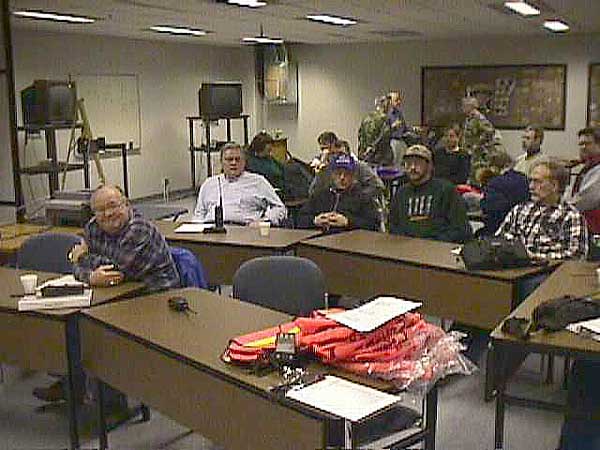 OZARES members in the Ozaukee County Justice Center's Emergency Operations Center, prior to heading out to search for debris from the Linda E. Safety vests and other search equipment can be seen on the table. Left foreground: AA9HR; left background: AA9GT; brothers N9SBA and KB9JNG; and WD9HOD. [Photo by Kent Christiansen, N9WHT] |
Hams in Wisconsin have helped to search for signs of a fishing vessel missing for about two weeks on Lake Michigan. At the Coast Guard's request, Ozaukee County, Wisconsin, Emergency Management organized a search effort earlier this month for any remains of the fishing boat Linda E. The 40-foot vessel had three people aboard. Searchers were looking for debris from the boat that might have washed up along the shore.
On December 15 and 19, Ozaukee County EC and Incoming Wisconsin SEC Stan Kaplan, WB9RQR, reports that hams and other searchers scoured some 22 miles of shoreline south of Port Washington for any clues that might point to the fate of the missing vessel. "There's nothing definitive at this point," said Kaplan. "We may have to repeat it next spring."
Most search personnel were members of OZARES, the county's Amateur Radio Emergency Service organization. They had help from local and regional search and rescue teams, including the Civil Air Patrol. Pairs of searchers walked the shoreline, communicating via Amateur Radio with a mobile station positioned on a high bluff nearby, Kaplan said. The mobile station relayed reports to emergency management's communications hub.
In addition to H-Ts, Kaplan said, each walking pair carried a GPS unit, allowing the searchers to pinpoint the few items found, all of which turned out to be unrelated to the missing craft. The GPS units also permitted accurate mapping of the areas covered by the searchers.
Milwaukee's Channel 12 TV covered the search and aired a short story on it, Kaplan said.--thanks to The Badger State Smoke Signals/Jim Romelfanger, K9ZZ
KANSAS KIDS TEST NASA QSO PROJECT
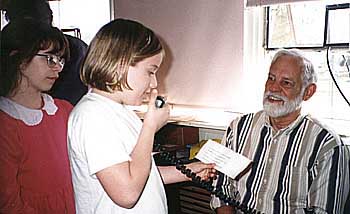 Sarah Littrell speaks with astronaut Laurel Clark while Kimberly Weiss awaits her turn. [Photo by Kristi McNerlin] |
With a big lull looming for Space Amateur Radio EXperiment--or SAREX--school contacts, NASA is toying with the idea of launching a more earthbound version of the SAREX program that puts youngsters in direct contact with astronauts via Amateur Radio. In late November, a group of pupils at the Pleasant Valley School in Winfield, Kansas, gave the idea a test flight during a 20-meter QSO with NASA astronaut Laurel Clark, KC5ZSU. Clark, a NASA mission specialist, spoke to the kids from W5RRR at the Johnson Space Center in Houston.
Helping out with the arrangements was John Nickel, WD5EEV, an early member of the SAREX Working Group and a retiree of Lockheed, a NASA subcontractor.
"I set up a portable station at the school, so we were all in a very full class room.," Nickel explained. His wife, Karen, WD5EEU, and he had a few practice sessions with the kids ahead of time so they'd feel at home with Amateur Radio.
The sole SAREX mission scheduled for 1999 doesn't happen at least until early April, and construction of the International Space Station is only now getting under way. Amateur Radio is considered "required crew equipment" aboard the ISS, but the first Earth-to-ISS school contacts are at least a couple of years off.
ARRL Educational Activities Department Manager Rosalie White, WA1STO, of the SAREX Working Group said similar terrestrial but space-related QSOs could fill the impending gap in the SAREX program. "This terrestrial QSO was a test to see how this new project involving astronauts and schools can work," she said. "These exciting school QSOs can tide us over until we're all set for future International Space Station QSOs."
SAREX Working Group Chairman Roy Neal, K6DUE, agreed. He called the idea "an excellent way to stay in touch with our schools while SAREX converts into ARISS facilities over the next few years."
Matt Bordelon, KC5BTL, SAREX Principal Investigator at NASA, helped with the arrangements. He said the current plan is to attempt these types of QSOs on an occasional basis, spending about 30 minutes with a school via HF or via one of the amateur satellites. "It gives the astronauts practice with school contacts via Amateur Radio, and it keeps ham radio visible," he said.
RTTY ROUND-UP PLAQUES TO BE AWARDED
For the first time ever, Overall and Division High-Score Plaques will be awarded in the 1999 ARRL RTTY Roundup. The event takes place January 2-3, 1999. "Because of the hard work and efforts of Jay Townsend, WS7I, and the late Northwestern Division Director Mary Lou Brown NM7N, we will be awarding over 20 plaques in the upcoming event," says ARRL Contest Branch Manager Dan Henderson, N1ND.
The plaques will be similar in size to those awarded in the popular ARRL International DX Contest, the ARRL November Sweepstakes, and the June VHF QSO Party. The attractive design features an old teletype machine and a modern computer and will include the winner's information.
Henderson expressed gratitude to "the many sponsors who have stepped forward to make this new plaque program possible." He said plaques also will be made available to any previous RTTY Roundup winners.
For price information or to order plaques for past years, contact Henderson at 860-594-0232; e-mail dhenderson@arrl.org.
ALPHA/POWER BUYS RFCONCEPTS
Alpha/Power, a leading manufacturer of HF linear amplifiers, has purchased the RFconcepts product line of VHF and UHF amplifiers. All service and repairs now are being handled by Alpha/Power, which is headquartered in Longmont, Colorado. The sale price was not disclosed.
The deal included the RFconcepts name and product line as well as inventory, current and non-current designs and manuals, finished goods, tooling, and vendor and dealer lists. Kantronics President Phil Anderson, W0XI, had announced in September that he was looking for a buyer for the company's RFconcepts product line, saying it "does not fit within our strategic plan for the future." Kantronics had bought the RFconcepts division in 1989 and moved it from California.
For the time being at least, Alpha/Power will continue to market RFconcepts products through the same dealer network. Alpha/Power expects to be manufacturing new products under the RFconcepts name by early 1999. A spokesman said Alpha/Power would be working with Kantronics to ensure a smooth transition. "We feel like it's a really good fit for our product line," he said of the RFconcepts purchase.
For more information, contact Alpha/Power, 14440 Mead Ct, Unit B, Longmont, CO 80504; tel 970-535-4173; http://www.Alpha-Power-inc.com.
DUTCH LOWFER EXPERIMENT FLIES
A serious effort by several Dutch radio amateurs to work as many other LF stations as possible has resulted in QSOs between PA2NJN in The Netherlands and several stations in the UK and Europe on 136 kHz. The original test was scheduled for November 14. Plans called for using a kite-borne 900-foot antenna, but that day produced no wind. However, the following Saturday, November 21, provided enough wind to loft the wire to about 80 degrees--nearly vertical.
Kite crewmember Richard Middel, PD1AOT, reports the day was cold (-6 degrees C), and windy. "When the kite reached a good height, we tied it to a string of thick nylon cable so the kit would stay there where it was," he said. "It was isolated from ground and it got charged with static electricity." Middel said that within seconds, he and Jeroen, PD1APA, got shocks from built-up static charges. "Sparks were springing from a distance of 2 cm," he said. At that point the antenna was not connected to the transceiver.
The group used a loop antenna and an "active antenna" for receiving, but Nico Nienhuis, PA2NJN, reports that once the transmitting antenna was in the air, they were unable to receive as well.
The transmitter power was 150 W. Calculations by the Dutch operators estimated the EIRP (effective isotropic radiated power) to be in the range of 10 to 15 W. Stations worked included G3KEV, G3YXM, G4GVC, ON6ND and ON6UX.
PA2NJN also got reception reports from several European listeners, including France, Germany, Sweden, Scotland, and Italy. Best DX was a listener report from IK5ZPV in Italy, a distance of 1095 km.
Operators at the station in Usquert, The Netherlands, included PE1PFR, PA3GUC, and PA2NJN. Others who monitored PA2NJN's experimental operation are requested to send a report to Nico J. Nienhuis, PA2NJN, Mensingeweersterweg 7, NL 9967 PA Eenrum, The Netherlands.
The ARRL has petitioned the FCC to create two low-frequency Amateur Radio allocations at 136 kHz and at 160 kHz. The League has proposed permitting CW, SSB, RTTY/data, and image emissions for amateurs in a 2.1-kHz "sliver band" from 135.7 to 137.8 kHz and in a 30-kHz segment from 160 to 190 kHz. (See The ARRL Letter, Vol 17, No 44, for November 6, 1998). The League proposed making the two bands available to General and higher licensees. -- thanks to Jim Romelfanger, K9ZZ/Badger State Smoke Signals
A HAM'S NIGHT BEFORE CHRISTMAS
Yet another corruption of Clement Clarke Moore's classic Christmas tale, this time distorted by Gary Pearce KN4AQ, and the Raleigh Amateur Radio Society, Raleigh, North Carolina, December 2, 1996.
-
'Twas the night before Christmas,
And all through 2 meters,
Not a signal was keying up
Any repeaters.
The antennas reached up
From the tower, quite high,
To catch the weak signals
That bounced from the sky.
The children, Tech-Pluses,
Took their H-Ts to bed,
And dreamed of the day
They'd be Extras instead.
Mom put on her headphones,
I plugged in the key,
And we tuned 40 meters
For that rare ZK3.
When the meter was pegged
by a signal with power.
It smoked a small diode,
and, I swear, shook the tower.
Mom yanked off her phones,
And with all she could muster
Logged a spot of the signal
On the DX PacketCluster,
While I ran to the window
And peered up at the sky,
To see what could generate
RF that high.
It was way in the distance,
But the moon made it gleam.
A flying sleigh, with an
eight-element beam,
And a little old driver
who looked slightly mean.
So I thought for a moment,
That it might be Wayne Green.
But no, it was Santa,
The Santa of Hams.
On a mission, this Christmas,
To clean up the bands.
He circled the tower,
Then stopped in his track,
And he slid down the coax
Right into the shack.
While Mom and I hid
Behind stacks of CQ,
This Santa of hamming
Knew just what to do.
He cleared off the shack desk
Of paper and parts,
And filled out all my late QSLs
For a start.
He ran copper braid,
Took a steel rod and pounded
It into the earth, till
The station was grounded.
He tightened loose fittings,
Resoldered connections,
Cranked down modulation,
Installed lightning protection.
He neutralized tubes
In my linear amp.
(Never worked right before;
Now it works like a champ).
A new, lowpass filter
Cleaned up the TV.
He corrected the settings
In my TNC.
He repaired the computer
That would not compute,
And he backed up the hard drive
And got it to boot.
Then, he reached really deep
In the bag that he brought,
And he pulled out a big box.
A new rig? I thought!
A new Kenwood? An ICOM?
A Yaesu, for me?!
(If he thought I'd been bad,
it might be QRP!)
Yes! The Ultimate Station!
How could I deserve this?
Could it be all those hours
that I worked Public Service?
He hooked it all up
And in record time, quickly
Worked 100 countries,
All down on 160.
I should have been happy,
It was my call he sent.
But the cards and the postage
Will cost two month's rent!
He made final adjustments,
And left a card by the key:
"To Gary, from Santa Claus.
73."
Then he grabbed his H-T,
Looked me straight in the eye,
Punched a code on the pad,
And was gone with no good-bye.
I ran back to the station,
And the pileup was big,
But a card from St. Nick
Would be worth my new rig.
Oh, too late, for his final
came over the air.
It was copied all over.
It was heard everywhere.
The Ham's Santa exclaimed
What a ham might expect,
"Merry Christmas to all,
And to all, good DX!"
©1996 Gary Pearce, KN4AQ
Permission granted for any print or electronic reproduction.
e-mail kn4aq@ipass.net
[Gary Pearce, KN4AQ, is Public Information Coordinator for the North Carolina Section.--Ed]
SOLAR UPDATE
Solar Santa Tad Cook, K7VVV Seattle, Washington, reports: The last propagation bulletin of 1998 is going out one day early so it can be distributed before the Christmas holiday. The author wishes everyone a warm holiday greeting, and promises better HF DX for all in 1999 [We'll hold you to that one, Tad!--Ed].
Solar activity was off a bit the past week, with average sunspot numbers lower by almost 55 points, and average solar flux down by only two points. Average solar flux for the previous 90 days was 133, and flux values were above this level on every day except December 22, indicating a general upward trend. For the next few days, solar activity should be higher. The December 24-27 solar flux is predicted to be 145, 148, 150 and 154, with planetary A index for each of those days at 9.
Recently we have reported optimistic news on the recovery of the Solar and Heliospheric Observatory, or SOHO project. There is a new report this week that the remaining gyro has failed, making future recovery operations when the craft is pointing away from the sun impossible. After SOHO was off for a long period earlier this year, only one of the three gyros remained working, and now that last one has failed. Currently there are no scientific operations planned until new flight software for gyroless operations is implemented. For more details, see http://sohowww.nascom.nasa.gov.
In VHF news this week, KD4ESV in Florida worked TI2ALF in Costa Rica on 6 meters, and heard K2OY, also in Florida, working HP2CWB in Panama. WA5JCI in Texas heard strong signals on 6 from ZF1DC in the Cayman Islands.
Sunspot numbers for December 17 through 23 were 93, 76, 88, 98, 72, 56, and 78, with a mean of 80.1. The 10.7-cm flux was 146.1, 154.7, 137.3, 134.7, 135.3, 128.8, and 139.8, with a mean of 139.5. The estimated planetary A indices were 2, 3, 7, 11, 3, 5 and 8, with a mean of 5.6.
In Brief:
- This weekend on the radio: The Stew Perry Topband Distance Challenge and the RAC Winter Contest are the weekend of December 26-27. ARRL Straight Key Night is January 1 (starts December 31 local time). The ARRL RTTY Roundup and the Kid's Day Operating Event are January 2-3.
Just ahead: The Japan International DX Contest (CW), Meet the Novices and Technicians Day, the QRP ARCI Winter Fireside SSB Sprint, the North American QSO Party (CW), and the Hunting Lions in the Air Contest are the weekend of January 8-10, 1999. - IOY nominations due soon: Nominations for the annual ARRL Instructor of the Year awards are due to section managers by January 31, 1999. It's easy to nominate an exceptional ham radio instructor, teacher, or recruiter. The nomination forms are available on ARRLWeb at http://www.arrl.org/ead/award/application.html. Nominations may be sent to section managers via e-mail. For more information, contact Jean Wolfgang, WB3IOS, e-mail jwolfgang@arrl.org; tel 860-594-0200. Award winners receive plaques and recognition for their time and effort in service to the amateur community.
- NACEC conducts "Radio Round Up": As Hurricane Mitch recovery efforts continue, the North American Center for Emergency Communications (NACEC) is conducting its first-ever Radio Round Up to acquire additional equipment for its "Mission Honduras" project. Through the Radio Round Up, individuals, organizations, and companies help by sponsoring 2-way communications gear needed in remote areas of Honduras. So far, the nonprofit NACEC says it's received contributions totaling just over $2300 targeted for Mission Mitch Honduras. The gear will help expedite recovery operations in the flood-ravaged Central American nation, where damage to the transportation and communication infrastructures has slowed communication necessary for relief. For more information, visit the NACEC Hurricane Mitch page, http://www.nacec.org/hurricane-mitch/; tel 888-746-2232; e-mail nacec@nacec.org. Contributions are welcome to "NACEC Operations Fund." Sent donations to NACEC Operations Fund, PO Box 23057, Minneapolis, MN 55423.--NACEC
- New TIS Coordinator: W1AW weekend operator Al Alvareztorres, AA1DO, begins a new position as ARRL Technical Information Service Coordinator on January 4, 1999. Members having technical questions may pose them to Al at 860-594-0214; e-mail tis@arrl.org, or write TIS, ARRL, 225 Main St, Newington, CT 06111.
- ARRL/TAPR site adds DCC highlights: The ARRL and TAPR Digital Communications Conference Web site now includes all recorded segments from the 1998 conference plus a story and photo section. Available at http://www.tapr.org/dcc/, highlights include the keynote address by Dale Hatfield, W0IFO, chief of the FCC's Office of Engineering and Technology; the APRS national symposium; presentations of technical papers; the Packet Radio Users Group of Japan technical seminar, and other sessions. Also find photos and 1998 Proceedings abstracts. The 1999 ARRL/TAPR Digital Communications Conference will be in September in Phoenix.--TAPR
- IDEA establishes scholarship: The Indiana Digital Experimenters Association (IDEA) has established a scholarship through The ARRL Foundation Inc to be awarded during the 1998-99 school year. The IDEA scholarship would go to an Indiana high school senior who is a Technician or higher-class licensee planning to study electronics, communications, or related fields at an accredited Indiana school. Preference is given to academic record, financial need, and demonstrated interested in promoting both the Amateur Radio Service and community service uses of ham radio. For details, contact Mary Robertson, N7IAL, at The ARRL Foundation; e-mail mrobertson@arrl.org; tel 860-594-0230.
- New address for Director Kanode: ARRL Roanoke Division Director John Kanode, N4MM, has a new mailing address, effective January 1, 1999. It's 1741 Old Chapel Rd, Boyce, VA 22620.
- Satellites get OSCAR assignments: Amateur Radio's two newest satellites, SEDSAT-1 and PANSAT, have been assigned OSCAR numbers by AMSAT. SEDSAT-1 now is SEDSAT OSCAR-33 or SO-33, while PANSAT is PANSAT OSCAR-34 or PO-34. Both were launched earlier this fall. AMSAT President Keith Baker, KB1SF, congratulated members of the SEDSAT and PANSAT teams on their success in placing their respective satellites into orbit. The assignment of consecutive OSCAR numbers to new ham radio satellites dates from the launch of OSCAR-1. To qualify for an OSCAR number, the satellite must successfully achieve orbit and one or more transmitters must be successfully activated in the Amateur Radio bands.--AMSAT News Service
- K6MD promoted to Brigadier General: Gerald Griffin MD, K6MD, has been promoted to a Brigadier General in the US Army. Griffin is a member of the ARRL RF Safety Committee, a member and past President of the Northern California DX Club, a DXCC Honor Roll member, and a member and past President of the Monterey Bay Chapter of QCWA. Congratulations!--thanks to Jim Maxwell, W6CF
- K1HT appointed to contest panel: ARRL New England Division Director Tom Frenaye, K1KI, has appointed Dave Hoaglin, K1HT, of Sudbury, Massachusetts, to serve as the New England Division member of the ARRL Contest Advisory Committee. Hoaglin, a member of the Yankee Clipper Contest Club, succeeds Kurt Pauer, W6PH (ex-W1PH) who served on the CAC for several years. New England Division members may contact Dave Hoaglin at dave_hoaglin@abtassoc.com.--Tom Frenaye, K1KI