ARRL Audio News
| · | To subscribe, unsubscribe, or change your e-mail delivery address: see How to Get The ARRL Letter, below |
| · | Delivery problems (ARRL member direct delivery only!): letter-dlvy@arrl.org |
| · | Editorial questions or comments: Rick Lindquist, N1RL, rlindquist@arrl.org |
| · | ARRL Audio News: http://www.arrl.org/arrlletter/audio/ or call 860-594-0384 |
| · | The ARRLWeb Extra: http://www.arrl.org/members-only/extra |
IN THIS EDITION:
- +FCC done "taking names"
- +Vice Director Bodson wins IEEE award
- +Ham radio hero honored
- +Educators get grants for ham stations, programs
- Maxim Award nominations open
- Dutch shore station schedules "farewell" event
- Solar update
- In Brief: This weekend on the radio; Vanity update; Mary Lou Brown, NM7N, memorial service set; Sugrue named Wireless chief; CW in the cinema; Strange signal; Sputnik telemetry software; ARRL Members Only Web Site a hit
+ Available on ARRL Audio News
FCC ENFORCEMENT HONCHO DONE "TAKING NAMES"
The FCC's Riley Hollingsworth, K4ZDH, is making his list and checking it twice. And now that he knows which hams are naughty, not nice, he's ready to take enforcement actions against the most flagrant amateur offenders.
"Fully half of the amateur problems on HF relate to a specific group of jammers--malicious interferers who apparently enjoy disrupting as much amateur communication as possible," said Hollingsworth, the FCC's point man for amateur enforcement within the Compliance and Information Bureau. "Enforcement action against this group is long overdue."
Coal could be showing up in some Christmas stockings. Hollingsworth has prepared a report to his boss, CIB Chief Richard D. Lee, detailing his findings and fingering the most serious violators in a "top 10" list which he declined to make public just yet. His memo urged "immediate enforcement action."
Hollingsworth said he's talked with more than 250 people on the amateur enforcement line (202-418-1184) since the end of September, when the FCC's latest amateur enforcement initiative kicked into high gear. In addition, he has received more than four dozen letters and e-mailed comments concerning problems in the Amateur Service. Hollingsworth has concluded that, while most amateurs abide by the rules, a few habitual offenders continue to flout the law.
"We are not going to stand for the Amateur Service to be further degraded or destroyed by them," he said.
Hollingsworth says that jamming and deliberate interference is the most common problem, accounting for 31% of all complaints. Repeater misuse and jamming account for another 29%. But he considers the HF abuses--most typically reported on 75 and 20 meters--to be the more serious offenses because they can be national or international in scope. Other general problems accounted for another 17% of the complaints, Hollingsworth said. A full 10% of complaints concerned an unlicensed individual in California who already has spent time in jail for past convictions.
Hollingsworth has sent out 30 informal "warning letters" to individual operators as a result of complaints. The letters warn the recipients that a complaint has been received about the recipient or someone using his or her call sign, indicate that the allegations--if true--could jeopardize the amateur's license, and request the recipient to contact the FCC to discuss the matter.
"In almost every case the recipient has contacted us," he said. "In one case, the licensee contacted us, apologized, and reports since that time indicate that the licensee has become a model operator." Some amateurs have reported to the ARRL that amateur behavior has improved--dramatically in some areas--since word hit the street that the FCC was taking amateur enforcement seriously. For its part, the League has said it is willing, for now, not to pursue its request to further privatize amateur enforcement.
Hollingsworth says the warning letters will continue, but now he's taking aim at the hard-core scofflaws within the Amateur Radio community. "We have now let everyone out there know we're back," he said. Continued violations will "guarantee" license revocations, fines, or--in extreme cases--equipment seizures.
"Church is out now," he said. "We mean business and we're strapped in and ready to ride." Hollingsworth said Amateur Radio rulebreakers "continue these violations at their own risk."
VICE DIRECTOR BODSON WINS IEEE STEINMETZ AWARD
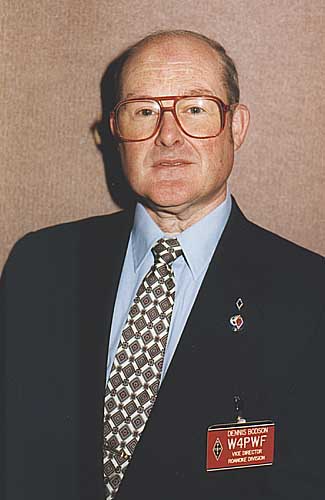 Roanoke Division Vice Director Dennis Bodson, W4PWF [Photo by Rick Palm, K1CE] |
Bodson recently retired as chief of the Technology and Standards Division for the National Communications System. He was cited "for leadership and technical contributions to standards for digital facsimiles and other telecommunications technologies."
In addition to the bronze medal and a certificate, the Steinmetz award carries a $5000 honorarium. A formal presentation will be made next June at the IEEE Communications Society's International Communications Conference in Vancouver, British Columbia.
Bodson, 59, was first licensed when he was a teenager. He's an ARRL Life Member, a Fellow of the IEEE and of the Radio Club of America. A Registered Professional Engineer in the District of Columbia and in Virginia, Bodson and his wife, Rita, live in Arlington. They have two sons, Dennis, W3DZK, and Brian.
HAM RADIO HERO HONORED
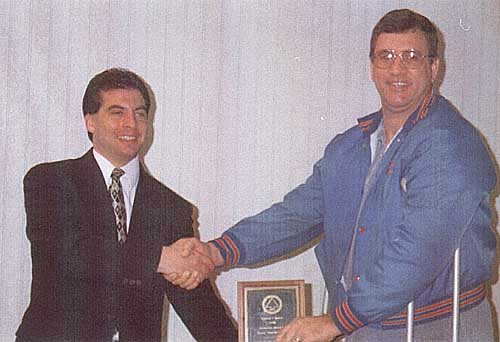 Lonnie McVaigh, KB9LUN (right), receives the 1998 Samuel I. Keene Memorial Award for Heroic Disaster Service from DERA trustee Steve Keene, Samuel Keene's brother. "Lonnie McVaigh represents the courage, commitment, and dedication for which this award was intended," said Steve Keene. [DERA photo] |
McVaigh was seriously injured while on storm-spotter duty. "Instead of simply reporting the location and movement of the funnel cloud that threatened Decatur on April 19, 1996, Mr. McVaigh warned people to get off the street and into shelters as the tornado bore down on them," a DERA statement said. As time ran out, McVaigh took refuge with a family in their basement as the twister hit their house. He was seriously injured when the storm toppled the chimney into the basement.
McVaigh's wife, Melissa, KB9MDF, had stayed in contact with him via Amateur Radio as the storm hit. As a result, she was able to alert the rescue squad, which promptly located McVaigh and got him to the hospital.
McVaigh suffered a broken pelvis and nerve damage in his legs. He has had to endure several operations and a lengthy and difficult rehabilitation program. Because of his injuries, McVaigh can no longer work at his job and has had to rely on public assistance, Social Security, and help from friends and his church. The McVaighs have three children of their own plus five foster children. His slow recovery continues.
DERA Executive Director Bascombe "Jay" Wilson, W0AIR, said the organization picked McVaigh from among candidates representing every continent. "The heroism and continued courage of Lonnie McVaigh serve as an inspiration for us all," Wilson said.
EDUCATORS "GO THE GRANT ROUTE" TO FUND SCHOOL HAM STATIONS, PROGRAMS
Three educators have received grants to set up ham radio stations in their classrooms. The biggest grant--a whopping $12,000--was garnered by electronics teacher Fred Usherson, N2EGQ, of Floral Park, New York. In his grant proposal to the World of Knowledge Foundation, Usherson cited the need to create an Amateur Radio program so that his Queens Vocational Technical High School students could handle emergency messages and gain marketable electronics skills. "Amateur Radio will be integrated into our electronics curriculum," he said. "I want to get all students in my classes as licensed hams."
Teacher Sarah Cowan isn't even a ham yet, but she still managed to get a $1,500 grant through Los Alamos National Laboratory to set up an Amateur Radio station at Pajaro Middle School in Santa Cruz, California. The grant, from the US Department of Energy's Teacher Opportunities to Promote Science (TOPS) program, will allow students to learn about technology in general and radio waves in particular, study for their ham licenses, and take field trips to see scientists at work.
The project is tied into scientific work at Los Alamos. Cowan's mentor there is Don Casperson, AA5PA, an ARRL Life Member who has volunteered his technical expertise. The Santa Cruz Amateur Radio Club also is assisting. Cowan says the community could benefit from having more youthful ham operators to help with emergency communications, since Pajaro is near an earthquake zone.
This year's ARRL Professional Teacher of the Year, Bob Lavin, K6BOB, of Calabasas, California, got $3,000 from his school's parent-teacher organization earlier this year to purchase a ham radio station. He has integrated ham radio into his classes, and 30 students and teachers now hold Technician or Tech Plus tickets.
For those who wish their school had a ham radio station and activities for kids, ARRL Educational Activities Manager Rosalie White, WA1STO, offers some suggestions. "Ask around to learn who're the innovative teachers in your district, and offer a hands-on geography or science lesson," she suggests. "Or get yourself invited to help students take part in the School Club Roundup (see January QST)."
White says hams also might check with their employers or with other local industries to learn if funding for educational projects is available. "Companies prefer to see funding go toward training their potential future employees," she said. "You can also do an Internet search on foundations and grants, and read QST's 'At the Foundation' for occasional stories about school-garnered mini-grants."
Getting grant money from various sources to fund Amateur Radio activities in the school is not a new idea, but it's one White says more teachers should explore. In 1995, four different grants gave teacher Sheila Perry, N0UOP, $155,000 for her school district. The money funded curriculum development, Amateur Radio equipment, electronic kits, a computer lab and other items.
Teachers interested in learning more about how to write grant proposals should read "A Trip Through the Teaching Universe," by Connie Dunn, KB5LES, QST, June 1995, p 44 or visit ARRLWeb, http://www.arrl.org/ead/teacher/perry.html.
NOMINATIONS OPEN FOR MAXIM MEMORIAL AWARD
Nominations are open for the Hiram Percy Maxim Memorial Award. The award goes each year to a radio amateur under the age of 21 whose accomplishments and contributions are of the most exemplary nature within the framework of Amateur Radio activities. These include, but are not limited to:
- Participation or leadership in organizational affairs at the local or national level.
- Technical achievement.
- Operating record.
- Recruitment and training of new amateurs.
- Public relations activities.
In keeping with the tradition of the award when it was first established in 1936, formal nominations are made by Section Managers. Supporting information, including the endorsement of ARRL-affiliated clubs and elected or appointed League Leadership officials, should be submitted with the nomination. An award panel will review the nominations received and select the winner. The prize consists of a cash award of $1000, a suitably engraved plaque, and travel and accommodation expenses to enable the winner to attend an ARRL convention for a formal presentation.
Nominations should document as thoroughly as possible the Amateur Radio achievements and contributions of the nominee during the previous calendar year. Additional information concerning the character of the nominee should be as complete as possible.
The award is intended to provide a tangible reward to those deserving young amateurs who contribute their time, skills and energies daily through their commitment to Amateur Radio. As models for their peers, and inspirations to us all, these fine young people are highly visible boosters of Amateur Radio awareness. We must continue to recognize and encourage their hard work and contributions at every opportunity.
Nominations must be sent to the Section Manager. Nominations must be received at Headquarters from Section Managers by March 31, 1999. There is no limit to the number of nominations one may make.
Sixteen-year-old Antone "Tony" Duarte, N1XRS, of Dartmouth, Massachusetts, was the 1997 Hiram Percy Maxim Memorial Award winner.
For more information and an application form, contact ARRL Field Services Manager Rick Palm, K1CE, e-mail rpalm@arrl.org or write him at ARRL Headquarters, 225 Main St, Newington, CT 06111.
SHORE STATION PCH SCHEDULES "FAREWELL DAY" EVENT
The longest established maritime radio service in the world--Scheveningen Radio, PCH, in the Netherlands--closes for good January 1, 1999. To mark the sad occasion, PCH will hold a "Farewell Day" special event later this month--on its 94th anniversary and has invited hams worldwide to participate. But there's a fly in the ointment for US hams!
The idea is for hams to contact either special event station PA6PCH (from the Radio Club Kennemerland station, PI4RCK), which will be active on 2 and 75 meters, or PCH itself on crossband. But that latter possibility--actually working PCH--should raise a warning flag to US hams. Lacking specific FCC authority, it's strictly illegal for US amateurs to communicate with a station operating in another radio service. Section 97.111(a)(4) in Part 97 of the FCC rules makes an exception only for Armed Forces Day contacts.
Here are the details for the PCH special event: Starting at 0800 UTC December 19, 1998, and continuing through 0800 UTC December 20, PA6PCH will operate on 75 meters, 3687 kHz, as well as on 2 meters, 144.315 MHz, SSB.
In addition, for stations whose countries authorize such operation: PCH will operate from 1500 UTC on December 19 until 0700 UTC on December 20 making crossband CW contacts with amateurs on the following PCH transmit/receive pairs (plus or minus QRM on the amateur bands): 4250/3525 kHz; 8622/7025 kHz; 12799.5/14050 kHz; 17198.9/18085 kHz.
This event has been approved by the Dutch Radiocommunications Agency for participation by hams in the Netherlands. However, it has not been approved by the FCC for participation by US amateurs, and such operation may be similarly prohibited in other countries as well.--Scheveningen Radio/PCH news release
SOLAR UPDATE
Propagation prognosticator Tad Cook, K7VVV Seattle, Washington, reports: Solar activity was lower this week, with both average solar flux and sunspot numbers down about 10 points each when compared to the previous week. Average solar flux for the previous 90 days was 131, and solar flux was above this value on every day, indicating a good general upward trend.
Solar flux peaked at 162 on December 8, and the trend now is downward. For the ARRL 10-Meter Contest, look for a solar flux of 132, 128 and 122 December 11-13. Geomagnetic indices should be unsettled to active, with the planetary A index peaking around 15 on December 12.
It would be nice to have a higher solar flux for the ARRL 10-Meter Contest, but contesters can look forward to much better conditions than last year. Last year the Friday through Sunday solar flux for the 1997 ARRL 10-Meter Contest was 92.5, 89.3 and 90. This just wasn't enough for good propagation over most paths. Just plug the numbers into any popular propagation prediction program, and the predicted numbers for this weekend look great in comparison.
The general trend in solar activity has been up this year. Take a look at the chart at http://www.dxlc.com/solar/ or at http://www.wm7d.net/hamradio/solar and see the general upward trend. Beyond this weekend look for solar flux to drop to 120 or lower by December 16, then rise above 130 three days later and above 140 by December 22. Flux values are expected to peak above 150 around December 27.
NASA released an interesting story this week about solar wind squeezing ions out of the ionosphere. See the press release and images at http://www-spof.gsfc.nasa.gov/istp/news/9812.
Sunspot numbers for December 3 through 9 were 136, 109, 91, 106, 143, 158, and 132 with a mean of 125. The 10.7-cm flux was 153.1, 148.2, 142.4, 142.3, 153.2, 162, and 153.9, with a mean of 150.7. The estimated planetary A indices were 7, 7, 12, 7, 6, 5 and 5, with a mean of 7.
Here are some path projections for the ARRL 10-Meter Contest this weekend:
Look for Europe from the East Coast around 1530-1700 UTC, South America with strong signals around 1430-1930 UTC, South Pacific around 1800-2200 UTC, Hawaii around 1800-2030 UTC, and the West Coast from 1800-1930 UTC.
From the Central USA, look for Europe around 1600 UTC, South America from 1500-2100 UTC, South Pacific at 1730-2330 UTC, Hawaii from 1800- 2300 UTC, Japan around 2200-2300 UTC, the East Coast around 1800-2000 UTC and the West Coast from 1700-2100 UTC.
From the West Coast, check South America around 1530-2330 UTC, South Pacific around 1830-0030 UTC, Hawaii around 2000-2100 UTC, and Japan around 2230-0000 UTC.
IN BRIEF:
- This weekend on the radio: The ARRL 10-Meter Contest and the Great Colorado Snowshoe Run are the weekend of December 12-13.
Just ahead: The Croatian CW Contest is December 19-20; the Stew Perry Topband Distance Challenge and the RAC Winter Contest are December 26-27. - Vanity update: The FCC in Gettysburg reports it has processed vanity call sign applications received through November 20. In the most recent run, December 9, the FCC granted 213 applications while another 187 landed in the work-in-process (WIPs) stack for further processing.--FCC
- Mary Lou Brown, NM7N, memorial service set: A brief memorial service for the late ARRL Northwestern Division Director Mary Lou Brown, NM7N, will be held Thursday, December 17, at 2 PM PST, at Guemes Island Road Community Church. Among those expressing sadness at the sudden death of Director Brown on December 3 was Radio Amateurs of Canada President J. Farrell "Hoppy" Hopwood, VE7RD, who called her "a special friend of Radio Amateurs of Canada" who was "always most generous in assisting RAC."--thanks to W7AGQ and VE7RD
- Sugrue named Wireless chief: Thomas J. Sugrue has been named chief of the FCC's Wireless Telecommunications Bureau, effective January 19. The WTB oversees Amateur Radio at the FCC. A communications lawyer in private practice since 1995, Sugrue has previous FCC experience as chief of the Policy and Program Planning Division in the FCC's Common Carrier Bureau and as special council for competitive policies. He later spent six years as deputy assistant secretary of Commerce in the National Telecommunications and Information Administration and twice served as acting NTIA administrator. Sugrue replaces Dan Phythyon as WTB chief. He's a graduate of Harvard Law School and also holds a master's in public policy from Harvard and a BS in physics from Boston College.--FCC
- CW in the cinema: Several ham-moviegoers have alerted ARRL HQ that the movie "Enemy of the State" contains a snatch of CW. In scenes depicting a spy satellite, the sound track includes a little Morse code: The satellite calls CQ! "As though pictures were sent from satellites by Morse," said Tom Bradbury, NU4G, who saw the movie in November with his daughter, Elizabeth, KE4IWN. "I broke out laughing, no doubt to the puzzlement of those around me," he said. "Somewhere in moviedom is a chuckling ham, I guess." Steve Kaufman, VE2SKA/KB2SPH, says that characters in the movie also use what appears to be a Yaesu HF transceiver to break into police frequencies. "The frequency shown is in the 40-meter band," he says, "but they do speak to the police dispatcher." The movie stars Will Smith and Gene Hackman.--thanks to Daniel Coates, N9XJF, Steve Kaufman, VE2SKA/KB2SPH, and Tom Bradbury, NU4G
- Strange signal: ARRL HQ received a number of complaints during November--mostly from hams in Maine--about a very strong pulse-type signal between 3910-3950 kHz. The signal, which was S9+ at W1AW, was reported to the FCC, which listened for it for more than two weeks from their monitoring facility in Columbia, Maryland. The FCC also heard the pulse-type interference faintly on several days, but only well enough to determine the signal was coming from the north. The FCC heard nothing from November 28 to December 6 and then closed the case. The ARRL has not received any more complaints, but the FCC said it would be glad to reopen the case if the interference resurfaces.--thanks to John Hennessee, N1KB
- Sputnik telemetry software: Hank Riley, N1LTV, has written a compact Windows-based program called Sputnik Telemetry Assistant that interprets audio frequencies measured from the Sputnik-41 transmissions and uses it to calculate the satellite's onboard temperature. The program is only 8 kB and runs under Windows 3.x and higher. See the High Altitude Balloon Launch Information Center Web site, http://www.geocities.com/capecanaveral/3161/hablic.htm and look for it in the "Download Special" section near the end of the home page. Riley welcomes comments at h1riley@umassd.edu.--AMSAT News Service
- ARRL Members Only Web Site a hit: Since it went on-line earlier this fall, the ARRL Members Only Web Site (http://www.arrl.org/members/) has topped the 30,000 mark for members registered to use it. During the last 10 days of November, nearly 7000 members visited the Web site. The site provides access to The ARRLWeb Extra, a new Web publication that contains current news and Amateur Radio features, as well as to past QST product reviews and other services and information. ARRL members also may sign up for free e-mail delivery of The ARRL Letter and W1AW bulletins and update their name, address, and call sign information with the League via the Members Only Web Site.