ARRL Audio News
| · | To subscribe, unsubscribe, or change your e-mail delivery address: see How to Get The ARRL Letter, below |
| · | Delivery problems (ARRL member direct delivery only!): letter-dlvy@arrl.org |
| · | Editorial questions or comments: Rick Lindquist, N1RL, rlindquist@arrl.org |
| · | ARRL Audio News: http://www.arrl.org/arrlletter/audio/ or call 860-594-0384 |
| · | The ARRLWeb Extra: http://www.arrl.org/members-only/extra |
IN THIS EDITION:
- +ARRL seeks new LF bands
- +Ham radio a lifeline for Central America
- +Shuttle launches PANSAT spread-spectrum satellite
- +SEDSAT-1 team to renew uplink efforts
- +New mini-Sputnik to launch from Mir
- Solar update
- In Brief: This weekend on the radio; Vanity update; All QSTs now available on CD-ROM; QSLing reminders; Netherlands LF test; QST Cover Plaque Award; RAC cuts dues, tightens belt; VG3W commemorative call sign; OD5LE elected as Lebanon's president
+Available on ARRL Audio News
2000 METERS AND UP? ARRL PETITIONS FOR LF BANDS
The ARRL has petitioned the FCC to create two low-frequency Amateur Radio allocations at 136 kHz and at 160 kHz. "These allocations will permit experimentation with equipment, antennas, and propagation phenomena in a small segment of the radio spectrum that has not been available to the Amateur Service for many years," the League's petition declared. The petition was filed with the FCC October 22.Specifically, the League has proposed permitting CW, SSB, RTTY/data, and image emissions for amateurs in a 2.1-kHz "sliver band" from 135.7 to 137.8 kHz and in a 30-kHz segment from 160 to 190 kHz. The 135.7 to 137.8 kHz band adheres to the European Conference of Postal and Telecommunications Administrations (CEPT) band plan.
The ARRL has proposed allowing a transmitter output in both LF segments of 200 W PEP, but in no case greater than 2 W EIRP (effective isotropic radiated power). The League's petition points out that poor antenna efficiencies and ground-loss characteristics likely would keep EIRPs at less than 1 W. The two bands would be available to General and higher licensees.
Unlicensed experimenters--some of them hams--currently operate on LF in the US under the FCC's Part 15 rules. These limit transmitter input power to 1 W and impose substantial restrictions on the size of the antenna. The proposed allocations "will provide the only low-frequency allocation for amateur use and will accommodate more flexible experimentation than is permitted under current Part 15 regulations," the League's filing said.
Hams would be secondary to the Fixed and Maritime Mobile services in the 136-kHz allocation, and secondary to the Fixed Service in the 160-190 kHz band. The League said its engineering surveys suggest that hams could operate in the two segments without causing problems to power line carrier (PLC) systems already active in that vicinity or to government assignments. Unallocated, Part 15 PLC systems are used by electric utilities to send control signals, data and voice.
Calculations included with the League's filing demonstrate how inefficient even relatively large radiators can be on LF (136 kHz is approximately 2205 meters). For example, at 200 W TPO (transmitter power output) and a 200 foot vertical radiator, efficiency is only in the range of 1%, yielding up to 2 W EIRP. A more practical setup--200 W TPO into a 100-foot vertical radiator (efficiency of 0.2%) would yield an EIRP of between 100 and 400 mW.
Several countries throughout the world already enjoy LF allocations. These include New Zealand, Great Britain, the Republic of Ireland, and several European nations.
The article "Exploring 136 kHz" by Peter Dodd, G3LDO, appears in the November 1998 issue of QST. It discusses practical equipment and an antenna system for the allocation. Dodd also is the editor of the LF Experimenter's Source Book (2nd ed) published by the RSGB and available from the ARRL for $14. Order Item 7148. Visit ARRLWeb for details or call, toll-free, 888-277-5289.
A special CW LF operation from the Netherlands is scheduled for November 14 at 0900 UTC at 136.5 kHz using the call sign PA2NJN (see In Brief item, "Netherlands LF test" below). The operation will run 150 W to a wire antenna, tethered to a kite at about 920 feet in the air.
A copy of the ARRL petition (lf-pet.pdf, Adobe PDF file, 52,510 bytes) is available on ARRLWeb.
AMATEUR RADIO PROVIDES LIFELINE IN CENTRAL AMERICA
Ham radio is playing a major role in rescue and relief efforts in storm-ravaged Central America. Hams in the Southern US are active in handling health-and-welfare traffic to and from Honduras and Nicaragua, both of which suffered death and destruction at the hands of Hurricane Mitch. Hams in Honduras and Nicaragua who are still on the air also have been using Amateur Radio to coordinate rescue and relief efforts there.ARRL radio gear that saw service several years ago in Puerto Rico after Hurricane Hugo and in Hawaii after Hurricane Iniki now is on its way to Honduras. ARRL Field Services Manager Rick Palm, K1CE, reports that five 2-meter hand-held transceivers and two 2-meter mobile units have been shipped to Omar Paredes, HR1OP, via his sister, Lidice Paredes, HR1LPS/W4, in Miami. Omar Paredes is affiliated with the Club de Radio Aficionados Central de Honduras in Tegucigalpa.
Responding to a request that came through the Hurricane Watch Net, Palm says a 2-meter repeater also will be sent to missionary Kenton Brown, KC8CXW/HR3, for a club in La Ceiba. The repeater will facilitate mainland communication with the islands of Roatan and Guanaja.
The equipment, part of the League's disaster communications inventory, was to be shipped on a Honduran World Foundation relief flight. The League also has made arrangements with WACOM in Texas to purchase a duplexer at a reduced cost. The duplexer and an antenna for the repeater will be shipped next week.
Lidice Paredes, HR1LPS, has been in touch with her brother on a regular 20-meter schedule. "Every day is worse," she said November 5 of the news she's been getting from home via ham radio. "The city is in complete devastation." Lidice Paredes said her brother, a pharmacist, has told her that there is only enough drinking water available for another two or three days. Flooding and mudslides have isolated some residents. Others are still awaiting rescue from trees and rooftops.
"A lot of ham radio operators lost their homes, their equipment," she said, but hams like her brother who are still on the air have been attempting to coordinate their disaster response activities. "It has not been very easy. It's taking a long time," she said.
Media reports also indicate that the Texas Baptist Men relief group is coordinating its efforts via ham radio in Nicaragua and Honduras. The organization has sent a planeload of supplies to Central America.
The Central America Emergency Net also has been active on 7090 kHz. Octavio Miranda, TI2OHL, in Costa Rica reports the only contact is via ham radio, with limited help from some military helicopters. The Salvation Army SATERN Net on HF has been operating to assist with emergency, logistical, and health-and-welfare traffic.
|
DISCOVERY LAUNCHES PANSAT SPREAD SPECTRUM AMATEUR SATELLITE
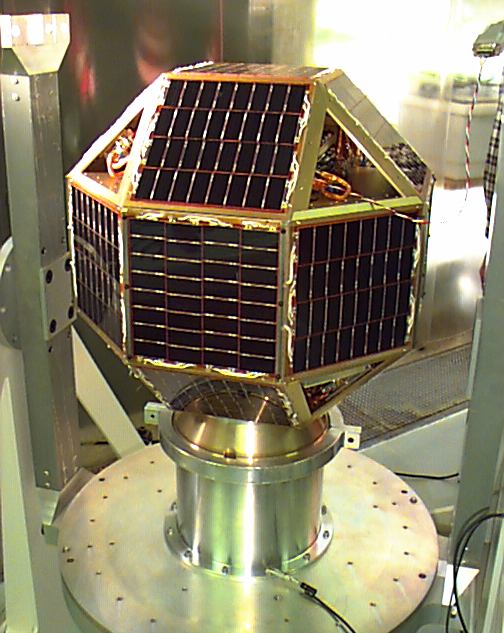
PANSAT, the Petite Amateur Navy Satellite, was launched over Australia October 30 from the space shuttle Discovery. The 150-pound Amateur Radio satellite carries a spread-spectrum communication package fabricated by student officers and faculty members at the Naval Postgraduate School here as an educational project and a means of demonstrating spread-spectrum communication. It was launched from Discovery as part of the third International Extreme Ultraviolet Hitchhiker (IEH-3) experiment. The NPS says the spacecraft will provide store-and-forward digital packet communication using direct-sequence spread-spectrum modulation with a center frequency of 436.5 MHz, a bit rate of 9842 bps and 9 MB of message storage. According to the NPS Web site, "Amateur Radio ground stations will be able to utilize PANSAT via a bulletin-board type user interface." PANSAT's Dan Sakoda, KD6DRA, says the team is doing initial assessments and has heard a reply signal from the spacecraft. But the ground crew has not yet been successful connecting via modems. "We've still got some bugs to shake out of our ground system," Sakoda said this week. He explained that the satellite does not have a beacon and only transmits when commanded to do so from the ground. "The fact that we saw PANSAT's response means that the satellite is working properly," he said. Sakoda does not expect PANSAT to be available to the Amateur Radio community for another couple of months. PANSAT has 18 body-mounted solar panels and four monopole antennas that provide omnidirectional coverage, so it does not need an attitude-control system. It was expected to achieve a low-Earth orbit (300 nautical miles) with an orbital plane of 28.45° and have a lifetime of up to six years. According to the PANSAT Web site, the pseudo-noise (PN) code used for spreading is one of the already approved codes for Amateur Radio spread spectrum, using a 7-bit shift register with taps at 7 and 1; and one sequence length per bit of information. For more information, visit the official PANSAT Web site, or see http://131.120.25.103/pansat/danspans/dspansat.html. |
SEDSAT-1 TEAM TO RENEW UPLINK EFFORTS
Efforts to establish an uplink to the troubled SEDSAT-1 Amateur Radio satellite so far have been unsuccessful. But, Chris Lewicki, KC7NYV, of the University of Arizona Student Satellite Project, reports that he and three other volunteer uplink stations will renew their efforts this week. The other stations include Stan Wood, WA4NFY, and Lou McFadin, W5DID, at the Phase 3D Integration Lab in Orlando; Jim White, WD0E, in Denver; and Tim Cunningham, N8DEU, in Huntsville, Alabama.Lewicki says he's been the only one attempting to uplink since SEDSAT-1, boosted into space October 24, began to experience power system problems. After fewer than two dozen orbits around Earth, problems arose with the spacecraft's batteries and solar panels. Lewicki said uplinking to SEDSAT-1 "is the last step needed to put SEDSAT in a more stable operational profile."
SEDSAT-1 was built by students at the University of Alabama-Huntsville. The ground station for SEDSAT-1 is at the University of Arizona in Tucson. Ground controllers will be Students for the Exploration and Development of Space (SEDS) and the Amateur Radio Club at the University of Arizona in Tucson.
As it stands now, Lewicki said, the satellite has been "cycling" through 25-hour periods of "uptime," when it is broadcasting telemetry, followed by 13-hour periods of silence, when the spacecraft is attempting to recharge its batteries.
Lewicki said most ground stations have resolved the center downlink frequency to be between 437.913 and 437.914 MHz--a bit higher than originally advertised. He encouraged stations sending telemetry reports to continue doing so. "We certainly appreciate your data!" he said.
The SEDSAT-1 package contains a Mode L digital store-and-forward transponder and a Mode A analog transponder. Also aboard are a multispectral telephoto camera and a 678x44 pixel panoramic camera to photograph views of Earth and its atmosphere.
Project Coordinator Mark Maier, KF4YGR, at UAH, has said that any hope of useful recovery depends on establishing uplink communication "the sooner the better." The uplink frequency is 1268.2125 MHz. Maier said Mode A cannot be turned on until the Mode-L uplink works and new code has been uploaded.
For more information, visit the SEDSAT Web site.
|
BIP-BIP-BIP! NEW MINI-SPUTNIK TO LAUNCH FROM MIR
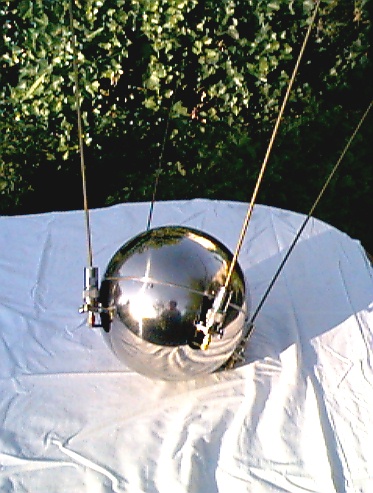
Another mini-Sputnik satellite will be launched by hand this month from the Russian Mir space station. The announcement of the so-called Sputnik 41 comes almost one year to the day after the launch of Sputnik 40, which commemorated the launch of the first artificial Earth satellite by the USSR in 1957. The newest Sputnik arrived on Mir aboard a Progress supply rocket late last month. It's due to be launched by hand during a spacewalk by the Mir crew in the November 10-11 timeframe. Sputnik 41, which is variously being called RS-18, was financed by the Aeroclub de France to mark its centennial. It's part of a program of satellites made in collaboration with Russian and French students. AMSAT-France is cooperating with the education department of the Russian Aeronautic Federation to bring about this latest Sputnik encore. Sputnik 41 is the same size as its predecessor--20 centimeters (just under 8 inches) in diameter--approximately one-third the size of the original Sputnik. It weighs 4 kg (almost 9 pounds). The latest version will carry a 150-200 mW transmitter that will transmit on or about 145.812 MHz (5 kHz and Doppler shift). The spacecraft will not carry solar cells, and it has an expected operational lifetime of up to 30 days. The last mini-Sputnik outlasted its expected one-month life by some 20 days, however. AMSAT-France's Gerard Auvray, F6FAO, reports that, like Sputnik 40, the new spacecraft will transmit its "bip-bip" beacon plus audio-frequency telemetry that indicates the satellite's internal temperature (see table, below). But, Sputnik 41 also will broadcast pre-recorded voice greetings in three languages, French, English, and Russian. One, read by 14-year-old Constantin Sambourov, declares in Russian-accented English: "1998 was the International Year of Air and Space." Sambourov is the son of Sergei Sambourov, RV3DR, who manages Amateur Radio activity aboard Mir. A second English message read by Project Chief Victor Kourilov of the Russian Aeronautic Federation states "International Space School Sputnik Program." The French and Russian messages convey the same greetings. Auvray himself reads one of the French greetings. Visit the 1998 International Year of Air and Space page. Telemetry of Internal Temperature
179 Hz = 38 |
SOLAR UPDATE
Solar scribe Tad Cook, K7VVV, Seattle, Washington, reports: Solar activity was up for the week, but down over the past month. Average solar flux for July through September was 114.1, 136, and 137.7, and only 117.3 for October. But conditions are definitely looking up over the past week. Average sunspot numbers jumped nearly 40 points to 84.7, and average solar flux increased about 17 points to 125.8. The really great news is that solar flux has been climbing rapidly this week. It jumped suddenly to 151.8 on Tuesday, and then on Thursday the three readings for the day at Penticton were 146.9, 152.7 and 158.6. The noon reading at 152.7 is the official number for the day.This weekend could have some interesting conditions for the ARRL November Sweepstakes (CW). Solar flux is expected to remain high at 155, 150 and 150 for November 6-9, but the planetary A index for the same period is expected to be 12, 24 and 32. This is due to some solar flares on November 4-5. High K index numbers of four or five or higher will make it harder to pick up KL7 and VE8 multipliers in the weekend contest.
Beyond the weekend look for more unsettled to active geomagnetic conditions from November 14-21, with the worst period around November 15-17.
The high solar flux has made the upper bands interesting. The author has been operating mobile on 10, 15 and 17 meters, and has been working the world during the daily commute using low power and a simple mobile whip. 17 meters has been particularly fun, since the higher frequencies often aren't open yet on the West Coast during the early morning drive to work.
Sunspot numbers for October 29 through November 4 were 81, 81, 71, 79, 76, 81, and 124 with a mean of 84.7. The 10.7-cm flux was 109.5, 111.5, 118.7, 121.4, 126.1, 151.8, and 141.4, with a mean of 125.8. The estimated planetary A indices were 8, 5, 5, 3, 5, 5 and 5, with a mean of 5.1.
In Brief:
- This weekend on the radio: The ARRL November Sweepstakes (CW) will dominate the HF bands this weekend along with the North American Collegiate ARC Championship (CW; see SS rule 6, October QST, page 118) and the International Police Association IPA SSB and CW contest. Just ahead: The Japan International DX Contest (SSB) is November 13-15, not November 7-9 as announced in November QST. The Worked All Europe Contest (RTTY), the OK/OM DX Contest, and the Peace Country Amateur Radio Club QRS Contest are November 14-15. See November QST, page 97, for details.
- Vanity update: The FCC in Gettysburg reports it has processed vanity applications received through October 8. The October 29 processing run yielded 177 license grants. Another 248 applications landed in the work-in-process (WIPs) stack.
- All QSTs now available on CD-ROM: Now you can see every issue of QST on CD-ROM! The 1915-29 QST View CD-ROM sets have arrived. Each page--all the ads, articles, columns and covers--has been scanned to provide a black-and-white image that can be read on your computer screen or printed. Easy-to-use software (included) allows you to search for articles by title and author, select specific year and issue, and browse individual articles or columns. Each set of CDs has an index to aid in finding the page or section of the issue you want to view or print. Requires Microsoft Windows 3.1 or higher. The 1915-1929 set is Item No 7009. Each set is $39.95. Visit ARRLWeb for details or call, toll-free, 888-277-5289.
- QSLing reminders: Effective January 1, 1999, the ARRL Outgoing QSL Service fee increases to $6 per pound (or portion thereof). Other fees remain unchanged. It still costs $1 for 10 cards, $2 for 20 cards and $3 for 30 cards, etc. Also, effective January 1, 1999, US first-class postage increases to 33 cents. Remember to send your Incoming QSL Bureau extra postage if you have envelopes on file bearing a 32-cent stamp. Also, include an address label or clearly print your return address on envelopes submitted to your Incoming QSL Bureau. Some Bureau Managers are receiving envelopes with no return address. Information sheets on the ARRL QSL Service are available from ARRL HQ. Send an e-mail request to buro@arrl.org or send an SASE to QSL Service, ARRL, 225 Main St, Newington, CT, 06111.--Martin Cook, N1FOC
- Netherlands LF test: A special CW LF operation will be on the air from the Netherlands beginning November 14 at 0900 UTC. The frequency will be 136.5 kHz, and the call sign will be PA2NJN. The operation will run 150 W to a wire antenna, tethered to a kite at about 920 feet in the air. (If there is not adequate wind, the experiment will be postponed.) Richard Middel in the Netherlands reports the last operation was done using a kite-flown wire antenna up about 225 feet. That station was heard in France, Belgium, the UK, Australia, and elsewhere. Send reports to PA2NJN c/o PI8AWT, or to richard.middel@hetnet.nl. The ARRL is seeking an LF allocation (see top story above) and other countries already have authorized LF operation around 136 kHz.--thanks to Jim Romelfanger, K9ZZ
- QST Cover Plaque Award: The QST Cover Plaque Award winner for October was John A. Hansen, W2FS, for his article "Using PIC Microcontrollers in Amateur Radio Projects." Congratulations, John!
- RAC cuts dues, tightens belt: A major restructuring plan is under way at Radio Amateurs of Canada. RAC says it's immediately rescinding a recent $10 membership fee increase, returning annual dues to $39.95. RAC says it will extend the membership of those members who paid the $49.95 rate. RAC plans to cut its operating expenses by $80,000 through "reductions in paid staff, decrease in office floor space rental, and costs of publishing The Canadian Amateur." For more information, see the RAC Web site.--RAC
- VG3W commemorative call sign: The special call sign VG3W has been assigned to the McCrae House Museum in Guelph, Ontario, for the period November 4-11, 1998, to commemorate the fallen of both world wars.--RAC
- OD5LE elected as Lebanon's president: Another radio amateur soon will become a head of state. Lebanese Army General Emile Lahoud, OD5LE, was elected Lebanon's president October 15. All 118 members of the parliament present voted for Lahoud, who heads Lebanon's army. Lahoud, 62, officially will succeed President Elias Hrawi November 24. He will serve a six-year term. A naval officer, Lahoud trained in the UK and speaks English fluently.