ARRL Audio News
| · | To subscribe, unsubscribe, or change your e-mail delivery address: see How to Get The ARRL Letter, below |
| · | Delivery problems (ARRL member direct delivery only!): letter-dlvy@arrl.org |
| · | Editorial questions or comments: Rick Lindquist, N1RL, rlindquist@arrl.org |
| · | ARRL Audio News: http://www.arrl.org/arrlletter/audio/ or call 860-594-0384 |
| · | The ARRLWeb Extra: http://www.arrl.org/members-only/extra |
IN THIS EDITION:
- +ARRL Board to hold special session
- +FCC issues ULS rules
- +Hundreds of hams doing flood duty
- +SEDSAT-1 set to launch October 25
- +P3D begins pre-launch testing
- Dan Henderson, N1ND, is new Contest manager
- Solar update
- Lee Aurick, W1SE, SK
- In Brief: This weekend on the radio; SEDSAT/DS1 special event; Marine Corps Marathon special event; Pensacola Interstate Fair special event; Vanity update; Hams to help anchor space coverage; NFCC/NFCB officers elected; Correction I; Correction II
+ Available on ARRL Audio News
ARRL BOARD OF DIRECTORS TO MEET IN SPECIAL SESSION
The ARRL Board of Directors meets in a special session on October 24 in St Louis. The agenda contains a single item: to consider the League's response to the FCC's August Notice of Proposed Rulemaking, WT Docket 98-143.
Among other things, the FCC has proposed elimination of the Novice and Tech Plus tickets and a reduction from six to four license classes. The FCC also invited comments on a number of other issues, including Morse code testing requirements.
At its July meeting, the ARRL Board issued its own license restructuring proposals that also call for an end to the Novice and Tech Plus tickets and four license classes. Additionally, the plan would offer substantial HF privileges with a 5 WPM Morse code test, require a 12 WPM code test for Advanced privileges, and eliminate the 20 WPM code test for Amateur Extra privileges. The League plan also called for beefing up the Extra class written exam and "refarming" the existing Novice bands--primarily as additional phone segments. The ARRL informed the FCC of its restructuring ideas by letter but did not file a formal petition for rulemaking.
Comments on the FCC's NPRM are due December 1. Reply comments are due January 15.
FCC ISSUES UNIVERSAL LICENSING SYSTEM RULES
The FCC has issued its long-awaited Report and Order on the Universal Licensing System, which affects all Wireless Telecommunications Bureau licensees. Among other things, the ULS will result in replacing Amateur Radio's familiar FCC Form 610 series with a new Form 605. The new rules become official 60 days after publication in The Federal Register--sometime around the end of the year. The FCC said it expects to have the ULS fully operational by next April. Using the ULS, applicants and licensees will be able to file, modify, and renew electronically. Access to the ULS is via http://www.fcc.gov/wtb/uls/.
The FCC's action consolidates approximately 40 existing forms into four ULS applications, including the new Form 605. Electronic filing in the ULS will not yet be mandatory for individual amateurs. Hams will have the option of filing electronically or on paper. However, electronic filing via the ULS will be required for Volunteer Examiner Coordinators in the Amateur Service.
Under the ULS, amateurs will use Form 605, the Quick-Form Application for Authorization in the Ship, Aircraft, Amateur, Restricted and Commercial Operator, and General Mobile Radio Services for all purposes. Applicants may continue to use the old forms for six months after the new rules go into effect, however.
Responding to comments from the ARRL and the W5YI Group, the FCC said it would include the Physician's Certification of Disability (Physician's Certification) on the new Form 605 in Part 2 of Schedule D.
As part of its Report and Order on the ULS, the FCC also issued amended rules (in WT Docket 96-188) to authorize visiting foreign hams to operate in the US pursuant to recent international reciprocal operating agreements. "We conclude that all alien amateur radio reciprocal operation should be authorized by rule," the FCC said. This means that foreign hams holding a CEPT radio-amateur license from a CEPT country or an International Amateur Radio Permit issued by a participating CITEL country may operate while visiting the US without having to apply for permission. Additionally, it will be easier for US hams to operate in participating countries in Europe and the Americas.
Against ARRL objections, the FCC eliminated the one-year term for an alien reciprocal permit and will not require an FCC license document. The FCC noted that the new system is similar to the one already in place for US and Canadian hams to operate in each other's countries. The authority would not extend to US citizens claiming second citizenship and an amateur license from another country, however.
The FCC said it will require the submission of a Taxpayer Identification Number by applicants and licensees using ULS, "consistent with the requirements of the Debt Collection Improvement Act of 1996." Some commenters, particularly amateur operators, argued against the requirement, saying that disclosure of a TIN--typically a Social Security Number--raised privacy concerns and was unnecessary to the Commission's regulatory goals. But, the FCC said its security measures will limit access to TIN data both online and to FCC staff. "Once data has been entered into ULS, sensitive data such as TINs will not be accessible to the public," the FCC said. The FCC has not addressed how it plans to handle applicants who do not have a TIN, such as foreign nationals who hold FCC licenses.
The FCC stood by its plan to use certain eligible private-sector entities, on a strictly voluntary basis, to issue club and military recreation station call signs.
Both text and formatted versions of the complete Report and Order, WT Dockets 98-20 and 96-188, are available on the FCC Web site, http://www.fcc.gov.
HUNDREDS OF HAMS VOLUNTEER FOR FLOOD DUTY
The death toll is approaching 30 in central and southern Texas as flooding that began last weekend continues to affect downstream communities. South Texas Section Manager Ray Taylor, N5NAV, reports that at least 425 hams are active in Texas, Louisiana, Oklahoma, and Arkansas handling various flood-related duties ranging from net control to shelter communication. With public telephone systems already overloaded or out of service, hams have been supporting the Texas Department of Public Safety by providing communication between its Austin headquarters and affected communities such as Victoria and Corpus Christi.
Taylor says the worst damage so far has been in the New Braunfels area in Comal County where he lives. Hams are providing communication assistance for the Dallas-based Baptist Men's Kitchens feeding program there and elsewhere as well as for the Salvation Army and other outside relief organizations. Taylor credited Comal County EC Todd Covington, N5IJR, with taking time away from his own flood-damaged home to roll out the PrimeCo communications van and pressing it into flood duty. He says two repeaters in the van are aiding Red Cross communication.
San Antonio and Bexar County also were hard-hit by the flooding. Bexar County EC Neil Martin, WA5FSR, says amateur have been providing continuous support for the Red Cross and other agencies since midday last Saturday.
Six shelters were open in the San Antonio area. Another 20 or more shelters remain open between San Antonio and the Gulf Coast, and additional shelters were being opened as other areas were affected to the east and southeast of San Antonio.
The Red Cross has had to rely more heavily than usual on ham radio assistance because its San Antonio headquarters was flooded out. The Red Cross has set up temporary headquarters at Fort Sam Houston, but it has only a few telephone lines available, Martin explained. "This lack of telephone capability is why we are having to man all of the shelters 24 hours a day," he said.
Martin said the long hours have begun to take their toll on the amateurs who have volunteered for duty, and he and Taylor have expressed concerns about finding relief operators. "We've had awful good cooperation, but we don't have enough operators without pulling them from somewhere else," Taylor said. He said he expects hams to be active in the flood emergency "for another three weeks."
The flooding and tornadoes last weekend knocked out power and telephone service for tens of thousands of Texas residents. In San Antonio, the 911 system was overloaded at one point with calls prompted by flood-related problems.
At Taylor's request, the FCC has declared a voluntary communications emergency. Hams are being asked cooperate by relinquishing the use of 7.285 and 7.290 MHz during daylight hours and 3.873 and 3.935 MHz during the evening. The FCC has asked hams to clear the frequencies within 3 kHz on either side. The communications emergency remains in effect until it's rescinded by the FCC.
SEDSAT-1 SATELLITE TO LAUNCH OCTOBER 25!
The SEDSAT-1 satellite package is set go into space Sunday, October 25, at 1200 UTC. That word this week from Chris Bond, KF4UGG, at the University of Alabama-Huntsville. SEDSAT-1 will include Amateur Radio digital packet store-and-forward and analog repeater systems. SEDSAT-1 will fly as a secondary passenger along with the Jet Propulsion Laboratory's Deep Space One mission aboard a Delta II booster.
Built by students at the University of Alabama's Huntsville campus, SEDSAT-1 will carry a Mode L digital transponder as well as a Mode A analog transponder.
Project coordinator and UAH Associate Professor Mark Maier, KF4YGR, says SEDSAT will separate from the second stage over the Eastern Pacific between California and Hawaii about 83 minutes after launch. SEDSAT will begin transmitting Mode L.
The Mode L frequencies will be 1268.175 to 1268.250 MHz up and 437.850 to 438.000 MHz down, FSK, 9600 baud. The Mode A frequencies will be 145.915 to 145.975 MHz up, and 29.35 to 29.42 MHz down.
Maier says the Mode A transponder will not be turned on immediately. "It will take several weeks and will have to be scheduled because of power issues," he said. "Also, we've seen a bit of frequency drift with time and temperature so don't be surprised at some changes in the exact values on orbit." Maier says this is due to the fact that the radios are "several years old, from an earlier incarnation of the project."
For additional information, visit the SEDSAT Web site, http://146.229.5.181/
PHASE 3D SATELLITE BEGINS THERMAL-VACUUM TESTING
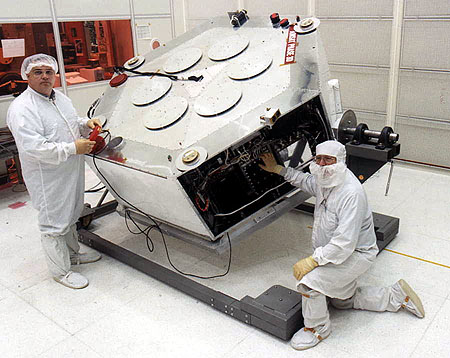 AMSAT Phase 3D Integration Lab Manager Lou McFadin, W5DID (right) and his first assistant Rick Leon, KA1RHL, prepare the Phase 3D spacecraft for thermal-vacuum testing at the Orbital Sciences Corp facility near Washington, DC. Photo by Ron Benden/OSC. |
OSC Manager of Systems Integration and Test John Cavallo, KB3BWP, says that once a vacuum has been established in the test chamber, the satellite will undergo several testing cycles at both hot and cold temperature extremes. The spacecraft will be subjected to a maximum temperature of 45º C and a minimum of -20 C over five testing cycles. Each test cycle lasts approximately 36 hours.
Phase 3D Integration Lab Manager Lou McFadin, W5DID, says the spacecraft will be powered up during the thermal-vacuum testing and will transmit telemetry just as though it were already in space. "Things are looking very good," McFadin said October 20, as P3D team members completed status checks prior to the testing.
Assuming the spacecraft successfully passes the thermal-vacuum testing, vibration testing likely will be conducted sometime after the first of the year, McFadin said. The vibration testing is designed to simulate the stresses the spacecraft must endure during launch.
"We look forward to getting this running," said McFadin, expressing the hopes of the amateur community.
For more information on Phase 3D, see the Phase 3D Spacecraft Integration Laboratory Web site, http://www.magicnet.net/~phase3d.
DAN HENDERSON, N1ND, IS NEW ARRL CONTEST BRANCH MANAGER
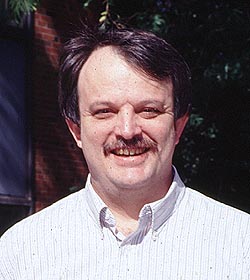
Dan Henderson, N1ND, says he's not a big-time contester, but he enjoys competing on a casual level. He also feels that his broad view of the hobby gives him the perspective he needs to be the League's new Contest Branch Manager. The 43-year-old Asheville, North Carolina, native joined the HQ staff this fall (September 30 was his first day) promising to make the Contest Branch "more responsive, more timely, and more accurate." He says he'll also seek better ways for contesters to transfer logging data to ARRL HQ.
What Henderson says he will not attempt is to "mess with successful contests." His philosophy is that contesting is beneficial on more than one level "as a means of promoting enthusiasm" within the hobby.
Henderson's "Yankee" call sign really has more to do with his alma mater in Indiana than with New England. It stands for "Number One Notre Dame."
A ham for approximately 27 years now, Henderson says his parents enrolled him in an Amateur Radio class as a "bored high school kid." He got his first (of several) Novice licenses in 1971 (he was WN4YMV and WN4QQN among others; as one ticket expired, he'd retake the test and get another).
Once beyond his serial-Novice phase, he progressed to Extra within six months. Henderson, who was WA4QQN for about 20 years, has served as an AEC, EC and DEC for more than 15 years and was active in developing VE exams in the early days of the WCARS/VEC. Over the years, he says, he's been very active in local club activity with an emphasis on Elmering and public service.
Before coming to ARRL Headquarters, Henderson taught high school in North Carolina and West Virginia and at the college level in North Carolina, Vermont, Georgia and Alabama.
Henderson says his favorite operating event is the ARRL International DX Contest CW, and he's in the process of joining the Yankee Clipper Contest Club. But he'd like to see some entry-level events, "maybe an Elmer-type contest" as a replacement to the Novice Roundup that pairs new hams with experienced hams to build interest among newcomers.
Dan Henderson welcomes your comments and suggestions. Contact him at dhenderson@arrl.org, or call him at 860-594-0232.
SOLAR UPDATE
Sun watcher Tad Cook, K7VVV, Seattle, Washington, reports: Solar activity was up again last week, but not by much. Average sunspot numbers increased from 95 to 113.6, and average solar flux was up from 119.7 to 125.9. The big event of the week was a major geomagnetic storm on October 19, when the planetary A index shot up to 52. The planetary K index was as high as 6 and the high latitude K index reached 7. This was all due to a coronal mass ejection on October 15.
Conditions should be fair for the CQ Worldwide DX Phone contest this weekend. There is a chance that coronal holes could disrupt geomagnetic conditions, but on the night of October 22, the predicted solar flux is around 115 for October 23-25, and a planetary A index for the same three days of 15, 12 and 10. Beyond the weekend, the solar flux is expected to stay around 115, then rise around November 3, to peak near 125 on November 4 and 5. Look for unsettled conditions around November 3-6.
KB4NEW sent word about an interesting chart on the NASA Space Science News Web site. Go to http://www.astronomynews.com, then click on "Oct 19: Sunspot Activity Increases." An article follows which talks about Cycle 23 predictions at the Marshall Space Flight Center. Clicking on the graph will reveal a large, high-resolution chart showing actual sunspot numbers against a very smooth predicted graph.
W2PAT sent some interesting statistics on PSK errors when detecting data on the CHU signal on 7.355 MHz. His records show an average number of 43 errors on each day from October 12-18, but on October 19 the errors went up to 422, the day with the big geomagnetic storm conditions.
Sunspot numbers for October 15 through 21 were 113, 120, 107, 136, 116, 104, and 99, with a mean of 113.6. The 10.7-cm flux was 131.1, 131, 135.4, 125.9, 118.5, 121.2, and 118.3, with a mean of 125.9. The estimated planetary A indices were 6, 4, 9, 10, 52, 17 and 23, with a mean of 17.3.
FORMER ARRL STAFFER LEE AURICK, W1SE, SK
Former ARRL HQ staff member Lee Aurick, W1SE, of Winter Springs, Florida, died October 15, after a brief illness. He was 76. From 1977 until 1987, Aurick was the advertising manager for QST and other League publications, but he first joined the ARRL staff in 1954, serving as assistant secretary until 1957. He then went to work for the RCA Advertising and Sales Promotion group but rejoined the HQ staff 20 years later. Aurick and his wife, Mary, moved to Florida following his retirement in August of 1987.
A New York native, Aurick was first licensed in 1946 as W2QEX. He was a graduate of Newark College of Engineering and served in World War II as a radio operator. As an amateur historian, he maintained a special interest in World War II and the events leading up to it. He also was a private pilot.
Aurick was a life member of the ARRL and of the Newington Amateur Radio League. He also was involved in Amateur Radio club activities in Florida and was active on the air until his death. In addition to his wife, survivors include his son, Lee II, K3QAF, and three other children, Caryl, Marjorie, and Sharon.
IN BRIEF:
- This weekend on the radio: The CQ WW DX Contest (SSB) is October 24-25. Just ahead: The BARTG RTTY Sprint is October 31.
- SEDSAT/DS1 special event: The Jet Propulsion Lab Amateur Radio Club will operate W6VIO as a special event station to celebrate the launch of the Deep Space One and SEDSAT-1 packages. JPLARC Vice President Mark Schaefer, WB6CIA, says W6VIO will be on the air starting at 0000 UTC October 24 until 0500 UTC October 28, on all HF bands, SSB and CW, near the top end of the band edges. W6VIO also will transmit SSTV on 14230 or 14233 kHz as propagation permits. A special QSL, certificate and fact sheet on the DS1 mission will be available. QSL to the JPLARC, Box 820, La Canada/Flintridge, CA 91012.
- Marine Corps Marathon special event: Special event station N4M will be on the air to commemorate the 23rd running of the Marine Corps Marathon, which is Sunday, October 25. N4M is sponsored by the Fauquier Amateur Radio Association. (The National Capital ARES Council will provide on-site communication). Special event frequencies are 3.855, 7.263, 14.255, 21.305, and 28.355 MHz. Operation begins 2100 UTC October 23 to 0100 October 24 and continues 1200 to 2100 UTC October 24 and 25.To receive a QSL, send a 9x12 SASE to FARA-Marathon, PO Box 752, Warrenton, VA 20188.
- Pensacola Interstate Fair special event: The Five Flags Amateur Radio Association will operate special event station K4P at the Pensacola Interstate Fair from October 22-31. Frequencies will be on or around 7.250, 14.250, 21.250 and 28.350 MHz. QSL to K4P, PO Box 5731, Navarre, FL 32566.--Ed Palmer, KU4LY
- Vanity update: The FCC in Gettysburg reports it has processed vanity applications received through September 21. In the last processing runs on October 20 and 21, there were 113 grants. Another 104 applications landed in the Work in Process (WIPs) stack.
- Hams to help anchor space coverage: CNN has announced that Miles O'Brien will coanchor that network's coverage of John Glenn's historic return to space with CBS broadcast legend Walter Cronkite, KB2GSD. O'Brien replaces the late John Holliman in covering the October 29 shuttle flight. Sources at CNN said the coverage will be dedicated to Holliman, who died in an automobile accident September 12. Meanwhile, SAREX Working Group Chairman and former NBC newsman Roy Neal, K6DUE, will be on NBC's Today show for the STS-95 launch and subsequent coverage. John Glenn's closest friend, Tom Miller, K4IC, will sit in during launch-day coverage as well.--New York Post/ShopTalk via The Hudson Loop
- NFCC/NFCB officers elected: The National Frequency Coordinators' Board (NFCB) has elected the following named persons to serve in the various National Frequency Coordinators' Council (NFCC) and NFCB offices until September, 1999. NFCC President: Dick Isely, W9GIG; NFCC Vice President: Whit Brown, WB0CJX; NFCC Secretary: Clay Freinwald, K7CR; NFCC Treasurer: Dave Shiplett, AC4MU; NFCB Chairman: Dick Isely, W9GIG; NFCB Vice Chair: Owen Wormser, K6LEW.
Additional note: The NFCC's new Web site is open at http://www.arrl.org/nfcc. Among other things, the site contains the ARRL/NFCC memorandum of understanding, the NFCC Bylaws as amended last January, and the NFCC Certification Standards. The Webmaster is Joe McElhaney, KR3P, who welcomes comments and suggestions. --Dick Isely, W9GIG - Correction I: Veteran DXer and DXpeditioner Jules Wenglare, W6YO, of Delano, California, died August 16. The date of his passing was incorrectly reported in The ARRL Letter, Vol 17, No 41.--thanks to John Gray, W6UZ
- Correction II: Our report on the Minneapolis Plenipotentiary Conference in The ARRL Letter, Vol 17, No 41, overstated attendance figures. Attendance at the Minneapolis Plenipot is not expected to exceed 1500 delegates and observers.