ARRL Audio News
| · | To subscribe, unsubscribe, or change your e-mail delivery address: see How to Get The ARRL Letter, below |
| · | Delivery problems (ARRL member direct delivery only!): letter-dlvy@arrl.org |
| · | Editorial questions or comments: Rick Lindquist, N1RL, rlindquist@arrl.org |
| · | ARRL Audio News: http://www.arrl.org/arrlletter/audio/ or call 860-594-0384 |
| · | The ARRLWeb Extra: http://www.arrl.org/members-only/extra |
IN THIS EDITION:
- +K4PG wins three-way race for SFL SM slot
- +Spectrum bill picks up additional sponsors
- +New satellites get OSCAR designations
- +NY club creates $100,000+ scholarship fund
- +AMSAT annual meeting set for October
- +Morse magazine gets new lease on life
- Solar update
- Ben Friedland, K2BF, SK
- "Ack" Atkerson, W4RRW, SK
- Harry Angel, VK4HA, SK
- In Brief: This weekend on the radio; Lighthouse/Lightship Activity Weekend; Correction; Clarification; Vanity update; The Million QSL March; July QST Cover Plaque Award; APRS frequency map on the Web; DLARC marks 50 years; Slovenia gets new bands; Turkey added to reciprocal, third-party lists
+ Available on ARRL Audio News
K4PG WINS SOUTHERN FLORIDA SM SLOT
Kevin M. "KB" Bunin, K4PG, has been declared elected as Southern Florida Section Manager. Bunin, who lives in Delray Beach, topped a field of three candidates for the post with 827 votes. Ed Petzolt, K1LNC, got 691 votes; Neil H. Lauritsen Sr, KA3DBK, got 400 votes. Ballots were counted August 18 at ARRL Headquarters. Bunin takes office October 1.Three other new section managers also will begin their terms of office October 1. All three were unopposed for election. In Puerto Rico, Juan Escobar, KP4ZZ, of San Juan, replaces Guillermo Schwarz, KP3S. In Idaho, Michael Elliott, KF7ZQ, of Boise, succeeds Mike Langrell, AA7VR. In Ohio, Joe Phillips, K8QOE, of Fairfield, replaces David Kersten, N8AUH.
Six incumbent section managers were unopposed for re-election and begin new terms October 1. They are Coy Day, N5OK, Oklahoma; Bill Kurtti, WC0M, North Dakota; Randy "Max" Wendel, N0FKU, Minnesota; Betsey Doane, K1EIC, Connecticut; Bill Thompson, W2MTA, Western New York; and John Ellis, NP2B, Virgin Islands.
Vermont got a new section manager on August 14. Bob T. DeVarney, WE1U, of Milton, succeeded Bernie Capron, N1NDN, who stepped down.
SPECTRUM BILL PICKS UP MORE SPONSORS
During August, HR 3752, the Amateur Radio Spectrum Protection Act, picked up seven new cosponsors. This brings the total to 64, plus the original sponsor Rep Michael Bilirakis of Florida.The August additions include Rep Frank R. Wolf, Virginia; Rep Linda Smith, Washington; Rep George Miller, California; Rep Max Sandlin, Texas; Rep Lynn Rivers, Michigan; Rep William Goodling, Pennsylvania; and Rep Anne Northup, Kentucky.
The ARRL's Legislative and Public Affairs Manager Steve Mansfield, N1MZA, returns to the Hill the first week of September to prepare for Congress' return from its "district work period" the following week.
NEW SATELLITES GET OSCAR DESIGNATIONS
Amateurs radio's two newest satellites, TMSAT-1 and TechSat-1B, are reported doing very well after a month in space. The two birds were launched jointly in late July from Russia's Baikonur Cosmodrome. At this point, neither satellite is ready for general use. The two spacecraft continue to undergo initial loading of flight software.
Both satellites also have received OSCAR designations from AMSAT. TMSAT has been dubbed TMSAT-OSCAR-31 (TO-31), while the Gurwin TechSat 1B will be known as Gurwin-OSCAR-32 (GO-32). The assignment of consecutive OSCAR numbers to new Amateur Radio spacecraft is a tradition that dates from the launch of the very first Amateur Radio Satellite--OSCAR 1. In order for an OSCAR number to be assigned, the satellite must successfully achieve orbit and one or more transmitters must be successfully activated in the Amateur Radio bands. Then, the builders/owners of the satellite must formally request that a consecutive OSCAR number be assigned to their satellite.
TMSAT, the first Thai microsat, was constructed by Thai engineers in cooperation with engineers at the University of Surrey in the UK. It's primarily designed along the lines of a low-earth-orbiting communications satellite, similar to those in the Iridium constellation. The TMSAT control station in Bangkok is HS0AM.
Chris Jackson, G7UPN/ZL2TPO, reports that TMSAT commissioning has proceeded slowly for a variety of reasons. Jackson says ground control stations have been operating the downlink transmitter mainly over Bangkok and Surrey. The satellite is also performing a number of new tasks that have not previously been used before, and this is taking some time to get fully operational in orbit.
Shlomo Menuhin, 4X1AS reports TechSat-1B is also responding well to ground control commands. Menuhin said the satellite recently took its first picture from space, centered over the French Riviera near San Tropez. The satellite contains an ultraviolet spectro-radiometer, a charged particles detector, and a superconductivity experiment, among other experiments.
Images from both satellites and access to additional information are available via the AMSAT Web site, http://www.amsat.org. Both satellites are expected to be available for general amateur use shortly. --thanks to AMSAT News Service
NEW YORK CLUB CREATES $100,000+ SCHOLARSHIP FUND
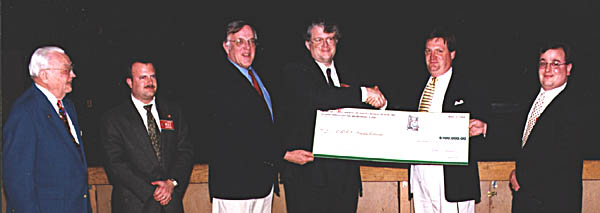 Officials of the Schenectady Amateur Radio Association present a symbolic check for $100,000 to create The Henry Broughton, K2AE, Memorial Scholarship. Shown, l-r, are Broughton Estate executor Jim Pontius, W2CPB; ARRL Hudson Division Vice Director J. P. Kleinhaus, W2XX; ARRL Hudson Division Director Frank Fallon, N2FF; ARRL New England Division Director Tom Frenaye, K1KI (representing the ARRL Foundation); SARA President John Domblewski, N2OJY, and SARA Treasurer Dennis Hudson, N2LBT. |
The Schenectady (New York) Amateur Radio Association (SARA) has used a trust established by the late William G. Broughton, W2IR--one of its most prominent members--to create a $100,000 scholarship fund. The scholarship will benefit college-bound hams in the Schenectady, New York, region. The stock transfer worth nearly $120,000 represents the single largest scholarship fund seed ever received by the ARRL Foundation, which will administer the fund.
The scholarship will be known as The Henry Broughton, K2AE, Memorial Scholarship. K2AE now is SARA's club station call sign. SARA established the scholarship to honor the memory of Henry Broughton, William's father. SARA says Henry Broughton's early work with Nikola Tesla exemplified the pioneering efforts of early wireless experimenters. William Broughton created the trust fund about 40 years ago in his father's memory.
Eastern New York Section Manager Rob Leiden, KR2L, said Broughton established the trust to help area amateur radio operators receive a quality education. "Bill understood that many college-educated amateur radio operators have made some of the most important scientific and engineering discoveries in this century," he said. "He was determined to do what he could to help maintain that record of achievement."
Applicants for the annual $1000 award must hold a General class or higher license and be accepted at or attend a four-year college or graduate program. Preference goes to students who live within 70 miles of Schenectady. Applicants must be enrolled in a course of technical study, such as engineering or the sciences, and academic excellence is the primary consideration. More than one scholarship may be awarded if the fund's earnings permit.
The Schenectady Amateur Radio Association and representatives from the American Radio Relay League celebrated the creation of the scholarship fund May 4, although formalities to establish the fund were only completed this summer.
16TH AMSAT ANNUAL MEETING AND SPACE SYMPOSIUM SET
The registration form and agenda for this fall's AMSAT Annual Meeting and Space Symposium now are available on the Web at http://pages.prodigy.com/DXHF93A. The symposium, set for October 16-18, 1998, at the Battlefield Inn, Vicksburg, Mississippi, offers a diversity of amateur radio satellite presentations. Among those on the program are:
- The History of the Amateur Radio Satellite Program, by Martin Davidoff, K2UBC.
- Antarctica and Amateur Radio, by Ron Ross, KE6JAB
- Working Satellites From Over 100 Grid Squares, Chuck Duey, KI0AG
- The Year 2000 Transition--Your PC and AMSAT Software, by Roy Welch, W0SL
- TRACKNET: An AMSAT Mobile Satellite System, by Bob Bruninga, WB4APR
- Development of Yet Another Housekeeping Unit for Phase 3D, by James Miller, G3RUH and associates
- SETI on the Cheap: Affording the Ultimate DX, by Paul Shuch, N6TX
- An EZ-Sat Update, by Fred Winter, N2XOU and Ken Ernandes, N2WWD
- JAWSAT Update, by Randolph Kohlwey, N7SFI
- International Space Station Status, by Will Marchant, KC6RCL
- The P3D Spacecraft Thermal Design, Dick Jansson, WD4FAB and Keith Baker, KB1SF
Other activities planned during the symposium include sessions devoted to a Phase 3D update and an introduction to Amateur Radio satellites by QST Managing Editor and satellite buff Steve Ford, WB8IMY. The Friday evening beginner's session on Amateur Radio satellites will be open to the public. The Saturday banquet speaker will be ARRL Vice President Joel Harrison, W5ZN.
Following the Area Coordinators' breakfast Sunday morning, participants will take a field trip to the US Army Engineers Waterways Experiment Station where--among other things--they will learn about using satellites to track sea turtles.
Transportation is available between the Jackson International Airport and the Battlefield Inn in Vicksburg. The Jackson Amateur Radio Club will host an AMSAT Welcome Table at the Jackson International Airport on Thursday and Friday, October 15 and 16, to assist with transportation.
The early-bird registration deadline is September 15. For more information, contact, Eddie Pettis, N5JGK, e-mail n5jgk@amsat.org.
MORSE MAGAZINE GETS NEW LEASE ON LIFE
The Morse magazine Morsum Magnificat, which had been on the verge of ceasing publication, has a new editor and publisher. Zyg Nilski, G3OKD, will take over the reins of the magazine following the publication of the December 1998 issue. The magazine's banner proclaims "Still flying the flag for Morse."
The magazine's current Consultant Editor, Tony Smith, G4FAI, said that subscriptions will be transferred to the new publisher. Nilski, 55, lives in England and has been a ham since 1960. His almost life-long interest in CW encompasses line telegraphy as well as the history of telegraphy and Morse technology.
Morsum Magnificat was first published in Dutch in 1983 by the late Rinus Hellemons, PA0BFN. A special English edition was put out in 1985. The following year, Smith--a writer specializing in Morse topics (and later chair of the European CW Association) joined the magazine as its English language editor. When Hellemons died in 1987, the Dutch edition ceased publication, and the magazine moved to England. Since 1990, Smith and Editor Geoff Arnold, G3GSR, have jointly produced the magazine.
SOLAR UPDATE
Sun watcher Tad Cook, K7VVV, Seattle, Washington, reports: Solar activity was down slightly this past week, but conditions are still very good and activity is still up. The average solar flux for the previous 90 days rose from 112 to 114 this week, and flux values were about 20 points higher on every day, indicating a strong upward trend. The solar cycle is definitely out of the doldrums. For dramatic graphic evidence of the strong upward trend, check out http://www.dxlc.com/solar/.
Activity should remain strong, with flux rising over the next few days to 142, 146 and 150 predicted for August 21-23. The planetary A index for the same period is predicted at 20, 18 and 10. Currently the A and K indices are rising as this is being written on Thursday evening, probably due to a major solar flare on August 18 as well as a northern polar coronal hole that extends somewhat down the solar surface. Additional flare activity could come from solar region 8307 before it departs around the end of August.
Solar flux should continue rising to around 160 for August 25-30, down to 150 around September 1-7, then up again around September 8 and 9 to 155. Watch for unsettled conditions around September 5-7.
Look for good 10, 12 and 15 meter conditions as we move toward the fall equinox in about a month. With higher solar flux, ten meters is opening up, particularly for those who live more toward the equator. Using a popular propagation prediction program, when I run a path projection for 10 meters to Ohio from my home in Seattle, the solar flux must be higher for good signals than if the path is from Los Angeles to Ohio. Los Angeles is nearly 1000 miles and 14 degrees latitude south of Seattle.
There were some interesting VHF propagation reports this week, with N0HJZ in Minnesota experiencing E-layer openings on both 6 and 2 meters to New Jersey and Connecticut, and 2 meter meteor propagation from Ontario. N5JHV in New Mexico worked several Europeans on 6 meters, and N9LR in Illinois worked WA2FGK in Pennsylvania on 222 and 1296 MHz via a tropospheric opening.
Sunspot numbers for August 13 through 19 were 109, 80, 106, 90, 90, 104, and 132, with a mean of 101.6. The 10.7-cm flux was 136.8, 137, 133.4, 139.7, 136.3, 132.6, and 134.6, with a mean of 135.8. The estimated planetary A indices were 9, 7, 6, 5, 5, 6, and 9, with a mean of 6.7.
BENJAMIN J. FRIEDLAND, K2BF, SK
ARRL Hudson Division Assistant Director Ben Friedland, K2BF (ex-K2PBP), of Mendham, New Jersey, died August 3. He was 55. Described as a fixture in the Northern New Jersey ham community, Friedland was president of the New Jersey DX Association, former president of the Morris Radio Club, Morris County RACES Radio Officer, trustee of the Morris County OEM 2 meter repeater, and NCS for many on-air nets. Friedland apparently collapsed while walking his dog shortly after running the Monday night RACES net. His wife, Janice, a son and a daughter are among the survivors. Friedland served as the president and general manager of Morristown & Erie Railway Inc for 20 years, was a member of the American Short Line Railroad Association, and a board member of the International Telecommunications Association. Services were August 5. The family has asked that memorial donations in Ben Friedland's name be made to the Morris Animal Foundation, the Whippany Railway Museum, or the American Heart Association. --The Hudson Loop
THOMAS E. "ACK" ATKERSON, W4RRW, SK
Tommy "Ack" Atkerson, W4RRW, of Jasper, Georgia, died August 2. He was 66. The owner of Ack Radio in Atlanta and Birmingham, he had recently retired to the North Georgia mountains. Atkerson served in the US Air Force before joining his dad, W4ECI (also known as "Ack") in Ack Radio. Tommy Atkerson opened the Atlanta office and then took over the supply company when his dad died. Atkerson sold ham gear for many years, but when Collins, Drake, and Ten Tec left the dealer market Ack Radio concentrated on electronic supplies. "Tommy was always smiling, and that's what we will miss most," said Southeastern Division Assistant Director David Thompson, K4JRB. Atkerson's son Steve (not yet a ham) now runs Ack Radio. The latest Ack Radio catalog has pictures of W4ECI and a young Tommy. --thanks to David L. Thompson K4JRB
HARRY ANGEL, VK4HA, SK
Australia's oldest ham, Harry Angel, VK4HA, died August 16. He was 106. A native of the UK, Angel arrived in Australia via California after a trip around the Horn as a young sailor. He enlisted in the Army at the start of World War I and was on the first ship of Aussie soldiers to leave for the war zone. He was posted to a communications unit in North Africa. After the war, he settled in Brisbane and eventually opened a radio repair shop. He became a radio amateur in 1935. When World War II broke out, he fudged his age and re-enlisted, serving in a radio repair and maintenance unit in Brisbane. "A ham for 63 years and an active DXer until his 100th Birthday, he was not known for the 10-second QSO, rather than the rag chew, and as an ambassador of Amateur Radio for his adopted country in particular," said Al Shawsmith, VK4SS. --QNews
In Brief:
- This weekend on the radio: The TOEC WW Grid Contest (CW) and the International Lighthouse/Lightship Activity Weekend are on tap this weekend. Just ahead: The SCC RTTY Championship, the Hawaii QSO Party, the BUBBA Summer QRP Spring, and the South Dakota QSO Party are the weekend of August 29-30.
- Lighthouse/Lightship Activity Weekend: This weekend is International Lighthouse/Lightship Activity Weekend. The event--which is not a contest--begins at 0001 UTC August 22 and continues until 2359 UTC on August 23 that will take place from 0001 UTC. Operation will be on 80, 40, 20, 15, and 10 meters. Stations will be on the air from lighthouses and lightships around the globe. To assist in identification, stations will add "light," "LGT," "lighthouse" or "lightship" after their call signs. Event coordinator Mike Dalrymple, GM4SUC, says each station decides how it will operate, including modes and bands. There is no restriction on power. "We wish operators to enjoy themselves and have fun whilst making contact with as many stations as possible," he said. Dalrymple said he hopes the international scope of the event will draw some attention to the hobby. Details of the activity are available on the Web at http://www.qsl.net/gm3zdh or contact Dalrymple at gm4suc@compuserve.com.
- Correction: The report "ARISS Delegates Discuss Ham Radio in Space" in The ARRL Letter, Vol 17, No 32, incorrectly stated that IARU satellite frequency coordinators from Regions 1 and 3 attended the AMSAT-UK session. The report should have said that IARU Satellite Frequency Coordinator Graham Ratcliff, VK5AGR, and IARU Satellite Advisor Hans van de Groenendaal, ZS5AKV, also were on hand. --thanks to Ray Soifer, W2RS
- Clarification: In its amateur rules "streamlining" Notice of Proposed Rulemaking, WT Docket 98-143, the FCC appears to require that comments filed on paper in this proceeding be accompanied by a word processing file on a computer disk. The FCC's Monte DePont has stated that this is not a strict requirement, and the FCC will continue to accept comments on paper only, unaccompanied by a computer file on disk. Diskless commenters may include a footnote saying: "My comments are being filed on paper only without a diskette, since it is not feasible for me to include a diskette." --thanks to Nick Leggett, N3NL
- Vanity update: Despite the fact that the vanity call sign fee does not drop to $13 until after September 14, there's little indication that anyone is waiting for that to happen before filing. The FCC in Gettysburg reports vanity applications through July 31 were processed this past week. In two processing runs, there were 188 grants and 245 applications ended up in the work-in-process (WIPs) stack. Among the more interesting call signs among the last two batches: KC2NYC, N4FUN, WR4USA, K3SEX, K7BEE, and K2FLY.
- The Million QSL March: It must be sunspots. ARRL Outgoing QSL Service Manager Martin Cook, N1FOC, reports the service topped the 1,000,000-QSL mark in August. As of August 14, the service had mailed 1,009,150 cards to QSL bureaus around the world. That represents an increase of more than 204,000 cards from the same date last year--up about 25%.
- July QST Cover Plaque Award: The July QST Cover Plaque Award went to Dennis Bodson, W4PWF, and Steven Karty, N5SK, for their article "FAX480 and SSTV Interfaces and Software," on page 32. Congratulations Dennis and Steven!
- APRS frequency map on the Web: Jeff Brenton, KA9VNV, says he's maintaining an APRS frequency map at http://www.dididahdahdidit.com/APRSFreq.htm. A text-only version with more detailed comments is at http://www.dididahdahdidit.com/APRSFrqt.htm. --Jeff Brenton, KA9VNV
- DLARC marks 50 years: Congratulations on the Delaware-Lehigh Amateur Radio Club for reaching the half-century mark as an ARRL-affiliated club. Clarence Snyder reports he was looking through some old papers and came across the ARRL Charter of Affiliation for DLARC dated July 13, 1948. --Clarence Snyder, W3PYF
- Slovenia gets new bands: Hams in Slovenia, S5, have been granted access to four new bands: 136 kHz, 70 MHz, 3.4 GHz, and a new 40 MHz "beacon band." The 40 MHz band is for beacons running narrowband FSK CW only. The frequency limits are 40.660 - 40.700 MHz, and the power limit is 10 dBW ERP. This is part of an IARU Region 1 initiative to obtain spectrum at 40 MHz for DX beacons, as an aid to propagation investigation, but it appears that Slovenia is the first country to make the allocation available. --QNews via RSGB and IRTS
- Turkey added to reciprocal, third-party lists: The ARRL (and the FCC) have belatedly received word that Turkey (TA) has signed a reciprocal operating arrangement with the US that permits hams of either country to operate in the other country. Turkey also has joined the list of countries that permit hams to handle communications on behalf of third parties.