ARRL Audio News
| · | To subscribe, unsubscribe, or change your e-mail delivery address: see How to Get The ARRL Letter, below |
| · | Delivery problems (ARRL member direct delivery only!): letter-dlvy@arrl.org |
| · | Editorial questions or comments: Rick Lindquist, N1RL, rlindquist@arrl.org |
| · | ARRL Audio News: http://www.arrl.org/arrlletter/audio/ or call 860-594-0384 |
| · | The ARRLWeb Extra: http://www.arrl.org/members-only/extra |
IN THIS EDITION:
- +FCC proposes to end Novice, Tech Plus
- +FCC proposes other Amateur Radio rules changes
- +ARISS delegates plan for ham radio in space
- +Wisconsin hams respond to flooding
- +FCC denies Checkpoint Systems petition
- FCC sequential call sign update
- Solar update
- In Brief: This weekend on the radio; Vanity update; WSWSS VHF+ Conference; Hams help MS bikeathon; Hams track down errant marine transmitter; KD4HGU honored for public service; WB0EJJ honored
+ Available on ARRL Audio News
FCC STREAMLINES AWAY NOVICE, TECH PLUS TICKETS
The FCC has proposed to phase out the Novice and Technician Plus class licenses, leaving just four amateur license classes in place--Technician, General, Advanced, and Extra. The Commission also has asked the amateur community to express its opinions on Morse code requirements for licensing and testing, but offered no specific changes. And the FCC proposed to permit Advanced class licensees to administer amateur exams up through General class. The proposals were among several suggested rules changes and invitations to comment contained in an FCC Notice of Proposed Rulemaking, WT Docket 98-143, made public August 10.
Given the December 1 comment and January 15 reply comment deadlines, it's likely that the issues the NPRM raises won't be resolved until well into next year.
In proposing to phase out the Novice and Tech Plus tickets, the FCC pointed to what it called "an unnecessary overlap between the Novice, Technician, and Technician Plus," and asserted that Technician and Tech Plus operators "predominantly" use FM and packet on VHF and UHF. The FCC said Novice applicants last year numbered fewer than 1000, while there were nearly 21,500 Technician applications.
Under the FCC plan, Novice and Tech Plus licensees would retain current operating privileges, but no new Novice or Tech Plus licenses would be granted. For examination purposes, current examination elements 2 and 3A would be combined into a new element 3A. For administrative purposes, the FCC would combine the current Technician and Tech Plus databases into a single Technician database.
The proposal would eliminate the 5 WPM code test, Element 1A, as a required element for any class of license, while retaining references to it elsewhere in the rules. This has left hams wondering exactly what the Commission intends. The elimination of the Novice and Tech Plus license classes and Element 1A as a requirement appear to effectively raise the bar for most future applicants wanting HF operating privileges, unless the FCC ultimately reduces Morse code requirements.
The FCC did not propose to change any operating frequencies or license privileges for amateurs. However, the FCC does seeks comment on the disposition of the current Novice HF bands, which carry a 200-W output power limit for all licensees. The FCC invited comment on whether it would be "appropriate" to delete the Novice bands and the power restrictions on higher-class licensees and permit Novices to operate CW anywhere on 80, 40, 15, and 10 meters at 200 W output.
The FCC opened the door to comments on all aspects of Morse code testing from the amateur community. In particular, the Commission said it wants to know if hams prefer the current three-level system or would like to see it reduced to a one or two-tier system--and, if so, at what required speeds. The FCC asked whether hams would be willing to trade a reduction in Morse code requirements for additional written elements on newer digital technologies "which, in part, are replacing the Morse code." And, the Commission asked whether it should consider specifying Morse code examination methods, such as fill-in-the-blank or one minute of solid copy, instead of allowing VEs to determine the testing method.
FCC PROPOSES OTHER AMATEUR RADIO RULES CHANGES
In its Notice of Proposed Rulemaking, WT Docket WT 98-143, the FCC seeks comments on how to deal with potential abuses of the current disability waiver for higher-speed Morse code tests. In its proposed rules, however, the FCC has altogether deleted current language regarding a physician's certification to waive the 13 or 20 WPM Morse requirement. In RM-9196, the ARRL had asked the FCC to require anyone applying for an exemption pursuant to a doctor's certification to first attempt the higher-speed test before examination credit could be given. The League also asked that VECs have access to relevant medical information from the certifying physician. The FCC said the ARRL's proposal would place "an unfair burden on examinees" and raised serious privacy and confidentiality issues.
The FCC went along with an ARRL petition and proposed allowing Advanced class hams to be eligible to prepare and administer license examinations up through General class under the VE program. The Commission said the change would permit greater testing opportunities for hams. The FCC also invited comments on whether it should change written examination requirements "to provide VEs and VECs additional flexibility in determining the specific contents of written examinations."
Referring to yet another ARRL petition, RM-9150, the FCC invited comments on how it can improve its Amateur Radio enforcement processes. The FCC applauded the ARRL "for its creative thinking" in that petition, but said the specific proposal was "inconsistent" with the current statutory role of administrative law judges. The FCC raised the possibility of encouraging complainants to include a draft order "to show cause to initiate a revocation or cease and desist hearing proceeding." The FCC said it also wants to hear how it can better use the services of the Amateur Auxiliary in beefing up enforcement.
The FCC proposed to phase out Radio Amateur Civil Emergency Service, or RACES, stations by not renewing their licenses. No new RACES licenses have been issued since 1980, and only 249 valid licenses remain. The FCC said RACES stations no longer are needed because any amateur station that has been properly registered with a civil defense organization has the same privileges as a RACES station.
The FCC also used the occasion to clarify the definition of "power" as used in the RF exposure table in Section 97.13(c)(1). The FCC said it refers to peak envelope power (PEP) input to the antenna. It also made clear that no one holding an FCC-issued ham ticket may apply for a reciprocal permit for alien amateur licensee.
Without comment in the NPRM text, the FCC also appears to have eliminated the 365-day time limit for a Certification of Successful Completion of Examination (CSCE) to remain valid. The current 365-day limit remains in proposed wording in Section 97.9(b), Operator license, however.
The FCC is expected to issue an erratum to correct outright errors in the NPRM, but it has no plans to clarify the Commission's intent on individual issues.
The FCC set a longer-than-normal comment period. The deadline for comments is December 1, 1998. The deadline for reply comments is January 15, 1999. The FCC will accept electronic comments via the Internet at http://www.fcc.gov/e-file/ecfs.html.
A copy of the complete NPRM has been posted on the ARRLWeb page, http://www.arrl.org. The FCC NPRM also can be downloaded from the FCC Web site in WordPerfect 5.1 and text versions as http://www.fcc.gov/Bureaus/Wireless/Notices/1998/fcc98183.wp or http://www.fcc.gov/Bureaus/Wireless/Notices/1998/fcc98183.txt, respectively.
An article and an editorial in the October issue of QST will explore the FCC's NPRM and its implications in greater detail.
ARISS DELEGATES DISCUSS HAM RADIO IN SPACE
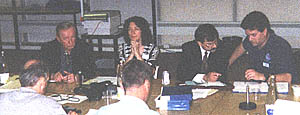 The ARISS delegates meet at the AMSAT-UK Colloquium in late July in Guildford, England. In the center, hands folded, is Rosalie White, WA1STO, of the ARRL and the SAREX Working Group. To her right is SAREX Working Group Chairman Roy Neal, K6DUE. To her left are Frank Bauer, KA3HDO, and Matt Bordelon, KC5BTL, of NASA. Photo by Terry Taylor, W5JFM. |
Amateur Radio delegates representing seven of the eight countries involved in Amateur Radio aboard the International Space Station (ARISS) met in England in late July to continue plans to establish the first permanent Amateur Radio presence in space. The session, chaired by Space Amateur Radio EXperiment (SAREX) Working Group Chairman Roy Neal, K6DUE, was held July 29-31 in conjunction with the AMSAT-UK 1998 Colloquium, held at the University of Surrey.
On hand or patched in via a teleconferencing hookup were 16 representatives from the US, Japan, Italy, Germany, Canada, the UK, and Russia. The representative from France was unable to attend because of a prior commitment.
ARRL Educational Activities Department Manager Rosalie White, WA1STO, represented the League and the SAREX Working Group. Observers at the sessions included AMSAT-NA President Bill Tynan, W3XO; former US astronaut Ron Parise, WA4SIR; and RSGB President Ian Kyle, GI8AYZ. IARU satellite frequency coordinators from Regions 1 and 3 also were on hand.
ARISS delegates formed two permanent working groups. The ARISS Hardware Group, chaired by Lou McFadin, W5DID--perhaps best known for his involvement in the Phase 3D project--is charged with designing and building space station equipment. The ARISS Administrative Group, chaired by Frank Bauer, KA3HDO, is charged with setting up ground rules for operation, finding financing, and handling all other administrative details.
Bauer, who's NASA Vice President of Human Satellite Programs and a SAREX Working Group member, said ham radio will be part of the ISS right from the start of construction. "What we're going to do is develop this in stages," he said. The first crew, aboard STS-88 at the end of this year, will have 2-meter hand-held and packet capability coupled with an antenna system that will be a cooperative effort of the Italian and Russian teams. A three-person crew will attach the trusses and begin building the ISS.
The ISS service module, due to be launched next summer, is the section of the ISS in which astronauts and cosmonauts will live during construction. An interim station for the first ISS crew at that point would add 70-cm capability and a German-designed "digitalker," and eventually a transportable station that could include SSTV and full-duplex VHF/UHF. The first crews to actually live aboard the ISS will graduate to mobile-type transceivers.
Bauer says the final ISS equipment complement is still in the conceptual stages but likely would include all-mode capability from 10 meters up through 13 cm.
Surrey ARISS delegates also discussed time-sharing and scheduling of the ham stations, crew training, educational opportunities, fund-raising, call signs, and frequencies. Details on these issues remain to be decided.
Neal credited SAREX Working Group Principal Investigator Matt Bordelon, KC5BTL, for "a superb job of lining up the NASA/ISS officials and channels for what's about to happen." A key player on the ARISS team, Bordelon, is scheduled to travel to Russia soon to work out details of the station installation aboard the ISS service module with Sergej Samburov, RV3DR, the Russian delegate.
Neal said he was gratified to see the plans coming together to put Amateur Radio aboard the ISS. "These meetings have gotten the worldwide Amateur Radio family on track," he said. "Amateur Radio is now getting ready to fly onboard!"
White said the most significant aspect of the session came on the afternoon of the second day, was when countries stepped forward to accept responsibility for various aspects of each Amateur Radio station. "For instance, for the interim Amateur Radio station, the US took responsibility for the packet module, adapter module, radio, and associated cables," she said. White said Germany agreed to build the digitalker, and to work with Russia to develop the antenna feed-through system. Italy will design and fabricate the antennas, and Russia will install the RF cables and antennas.
For the transportable setup, the US will handle the packet TNC, equipment integration, and the NASA-required Safety Data Package, while Germany will design and build the system.
"The ARISS project will truly be an international project," said White. "It will be well worth our years of work, because each delegate believes ARISS is a wonderful resource for the Amateur Radio service and a great educational tool for our world's youth."
Russia said this month that it would meet its commitments to the ISS, despite its well-publicized economic problems. The ISS program is already a year behind because of delays related to Russia's money woes. In the US, NASA and White House budget officials have faced tough questioning about the space station project. The US share of the construction cost will be in excess of $20 billion.
WISCONSIN HAMS REACTIVATE FLOODED STATION TO ASSIST RED CROSS
Heavy rainfall August 6 caused severe flooding in southeastern Wisconsin. Four counties, Sheboygan, Milwaukee, Waukesha and Rock, were declared disaster areas. The floods put dozens of people out of their homes and shut down some roadways and bridges. A SKYWARN net was activated for the southeastern part of the state.
ARRL Emergency Coordinator Mike Musiel, K9SJ, of Cleveland, Wisconsin, says the floodwaters inundated the basement of the local Red Cross headquarters where the Sheboygan County ARC and ARES radio room was located. "As soon as the waters were safe, Larry Bahr, WB9FXQ, and I went in Thursday night (August 6) and recovered what equipment we could," he reports. Musiel said the radios could be salvaged, but the shack itself was totally out of commission.
Musiel says he and Rob Jacobson, KB9AFT, contacted the Sheboygan Red Cross and prepared to regroup. "Unfortunately, most of the Red Cross relief supplies were also in the basement," he said. He says he made up cables for the temporary station and, with help from Jacobson and Sky Borgenbagen, N9XRU, set up the temporary station at the Red Cross to assist the damage assessment teams in the field.
"I can not begin to describe the amount of loss thousands of people have lived through," he said.
The Red Cross damage assessment teams needed to canvass large areas of the city quickly, Musiel explained. "Hams tailed the damage assessment teams to handle questions from local residents. Most of the affected areas had no power, gas, or phone service," he said. Hams were able to get messages directly to Red Cross headquarters and respond to residents in a timely fashion, however. Musiel says he had a cell phone along, but the local cells were saturated with traffic. The hams were able to set up a mobile transceiver in crossband repeat mode so they could use H-Ts on low power and extend their battery life.
Musiel said the N9REH VHF machine in Sheboygan was out of service. Most traffic went through the AC9A UHF machine in Sheboygan, and the WE9R SCARC club VHF repeater in Plymouth.
Musiel said he was not certain how much longer ham radio help would be needed. "A number of hams were in the badly affected areas. I know some of them took heavy damage," he said. Additional volunteers arrived last weekend, he said. Among hams that assisted were KB9AFT, N9XRU, K9XJ, AA9LV, KD9TZ, KB9QPM, N9SVV, WB9FXQ, KB9GHE, K9JHK, KF9XZ, and K9SJ.
First Lady Hillary Rodham Clinton toured Wisconsin's Rock County on August 12 and announced the availability of federal aid for the four affected counties.--thanks to Jim Romelfanger, K9ZZ
FCC DENIES CHECKPOINT SYSTEMS PETITION
The FCC has turned down a bid by Checkpoint Systems, a maker of theft deterrent systems for stores, to raise the permissible radiated and power-line conducted emission levels of its products operating at HF. The Part 15 devices, known as electronic article surveillance or EAS systems, are located at store entrance and exit gates. The gates include a transmitter and receiver that can detect passive electronic tags attached to merchandise and trigger an alarm.
Last year, Checkpoint asked the FCC to be allowed to operate between 1.705 and 30 MHz at a maximum radiated emission level of 1000 uV/meter (measured at a distance of 30 meters), and a maximum conducted emission level of 3000 uV. Current rules permit a maximum radiated emission level of 30 uV/meter (measured at a distance of 30 meters) between 1.705 and 30 MHz, or 100 uV per meter between 1.705 and 10 MHz. The current conducted emission limit for such devices operating between 1.705 and 10 MHz is 250 uV.
In its comments, the ARRL opposed the Checkpoint petition arguing that it would result in increased interference to amateur HF operation. The League also said Checkpoint had not provided any technical analysis of the potential for increased interference at the frequencies in question.
In a decision issued August 5, the FCC went along with the League, saying Checkpoint had not provided sufficient technical analysis to justify the requested tenfold increase in radiated emission limits. The Commission also said that Checkpoint had not justified its assertion that its EAS systems were in danger of being "drowned out" by other sources of radio noise.--FCC
FCC SEQUENTIAL CALL SIGN UPDATE
The following is a list of FCC sequentially assigned call signs issued as of August 3, 1998. For more information about the sequential call sign system, see Fact Sheet PR5000 #206S or contact the FCC, 1270 Fairfield Rd, Gettysburg, PA 17325-7245; e-mail fccitd@fcc.gov.
| District | Group A Extra | Group B Advanced | Group C Tech/Gen | Group D Novice |
|---|---|---|---|---|
| 0 | AB0HV | KI0NX | ++ | KC0DYE |
| 1 | AA1TY | KE1KE | ++ | KB1DCI |
| 2 | AB2FN | KG2OU | ++ | KC2DXK |
| 3 | AA3RJ | KF3BY | ++ | KB3CXK |
| 4 | AF4LD | KU4TV | ++ | KF4ZOT |
| 5 | AC5QY | KM5RZ | ++ | KD5EXT |
| 6 | AD6GD | KQ6XK | ++ | KF6SFS |
| 7 | AB7YR | KK7PA | ++ | KD7CKW |
| 8 | AB8DB | KI8GM | ++ | KC8KSH |
| 9 | AA9WJ | KG9OD | ++ | KB9TFG |
| N. Mariana Island | NH0F | AH0BA | KH0HE | WH0ABJ |
| Guam | ++ | AH2DH | KH2TQ | WH2ANX |
| Hawaii | NH7I | AH6PM | KH7JZ | WH6DEU |
| American Samoa | AH8R | AH8AH | KH8DM | WH8ABF |
| Alaska | AL0M | AL7RE | KL0PT | WL7CUW |
| Virgin Islands | ++ | KP2CN | NP2KD | WP2AIJ |
| Puerto Rico | NP3Y | KP3BI | NP3XZ | WP4NNV |
++ All call signs in this group have been issued in this district.
SOLAR UPDATE
Solar savant Tad Cook, K7VVV Seattle, Washington, reports: Solar activity was up again last week in a big way. Average sunspot numbers were up by 42 points, and average solar flux was up over 32 points. The highest solar flux was on August 9 when it was 154.1. The last time the flux was this high was in early 1993.August 14-16, look for solar flux to decline to 140, 135, and 130. Solar flux should go under 120 around August 20 and down to 110 around August 22, then increase to over 150 again after the beginning of September. The planetary A index was very high at 69 on August 12, and we should see high A index values indicating geomagnetic disturbances around August 19 and 20.
There is more good news concerning the SOHO satellite, which is used to observe the sun. The satellite has now recovered to the point that it is sending out some data, such as temperature readings.
With solar flux over 150 and fall soon upon us, strong 10 meter openings cannot be too far away. 15 meters should be stronger as well, now that the solar cycle seems to be moving up again.
Sunspot numbers for August 6 through 12 were 122, 127, 121, 155, 136, 144, and 137, with a mean of 134.6. The 10.7-cm flux was 138.3, 145, 146.8, 154.1, 149.2, 150.1, and 147, with a mean of 147.2. The estimated planetary A indices were 69, 28, 12, 4, 14, 9, and 10, with a mean of 20.9.
In Brief:
- This weekend on the radio: The ARRL 10 GHz and up Cumulative Contest, the New Jersey QSO Party, the North American QSO Party (SSB), the SARTG RTTY Contest, the W/VE Islands Contest, and the SEANET Contest (SSB) all are on tap this weekend. Just ahead: The TOEC WW Grid Contest, CW is the weekend of August 22-23.
- Vanity update: The FCC in Gettysburg reports it has processed vanity call sign applications received through July 9. This past week, 62 call signs were granted. Another 79 applications landed in the work in process (WIPs) stack. During July the FCC received 632 vanity applications, 527 of them electronically filed.
- WSWSS VHF+ Conference: The 50 MHz and Up Group of Northern California, Inc. and the Western States Weak Signal Society will hold the annual WSWSS VHF+ Conference October 3, 1998 at the Sunnyvale Hilton, Sunnyvale, California. The conference will have two presentation paths, one for general interest and one for technical specialties. Papers or presentations are being accepted at this time. Topics should be of general VHF+ interest or detailed technical content. Those interested in participating should submit a paragraph outlining content to Jim Moss, 862 Somerset Dr, Sunnyvale, CA 94087; e-mail n9jim@aol.com. See http://www.qsl.net/wb9ajz/wswss98 for more information. --AMSAT News Service
- Hams help MS bikeathon: Hams in New York and Vermont provided communication and route support for the annual bikeathon sponsored July 11-12 by the Multiple Sclerosis Society of Northeastern New York. The 150-mile trek from Saratoga to Ticonderoga (New York) and back took a scheduled detour through Vermont (by ferry). Nearly 30 hams from the Adirondack Amateur Radio Club, the Mountain Valley Amateur Radio Club, the Saratoga County RACES Association, Vermont ARES, and the Albany Amateur Radio Association--combined with Northeast Mobile Search and Rescue, the CVS Samaritan Van, and the New York Guard to assist with the fundraiser. The event attracted cyclists from as far away as Texas. --thanks to April Stack, K2ZCZ
- Hams track down errant marine transmitter: Hams in Florida recently helped to track down the source of a signal on marine channel 16, the one most often used for emergencies and as a calling frequency. DEC Linda Mullen, AD4BL, reports that WA4IMC was able to find the offending transmitter "through a process of elimination" of reports from other amateurs monitoring the 156.80 MHz signal. Apparently, a sailboat operator had dropped a bag on his marine radio's mike. The signal remained on the air for several hours. "The Coast Guard was in a tizzy," AD4BL reports. --thanks to Nils Millergren, WA4NDA
- KD4HGU honored for public service: John P. Galaider, KD4HGU, has been honored by the Margate, Florida, City Commission for his long years of public service. At its regular City Commission meeting, Wednesday, July 8, 1998, Margate's Mayor, Joseph P. Varsilone, presented Galaider with a proclamation and plaque, proclaiming him as an Honorary Mayor of the City of Margate. The mayor spoke of the many public services provided by Amateur Radio operators. Galaider, 86, serves as a net control operator on the Southeast Florida Traffic Net. "John not only is an asset to the city, he is a good-will ambassador also, with his many ham radio contacts around the world," the mayor said. Attending the ceremony were ARRL Southern Florida Assistant Section Manager Chuck Baer, W4ROA, and Southern Florida Section Emergency Coordinator, Jim Goldsberry, KD4GR.--thanks to Ron Toller, N1RT
- WB0EJJ honored: Beryl Masters, WB0EJJ, received the American Council of the Blind's Lifetime Membership Award at the council's annual convention July 5 in Orlando, Florida. Masters, 79, was among 10 others getting the award. A few days after the event, Masters underwent knee replacement surgery and is reported to be recovering well. He's a member of the Heart of America Radio Club and is well-known as the founder and net control of Kansas City's Paul Revere Net, held each Saturday at midnight and rumored to be the longest-running 2-meter net in the US.--thanks to Larry Staples, W0AIB