ARRL Audio News
| · | To subscribe, unsubscribe, or change your e-mail delivery address: see How to Get The ARRL Letter, below |
| · | Delivery problems (ARRL member direct delivery only!): letter-dlvy@arrl.org |
| · | Editorial questions or comments: Rick Lindquist, N1RL, rlindquist@arrl.org |
| · | ARRL Audio News: http://www.arrl.org/arrlletter/audio/ or call 860-594-0384 |
| · | The ARRLWeb Extra: http://www.arrl.org/members-only/extra |
IN THIS EDITION:
- +Sen Barry Goldwater, K7UGA, SK
- +League comments on declaratory ruling request
- +ARRL suggests ULS changes
- +Andy Thomas sends greetings from space
- +W1AW to operate Class A during Field Day
- First 47-GHz VUCC!
- Four inducted into CQ Contest Hall of Fame
- Solar update
- Charles Michaels, W7XC, SK
- In Brief: This weekend on the radio; Vanity update; Affiliated clubs info on the Web; ARRL DX contest entries posted; Worldwide ham population; New prefix for Pitcairn; Call for papers; SETI League names Bruno Award winners; Titanic call sign fever
+ Available on ARRL Audio News
SEN BARRY GOLDWATER, K7UGA, SK
Former US Senator, onetime presidential candidate, and noted radio amateur Barry Goldwater, K7UGA, died May 29. He was 89. Goldwater had suffered a stroke in 1996 and had been in failing health.
A staunch conservative, Goldwater was the 1964 Republican presidential nominee and served five terms in the US Senate. He also authored the book Conscience of a Conservative. Goldwater retired from politics in 1986. His home was in Scottsdale, Arizona.
As a Senator, Goldwater's legacy included several pieces of Amateur Radio-related legislation. In 1964, Goldwater's bill to allow reciprocal operating agreements between the US and other countries was signed into law. It was his work on the bill that prompted the Arizona Senator to renew his interest in ham radio after a long absence.
Goldwater's 1964 presidential campaign tried to tap into his ham radio connections with a "Hams for Barry" fundraising effort. He took time out of the campaign to address the ARRL National Convention in New York City, on the occasion of the League's 50th anniversary. In his remarks, Goldwater reminisced about his youthful foray into Amateur Radio as 6BPI. He was first licensed in 1921, and joined the ARRL in 1923. "You can't imagine what a relaxation ham radio is for me," the campaign-weary Goldwater told the gathering. He related how, during the GOP Convention earlier that summer, he'd made several hundred contacts from his hotel room using a borrowed Collins S-line. The convention presented Goldwater with a certificate of appreciation for his work on behalf of the hobby (see QST, Oct 1964, p 80). Goldwater lost the 1964 election to Lyndon Johnson.
While serving as chairman of the Senate Communications Subcommittee in 1981, Goldwater introduced landmark legislation proposing several changes to the Communications Act affecting amateurs. In 1982, Congress finally approved and President Reagan signed what came to be known as the Goldwater Amateur Radio legislation, enacted as Public Law 97-259. The measure established the Amateur Auxiliary and the volunteer examination programs, permitted 10-year license terms, and exempted Amateur Radio from the secrecy provisions in the Communications Act. The Goldwater bill also ended years of Congressional wrangling and authorized the FCC to set RFI susceptibility standards for home electronic devices.
A year later, President Reagan signed into law a bill including a Goldwater amendment that allowed the recovery of costs in the Volunteer Examiner program (the FCC didn't authorize the plan until months later, however).
At one point in his ham radio career, Goldwater operated as K3UIG from his Senate office and as K7UGA when he was home in Arizona. He called his Arizona ham shack "bash-hal-ne-ae," which he said was Navajo for "music from iron" or "metal that talks."
Goldwater was a life member of the ARRL. He was elected president of the Quarter Century Wireless Association in 1971. A pilot during World War II, he held the rank of General in the Air Force Reserve and was an active member of Air Force MARS. During the Vietnam War era, Goldwater handled hundreds of thousands of phone patches. He also held a pilot's license and occasionally operated aeronautical mobile.
In 1983, Amateur Radio paid homage to Goldwater as "its governmental protector and advocate" by establishing the $5000 ARRL Scholarship to Honor Barry Goldwater, K7UGA. In announcing the scholarship, then-ARRL Washington Area Coordinator Perry Williams, W1UED, said that Goldwater's Amateur Radio involvement had "brought joy to thousands of members of the armed services stationed overseas, and through his professional career, he has exemplified the principles of commitment and service to one's country and fellow citizens."
Then-FCC Chairman Mark Fowler said the Amateur Radio community was lucky to have Goldwater as its "elder statesman" in government and noted that the FCC often had Goldwater review ham-related proposals before it took action on them.
The Goldwater scholarship, administered by the ARRL Foundation, is awarded each year to a deserving radio amateur to encourage a spirit of achievement and dedication in the field of communication.
ARRL Executive Vice President David Sumner, K1ZZ, said that of amateurs in the public sector, Goldwater was "without peer." Southwestern Division Director Fried Heyn, WA6WZO, called Goldwater "a super ham" who was "concerned about the future of Amateur Radio."
Goldwater's first wife, Peggy, died in 1986. The couple's two sons and two daughters and Goldwater's second wife, Susan, are among his survivors.
DECLARATORY RULING REQUEST MISHANDLED AND MISUNDERSTOOD, LEAGUE SAYS
The ARRL says its request seeking an FCC declaratory ruling affirming the value of band plans was mishandled by the FCC and misunderstood by the amateur community. In comments on RM-9259 filed with the FCC in May, the ARRL says it never intended to propose any changes to the amateur rules, and its request should not have been treated as a rulemaking petition.
The ARRL said it does not dictate how bandplans are developed and was not asking to make specific bandplans mandatory or to accommodate certain uses to the exclusion of others. "Exactly the opposite is intended," the League's comments declared. "Voluntary bandplans should be voluntary, and adherence to them should remain voluntary."
The League said its only goal was to have the FCC interpret and clarify the scope of "good amateur practice" as the term is used in Part 97 of the Commission's rules. It wants the commission to affirm--as the then-Chief of the Private Radio Bureau did in 1983--that, "given the widespread acceptance of band plans in the Amateur Service, operation not in harmony with those plans, which results in interference to other amateur uses, is not good amateur practice."
The ARRL reiterated that voluntary bandplans that enjoy general acceptance and adherence among hams are "indispensable" and a keystone to self regulation.
The FCC's handling of the request as a rulemaking petition "has caused confusion in the amateur community, the League said. "This misunderstanding has led commenters to presume that to grant the request would provide absolute authority on the part of the League or to volunteer repeater coordinators" to decide bandplans with the force of rule, the League said. "Not so," the League's filing said. "Nothing gives voluntary band plans any more force or effect than is afforded by the amateur community that accepts, rejects, or modifies them."
The ARRL's comments conclude by again asking the FCC to issue a declaratory ruling stating that "'good amateur practice' anticipates compliance with accepted, voluntary, international, national, and regional bandplans adopted by cooperation and coordination among individuals and licensees."
A copy of the League's comments to the FCC is on the ARRLWeb page at http://www.arrl.org/announce/RM-9259-cmt.pdf. (Requires Adobe Acrobat, 23,406 bytes)
LEAGUE SUGGESTS ULS CHANGES
The ARRL has expressed overall support for the FCC's wide-ranging rulemaking proposal to implement the Universal Licensing System (WT Docket No. 98-20). But the League also suggested several changes to the plan.
In comments filed May 21, the League supported deleting the application process for non-US hams to operate in this country. But the League says the FCC should impose a one-year time limit on such operation or at least be consistent with CEPT and CITEL requirements. The ARRL took advantage of the opportunity to urge the FCC to authorize visitors from certain European countries and the Americas to operate during short visits to the US. The League also said the new rules should require non-US ops to have their license document in their possession while operating in the US or its possessions.
In the same vein, the League's said it would "object strongly" if the FCC stopped issuing license documents to hams. The League said it's often necessary to prove that one is a licensee. It cited amateur protections under state and local scanner and antenna laws, as well as requirements to produce a license for overseas operation. The FCC's ULS proposal did not suggest eliminating license documents, but the League said it's heard "repeated staff references" to the notion, and added that the proposed rules "contain nothing that would continue to obligate the Commission to issue license documents."
The League also discouraged the FCC from adopting a proposal to turn over issuance of club and military recreation licenses to private, third-party administrators. "The task is of a minimal nature and does not justify the creation of a cumbersome, multiple-administrator system that requires real-time coordination among the multiple administrators." The League said that the current system works well and should be left in place.
The League also suggested changes for the new multiple-service FCC Form 605, slated to replace the venerable Form 610 when the ULS is adopted. The League said the new form makes it "inherently more cumbersome for the amateur licensee to determine which portions of the Form are to be used and which may be disregarded." Certain items that were not in the old Form 610 "should be deleted for amateur applicants," the ARRL said. Also, the League urged the FCC to retain a standard physician's certification for a medical exemption from the higher-speed Morse Code requirement.
The ARRL also questioned the requirement for applicants to supply a Taxpayer Identification Number (TIN)--typically a Social Security Number--if they are not participating in the vanity call sign program, which is subject to a regulatory fee. "Many radio amateurs are concerned about disclosing their Social Security numbers without assurance of the necessity therefor and without assurance of confidentiality," the League's filing said. "The Notice offers very little of either."
The League also said the FCC should not make electronic filing mandatory as of January 1, 1999, as the FCC's Notice proposes. The League said electronic filing is not yet available to all applicants and the requirement "would certainly disenfranchise some."
MIR-SCHOOL QSOs CONCLUDE; ANDY THOMAS SAYS "THANKS" FROM SPACE
A special arrangement linking several schools and individuals via telephone and Amateur Radio with US astronaut Andy Thomas, KD5CHF, aboard the Mir space station capped a series of highly successful Mir-school Amateur Radio contacts. The historic, early-morning QSO May 29 very likely marked the last ham radio contact between earthbound students and a US astronaut aboard Mir. The contact was coordinated by the Space Amateur Radio EXperiment, or SAREX. Thomas' Mir tour ends in June. He's the seventh and last US astronaut scheduled to stay aboard Mir, and his departure comes amid renewed concerns about the safety of the Russian space outpost.
A school that had been scheduled for the time slot at the last minute wasn't able to get details coordinated in time. So AMSAT SAREX representative Frank Bauer, KA3HDO, took things in hand. He contacted the Burbank School in the Chicago area and Santa Rosa Junior College in California. The schools were able to quickly round up students, teachers, and mentors who were more than happy to get up before dawn to speak with Thomas.
ARRL SAREX representative Rosalie White, WA1STO, also got to take part in her first SAREX QSO, after years backstage arranging contacts.
T.J. Bailey, KF6IAO, of Geyserville, California, High School had the honor of calling Thomas on the radio and hearing Thomas Australian-accented reply. Outstanding conditions allowed Bauer to begin by thanking Thomas on behalf of the SAREX Working Group for touching the lives of thousands of students, teachers and parents all over the US in the past 14 weeks.
"It was my pleasure!" Thomas replied. "The students and you all are the ones who got up early. You're the ones who should be thanked."
White then thanked Thomas on behalf of the ARRL. "The future of the United States is in the hands and hearts of our youth, and you've fired their imaginations as you've spoken with them via ham radio," she said. White asked Thomas if he felt the students got a lot out of the SAREX contacts.
Thomas replied in the affirmative. "If the level of questions can be considered indicative, then these students gained tremendously," he said. "The questions from the many different young people were quite penetrating--they have a keen interest in the space program."
Students and teachers at the various locations then asked questions about the crew's sleep schedule, the greatest thing learned during any of the Mir missions, how he felt physically, and Mir's safety. Thomas reported that the Mir is very stable now, and that the hardware is "robust."
Thomas recently issued a "thank you" message of his own to hams around the world who have sent messages via the Mir packet system. "I hope it is understood that the volume of traffic has made individual responses impossible, but we really enjoy your mail," he said in a packet broadcast from R0MIR.
Thomas said FM voice contacts have been "very difficult" because of the large number of stations calling him, especially over the US and Europe. He said he would try to do more FM contacts "in the short time I have left," but he asked stations that already have worked him on FM to stand by and give others a chance.
Earlier this month, students at schools in Texas, Tennessee, and Australia also were successful in speaking with Thomas during SAREX-arranged contacts. Thomas chatted with students at two schools in his native Australia. Bauer reports that students at the School of the Air--located in several remote areas--were bridged together with VK5AGR using a teleconferencing facility for the May 25 contact. "When asked what he misses most, he said he would love to have a hot shower," Bauer said. He also said he was looking forward to being part of the construction of the International Space Station. Bauer said students at Australia's Gormandale and District School stumped Thomas with the question, "How does a yo-yo work in space."
Thomas is due to return to Earth June 12 aboard the shuttle Discovery. NASA has said it wants to postpone the launch of the first pieces of the ISS, delaying the start of in-orbit construction until the end of the year. The first part of the station, a Russian-built control module, is behind schedule.--thanks to Rosalie White, WA1STO, and Dave Larsen, N6CO
W1AW TO OPERATE CLASS A DURING FIELD DAY
Maxim Memorial Station W1AW will operate as a Class A entry this year during Field Day. The popular annual event occurs this year on June 27 and 28.
"We've operated as a Class D entry much too long," said W1AW Manager Joe Carcia, NJ1Q. Carcia says W1AW will probably operate as a Class 3A entry from a state park in Bloomfield, Connecticut.
Carcia and HQ staff volunteers will operate W1AW during the event. Operating positions will be set up in advance of the start of Field Day at 1800 UTC on June 27. He said he expects to have two generators on hand supplemented by two 750 W inverters. "We may also have a large tent for protection from the elements--the weather, not the antennas," he said. W1AW Field Day ops will log on computers
47 GHZ VUCC No 1 YIELDS NEW NORTH AMERICAN DISTANCE RECORD
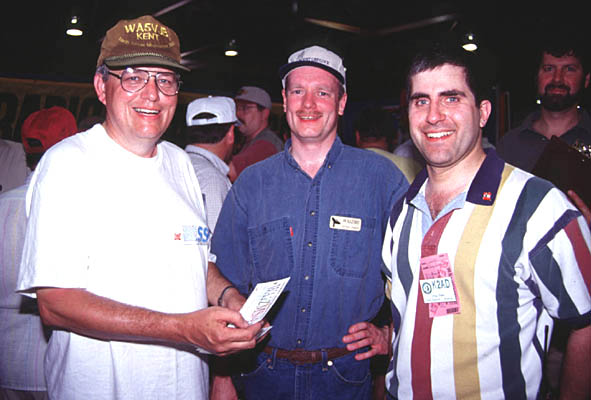 At the Dayton Hamvention, Kent Britain, WA5VJB (left), checked the QSL cards to confirm VUCC No 1 for W2SZ/4 ops Brian Justin, WA1ZMS (center), and Doug Sharp, K2AD (right). |
Doug Sharp, K2AD, and Brian Justin, WA1ZMS, operating as W2SZ/4, have earned the first VHF/UHF Century Club (VUCC) award on 47 GHz and now are setting their sights on 76 GHz. The pair accomplished the feat during the weekend of May 9-10 from a site on Apple Orchard Mountain, just off the Blue Ridge Parkway near Bedford, Virginia (FM07). One contact also set a new North American distance record for 47 GHz, a distance of 107 km (71 miles) to Leigh Mountain near Farmville, Virginia (EM96). That barely beat the former NA distance record of 105 km set in 1988.
Sharp operated rover station WA1ZMS/4 for all the contacts, while Justin operated W2SZ/4. The two ops said the hardest part of the whole venture probably was the two years it took to collect the parts they needed and to construct their gear. Once up and running, though it only took about 30 hours to make VUCC, including waiting for the rain to stop. Justin and Sharp point out that rainfall and even humidity can affect propagation at 47 GHz. The mountaintop station had a 2-foot dish, while the rover used a 1-foot dish. The antennas have a 1° beamwidth. They used a surveyor's compass, an inclinometer, and rifle scopes attached to their power-supply modulated Gunn sources to set up the line-of-sight contacts. Crystal-controlled frequency sources aided in tuning. "Coordinating the frequency was a bit of a trick," Sharp said, because of drift. Power levels were in the vicinity of 100 mW.
W2SZ, the club station of the Renssalaer Polytechnic Institute (RPI) Amateur Radio Club in Troy, New York, already holds VUCC No. 1 on 3, 5, and 24 GHz.
WA5VJB checked the cards for the VUCC award at the Dayton Hamvention. For more information and photos, see http://www.mgef.org/47ghz.htm
FOUR INDUCTED INTO CQ CONTEST HALL OF FAME
Contesters Richard Frey, WA2AAU, Glenn Rattmann, K6NA, Roger Western, G3SXW. and Gene Walsh, N2AA, have been inducted into the CQ Contest Hall of Fame. The four were honored during the CQ Contest dinner held during the Dayton Hamvention, May 15-17.
The event, organized by John Dorr, K1AR, and Tim Duffy, K3LR, was sold out, and upwards of 300 were on hand for the ceremony. Inductee G3SXW gave a short talk about how "fun" and "focus" make for successful contesting.
Receiving certificates for the best presentation at the contest forum were Ken Silverman, K2KW, and Tom Schiller, N6BT. Their presentation was about the 6Y4A DXexpedition.
John Kanzius, K3TUP, and A61AJ were acknowledged for their material support of CQ contest log processing/checking.--Mark Wilson, K1RO
SOLAR UPDATE
Solar prognosticator Tad Cook, K7VVV, Seattle, Washington, reports: Solar indices were down this week, as they have been during the past few weeks. The sunspot number is half what it was the previous week, and the solar flux was down over 16 points. So far this month the average flux is running about the same as April and March, when it took a jump of about 16 points over January and February.
Solar flux is expected to peak May 29 and 30 at 98, then drift to 96 on May 31, then go below 90 after June 7. Flux values should drift above 90 around June 18 and to the mid-90s in the week prior to the end of June.
During June we will be experiencing more summer-like HF conditions, with weaker daytime signals and higher noise, due to increased thunderstorm activity in the northern hemisphere. With fewer hours of darkness and more storms, look for poorer conditions on 160 and 80 meters. Although 20 meters has been the best DX band around the clock, there is a good chance that solar activity will move higher this summer, and 15 meters could become the best daylight band for the season.
There was a solar flare during early hours UTC on May 28, but it is not expected to affect geomagnetic indices. About 12 hours earlier there was some activity that could cause a rise in geomagnetic activity on May 30 or 31. Look for very quiet geomagnetic conditions around June 9-13 and possibly on June 15 and 18.
WA5JCI in Texas reports the best tropo openings in years, when he worked several Gulf Coast states and then heard Mexico on a local 2-meter repeater. Also, N0JK in Kansas worked a number of Gulf Coast and Midwest states on 2-meter tropo and heard KT4AL in Florida on 432 MHz.
Sunspot numbers for May 21 through 27 were 29, 26, 47, 41, 57, 49, and 49, with a mean of 42.6. The 10.7-cm flux was 89, 87.4, 90.3, 95.6, 92.3, 92.5, and 94, with a mean of 91.6. Estimated planetary A indices were 14, 8, 13, 16, 15, 8, and 7, with a mean of 11.6.
CHARLES MICHAELS, W7XC, SK
QST author Charles Michaels, W7XC, of Phoenix, Arizona, died March 22. He was 75. Among other contributions, Michaels wrote "The Null Steerer Revisited" in the July 1994 issue of QST, and "Some Reflections on Vertical Antennas," in the July 1987 issue of QST. A Philadelphia native, Michaels was first licensed as W3IGR in 1939. He served as a radioman in the US Navy and was at Pearl Harbor on December 7, 1941, when the Japanese attacked. Following World War II, he graduated from the University of Pennsylvania and later advanced to chief engineer, systems, for Eckert-Mauchly Computer Corporation (later Sperry-Rand's UNIVAC division). He also held positions with Honeywell, GE Computer Operations, and Xerox Corporation before he retired. Michaels was an ARRL life member. He also enjoyed amateur astronomy.
In Brief:
- This weekend on the radio: The CQ WW WPX Contest (CW) is this weekend. Just ahead: The QRP TACtical Contest is June 6. The ARRL June VHF QSO Party is June 13-15.
- Vanity update: The FCC in Gettysburg reports it has processed vanity call sign applications through May 8. On May 28, the FCC granted 103 new call signs. Another 124 applications landed in the work in process stack and have been processed.--FCC
- Affiliated clubs info on the Web: The ARRL Field Services Department reports major improvements to the information available for ARRL Affiliated Clubs on the ARRLWeb page, http://www.arrl.org/field/club/. In addition to the summary information already on the Web, detailed club information now is available. Searches are possible by club name as well as by state, section and ZIP code. Club officials can submit updated information to the Field Services Department directly from the club search facility. This capability replaces the electronic annual report form previously in use. The system also now permits FSD staff to update Web information as often as needed, instead of just monthly.
- ARRL DX contest entries posted: ARRL Contest Manager Billy Lunt, KR1R, report that a list of W/VE entries in the 1998 ARRL International DX CW Contest has been posted at http://www.arrl.org/contests/claimed/98/usdxcw.html. If you don't find your entry, or if there is an error with your entry, contact the Contest Department as soon as possible at 860-594-0252 or via e-mail kr1r@arrl.org. Lunt says the DX entry list will be coming soon.
- New prefix for Pitcairn: The new prefix for Pitcairn Island in the South Pacific is VP6. The British possession changed its call sign prefix from VR6 to VP6 on May 1. Call sign suffixes will remain the same. As part of the reversion of Hong Kong to China, the British government also ceded the international ITU prefix block, VRA-VRZ, to China. Old timers may recall that VP6 used to belong to Barbadoes before it became independent.
- Worldwide ham population: According to the annual statistics collected by the International Amateur Radio Union (IARU), there were 2,777,000 amateur radio operators in the world in 1997.--thanks to Nao Akiyama, NX1L
- Call for papers: Papers are due July 1 for the 24th annual Eastern VHF/UHF Conference, August 21-23 at Harley Hotel, Enfield, Connecticut. The conference is sponsored by the Eastern VHF/UHF Society and the North East Weak Signal Group (see http://uhavax.hartford.edu/~newsvhf). Last year's subjects included operating, antennas, equipment design, interfacing, and testing. All submittals must be camera-ready with one-inch borders and separate photos with accompanying page layout. Send submittals to Bruce Wood, N2LIV, 1998 Eastern VHF/UHF Conference Chairman & Proceedings Editor, 3 Maple Glen Ln, Nesconset, NY 11767-1711; tel 516-225-9400 (days) or 516-265-1015 (eves); e-mail bdwood@erols.com. This year's conference will feature speakers, and a technical laboratory. Gerry Rodski, K3MKZ, of SSB Electronic will conduct a preamp noise-figure measurement workshop (50 MHz-10 GHz). Joe Reisert, W1JR, will manage the antenna gain-measurement range (222 MHz and up; entrants receive a hard copy plot of their antenna). Ernie Gray, W1MRQ, will host a VHF-SHF trivia quiz. The ARRL will publish the Proceedings which will be available at the event.
- SETI League names Bruno Award winners: The SETI League has named two hams from England as winners of the group's Giordano Bruno Memorial Award--its highest honor. Ken Chattenton, G4KIR, and Trevor Unsworth, G0ECP, received the award at the SETI League's annual meeting March 29 for their contributions to Amateur Radio astronomy. The pair had volunteered to coordinate SETI League activity in the UK. The SETI League is promoting a privately funded effort to search for extraterrestrial intelligence. The group's executive director is Paul Shuch, N6TX. For more information, see http://www.setileague.org, e-mail n6tx@setileague.org, or call 800-828-7384 (TAU-SETI).--SETI League
- Titanic call sign fever: Mark Richards of Littleton, Massachusetts, has a new vanity call sign. It's K1MGY. "As you know, MGY was the call sign of the Titanic," he writes. "I am pleased to carry this fine call sign." (Let's hope Mark doesn't feel compelled to go down with the ship--Ed.)