ARRL Audio News
| · | To subscribe, unsubscribe, or change your e-mail delivery address: see How to Get The ARRL Letter, below |
| · | Delivery problems (ARRL member direct delivery only!): letter-dlvy@arrl.org |
| · | Editorial questions or comments: Rick Lindquist, N1RL, rlindquist@arrl.org |
| · | ARRL Audio News: http://www.arrl.org/arrlletter/audio/ or call 860-594-0384 |
| · | The ARRLWeb Extra: http://www.arrl.org/members-only/extra |
IN THIS EDITION:
- +School QSOs with Mir announced; R0MIR on FM voice
- +FCC's Amateur Radio computer system down
- +Two hams assigned to John Glenn flight
- +Phase 3D closer to reality
- +Radio Coaches program ready to roll
- Solar update
- Olof W. H. Johnson, W1JY, SK
- In Brief: This weekend on the radio; HQ employment opportunity; IOY nominations deadline near; Hams help in apartment house fire; K1CE at Hurricane Center confab; TWIAR celebrates with special event station; NFCC Board, officers elected; Crossword goof; Canadian hams honored; New LF beacon in EI
+ Available on ARRL Audio News
FOUR SCHOOLS SCHEDULED FOR MIR QSOs
The SAREX Working Group has announced that four schools have been tentatively scheduled for school-to-Mir contacts in the very near future. If all goes as planned, students at the schools will get to talk with US astronaut Andy Thomas, KD5CHF/VK5MIR, who arrived aboard the Russian space station in late January.Schools on the "prime" contact list include Shell Beach Elementary School, in Pismo Beach, California; Prairie Hills Elementary School, Colorado Springs, Colorado; Buist Academy, Charleston, South Carolina; and Carey Junior High School, Cheyenne, Wyoming. Arranging the contact schedule has taken several months and was complicated by equipment problems aboard Mir and--more recently--the change in crews.
Sources at NASA say the contacts could happen within the next two weeks, and possibly as early as next week.
The schools involved have been given tentative QSO dates, but these could change. "There is always a possibility of a delay with SAREX schedules," warns ARRL Educational Programs Coordinator Glenn Swanson, KB1GW. "Such is the nature of any experiment."
A typical Mir pass lasts approximately ten minutes, during which students will interview the spacecraft's crew by asking prepared questions. Also aboard Mir are two Russian cosmonauts--both hams: Talgat Musabayev, RO3FT, and Nikolai Budarin, RV3FB (ex-RV3DB/R4MIR).
The school contacts will be a new experience both for the pupils on Earth and for Thomas aboard Mir. So far, Thomas has logged very little time on the spacecraft's Amateur Radio equipment because of the crew's busy schedule, but he did make some contacts this week on 440 MHz, using the R0MIR call sign. Al Emer, N2YAC, in Holmdel, New Jersey, talked to Thomas for about six minutes on February 17 at around 1825 UTC.
"He seemed to be in no rush to get off the air," Emer said. "He's a real ham. He likes to talk!" Emer said he wished his son, Sean, had been there for the contact, but he was still at school. N2YAC was running 12 W to KLM 14C and 18C circularly polarized antennas at the time of the contact. He reported good signals on both ends.
Russian crew members Anatoly Solovyov and Pavel Vinogradov left for home in a Soyuz capsule on February 19--the 12th anniversary of the Mir's launch--and returned to Earth in a raging snowstorm. They had been on Mir since last August. Departing with them was French researcher Leopold Eyharts. Thomas, 46, will remain aboard Mir until June. It's not yet been decided if another US astronaut will succeed him on the Russian space station.
FCC AMATEUR RADIO COMPUTER SYSTEM DOWN
The FCC says it hopes to have its Amateur Radio licensing computer system, down since February 10, back on line by February 21. No paper or electronic applications have been processed since the computer system stopped functioning.FCC sources attribute the situation to a combination of problems and say three people are working on it. Late word from Gettysburg was that personnel will try to process data submitted on February 11 and 12 by VECs. If all goes well, the FCC will have an updated file available for Internet call sign servers on February 21. The FCCs computer system has failed before, but never for this long.
Again pending successful testing, on February 23 the FCC plans to ask VECs to send on the applications theyve been holding back at the FCCs request.
The situation has frustrated those who have been hoping to learn their new call signs or to check on updated licensing status. Call sign servers on the Internet also have been affected.
Earlier this week, the FCC apologized to VECs and asked them to not file any Amateur Radio applications. "We are sorry for the inconvenience," the FCC said.
TWO HAMS ASSIGNED TO JOHN GLENN FLIGHT
Two hams--US Astronaut Scott Parazynski, KC5RSY, and European Space Agency astronaut Pedro Duque, KC5RGG, of Spain--will be among an international crew this fall when US Senator John Glenn gets his second chance at space travel. The STS-95 mission will mark the third shuttle flight for Parazynski, a medical doctor who trained for a stay aboard Mir but had to be reassigned after it was determined he was too tall to fit the Russian space suits worn aboard the Soyuz.It's still not known at this time if the Shuttle Amateur Radio EXperiment (SAREX) payload will be aboard STS-95, which is scheduled to go up in October. The launch date for the only scheduled SAREX mission, STS-93, has slipped from August to December. The STS-95 flight that will carry the United States' newest and oldest astronaut into space has been under consideration for several months as a possible SAREX flight. Nothing has been confirmed yet, however. Crew members now are looking at possible secondary payloads for the mission. Glenn, who will be 77 when he goes into space again, has begun his astronaut training. He has undergone extensive medical tests. This week, he spent time in a centrifuge for the first time in decades.
Other members of the STS-95 crew include Japanese astronaut and cardiologist Chiaki Mukai, and Americans Steve Lindsey and Steve Robinson. Commanding STS-95 will be shuttle veteran Curt Brown.
PHASE 3D CLOSER TO REALITY
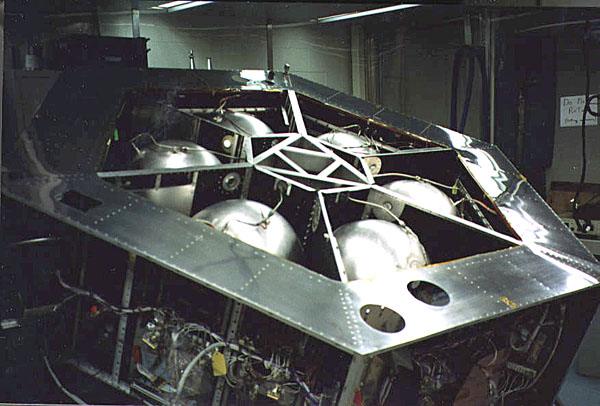 The Phase 3D satellite package is nearly ready for launch. Here it sits at the Phase 3D Integration Lab in Orlando, Florida. [Photo by Steve Ford, WB8IMY] |
QST Managing Editor and satellite columnist Steve Ford, WB8IMY, recently visited the Integration Lab. He says he was impressed by the way the AMSAT Phase 3D team has managed to keep down costs by manufacturing many expensive-to-buy items themselves. "In the best ham tradition," Ford says, "they also 'shopped smart,' getting donated gear and components whenever possible or procuring components at bargain prices."
Ford and other presenters attracted nearly three dozen satellite enthusiasts to a workshop during the Orlando Hamcation the weekend of February 13 and 14. Ford says the workshop attempted to bust the myths that satellites are hard to work and that setting up a satellite station is expensive. Other presenters in the five-hour session included Barry Baines, WD4ASW, Steve Bible, N7HPR, Dick Jansson, WD4FAB, and Keith Pugh, W5IU.
RADIO COACHES PROGRAM READY TO ROLL
The ARRL's Radio Coaches program staff reports that the League has received more than 100 requests for application materials for the new youth-oriented club program.Radio Coaches stems from the kickoff of America's Promise, the Alliance for Youth, a national campaign to improve the lives of the nation's young people and put them on paths to brighter, more productive futures. The ARRL Board of Directors authorized the creation of the Radio Coaches program as Amateur Radio's commitment to youth.
Through Radio Coaches, we want to reinforce the idea that Amateur Radio is a "sport for the brain." Ham radio provides not only a lifetime of enjoyment, but also, potentially, a lifetime career.
Special Radio Coaches binders full of additional program information, advisor sheets and student handouts will go out soon to all those who have requested a program application.
It's not too late to get your club involved! For more information on Radio Coaches or to sign up your club, contact Jennifer Gagne, N1TDY, 860-594-0328; e-mail coaches@arrl.org.
SOLAR UPDATE
Solar prognosticator Tad Cook, K7VVV, Seattle, Washington, reports: Solar activity was way up this week, with average solar flux increasing by almost 18 and average sunspot numbers up nearly 34 points. Solar flux was above the average of 96 for the previous 90 days on five out of seven days this week. Solar flux peaked on Sunday at 107.3. This value last topped out at 108.3 three weeks earlier. A February 14 coronal mass ejection caused disturbed conditions a few days later, resulting in planetary geomagnetic A indices of 14 and 26.As this report was being written on Thursday evening the solar flux had dropped to 98.5. On Friday, Saturday and Sunday the flux is predicted to be 97, 95 and 95. Over the next few weeks solar flux is predicted to drift toward the mid to low 80s after March 1, then rise to the mid-90s by the middle of March.
As daylight lengthens in the northern hemisphere, expect more openings on 15 meters during periods of high solar flux. Look for fair conditions during the ARRL International CW DX Contest this weekend, with no predicted geomagnetic conditions.
Sunspot numbers for February 12 through 18 were 67, 62, 88, 86, 88, 85 and 64 with a mean of 77.1. The 10.7-cm flux was 90.6, 94.7, 104.8, 107.3, 106.8, 104.9 and 103.3, with a mean of 101.8, and estimated planetary A indices were 8, 6, 5, 3, 3, 14, and 26, with a mean of 9.3.
OLOF W. H. JOHNSON, W1JY, SK
Veteran New Hampshire Section Technical Coordinator Olof W. H. "Johnny" Johnson, W1JY, of Bristol, New Hampshire, died February 14, 1998, after a brief illness. He was 84 and had served as New Hampshire TC for 12 years--from 1985 until June 1997, when he retired.New Hampshire Section Manager Al Shuman, N1FIK, recalled Johnson fondly. "I would refer calls from hams to him and later find out later that he had traveled across New Hampshire to investigate a RF problem only to help someone resolder a connector," he said. "He gave us the best kind of example to follow."
Johnson was a member of the ARRL, the Central New Hampshire Amateur Radio Club, and the New Hampshire Repeater Association.
A Massachusetts native, Johnson became interested in radio as a youngster when he heard transmissions from pioneer broadcaster KDKA in Pittsburgh in 1920. In 1932, he got his ham ticket, W1JCT, while serving aboard an ice breaker for the US Coast Guard. He retired from the Coast Guard as a lieutenant following 30 years service. He later worked for Lockheed Sanders on electronic countermeasures systems for the U2 spy plane.
A memorial service was held February 18. Survivors include his wife, Helen, and two sons. --Al Shuman, N1FIK
In Brief:
- This weekend on the radio: Topping the competition is the ARRL International DX Contest (CW).
- HQ employment opportunity: The ARRL/VEC seeks a fulltime amateur license information supervisor to work at ARRL Headquarters in Newington, Connecticut, weekdays from 12 noon until 8 PM. The amateur license information supervisor will be responsible for operational oversight of the ARRL/VEC's week night license information service and its week night publications and membership-sales service. The individual will directly supervise some part-time staff members. Knowledge of the Amateur Radio Service licensing system and of ARRL membership and publications is a plus. The base salary for this position is $17,433, depending upon qualifications. For more information, contact Bart Jahnke, VEC Manager, ARRL/VEC, 225 Main St, Newington, CT 06111; tel 860-594-0251; e-mail bjahnke@arrl.org. The ARRL is an Equal Opportunity Employer.
- IOY nomination deadline near: Saturday, February 28, is the deadline to send ARRL Instructor of the Year awards nominations to ARRL Section Managers. Each year, the ARRL Board of Directors selects recipients for each of four award categories. The ARRL Herb S. Brier (W9AD) Instructor of the Year Award is presented to an unpaid volunteer instructor. The ARRL Professional Educator of the Year Award is presented to a paid, professional, state-certified teacher. The ARRL Professional Instructor of the Year Award is presented to a paid instructor who is not state-certified. The ARRL Excellence in Recruiting Award is presented to an individual who recruits more than teaches. Section Managers forward nominations to the Educational Activities Department at ARRL, and EAD will send details to nominees about how to compete for the awards. See page 12 in any QST for your Section Manager's name and address. More information and nominating forms can be found on the ARRLWeb at http://www.arrl.org/ead/award/. For further information, e-mail ead@arrl.org.
- Hams help in apartment house fire: Westchester County (New York) ARES was called out February 10 for the second time in three weeks to provide communication assistance during a major apartment building fire. Hams shadowed Westchester County Red Cross officials and provided communication at the chapter headquarters and at a shelter set up at White Plains High School. Nine ARES members participated. Recently, two Westchester County ARES/RACES members--Dwight Smith, N2FMC, ARES AEC and Repeater Operations Director for the Westchester Emergency Communications Association and Joe Bruno, WB2VVS, ARES DEC for Southern ENY, and RACES Radio Officer--along with many volunteer fire and EMS personnel, were awarded citations for their help in the Northern New York ice storm recovery. --Westchester County EC Alan Crosswell, N2YGK
- K1CE at Hurricane Center confab: ARRL Field Services Manager Rick Palm, K1CE, was a presenter at the third annual Amateur Radio Conference at the National Hurricane Center in Florida on February 7. Palm also conducted a forum at the Miami Tropical Hamboree with South Florida Section Manager Robert "Rip" Van Winkle, AA4HT, and later visited the headquarters of the Association of Public-safety Communications Officials (APCO) in South Daytona Beach. APCO has 13,000 members and a staff of 50.
- TWIAR celebrates with special event station: This Week in Amateur Radio will celebrate its fifth anniversary of providing Amateur Radio news, information, and features via satellite and the Internet with a special event station. The call sign W2T will be on the air from February 28 until March 14. A commemorative QSL card will be available to all who QSL with an SASE to Stephan Anderman, K2SMA, 183 Pine Ln, Stillwater, NY 12170-1259.
- NFCC Board, officers elected: The National Frequency Coordinators' Council (NFCC) completed its second directors' election on January 14. The new National Frequency Coordinators' Board includes Whit Brown, WB0CJX, Clay Freinwald, K7CR, Dick Isely, W9GIG, Dave Shiplett, AC4MU, and Owen Wormser, K6LEW. On January 24, after several days of discussion, the Board chose NFCC officers and Board officers as follows: Dick Isely, W9GIG, president, Whit Brown, WB0CJX, vice president; Clay Freinwald, K7CR, secretary; Dave Shiplett, AC4MU, treasurer. Isely also will service as Board chairman; Freinwald will be vice chairman. All officers will serve until the next NFCC directors' election in September.--Dick Isely, W9GIG
- Crossword goof: A crossword puzzle in the popular weekly TV Guide January 17 badly blurred the distinction between ham radio and CB. In the puzzle, "CBer" was given as the answer for the clue "ham radio user." ARRL Public Relations Specialist Jennifer Gagne, N1TDY, wrote TV Guide after several members brought the error to the League's attention. In a follow-up call, she was told that the appropriate staff people were made aware of the mistake and that the magazine may run a brief item telling readers that letters were received on the issue. Gagne said it was unlikely that the puzzle would ever be reprinted.
- Canadian hams honored: The Board of Trustees of the Canadian Amateur Radio Hall of Fame is pleased to announce awards to two exceptional Canadian Amateurs. Bill Wilson, VE3NR, of Ottawa, Ontario, has received the 1998 Award of Member of the Hall of Fame. Burns Getchell, VE1CL, of St Stephen, New Brunswick, has received the 1998 Award of Honour. Details will be published in a forthcoming issue of The Canadian Amateur.--Radio Amateurs of Canada
- New LF beacon in EI: EI0CF operates a LF beacon at 136.36 kHz, Saturdays and Sundays from 1000 until 1300 UTC. The 135.7 to 137.8 kHz band now is available in most CEPT countries as a secondary allocation on a non-interference basis.--QNews