ARRL Audio News
| · | To subscribe, unsubscribe, or change your e-mail delivery address: see How to Get The ARRL Letter, below |
| · | Delivery problems (ARRL member direct delivery only!): letter-dlvy@arrl.org |
| · | Editorial questions or comments: Rick Lindquist, N1RL, rlindquist@arrl.org |
| · | ARRL Audio News: http://www.arrl.org/arrlletter/audio/ or call 860-594-0384 |
| · | The ARRLWeb Extra: http://www.arrl.org/members-only/extra |
IN THIS EDITION:
- +KD5CHF a tight fit on Mir
- +Ice storm situation improving
- +Phase 3D hoping for Ariane 503 ride
- +FCC's John Johnston, W3BE, retires
- +W1AW inaugurates new 20-meter rig
- +Raft carrying ham radio lost
- Solar update
- Louis J. LaBonte, K6KDU, SK
- In Brief: This weekend on the radio; ARRL Audio News OK for repeater nets; Farewell! Outgoing QSL Service stats; Vanity update; Hams active after surprise storm; ARES helps at fire scene; Deer hunting ham helps heart attack victim
+Available on ARRL Audio News
KD5CHF/VK5MIR SWAPS PLACES WITH KC5VPF ABOARD MIR
There were some tense times aboard Mir this week--not as a result of any more mechanical problems or computer crashes but because of what seemed to be an ill-fitting space suit. Ham astronaut Andy Thomas, KD5CHF/VK5MIR--who this week replaced Dave Wolf, KC5VPF, aboard the Russian space station--discovered he could not get into the custom-fitted space suit he'd need if he ever needed to use the Soyuz escape module in an emergency. That would have been a show-stopper, and, for a while at least, it looked as though Thomas might not get to stay aboard Mir until June after all.The problem was solved on Monday with a few adjustments to the suit. The space garb--called a Sokol suit--is only worn aboard the Soyuz and is not the same one astronauts and cosmonauts use during space walks.
Thomas spent part of the rest of the week working closely with Wolf to get oriented with the routine aboard Mir. It's not yet known how active Thomas will be on Amateur Radio. The Australian Communications Agency recently granted Thomas--an Australian-born engineer--the special event call sign VK5MIR. The shuttle Endeavour, which is carrying Wolf back to Earth, undocked from Mir on January 29 to return to Earth on January 31. Wolf, 41, said he was looking forward to returning to Earth and seeing his girlfriend again. A new Russian crew, Talgat Musabayev, RO3FT, and Nikolai Budarin, RV3FB (ex-RV3DB/R4MIR), and French astronaut Leopold Eyharts, blasted off for Mir this week. They're scheduled to arrive February 1. Eyharts will stay for three weeks.
Thomas, the seventh US astronaut to serve aboard Mir, might turn out not to be the last, as had been announced before his flight. NASA this week left open the possibility that more US astronauts might be stationed aboard the Russian space outpost after Russia requested further US participation. Duty aboard Mir is considered training for the International Space Station. But Russian delays on delivery of the ISS service module--where cosmonauts will live--pushed back all the launch dates. The first module of the ISS, built in Russia with US funds and originally scheduled to launch last November, now is set for launch on June 30. The ISS will replace Mir, which has been in service for almost 12 years.
ICE STORM SITUATION IMPROVING
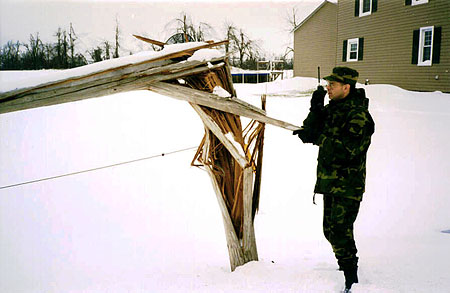 Ham and Civil Air Patrol volunteer Jim Edmonds, WA1KPG, of Liverpool, New York, reports in using his H-T while conducting route reconnaissance in the Watertown, New York, area. One available estimate said the storm downed 180,000 utility poles in New York along. [Photo by Sue Edmonds, N2GNN]
 |
While a complete recovery from this month's Northeast ice storms is months--perhaps even years--away, the situation in Northern New York and elsewhere "has stabilized and is gradually improving," according to Eastern New York Section Manager Rob Leiden, KR2L. Ham radio is no longer playing a primary communication role but continues to support the National Guard and relief agencies as needed. Hams from the affected counties and elsewhere in the Empire State "played a key role in assisting the Red cross, the New York National Guard, and RACES activities for several weeks of around-the-clock activity," Leiden says. Hams are using both HF and VHF channels to keep open necessary communication links. The FCC has dropped a voluntary communication emergency that had effectively roped off several segments of 2 meters for emergency traffic only.
On January 23, hams were relieved of duties at the New York State Emergency Management Office (NY SEMO). "There is a huge roster of hams to be thanked," said Eastern New York DEC for Administration April Stack, K2ZCZ.
Leiden says the wide use of HF for emergency communication and health-and-welfare traffic "once again confirmed that VHF/UHF point-to-point links are not always sufficient for large, regional activity." He says knowledge of HF propagation proved to be valuable as net control stations "quickly adjusted to band conditions" and managed the mix of both HF and VHF channels. He also had high praise for the New York SEMO crews in working with hams and other emergency workers. "Governor Pataki, a former ham himself (he used to be K2ZCZ), and his staff had an opportunity to see firsthand the large effort and significant contribution made by the many Amateur Radio operators involved in the Northern New York relief effort," Leiden said.
Hams maintained a presence in many emergency shelters; more than 1000 people were still in shelters as of last week. Herkimer County, New York, ARES/RACES EC Don Rankins, N2ZWO, said that spirit in the shelters he visited was good. "People were doing well in close quarters. Hams have provided good support." Rankins said hams in his area have been assigned to damage assessment teams with the Red Cross.
Members of the RidgeTop Amateur Radio Club who went to assist in hard-hit Franklin County, New York, report that ham radio was the hit of the shelters as it provided a way for shelter guests to check with other family members or to get word on their homes. Ham radio also facilitated transportation of needed medications to shelter guests.
John Gabrielson, KC2AGM, of Earlton, New York, spent his 55th birthday (January 17) helping out at the Red Cross shelter in Malone. Gabrielson said the local hams were busy trying to get repeaters back on line, trying to heat their own homes, and working long hours at their jobs--which included EMS, state and local police, Red Cross, and other government agencies. Others got on the air. "Jeff Jones, K3KYR, stayed home heating his house with wood, running a generator to power his station as an HF link and spending a huge amount of time on the air," he said. Gabrielson reported that after Jones spent 11 days as the only HF link in Franklin County, he and his wife volunteered for Red Cross duty. "His wife now wants to become a ham," he said.
In Maine, State RACES Director Rod Scribner, KA1RFD, reports another ice storm earlier this week plunged 30,000 homes into darkness and Red Cross shelters were opened in several locations. "Hams were on call, but normal communications stayed up, so we remained available and assisted neighbors," Scribner said.
PHASE 3D ANGLING FOR "STANDBY" STATUS ON ARIANE 503
Phase 3D Project Leader and AMSAT-DL President Karl Meinzer, DJ4ZC, has "expressed a strong desire" to European Space Agency officials for a Phase 3D launch aboard Ariane 503, which is set for sometime in May. Meinzer met January 20 in Paris with ESA officials to discuss including Phase 3D aboard the third test flight of the Ariane 5 launch vehicle.AMSAT-NA Executive Vice President, Keith Baker, KB1SF, likened the situation to flying standby in order to get a seat on a fully booked airline flight. "That strategy often pays off," he added. Baker said this week that an international Phase 3D team has "been pressing ahead with getting the satellite flight ready" at the Phase 3D Integration Lab in Orlando, Florida. But he conceded that "things are still very fluid" regarding possible launch vehicles and a firm launch schedule for Phase 3D.
AMSAT says the ESA officials "indicated willingness to consider a launch on AR-503," but made no commitments. There's a possibility that another payload might fly aboard AR-503 that would preclude Phase 3D. But, ESA did agree to take a look at what would be required to carry the Phase 3D payload. ESA also agreed to investigate other possible launch opportunities, including Ariane 4 flights. Another meeting is set for late February.
"ESA is making bona-fide efforts to identify a launch for us. I think we stand a good chance," he said after the meeting. Meinzer and AMSAT-NA officials have agreed that their job now is to get Phase 3D completed and tested, so that it will be ready to go if ESA gives the green light.--AMSAT News Service; Keith Baker, KB1SF
FCC'S JOHN B. JOHNSTON, W3BE, RETIRES
A well-known name at the FCC, John B. Johnston, W3BE, has retired. His last position at the Commission was as Special Assistant for Personal Radio Services to the Public Safety and Private Wireless Division. Johnston's last day at the FCC was Friday, January 30.After an electrical engineering career in the private sector, Johnston joined the FCC in 1972 as Chief, Rules and Legal Branch, Amateur and Citizens Radio Division, where he worked under Prose Walker, W4BW. In 1975, Johnston replaced Walker as Chief of the Amateur and Citizens Radio Division. Later, he served as Chief of the Personal Radio Branch, Special Services Division, in the Private Radio Bureau (now the Wireless Telecommunications Bureau).
Johnston, who's 70, only made it known this week to his FCC colleagues that he'd be leaving, but his retirement was not entirely unexpected since his wife retired last fall. For the time being, Bill Cross, W3TN, will be handling Amateur Radio matters formerly done by Johnston.
A former ARRL Assistant Atlantic Division Director, Johnston served earlier in his ham radio career as president of the Frankford Radio Club and authored some articles for QST, including "Some Notes on Acquiring the Code" in November 1966, and "A New Year's Resolution" in March 1966, for which he won an award from the ARRL Communications Department. He is a Charter Life Member of the ARRL.
|
W1AW INAUGURATES NEW 20-METER BULLETIN RIG
If W1AW's 20-meter signal has sounded especially robust in the past couple of weeks, you can thank the generosity of manufacturers and lots of hard work on the part of the W1AW and the ARRL Lab staffs. As a first step in upgrading and replacing some of its aging station components, W1AW has purchased and installed a new Ten-Tec OMNI VI Plus transceiver and a custom-built Command Technologies single-band, three-tube, grounded-grid linear amplifier. Eimac donated the three 3CX800A7 power amplifier tubes for the Command amp. With help from other Headquarters staffers, W1AW Station Manager Joe Carcia, NJ1Q, installed the new gear during January to replace the older Harris commercial transceiver and amplifier used to air W1AW code practice and bulletin transmissions on 20 meters. Carcia praised both manufacturers for going the extra mile. "Ten-Tec modified our OMNI VI Plus by installing additional crystal ovens," he explained. "The result is a clean and very stable signal." Carcia said Command Technologies had to redesign its HF-2500E 5 kW linear, normally a desk top unit, so it would fit easily in the W1AW equipment racks. The RF deck was modified to allow a maximum of 1500 W output. The unit also has overdrive protection to ensure longer tube life. Earlier this year, the station also installed two new MFJ-812B VHF SWR/wattmeters, donated by MFJ, plus a new two-meter bulletin transmitter--a Kendecom MT-4 repeater transmitter. |
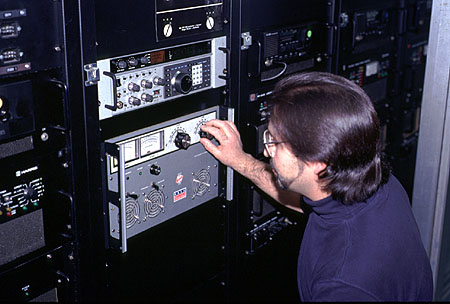 W1AW Station Manger Joe Carcia, NJ1Q, tweaks the controls on the new 20-meter transmitter installation at the Maxim Memorial Station. [Photo by Rick Lindquist, N1RL]
RAFT CARRYING HAM RADIO LOST AT SEA
Tragic news from the Far East this week: Word from South Korea is that all hands aboard a research raft carrying ham radio station HLØJQT/mm (see "Raft /mm station active," The ARRL Letter, Vol 17, No 4) were lost January 24 in heavy seas off the coast of Japan. Japanese Maritime Safety Agency authorities had responded to a distress call that the crew was extremely exhausted. It's not clear if the distress call went out on Amateur Radio frequencies, however. Bodies of three of the crew members had been recovered, but a fourth was still missing in the frigid waters and presumed drowned.The 23-foot research raft, which had a sail but no engine, was attempting a voyage from Vladivostok, Russia, to Pusan, South Korea, when it capsized in stormy seas. News reports from South Korea said the four-man crew, led by 48-year-old skipper Lee Duk-young, was attempting to retrace the sea route linking Palhae, an ancient Korean dynasty that originated in northeast China, to the Korean Peninsula.--Vernon Eubanks, KØLVS/HL9VE
SOLAR UPDATE
Solar scribe Tad Cook, K7VVV Seattle, Washington, reports: Solar activity increased this week over last, but not by much. Average sunspot numbers were up by 17 points, and average solar flux was also higher, but by less than five points. Average solar flux for the previous 90 days rose from 96 to 97, and the daily flux was above the average for that day on five out of seven days. This indicates a moderate general upward trend in solar flux values.Solar flux peaked at 108.3 on January 25 but now is headed down to the low 90s. For January 30 through February 1 flux values are projected at 94, 93 and 91. A coronal mass ejection earlier on January 25 should cause unsettled conditions on the last two days of January, but the A index is only expected to rise to around 20. This is enough to cause problems over polar radio paths and in higher latitudes, however. Solar flux is expected to bottom out around 90 between February 5-9, then rise up near 100 again later in the month.
Sunspot numbers for January 22 through 28 were 37, 57, 88, 104, 99, 98, and 89 with a mean of 81.7. The 10.7-cm flux was 93, 96.9, 97.5, 108.3, 100, 100.8, and 96.6, with a mean of 99, and estimated planetary A indices were 4, 3, 4, 9, 3, 6, and 2, with a mean of 4.4.
The January 1998 issue of Scientific American contains an interesting article on the Ulysses mission, which is returning new data on high latitude solar magnetic fields. NASA has a web site for this mission at http://ulysses.jpl.nasa.gov/.
Another NASA project of interest to solar observers is the Advanced Composition Explorer (ACE), launched last summer. The February, 1998 issue of Monitoring Times magazine has an informative article on solar weather and the ACE mission. The Goddard Space Flight Center ACE web site is http://www.gsfc.nasa.gov/ace/ace.html.
LOUIS J. LaBONTE, K6KDU, SK
Louis "Buz" LaBonte, K6KDU, of Citrus Heights, California, died January 28, 1997. He was 60. LaBonte, engineer at KVIE-TV in Sacramento, was an ATV pioneer in Northern California and served as video advisor to the Governor's Office of Emergency Services in California. He also served as the TV vice chair of the Sacramento-Sierra Local Emergency Communications Committee for California's largest Emergency Alert System cluster of 17 counties. A memorial gathering will be held February 5, 5:30 PM (PST), at KVIE-TV, 2595 Capitol Oaks Drive, Sacramento.--Stanly E. Harter, KH6GBXIn Brief:
This weekend on the radio: The YL International SSB QSO Party and the UBA SSB Contest (see January QST, page 105), plus the North American SSB Sprint (see February QST, page 94), are on tap this weekend. Enjoy!ARRL Audio News OK for repeater nets: ARRL Audio News is available from the ARRLWeb in RealAudio format or by telephone at 860-594-0384. We encourage the use of ARRL Audio News--in whole or in part--on local repeater nets. You don't need any special permission to use it, but please identify it as ARRL Audio News.
Farewell! ARRL Assistant Technical Editor Paul Danzer, N1II, departed the HQ staff January 15 for a community college teaching position. During his tenure on the Book Team, he served as editor of The ARRL Operating Manual and The ARRL Handbook, among other publications. We wish him well in his new endeavors.
Outgoing QSL Service stats: Propagation must be looking up. The ARRL Outgoing QSL Service handled 1,378,240 QSL cards to DX stations during 1997--that's 9,200 pounds, or more than 4-1/2 tons, of cards. The number represents an increase from 1996 of more than 78,000 cards handled.
Vanity update: The FCC in Gettysburg reports it has run all vanity applications received through December 22, 1997. All work in process (WIPs) also has been processed. The FCC granted 174 new call signs on January 22.--FCC
Hams active after surprise storm: Local ARES/RACES units were activated in Virginia following a surprise storm January 27 that left two feet or more of heavy, wet snow in parts of Appalachia. At one point, more than 60,000 were reported without power between the Roanoke Valley and the Tennessee and Kentucky borders. Governor Jim Gilmore declared a state of emergency and activated the National Guard to help, and power is being restored. At least one death was blamed on the storm, which snarled traffic and stranded travelers on two major interstate highways. In Scott County on the Kentucky border, ARES was activated on the evening of January 27 and helped to provide emergency communication there. "I spent the entire night at the EOC," reports District 14 DEC and Scott County EC Jim Flanary, K4LMP, of Gate City. Flanary says Dickenson County ARES also activated. "It was a rough night for a lot of us," he said. Flanary reports some homes in his area could be without power for as long as a week. "We are assisting in every way possible to help out in this time of need." Virginia SEC and State RACES Chief Frank Mackey, K4EC, says Chesterfield County ARES (Richmond area) offered to mobilize its ARES communications van, which is equipped with a generator, portable repeater and two operators. "We are monitoring their activities and the need for additional assistance," he concluded. By week's end, temperatures had risen and the snow was reported melting fast.--Frank Mackey, K4EC
ARES helps at fire scene: The Red Cross called in local ARES to help provide communication at the scene of an apartment house fire January 23 in White Plains, New York. Eight local hams took part, shadowing Red Cross and emergency services officials at the fire scene, at three local churches being used as service centers, at the White Plains High School (being used as a shelter), and at Red Cross Headquarters. The fire affected 90 families. One person died, and ten were injured.--Alan Crosswell, N2YGK
Deer hunting ham helps heart attack victim: Out enjoying the last day of deer hunting season last November, John McClellan, KB8GGK, heard an urgent call over the Cherryland Amateur Radio Club repeater in the Traverse City area of Michigan. Traveling through the area from out of town with his wife, Ken McClurken, KB8VG, reported he was having chest pains and needed directions to the nearest hospital. McClellan directed the couple to a local hospital, while Jane Newton, KC8HJQ--who'd heard the call--dialed 911. Bill Shenk, W8PIT, of the Cherryland ARC, reports McClurken was released from the hospital a week later and was recovering at his home in Grandville, Michigan.