Address Changes: Kathy Capodicasa, N1GZO, e-mail kcapodicasa@arrl.org.
Editorial: Rick Lindquist, N1RL, e-mail elindquist@arrl.org.
| IN THIS EDITION: |
- FCC revises RF safety "thresholds"
- Azden leaving US ham market
- KC5VPF still on Mir schedule
- Ham radio to benefit from ACE spacecraft
- A message with the music
- HANDI-HAM Actividay on August 30
- James L. Russell, W8BU, SK
- In Brief: This weekend on the radio; Bill Petrie, K1ETR, turns 100! SBE honors W3KD, K7CR, KB7UXU; Special event call sign ID reminder; KE6MWX Yagi project among science fair winners; Searchable Code of Federal Regulations; Maritime station KPH goes dark; US House honors Pasadena Radio Club
| FCC REVISES RF SAFETY "THRESHOLD" LEVELS |
The FCC has revised the power level thresholds to trigger a routine Amateur Radio station RF exposure evaluation, and the changes will be welcome news for most hams. When the FCC first decreed a year ago that ham radio stations would have to comply with RF exposure guidelines, it set a 50-W threshold level. The updated guidelines, announced August 25, increase that threshold level on all HF bands except 10 meters, where it remains at 50 W. The FCC made no changes in the RF exposure limits it announced last year.
The new RF safety guidelines are scheduled to become effective January 1, 1998, for Amateur Radio stations.
The FCC went along in part with a request by the ARRL to establish a sliding scale for threshold levels, depending upon frequency. The revised thresholds are 500 W for 160 through 40 meters, 425 W on 30 meters (where the maximum legal power is 200 W), 225 W on 20 meters, 125 W on 17 meters, 100 W on 15 meters, 75 W on 12 meters and 50 W on 10 meters. The threshold for all VHF bands is 50 W. On UHF, the threshold level is 70 W on 70 cm, 150 W on 33 cm, 200 W on 23 cm, and 250 W on 13 cm and above. Stations operating at or below these respective power levels are categorically excluded from having to perform a routine RF radiation evaluation. However, all stations, regardless of power level, still must comply with the RF exposure limits.
Along with its August 25 Second Memorandum Opinion and Order announcing the changes, the FCC released the "core" text of its long-awaited Office of Engineering and Technology (OET) Bulletin 65, Evaluating Compliance with FCC Guidelines for Human Exposure to Radiofrequency Electromagnetic Fields. The bulletin contains generic equations that can be used to analyze fields due to almost all antennas, although the FCC warns that "the resulting estimates for power density may be overly conservative in some cases." Hams leery of formulas might opt to wait for the easier-to-use Supplement B to OET Bulletin 65, which will include information designed specifically for evaluating Amateur Radio installations. The supplement promises to detail how hams can determine more simply if their individual stations comply with the new regulations. The FCC says the supplement will contain "information on projected minimum exclusion distances from typical amateur antenna installations."
The FCC said it would issue Supplement B "as soon as a review of the current draft is complete." When it's ready, Supplement B will be available to download from the FCC's Web site, http://www.fcc.gov/oet/rfsafety. The FCC directed inquiries as to the availability of the supplement and other RF-related questions to its RF Safety Program, 202-418-2464; e-mail rfsafety@fcc.gov.
Last year, the FCC established time-averaged maximum permissible exposure (MPE) limits for RF fields in two tiers--for controlled environments (ie, a ham's immediate household, including visitors) and uncontrolled environments (ie, neighbors, the general public). If a routine evaluation of a ham station indicates that human exposure to RF fields could be in excess of the FCC's MPE limits, the licensee must act to correct the problem and ensure compliance. This could include changing operating patterns, relocating antennas, restricting access, changing frequency, output power or emission type or any combination of these and other remedies.
The FCC says that ham radio facilities "represent a special case for determining exposure, since there are many possible antenna types that could be designed and used for amateur stations."
The revised regulations categorically exclude most mobile installations, including those in the Amateur Radio Service, from having to comply with the RF-exposure or station evaluation guidelines. Since the FCC issued its guidelines, additional questions on RF safety have been added to the Amateur Radio examination question pool.
OET Bulletin 65 and the FCC Second Memorandum Opinion and Order are available at http://www.fcc.gov/oet/dockets/et93-62/. More details on the FCC's latest announcement on RF safety will appear in the October issue of QST.
| AZDEN LEAVING THE US HAM RADIO MARKET |
A player in the US ham radio market since the 1970s, Azden is leaving the Amateur Radio business in this country as of August 31. A letter from Azden's Lew Reinberg, W2BIE, cited "the worldwide decline of the business" as the reason for the move. "We entered the US market through this office very late in the game and with older product," Reinberg's letter states. "The lack of growth of the end-user base made it impossible for us to spend the huge amount of capital necessary to design and tool up for a more advanced model."
Azden's pullout applies only to the US market. Azden Vice President Ken Bush said this week that Azden radios continue to be sold in Japan.
Among Azden's product lineup were similar FM mobile transceivers for several bands. The company also marketed some H-Ts and a headset. The company's remaining ham radio inventory has been sold to Amateur Electronic Supply (800-558-0411; http://www.aesham.com; e-mail help@aesham.com).
Reinberg said that while Azden will stop selling ham radio gear in the US, the company will continue to repair its radios at its Franklin Square, New York, headquarters "for the foreseeable future." Parts and manuals for Azden gear will continue to be available as well.
Sid Wolin, K2LJH, manager of Azden's Communications Division, reportedly plans to retire. Reinberg says he will remain at Azden's Franklin Square office to handle customer questions and process service and repair orders.
For more information, call Azden at 516-328-7500; e-mail azdenus@aol.com; http://www.azdencorp.com.
| WOLF REMAINS ON SCHEDULE TO REPLACE FOALE ABOARD MIR |
It appears that NASA will allow David Wolf, KC5VPF, to take the place of Mike Foale, KB5UAC, aboard the Russian Mir space station next month. That is, as long as Mir repairs continue to be as successful as they were last week and this. NASA has not yet made it official, however.
FCC notifications already have been submitted to allow Wolf to operate the ham gear aboard Mir to contact third parties.
Following another brief crisis on Monday, the Mir's oxygen generation systems were reported back in working order by the following day. Both the main and backup systems went down simultaneously for several hours on Monday. Other recent problems have included another computer crash August 18 that caused power aboard the spacecraft to fail as the Mir lost its orientation with the Sun.
Foale has posted occasional bulletins on the R0MIR packet system aboard Mir to update the ham radio community on the situation aboard the spacecraft. "We are now getting the station back into shape, trying to reconnect cables disconnected before the EVA [space walk]," Foale reported last weekend.
Some power was reported flowing through cables that pass through a makeshift hatch from three of the solar arrays attached to the damaged Spektr module. As of Thursday, the Mir crew still was seeking a way to activate the motors that aim the solar arrays. The two Russian crewmates, Anatoly Solovyov and Pavel Vinogradov, installed the cables from Spektr during an internal spacewalk a week ago. Foale monitored the "internal spacewalk" from the safety of the Soyuz spacecraft that serves as both the transportation vehicle for the Russian crew members and an escape vehicle for all space station occupants.
Until this week, the station had been operating at approximately half power as a result of damage sustained when the station collided with a Progress supply rocket during a practice docking maneuver June 25.
Foale and Solovyov are set to do an external spacewalk September 3 to determine the extent of damage to the Spektr module.
| HAM RADIO WILL BENEFIT FROM NEW ACE SPACECRAFT |
Data gathered by the Advanced Composition Explorer (ACE) spacecraft--launched this week from Kennedy Space Center--will be of importance to everyone from Amateur Radio operators to solar and space physicists during the next 2 to 5 years as we approach the solar maximum in 2000.
This spacecraft will serve as the first real-time space weather satellite that will provide forecast centers around the world with valuable real-time information regarding the near-Earth and interplanetary space environments. The latest word is that the spacecraft is functioning perfectly.
The spacecraft is on its way toward an orbital location approximately one million miles toward the Sun, between the Sun and the Earth (at what is known as the L1 point--the first liberation point, or the first Lagrangian point). This is a point between the Sun and the Earth where the various forces which act upon spacecraft (gravity, for example) precisely balance out, enabling the spacecraft to orbit the Sun at the same rate as the Earth, but one million miles ahead of the Earth. ACE will require approximately 113 days to reach its final orbital position and complete its checkout. Data should be flowing from all instruments by then.
The ACE spacecraft is equipped with an array of instruments that will measure such important quantities as the velocity of the solar wind, the composition of the solar wind, the composition of extrasolar and extragalactic matter, and much more. It also has equipment which will allow it to transmit continuously to the Earth. NOAA has set up three primary reception centers that will maintain contact with this datastream 24 hours a day, 365 days a year, for as long as the spacecraft remains operational. This data will then be processed and made available on the Internet for anyone to receive. Real-time ACE data will be available to the public and scientific communities through the SWARM (Solar Warning and Realtime Monitor) software at http://solar.uleth.ca/solar/www/swarm.html. Data are expected to begin flowing from the ACE spacecraft through the near-real-time data system (and through SWARM) by about February 1998.
This availability of data will provide researchers and amateurs with the unprecedented ability to observe (up to 60 minutes before the Earth is impacted) the arrival of major interplanetary disturbances ejected from the Sun. Such disturbances can severely disrupt radio communications, spacecraft operations, and even such things as electrical hydro power generation and distribution.
Having advance word on such disturbances could be highly useful. Hams and professional radio communicators will be able to complete communications or adjust frequencies and transmitter powers prior to the arrival of such disturbances. Power plant operators will be prepared to shift loads in the event of induced electrical currents from strong geomagnetic storms that form as a result powerful solar disturbances impacting with the Earth. Satellite operators will be able to monitor their spacecraft more closely and take appropriate actions to prevent surface charging or other hazardous events from damaging spacecraft.
Observers of these natural phenomena also will benefit. People will be able to drive to favorable dark-sky sites to observe the explosive release of energy in Earth's upper atmosphere that is responsible for forming the northern and southern lights, also known as the aurora borealis and the aurora australis, respectively. --Cary Oler
| A MESSAGE WITH THE MUSIC |
A recent "Mr. Music" column by syndicated writer Jerry Osborne addresses the appearance on some music albums of messages or phrases in Morse code. For example, at the beginning of the Barclay James Harvest's Ring of Changes, the album's name is spelled out in CW on the first track. Barclay James Harvest member John Lees is a ham (WD4FHD).
Rocker Joe Walsh, WB6ACU, taps out the words "Register and vote for me AR" at the start of the song "Vote for Me" on his album Songs for a Dying Planet. The characters YYZ are belted out on percussion then by the bass guitars on the song of the same name on the Rush album Moving Pictures. Osborne says YYZ is the beacon ID for the Toronto International Airport, and the group's guitarist is a private pilot.
The B-52s use some CW in Planet Claire. So did the Blues Magoos in their album I Can Move a Mountain. In the song "Pencil Rain" by They Might Be Giants, a stretch of code spells out a refrain, in Spanish, of a popular Mexican song. The Roger Waters album Radio K.A.O.S. is filled with Morse code messages, much of it under the music. The cover also has the titles of the tracks spelled out in code.
Osborne says the track "Miss Morse" on the album One Nation Underground by the rock band Pearls Before Swine reportedly spells out various vulgarities in CW.
| HANDI-HAM ACTIVIDAY THIS WEEKEND |
All amateurs are eligible to participate in the HANDI-HAM Actividay, Saturday August 30, 1997, 1200 to 2400 UTC. Single or multi-ops are permitted. Suggested CW frequencies are 3675 to 3750, 7100-7150, 14025 to 14100, 21025 to 21200, and 28100 to 28300 kHz; suggested SSB frequencies are 3875 to 3950, 7250 to 7290, 14270 to 14300, 21350 to 21400, and 28300 to 28500 kHz.
Logs should indicate date, time, station worked, operator's name and QTH, frequency, type of emission, output power, report sent, report received, and whether the operator worked is a HANDI-HAM member. Logs also should show the total number of contacts and claimed score. Include your name, address and call sign, and indicate if you're a HANDI-HAM member.
Score 5 points for contacts with W0ZSW, the HANDI-HAM HQ station; 5 points for contacts with W0EQO, the HANDI-HAM camp station; 2 points for contact with HANDI-HAM member; 1 point for contact with nonmember. Work stations only once per band per mode.
A HANDI-HAM logo mug goes to the station with the most points. All participants who send in logs will receive a certificate. Send an SASE (minimum 5x7) with log to Jim Whittaker, WB0TVL, 3019 O'Henry Rd, Brooklyn Center, MN 55429-2220.
For more information on the Courage HANDI-HAM System, call 612-520-0515; e-mail handiham@mtn.org or visit http://www.mtn.org/handiham.
| JAMES L. RUSSELL, W8BU, SK |
Veteran ham radio operator Jim Russell, W8BU, of Rocky River, Ohio, died August 15, 1997. He was 98 and had been a ham for approximately 85 years. Russell was said to be the first ham west of the Allegheny Mountains to work Europe. He was an ARRL and QCWA member and served as a net control station for the Intercontinental Traffic Net. In his professional life, Russell was an attorney, a justice of the peace and the public safety director for Fairview Park, Ohio. He also dabbled in astronomy and telescope building. His late wife, Eila, was WA8EBS. His brother, Dave, is N8DR. --Jerry Murphy, K8YUW
| In Brief: |
- This weekend on the radio: The HANDI-HAM Actividay is set for Saturday.
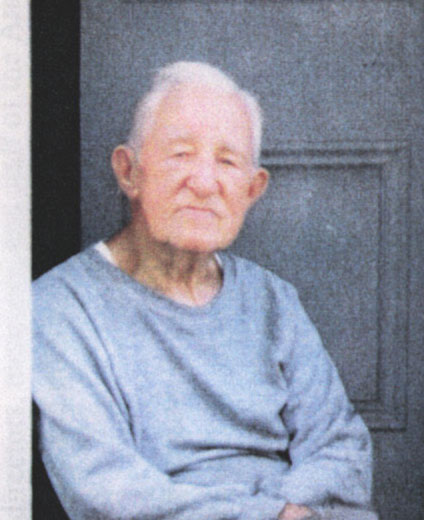
- Bill Petrie, K1ETR, turns 100! Thomas W. "Bill" Petrie, K1ETR, of Waltham, Massachusetts, turns 100 years old today. In a letter, ARRL Executive Vice President David Sumner, K1ZZ, extended hearty congratulations to Petrie on behalf of the officers, directors, members and staff of the League. Petrie's niece, Marcy Just, says that Petrie was born in England and came to the US as a youngster. He is a World War I veteran and is retired from the Waltham Watch Company. He's been a ham for more than 40 years and is still active on the air. Ken Hopper, K2VAM, in Phoenix, Arizona, wrote HQ to say that Bill recently told him he was planning to make a trip up his tower to "tighten some bolts."
- SBE honors W3KD, K7CR, KB7UXU: The Board of Directors of the Society of Broadcast Engineers elected Chris Imlay, W3KD, a Fellow of the Society in recognition of his service and contributions to the advancement of broadcast engineering. Imlay, the ARRL General Counsel, has served as SBE in the same capacity since 1992 (and previously, as SBE's legal counsel since 1984). The society said Imlay "has provided a professional and respected voice on legislative and regulatory issues." The SBE has named Clay Freinwald, K7CR, of Auburn, Washington, as Broadcast Engineer of the Year. He's chief engineer at KBSG-AM/FM in the Seattle area. The SBE named Michael P. Scott, KB7UXU, of Pulyallup, Washington, as Educator of the Year for the second year in a row. He's an instructor at Bates Technical College in Tacoma. --Society of Broadcast Engineers
- Special event call sign ID reminder: When taking advantage of the newly available 1x1 special event call sign program, operators are reminded that a station using a 1x1 call sign must announce its regularly assigned call sign at least once an hour.
- KE6MWX Yagi project among science fair winners: Fourteen-year-old Sara Hanna, KE6MWX, of Willits, California, was among the winners at the 46th annual California State Science Fair held in May in Los Angeles. Her project, "Does the design of the driven element affect the radiation pattern of a Yagi antenna?" placed first in the junior division of electricity and electronics. She got a gold medal and a cash award. Last year, Sara finished in second place in the same division with her project comparing Yagi and quad antennas. Her parents are Tim and Sue Hanna, WB9NJS and KE6YKY, respectively. --Tom Orman, KD6VWD
- Searchable Code of Federal Regulations: A searchable Code of Federal Regulations, which, of course, includes 47CFR97--the Amateur Radio regulations--is available at http://www.access.gpo.gov/nara/cfr/cfr-table-search.html from the National Archives and Records Administration. --thanks to Ed Hare, W1RFI
- Maritime station KPH goes dark: The oldest West Coast maritime station, KPH in California's Marin County 20 miles northwest of San Francisco, has been closed--a victim of a shrinking market for its services and competition from satellite systems. KPH was bought by Globe Wireless, a competitor. KPH used high-speed Morse and SITOR to communicate with ships. The station had operated from the Bay Area for more than 80 years. --thanks to Daniel Mackintosh, W6SPC
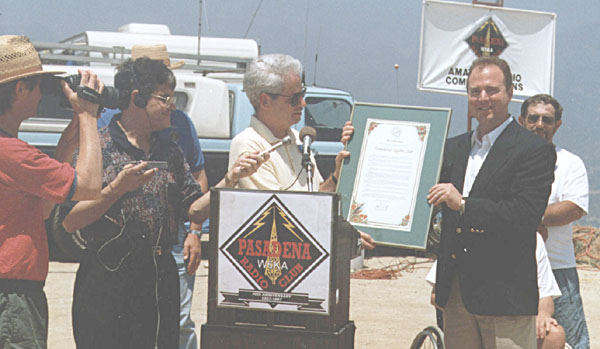 California State Sen Adam Shiff of Burbank (right) presents a resolution from the California Legislature to Pasadena Radio Club President John Minger, AC6VV, recognizing the club's 40 years of public service activities.
 - US House honors Pasadena Radio Club: The Pasadena Radio Club, W6KA, took advantage of this year's Field Day (June 28-29) to commemorate its 40th year of affiliation with the ARRL. Proclamations from both the US House of Representatives and the California Legislature honored the group's 40 years of public service. The club was founded in 1957 and has been called upon numerous times over the years to help out in emergencies. Club members relayed health and welfare traffic during the days following the 1994 Northridge earthquake. The club also has supported public service activities and events. --Brett R. Henry/Pasadena Radio Club
| The ARRL Letter |
The ARRL Letter is published by the American Radio Relay League, 225 Main St, Newington, CT 06111; tel 860-594-0200; fax 860-594-0259. Rodney J. Stafford, KB6ZV, President; David Sumner, K1ZZ, Executive Vice President.
Circulation, Kathy Capodicasa, N1GZO, e-mail kcapodicasa@arrl.org.
Editorial, Rick Lindquist, N1RL, e-mail elindquist@arrl.org.
Visit the ARRLWeb page at http://www.arrl.org.
The purpose of The ARRL Letter is to provide the essential news of interest to active, organizationally minded radio amateurs faster than it can be disseminated by our official journal, QST. We strive to be fast, accurate and readable in our reporting.
Material from The ARRL Letter may be reproduced in whole or in part, in any form, including photoreproduction and electronic databanks, provided that credit is given to The ARRL Letter and The American Radio Relay League.
| How to Get The ARRL Letter: |
The ARRL Letter is distributed directly from ARRL HQ only to elected League officials and certain ARRL appointees and to paid subscribers of the now-defunct hard-copy edition of The ARRL Letter . For members and nonmembers alike, The ARRL Letter is available free of charge from these sources:
- The ARRLWeb page (http://www.arrl.org/arrlletter/). This version of The ARRL Letter includes any photographs.
- The HIRAM BBS: 860-594-0306.
- The ARRL Technical Information Server (Info Server): Send an e-mail message to info@arrl.org. The subject line should be blank. In the message body, type send ltrmmdd.txt, where mm represents two digits for the month and dd represents two digits for the day (The ARRL Letter is published every Friday). For example, to request The ARRL Letter file for Friday, January 3, 1997, you'd type send ltr0103.txt. Then, on a separate line, type quit.
- CompuServe and America Online subscribers, as a downloadable text file in the services' ham radio libraries
- The Netcom server, run by the Boston Amateur Radio Club and Mike Ardai, N1IST: Send e-mail to listserv@netcom.com (no subject needed). The body of the message should say subscribe letter-list.