Address Changes: Kathy Capodicasa, N1GZO, e-mail kcapodicasa@arrl.org.
Editorial: Rick Lindquist, N1RL, e-mail elindquist@arrl.org.
| IN THIS EDITION: |
- FCC implements new 1x1 special event call sign rules
- Gate 3 call sign grants could be soon
- Director elections set in three divisions
- SM election results
- Ooops! MARS CW ban still in effect
- Huntsville attendance, mood up
- Lighthouses, lightships on the air
- Mini-Sputnik to be launched from Mir
- Solar update
- In Brief: This weekend on the radio; JOTA information available; New SC SM; Pennsylvania ARES proves mettle; Keough departs World Radio; E. F. Johnson Company to be sold; Balloon-based repeater a success; CQ-ing cellphone
| NEW 1X1 SPECIAL EVENT CALL SIGN RULES IMPLEMENTED |
New FCC rules to obtain one-by-one call signs for special events have been implemented, and four coordinators have been authorized to handle call sign requests. The first special event call sign, W3W, was coordinated August 20 at the request of the Scranton Pocono Amateur Radio Klub (SPARK) of Scranton, Pennsylvania. W3W will be activated October 11-12, 1997, during the Steamtown Marathon.
On August 18, the FCC authorized the ARRL, The W5YI Group Inc of Arlington, Texas, the Western Carolina Amateur Radio Society/VEC Inc of Knoxville, Tennessee, and the Laurel Amateur Radio Club Inc of Laurel, Maryland to "coordinate, maintain and disseminate a common database of amateur station special event call signs." The National Conference of Volunteer Examiner Coordinators (NCVEC) maintains a shared database so that both requesters and coordinators will know which call signs are available at any given time.
The FCC says that special event 1x1 call signs are authorized for use "in conjunction with an event of special significance." This suggests an event with high public visibility, as opposed to a routine ham radio contest or other operating event. However, a special event call sign could be used in conjunction with a contest if one were to occur within the call sign reservation period.
The four special event call sign coordinators have the authority to determine if a request is in keeping with the intent of the special event call sign system. Any licensed amateur may request a special event call sign. Call signs may be requested up to one year in advance of their use on the air. Call signs normally will be granted for periods of 15 days or less. Because of the limited number of call signs available, requesters are encouraged to limit their requests to the duration of the special event.
A block of 750 call signs is available for use in the special event call sign system. The format of each 1x1 call sign consists of a single letter K, N or W prefix followed by a single numeral, 0 through 9, followed by any single letter except the letter X, which is not available to amateur stations.
For more information on the special event call sign system, call 860-594-0300 or e-mail vec@arrl.org. You also can contact any of the other special event call sign coordinators.
| FCC POISED FOR GATE 3 GRANTS |
Grants for first-day applicants under the FCC's vanity call sign program Gate 3 could start showing up soon. The FCC has been wading through the vanity applications it received prior to the opening of Gate 3 on August 6. On August 22, the FCC reported it had processed vanity applications received up through August 5 -- the day before Gate 3 opened -- but was still dealing with apparently unsuccessful or problematic applications in the so-called "work in process" (WIPS) stack.
In a last-minute flurry of activity this week, the FCC granted 232 vanity call signs for applications received from July 17 through August 5. Another 325 applications from that period hit WIPS, and it is those applications the FCC will deal with next, before moving on to Gate 3 applications. The FCC says it received 1613 vanity applications between August 6 and August 20.
| THREE DIRECTORS FACE COMPETITION |
Three ARRL directors will face competition this fall for their seats on the ARRL Board of Directors. The contests are in the Atlantic, Delta and Great Lakes divisions.
- In the Atlantic Division, the candidates are incumbent Director Kay Craigie, WT3P, of Paoli, Pennsylvania, and Jim Carson, WK2K, of Ithaca, New York. Atlantic Division Vice Director Bernie Fuller, N3EFN, is without opposition for his seat.
- In the Delta Division, incumbent Director Rick Roderick, K5UR, of Cabot, Arkansas, will face Malcolm Keown, W5XX, of Vicksburg, Mississippi. Delta Division Vice Director Henry Leggette, WD4Q, has no opposition.
- In the Great Lakes Division, incumbent Director George Race, WB8BGY, of Albion, Michigan, will face Joseph Falcone, N8TI, of Livonia, Michigan. Great Lakes Division Vice Director Dave Coons, WT8W, is unopposed.
Ballots will be distributed by October 1, 1997, to ARRL members of record as of September 10, 1997. Ballots must be returned by November 21, 1997.
Candidates in several other divisions also faced no opposition and are considered elected. Uncontested candidates are:
- In the Dakota Division, Director Tod Olson, K0TO, and Vice Director John Bellows, K0QB (incumbent Dakota Vice Director Hans Brakob, K0HB, decided not to seek re-election.)
- In the Midwest Director Lew Gordon, K4VX, and Vice Director Bruce Frahm, K0BJ.
- In the Pacific Division, Director Brad Wyatt, K6WR, and Vice Director Jim Maxwell, W6CF.
- In the Southeastern Division, Director Frank Butler, W4RH, and Vice Director Evelyn Gauzens, W4WYR.
Terms of office for successful candidates begin January 1, 1998.
| SECTION MANAGER ELECTION RESULTS |
John Wallack, W6TLK, will return to the position of San Francisco Section Manager starting this fall. Wallack, a former SM, outpolled incumbent SM Tom Orman, KD6VWD, 318 to 270 in balloting earlier this month.
Section Manager candidates in eight other sections had no opposition and were declared elected. These include Tim Armagost, WB0TUB, Colorado; Nelson "Sandy" Donahue, W4RU, Georgia; Kyle Pugh, KA7CSP, Eastern Washington; Phineas Icenbice Jr, W6BF, Los Angeles; Jettie Hill, W6RFF, Sacramento Valley; Ray Taylor, N5NAV, South Texas; Olie Rinehart, WD8V, West Virginia; and Harry Lewis, W7JWJ, Western Washington. All assume office October 1, 1997.
| MESSAGE TO MARS MEMBERS: CW BAN REMAINS IN EFFECT |
MARS members can put those bugs, paddles and keys away again. The head of the MARS program, Joseph Frizzell, says the ban on the use of CW on MARS frequencies remains in effect. Frizzell said a "miscue" led to an erroneous announcement within the Navy-Marine Corps MARS program to the effect that CW would again be permitted for informal use on MARS frequencies (see The ARRL Letter, Vol 16, No 32). Some Navy-Marine Corps MARS members had already resumed using the mode in the wake of that announcement.
Frizzell said that while he personally has no objections to the use of CW, he must follow the policy dictates now in effect. CW was banned from MARS frequencies as of last October 1 as a result of the policies of former Assistant Secretary of Defense Emmett Paige. "The policy has not changed," Frizzell emphasized this week. "That's a fact."
Both Frizzell and Paige are hams.
Frizzell said a change in policy is always possible, but he added that "there's nothing on the horizon" to indicate that CW will again be authorized for use on MARS frequencies. Frizzell said Congress has asked for a report on the MARS program by year's end. Among other things, the report will look into possible changes in the MARS mission.
| HUNTSVILLE HAMFEST LOGS INCREASED ATTENDANCE |
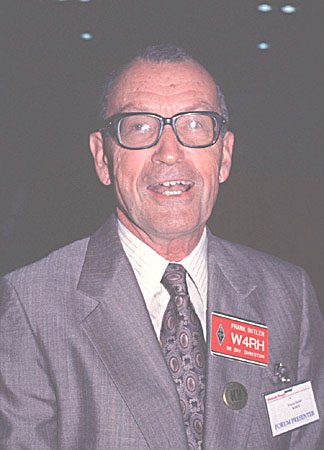 Southeastern Director Frank Butler, W4RH, reflects the mood of the Huntsville Hamfest. |
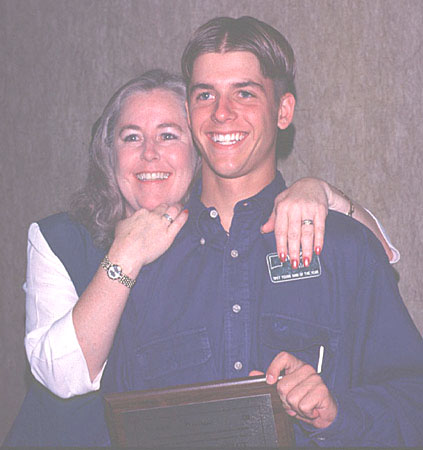 Newsline's Young Ham of the Year, Brian Mileshosky, N5ZGT, gets a hug from his mom at the Huntsville Hamfest. |
For the second year, attendance was up at the Huntsville (Alabama) Hamfest August 16 and 17, a possible indicator of renewed optimism and enthusiasm within the hobby. Saturday's attendance was unofficially reported at 6200, up substantially over last year's attendance. Although Sunday attendance at Huntsville was much lighter, it was expected that the total might top 6500 or more. Despite the hot and humid weather outside, the crowd at Huntsville was mostly upbeat. For the first time, the convention was held in the new South Hall at the Von Braun Civic Center in Huntsville, which offers superb air conditioning. The Huntsville Hamfest, which serves as the Alabama Section convention, is sponsored by the Huntsville Amateur Radio Club.
Approximately 35 people attended the ARRL Forum on Saturday. Southeastern Division Director Frank Butler, W4RH, welcomed those on hand, and Alabama Section Manager Tom Moore, KL7Q, discussed various issues of importance to Alabama hams, including restrictive antenna ordinances cropping up in several towns and cities. Moore said a proposal for the city of Birmingham was defeated, but other municipalities have proposed very restrictive tower ordinances that include application fees and limit antennas to only 20 or 30 feet. Moore recommended making sure that towns and cities have copies of PRB-1. "It's been very helpful in getting us exempted from these tower ordinances," he said. Alabama SEC and Assistant Section Manager Rick Kimbrell, KC4RNF, also spoke.
Delta Division Vice Director Henry Leggette, WD4Q, and Georgia Section Manager-elect Sandy Donahue, W4RU, also attended the convention, along with HQ staff members Rosalie White, WA1STO, and Rick Lindquist, N1RL. White conducted two forums during the convention. At her forum for newly licensed hams, Yaesu USA's Chip Margelli, K7JA, presented a slide show depicting his ham radio adventures while operating from various parts of the world. Margelli emphasized that ham radio can be "a great way to get to know other people, other countries and places."
The presentation of Newsline's Young Ham of the Year Award to 17-year-old Brian Mileshosky, N5ZGT, of Albuquerque, New Mexico, highlighted the convention banquet Saturday evening. Mileshosky said he was "overwhelmed" by the award and by the attention. His mother, father and brother were on hand for the occasion. In addition to the award plaque, he received a scholarship from CQ magazine to attend the nearby Space Camp at the US Space and Rocket Center in Huntsville. Yaesu USA presented him with an FT-840 transceiver and power supply. Mileshosky will attend the University of New Mexico this fall as an engineering student. He hopes to become an astronaut.
| LIGHTHOUSES, LIGHTSHIPS TAKE TO AIR THIS WEEKEND |
There's a bit of a maritime twist to two ham radio activities set for the weekend of August 23-24. Northern Lighthouse Weekend will put ten Scottish Amateur Radio stations on the air from lighthouses around Scotland. At the same time, the Lighthouse/Lightship Activity Weekend will see hams operating from other lighthouses and lightships around the world.
Both events will be from 0900 UTC, Saturday, August 23, until 1700 UTC, Sunday, August 24. Some lighthouses in very isolated locations will not remain on the air for the entire period, but all of the lighthouse/lightship stations are expected to be from 0900 until 1700 UTC both days. Except for GM0KCY, Scottish stations will use special call signs with suffixes to match their particular QTH. Other participating stations will add "LIGHT," "LGT," "LIGHTHOUSE," or "LIGHTSHIP" after their call signs.
Look for CW activity centering on 3521, 7012 and 14021 kHz. SSB activity will center on 3721, 7051, and 14221 kHz.
The Northern Lighthouse Weekend stations are:
- GB2LO: Lighthouse Orkney, EU-009
- GB2LTH: Lighthouse Tiumpan Head (on the Isle of Lewis, Outer Hebrides), EU-010
- GB2LCP: Lighthouse Corsewall Point
- GB2LBN: Lighthouse Barns Ness
- GB2LT: Lighthouse Turnberry
- GB2LTN: Lighthouse Tarbet Ness
- GB2LCL: Lighthouse Corran Light
- GB2LKN: Lighthouse Kinnaird Head
- GB2LDH: Lighthouse Dunnet Head
- GM0KCY: Butt of Lewis Lighthouse (lighthouse keeper GM0KCY will be QRV from his lighthouse on the Isle of Lewis), Outer Hebrides, EU-010
Lighthouse/Lightship Activity Weekend stations include: OZ7DAL (Fyrskib XXI, a wooden lightship built in 1910, situated at Edeltoft); OZ1VYL (Motorfyrskib 1, a wooden lightship built in 1920); OZ?DSB (Sprogo Fyr); OZ?SKA (Skagen Fyr); OZ1LFA (Gedser Fyr on Falster Island, EU-029; DL0BRF (Borkumriff lightship; DL0MF (Amrumbank); DL0EM (Campen lighthouse); DL0PJ (Norderney Island lighthouse); DL0KA (Cologne/Rhine lighthouse); GB2NFL (North Foreland Lighthouse); GB2SFL (South Foreland Lighthouse); G0VOP/P (Portland Bill Lighthouse); GB2MHL (Milford Haven Lightship); CS1CRA (Clube Radios no Atlantico will operate three or four stations at Portuguese lighthouses); PA6NH (Noord Hinder lightship); PA6URK (Urk lighthouse); PI4ZVL (Nieuwe Sluis lighthouse); SK7DD (Kullen lighthouse); JW6RHA, JW9THA and JW8KT (Vestpynten lighthouse, Svalbard Island, EU-026); and F6KUM (Ailly Lighthouse).
Stations worked in these events may be valid for various awards, including IOTA. Manager for the Northern Lighthouse Weekend Award is GM4SUC, Box 36, Prestwick KA9 1AL, Scotland. QSL all stations via the bureau or direct. For more information, contact Mike Dalrymple, GM4SUC, e-mail GM4SUC@compuserve.com
| MINI-SPUTNIK TO BE TOSSED FROM MIR |
To mark the 40th anniversary of the 1957 launch of Sputnik I satellite and the start of space conquest, l'Aeroclub of France and the Russian Astronautical Federation have embarked on a joint venture to launch a miniature, working version of the original Sputnik.
Students from the FR5KJ radio club at Jules Reydellet College in St Denis, Reunion Island, and at the Polytechnic Laboratory of Nalchik Kabardine in Russia are cooperating on the mini-Sputnik I. The miniature will be able to work in space after it's hand-tossed by a cosmonaut from the Russian Mir space station. The Russians will build the satellite body. A transmitter made by the French students will be placed inside and will emit a continuous series of beeps on 2 meters starting October 4, 1997. During any given month, the signal will be able to be received in every part of the world. (The original Sputnik I satellite transmitted a beacon on 20 MHz.)
The idea was to interest youth in space projects and inspire them to consider careers in space-related fields. --AMSAT News Service, with thanks Philippe Mondon, FR5DN
| SOLAR UPDATE |
Solar oracle Tad Cook, K7VVV, Seattle, Washington, reports: I'm on vacation in Oregon this week. The bulletin will return on August 29 with solar data for the previous two weeks.
The ionosphere thins due to heating during the summer, and this effect lessens as we move toward fall in the northern hemisphere. The result should be better daytime MUF values. As daylight hours shorten, 40 meters should also improve at night. Currently 20 meters is still the best all around band for worldwide propagation.
Sunspot numbers for August 7 through 13 were 55, 65, 61, 31, 53, 57, and 61 with a mean of 54.7. The 10.7 cm flux was 77.9, 77.8, 78.1, 78.3, 79.5, 80.8 and 82, with a mean of 79.2, and estimated planetary A indices were 6, 5, 7, 7, 9, 5, and 12, with a mean of 7.3.
| In Brief: |
- This weekend on the radio: The TOEC WW Grid CW Contest and the Northern Lighthouse Weekend are scheduled.
- JOTA information available: Looking for a way to introduce young people to Amateur Radio? When Scouts want to meet young people from another country, they usually think of attending a world Jamboree. But few people realize that each year more than 400,000 Scouts and Guides get together over the airwaves for the annual Jamboree on the Air (JOTA). JOTA is an annual event in which Boy and Girl Scouts and Guides from all over the world speak to each other by means of Amateur Radio. Scouting experiences are exchanged and ideas are shared via radio waves. This presents a terrific opportunity for you (or your club) to host some scouts for this annual event -- and introduce them to Amateur Radio! How can you get in on the action? The ARRL Educational Activities Department has a package of materials that includes brochures (ask for the number of Girl Scout or Boy Scout brochures that you need), ideas for suggested activities, and information on the Boy Scout Radio merit badge and a suggested "radio patch" for Girl Scouts. Or, you can get the material on the ARRLWeb at http://www.arrl.org/ead/#scout. For a package containing the information plus 7 brochures, please send an 8-1/2 by 11-inch self-addressed, self-stamped envelope (SASE), with $1.25 (US) postage on it (add $0.23 for every 5 additional brochures) to: ARRL-EAD, 225 Main St, Newington, CT 06111, ATTN: Scout. --Glenn Swanson, KB1GW
- New SC SM: South Carolina got a new Section Manager, effective August 15. Les Shattuck, K4NK, of Greenville, takes over for Dave Berry, KE4W, of Conway, who resigned to take a new job in another state. Shattuck will serve the remainder of Berry's term, which expires December 31, 1998.
- Pennsylvania ARES proves mettle: During the week of August 3, authorities in Butler County, Pennsylvania, conducted a search and rescue operation for a missing 40-year old man. A request was made to the Butler County ARES unit for communication help. In the absence of Butler County EC Larry Bertoncello, KA3HUK, Assistant EC Ray Albert, N3XCD, activated the county's ARES unit and called for assistance from other ARES units. Dave Leiser, K3NPX, Beaver County EC, was able to offer the services of a search and rescue team that. Allegheny County established a net on the 147.09 repeater to recruit additional help. Greg Kerr, N3PHF, District EC contacted ARES units within district S-2 and had additional help. Mary Housholder, N3QCR, Venango County EC, also began recruiting efforts. Unfortunately, the lost individual was found dead. Western Pennsylvania Section Manager Bill Edgar, N3LLR said he was "pleased with the number of people assisting and once again, proving that the organization can and will respond to a call for help. My personal thank you goes out to all who assisted with this operation!" --Kay Craigie, WT3P
- Keogh departs World Radio: Lou Ann Keogh, KB6HP, has resigned as editor of World Radio magazine. An independent ham radio journal, World Radio is published monthly.
- E. F. Johnson Company to be sold: Transcrypt International Inc has announced it's signed a letter of intent to acquire E. F. Johnson Company, a former ham radio manufacturer. Johnson was a popular manufacturer of ham transmitters, antenna tuners and station accessories during the 1940s, 50s and 60s. Some Johnson ham equipment still is highly prized among collectors. E. F. Johnson is privately held and posted revenues of $79.3 million in 1996. The company manufactures equipment for the public safety and land mobile services. Transcrypt went public in January 1997 and had 1996 revenues of $13.8 million. The total sale price is said to be $34 million. E. F. Johnson Company founded in 1923 by Edgar F. Johnson in Waseca, Minnesota, was one of the first developers of two-way radio systems. The company employs 650 people at its Waseca, Minnesota, facility. For more information, see http://www.transcrypt.com/Pages/News/efj.html. --thanks to David Thompson, K4JRB
- Balloon-based repeater a success: A balloon with a crossband repeater aboard was successfully launched August 9 by the North Okanagan Radio Amateur Club (NORAC) of Vernon, British Columbia, Canada. Dubbed VBX (for Vernon Balloon eXperiment), the launch project took place during the sixth annual Sky High Hamfest on Silver Star Mountain. Approximately 70 contacts were made through the airborne repeater -- the farthest away in Tacoma, Washington. As of August 14, the balloon still had not been located. Wilfried Mulder, VE7OHM, reports the balloon's path would have taken it south toward California. NORAC is offering a $50 reward plus free admission to next year's Sky High Hamfest to the lucky finder. For more information on the balloon experiment, see http://www.junction.net/norac/vbx.htm, or contact Wilfried Mulder, VE7OHM, gwmulder@junction.net. --RAC; Wilfried Mulder, VE7OHM
- CQ-ing cellphone: Maybe it's a bit of an inside joke on the part of cellular telephone manufacturer Nokia of Finland, but Sam Haviland of Farmington, Connecticut, recently discovered that one of the ring options on Nokia's Model 638 makes the phone send CQ in Morse code. Haviland, a Navy veteran, is not a ham but he still remembers the code. Coincidentally, Haviland's father-in-law was F. Cheyney Beekley, W1GS, an early QST advertising manager.
| The ARRL Letter |
The ARRL Letter is published by the American Radio Relay League, 225 Main St, Newington, CT 06111; tel 860-594-0200; fax 860-594-0259. Rodney J. Stafford, KB6ZV, President; David Sumner, K1ZZ, Executive Vice President.
Circulation, Kathy Capodicasa, N1GZO, e-mail kcapodicasa@arrl.org.
Editorial, Rick Lindquist, N1RL, e-mail elindquist@arrl.org.
Visit the ARRLWeb page at http://www.arrl.org.
The purpose of The ARRL Letter is to provide the essential news of interest to active, organizationally minded radio amateurs faster than it can be disseminated by our official journal, QST. We strive to be fast, accurate and readable in our reporting.
Material from The ARRL Letter may be reproduced in whole or in part, in any form, including photoreproduction and electronic databanks, provided that credit is given to The ARRL Letter and The American Radio Relay League.
| How to Get The ARRL Letter: |
The ARRL Letter is distributed directly from ARRL HQ only to elected League officials and certain ARRL appointees and to paid subscribers of the now-defunct hard-copy edition of The ARRL Letter . For members and nonmembers alike, The ARRL Letter is available free of charge from these sources:
- The ARRLWeb page (http://www.arrl.org/arrlletter/). This version of The ARRL Letter includes any photographs.
- The HIRAM BBS: 860-594-0306.
- The ARRL Technical Information Server (Info Server): Send an e-mail message to info@arrl.org. The subject line should be blank. In the message body, type send ltrmmdd.txt, where mm represents two digits for the month and dd represents two digits for the day (The ARRL Letter is published every Friday). For example, to request The ARRL Letter file for Friday, January 3, 1997, you'd type send ltr0103.txt. Then, on a separate line, type quit.
- CompuServe and America Online subscribers, as a downloadable text file in the services' ham radio libraries
- The Netcom server, run by the Boston Amateur Radio Club and Mike Ardai, N1IST: Send e-mail to listserv@netcom.com (no subject needed). The body of the message should say subscribe letter-list.