Address Changes: Kathy Capodicasa, N1GZO, e-mail kcapodicasa@arrl.org.
Editorial: Rick Lindquist, N1RL, e-mail elindquist@arrl.org.
| IN THIS EDITION: |
- Electronic applications predominate in Gate 3
- Clinton names new FCC chair, member
- Tougher anti-eavesdropping bill introduced
- FCC seeks comments on League petition
- One less Little LEO
- Foale still active from Mir
- UPS strike might delay ARRL shipments
- N6LF is new QEX editor
- Satellite workshop set
- QRO not welcome in satellites
- 1997 ARRL/TAPR confab set
- FAR scholarship winners
- FCC sequential call sign update
- Solar update
- In Brief: Correction; This weekend on the radio; VWOA honors two hams; MS Society honors ham; New England DXCC Convention; Linenger, MIREX lauded in Congressional Record; Moonbounce requiem; Balloon-based repeater to launch; RSGB ends D-I-Y Magazine; DJ5RT honored
| ELECTRONIC VANITY APPLICATIONS FLOOD GATE 3 |
Gate 3 vanity filers flooded the FCC with nearly 1200 electronic and only around 300 paper applications Wednesday. The disparity was in apparent reaction to the FCC's announcement last month that it would give priority in processing to electronically filed vanity applications. But the actual number of electronic filers could be far less than the 1182 the FCC received on August 6. FCC officials in Gettysburg, Pennsylvania, believe that many hams filed more than one electronic application.
Whatever the final tally, the number of first-day Gate 3 applications was far fewer than the more than 3600 that showed up on the opening day of Gate 2.
The FCC will not begin to process the applications until the 10-day deadline to receive the $30 application fee has passed. Only applications for which a fee has been paid will be processed.
To clear the decks in anticipation of processing the Gate 3 applications, FCC personnel in Gettysburg have been making nearly daily runs of vanity applications that arrived prior to the opening of Gate 3 on August 6. As of today (August 8), the FCC had processed vanity applications received through July 11.
The FCC is not expected to begin processing the Gate 3 applications until mid-month at the earliest.
The vanity application fee increases to $50 on September 15. The FCC has not announced when it plans to open Gate 4.
| PRESIDENT CLINTON NAMES NEW FCC CHAIR, MEMBER |
President Clinton announced Wednesday that he plans to tap William E. Kennard of California as the next chairman of the FCC, subject to Kennard's confirmation by the Senate as an FCC member. Kennard, 40, already had been nominated to succeed retiring commissioner James Quello. He would step into the top spot being vacated by Reed Hundt. Kennard has served as general counsel of the FCC since December 1993. As general counsel, Kennard is the Commission's principal legal advisor and represents the agency in court. He has prior experience in communications law.
Kennard is a graduate of Stanford and of Yale Law School. If confirmed, he would be the first African-American to head the FCC.
The president also announced the nomination of Michael K. Powell of Virginia to a seat on the FCC. Powell, the son of Gen Colin Powell, is now the chief of staff of the Antitrust Division in the US Department of Justice. He also has experience in telecommunications law. He's a graduate of The College of William and Mary and of Georgetown University Law Center.
| TAUZIN WANTS TEETH IN ELECTRONIC EAVESDROPPING LAW |
Another bill introduced in Congress to beef up prohibitions against electronic eavesdropping has scanner enthusiasts and equipment makers worried and could affect some Amateur Radio equipment. HR 2369, the Wireless Privacy Enhancement Act of 1997, was introduced by Rep Billy Tauzin of Louisiana. If passed, it would--among other things--amend the Communications Act of 1934 to ban the sale of scanning receivers capable of receiving transmissions on any frequency allocated to any Commercial Mobile Radio Service (CMRS). The CMRS is a relatively new umbrella designation of subscriber-based radio services that act like telephone services. In addition to cellular telephone, such services include commercial paging services, commercial air-to-ground services, offshore radiotelephone, personal communication services, and specialized mobile radio services.
HR 2369 would prohibit receiving, divulging, publishing or using any intercepted transmission, and subject violators to substantial fines. It also would make it illegal to modify equipment so that it may be used to unlawfully intercept or divulge radio communications. The FCC would be charged with investigating complaints and enforcing the stiffer regulations.
As currently drafted, the bill appears to affect equipment available to scanner enthusiasts, hams who use scanning transceivers to receive out-of-band, and hams who use out-of-band capability for volunteer work. It would not affect ham frequencies, per se. The League's Legislative and Public Relations Manager, Steve Mansfield, N1MZA, says the ARRL is studying the bill to determine its long term implications for ham radio and ham gear. The ARRL has contacted Tauzin's office to express its concerns, and Mansfield says the League "will continue to work with members of Congress to have the bill modified to reflect the needs of the Amateur Radio community."
The Tauzin bill comes fast on the heels of very similar, but less-stringent, legislation proposed by Rep Edward Markey of Massachusetts (see The ARRL Letter, Vol 16, No 29). The ARRL has met with Markey's staff to discuss the negative implications of HR 1964 for Amateur Radio. That bill was not given much chance of passage.
An incident last year in which House Speaker Newt Gingrich's cellular telephone conversation was illegally intercepted, taped and published by the media prompted calls in Congress for stronger anti-eavesdropping legislation.
| FCC SEEKS COMMENTS ON LEAGUE-SPONSORED PETITION |
The FCC seeks comments within 30 days on the ARRL's Petition for Rulemaking (RM 9150) that asks the Commission to improve the way it addresses serious Amateur Radio rules violations (see The ARRL Letter, Vol 16, No 16). The petition, filed in late March, calls on the FCC to "create a streamlined, privatized enforcement process" to handle and adjudicate the most serious Amateur Service rules violations. The League asked that the FCC change its rules to permit members of the volunteer Amateur Auxiliary to bring evidence of malicious interference violations directly before the Chief Administrative Law Judge. The Chief ALJ would be authorized to determine if the complainants have a valid case, to issue show-cause orders, and to designate complaints for hearing.
The League recommended that the FCC capitalize on the volunteer resources available through the Amateur Auxiliary to relieve the evidence-gathering burden in such cases.
Comments to the FCC should reference RM 9150. Address them to Secretary, Federal Communications Commission, 1919 M St NW, Washington DC 20554.
| ONE LESS LITTLE LEO |
The Little LEO industry that has been seeking access to spectrum below 1 GHz, including amateur bands, is about to have one less player. On July 14, CTA Incorporated of Rockville, Maryland, and Orbital Sciences Corporation of Dulles, Virginia, announced an agreement for Orbital to purchase CTA's satellite manufacturing and communications service business units. The deal is expected to close in August.
Orbital is already in a joint venture with Teleglobe to provide Little LEO services through Orbital Communications Corp. (ORBCOMM). ORBCOMM's system is already licensed and is operational on a limited basis. Uplinks are 2400 bps FSK in the 148-149.9 MHz band and user downlinks are 4800 bps FSK in the 137-138 MHz band, with beaconing in the 400-401 MHz band. In its press release announcing the acquisition, Orbital said that a CTA service it had purchased, called GEMtrak, may be expanded to use the ORBCOMM network in the future. GEMtrak is a system for tracking truck trailers and rail cars and their cargoes.
ARRL Executive Vice President David Sumner, K1ZZ, noted that the combining of CTA's satellite business with ORBCOMM's will reduce by one the number of companies seeking Little LEO licenses. "CTA was one of the companies that sponsored the ill-conceived and controversial 'flexible allocation' proposal that we had to oppose earlier this year," he said. "ORBCOMM did not endorse the flexible allocation concept."
The Little LEO issue is on the agenda for the World Radiocommunication Conference (WRC-97) to be held this fall. ARRL Technical Relations Manager Paul Rinaldo, W4RI, is a member of the US delegation. The US is now finalizing its proposals for the conference. At this point, no US Little LEO proposal for WRC-97 would affect ham radio.
| FOALE STILL ACTIVE ON HAM RADIO FROM MIR |
US astronaut Mike Foale, KB5UAC, was active on Amateur radio from the Russian Mir space station as he and his two Russian crewmates awaited the arrival of the two cosmonauts who will help repair the crippled ship. The cosmonauts then will replace the current Russian crew, while Foale is to remain aboard Mir until September when astronaut David Wolf, KC5VPF -- a medical doctor -- is scheduled to arrive via the space shuttle. Foale has been aboard Mir since May.
Foale told MIREX chief Dave Larsen, N6CO, this week that the SAFEX FM repeater remains off the air until repairs can be made to the spacecraft. "SAFEX won't be on until Priroda is powered. That won't be until Spektr power is restored--everything depends on this, including SAFEX," Foale said. The Spektr module was damaged in late June when it struck a Progress supply rocket during a test maneuver. Foale and the Russian crew members spent this week preparing for the arrival of the new crew on Thursday (August 7).
Foale also has been awaiting a new TNC for the Mir packet system, which has been malfunctioning in recent weeks and losing messages. A new TNC was to arrive with the two Russian crew members.
Foale has been using 145.985 MHz while over the US and the 145.200/800 MHz split pair elsewhere. --thanks to AMSAT News Service and Dave Larsen, N6CO
| UPS STRIKE MIGHT DELAY ARRL SHIPMENTS |
The current United Parcel Service (UPS) strike very likely will delay deliveries of some shipments from ARRL Headquarters. Fortunately, our Shipping Room Supervisor, Steve Capodicasa, had anticipated the walkout. "Consequently, over a week prior to the actual strike, we had already begun routing our orders through the United States Postal Service," said Circulation Manager Deb Jahnke. "We believe that we were able to divert virtually all customer orders from being left in limbo in the UPS system." But, Jahnke said that since all carriers have suspended their normal service standards, "delays will be inevitable."
ARRL Business Manager Bob Boucher says that nonessential mailings are being held back in hopes the strike won't last long. "In the meantime any items going out will be done via USPS Priority, if the cost is comparable," he said.
UPS delivers approximately 80% of all US packages, and other carriers so far have not been able to pick up the slack.
| RUDY SEVERNS, N6LF, IS NEW QEX EDITOR |
Rudy Severns, N6LF, of Cottage Grove, Oregon, is the new editor of QEX: The ARRL Experimenter's Exchange. Rudy has volunteered to take over the helm from Jon Bloom, KE3Z, as of the August issue. Jon, who's now heavily involved in the ARRL's electronic publications and software operation, had served as QEX editor for 5 years.
Rudy, an electrical engineer and a ham since 1953, has contributed to the ARRL Antenna Compendium series, Communications Quarterly, and the 18th edition of The ARRL Antenna Book. "I view QEX as an important vehicle for keeping our technical tradition alive," Rudy said in his introductory editorial in the August issue of the journal. Rudy welcomes contributions of technical articles from QEX readers. Contact him at n6lf@arrl.org or by writing to him care of QEX, 225 Main St, Newington, CT 06111.
In addition, Senior Assistant Technical Editor Bob Schetgen, KU7G, has accepted responsibility for managing the HQ part of the QEX editorial process and will work closely with Rudy throughout the editing and production process.
Domestic subscriptions to QEX: The ARRL Experimenter's Exchange are $15 for ARRL members and $27 for nonmembers. Write QEX, 225 Main St, Newington, CT 06111; tel 860-594-0200; toll-free 888-277-5289.
| TIRED OF THE SAME OLD ON-THE-AIR STUFF? TRY SOMETHING NEW |
Get ready to learn something new--from the exciting world of Amateur Radio satellites! Sign up for a fast-moving, five-hour workshop in southern California on everything you need to get "on the birds." Become an expert operating through digital satellites, the "easy-sats," low-orbit and high-altitude satellites such as AO-10, Russian satellites, and learn a bit about the Russian Mir and NASA's SAREX missions. Prepare for the upcoming Phase-3D satellite. You'll hear about equipment needs and how to use all modes, including dial-in access to a packet satellite without spending money for equipment.
WHO: Instructor Keith Baker, KB1SF, and other AMSAT experts.
WHEN: Friday September 12, 1 PM - 6 PM.
WHERE: Riverside Convention Center - Riverside, California
HOW: Space is limited. To register, contact Rosalie White, WA1STO, at ARRL HQ (tel 860-594-0237; fax 860-594-0259) before September 9, 1997. The fee is $20 for ARRL members and $25 for nonmembers. You'll receive free materials and five hours of practical information. This workshop is sponsored by AMSAT and the ARRL. Those who take part all day will earn a certificate for 0.5 Continuing Education Units. --Rosalie White, WA1STO
| HIGH POWER NOT WELCOME ON OSCARS |
BJ Arts, WT0N, serves as an Official Observer (OO), and has received many complaints about satellite operators running excessively high levels of transmitter power within the uplink passband of Amateur communication satellites. Recently, he observed stations on FO-20 and FO-29 running enough power to be much stronger than the beacon signal. In one case, two operators, who were in contact with one another, were causing FO-20's AGC to block out all other incoming signals operating with normal levels of transmitter power.
Satellite users should make certain that their downlink signals are no stronger than that of the beacon transmitter. Excessive levels of uplink power prevent other users from equally sharing the satellite's transponder. It only takes several watts of transmitter power to make contacts through low-earth orbiting Amateur satellites. If ground stations have difficulty hearing their uplink signal with more than several watts of power, then a significant upgrade in receiver sensitivity may be in order. This can be accomplished by using a higher gain downlink antenna, high quality coax, or the use of a low-noise preamplifier (preferably mounted at the feed point of the antenna). --AMSAT News Service
| 1997 ARRL/TAPR CONFAB SET FOR OCTOBER |
The year's premier event in Amateur Radio digital communication--the 1997 ARRL and TAPR Digital Communications Conference--is set for October 10-12, 1997, in Baltimore, Maryland. The location is just minutes away from Baltimore-Washington International Airport (BWI).
This marks the second year in which the ARRL Digital Communications Conference and TAPR Annual General Meeting have joined into one conference. The 1997 DCC will be co-hosted by AMRAD (Amateur Radio Research and Development Corporation).
The ARRL and TAPR Digital Communications Conference is an international forum for radio amateurs and experts in digital communications, networking, and related technologies to meet, publish their work, and present new ideas and techniques for discussion. Presenters and attendees will have the opportunity to exchange ideas and learn about recent hardware and software advances, theories, experimental results, and practical applications.
Papers are invited for publication in the Conference Proceedings. Presentation at the Conference is not required for publication. Papers are due by August 20, 1997. Submit papers to Maty Weinberg, ARRL, 225 Main St, Newington, CT 06111; lweinberg@arrl.org. Paper submission guidelines are available on-line at http://www.tapr.org/dcc. ARRL and TAPR especially welcome papers from full-time students to compete for the second annual student papers award.
The conference has scheduled seminars and symposiums on Friday afternoon and Sunday. Conference papers, selected topics thread, lunch, and dinner are on Saturday. Symposiums held at this year's DCC will include a full-day symposium on APRS packet-location software, a half-day symposium on spread spectrum system design and theory, and a half-day seminar on Friday entitled "RF Basics for Computer Weenies: Helping the RF-Challenged Get the Most Out of the New High-Speed Wireless Toys."
For more information, contact TAPR, 8987-309 E Tanque Verde Rd, No. 337, Tucson, AZ 85749-9399; tel 817-383-0000; fax 817-566-2544; e-mail, tapr@tapr.org; Web http://www.tapr.org.
| 1997 FAR SCHOLARSHIP WINNERS ANNOUNCED |
The Foundation for Amateur Radio (FAR) has announced the 1997 winners of the 59 scholarships it administers. These scholarships were open to all radio amateurs meeting the qualifications and residence requirements of the various sponsors. FAR is a nonprofit organization incorporated in the District of Columbia that represents more than 75 clubs in Maryland, the District of Columbia and Northern Virginia. It is devoted exclusively to the scientific, literary and educational pursuits that advance the purposes of the Amateur Radio service.
| Congratulations to these scholarship winners! |
-
FAR Silent Key Memorial Scholarships ($1000 each): Carolyn M. Creel, N3UXZ, Silver Spring, Maryland; Antonio Fominaya, N3UIO, Greenbelt, Maryland; David J. MacCormack, N3BUX, Ellicott City, Maryland.
QCWA Memorial Scholarships: Ralph Hasslinger (W2CVF) Charter Member Scholarship ($1100), Angela C. Skolaut, N0UAI, Great Bend, Kansas; Max Jacobson-John Kelleher Family Scholarship ($900), Richard S. Garrett, AA0CH, Florissant, Missouri; QCWA Robert Cresap (W9LRI) Memorial Scholarship ($700), Landon E. Quan, KE6UAS, San Rafael, California; QCWA Leo Meyerson Family Living Scholarship ($600), John H. Ghigliotti, KC5GJJ, Norman, Oklahoma; QCWA Edwin Woodruff (W3SX) Memorial Scholarship ($600), Dakota A. Derr, AA0NB, Burlington Junction, Missouri
QCWA Memorial Scholarships ($800 each): Jason S. Arntz, KB5ZQZ, Fort Worth, Texas; Shannon Brassfield, KB5RBX, Oklahoma City, Oklahoma; Dustin K. Bennett, KC5HGZ, Taloga, Oklahoma; David A. Case, KA1NCN, Hampton, Connecticut; Angela M. Cruz, KB5UJR, Slidell, Louisiana; Gregory Gutka, N3NLF, Easton, Pennsylvania; Jeremy M. Hanken, N1KWT, Hiram, Maine; Joshua J. Henry, KB9JJG, Wisconsin Rapids, Wisconsin; Amanda L. LaValle, N2TSO, Woodstock, New York; Jeffrey A. Sherer, N3IPT, Allentown, Pennsylvania.
Radio Club of America Scholarships ($750 each): From the Grebe Fund, Ethan Handwerker, N1SOH, Lexington, MA; from the Poppele Fund, Zachary D. Sadecki, KB7FUV, Ashton, Idaho, and James S. Sikorski, N3PBH, Wapwallopen, Pennsylvania; from the Somers Fund: John M. Steenis, KI7LX, Phoenix, Arizona.
Richard G. Chichester Memorial Scholarship ($1000), sponsored by Patricia and Jack (W9AMF) Chichester: John Cowden, KC5DCP, Benton, Arkansas.
Young Ladies' Radio League Scholarship ($1500): Michelle R. Sciarini, KB8ILX, Dover, Ohio.
Columbia Amateur Radio Association Scholarship ($1000): Michael S. Calhoon, N3SMI, Arnold, Maryland.
Baltimore Amateur Radio Club Scholarships ($1000 each): Andrew M. Leeds, N3MCB, Finksburg, Maryland; Nicholas P. Schaub, KE3HV, Baltimore, Maryland; Franklin L. Wright, N3OQB, Silver Spring, Maryland; Aileen K. Hudspeth, N3YAC, Woodbine, Maryland; Ernie Dobos Memorial Scholarship, Andrew J. Guenther, N3NRP, Leonardtown, Maryland.
Ralph V. "Andy" Anderson , K0NL, Memorial Scholarship ($1000): Nicholas R. Guydosh, N2MSE, Apalachin, New York.
Dade Radio Club Tropical Hamboree Scholarships ($1000 each): Eric P. Kessler, KD4DOF, St Petersburg, Florida; Wendy Joy Silverman, KC4ZQW, Spring Hill, Florida;
Rose Ellen Bills Memorial Scholarships ($2000 each): Paige E. Forrest, KE3UB, Baltimore, Maryland; Daniel S. Zimmerman, N3UMH, Erie, Pennsylvania.
Victor C. Clark Memorial Scholarship ($1000), sponsored by the Vienna Wireless Society: Matthew P. Ipock, KM4WZ, Chesapeake, Virginia.
Frederick Amateur Radio Club Scholarship ($1000): Mark W. Lazzaro, N3BVW, Mt Airy, Maryland.
10-10 International Net Scholarships ($1000 each): Nicholas Goad, N1OOX, Randolph, Vermont; Nathan Jeffries, KI7QT, Spokane, Washington; Timothy Mosher, WX9I, Woodridge, Illinois.
Kevin Barry Perdue Memorial Scholarship ($2000), sponsored by Kay (WT3P) and Carter (N3AO) Craigie: Patricia Pelczar, KA1TPM, Rocky Hill, Connecticut.
WARAC Memorial Scholarships ($1000 each), sponsored by the West Allis Radio Amateur Club: Steven D. Miller, KB9DFE, Spooner, Wisconsin; Christopher D. Molek, KB9GTK, Richland Center, Wisconsin; Amy L. Tlachac, N9TLN, Wisconsin Rapids, Wisconsin.
South Milwaukee Amateur Radio Club Scholarships ($500 each): Benjamin F. Kablau, AA9RI, Shorewood, Wisconsin; Steven Lampereur, KB9MWR, Green Bay, Wisconsin; Raymond G. Meyer, N9PBY, Port Washington, Wisconsin; James E. Slone, KB9JSI, New Palestine, Indiana.
Nanticoke Amateur Radio Club Scholarship ($1000): Scott M. Affens, KA3TUE, Olney, Maryland.
Murgas Amateur Radio Club Scholarship ($500): Mary E. Jauregui, N8UNV, Philadelphia, Pennsylvania.
Virginia Beach Hamfest Scholarships ($1000 each): Victoria L. Crawford, N4XDR, Virginia Beach, Virginia; Darla L. Dilks, KB2LJX, Culpeper, Virginia.
Martin County ARA Scholarship ($1000): Steven Vitrella, KC4VBE, Jensen Beach, Florida.
Baltimore Radio Amateur TV Society Scholarship ($1000): Dana L. Eshelman, WS3L, Ft Washington, Maryland.
Beatrice Chapman, K1OKC, Family Memorial Scholarship ($500), sponsored by the Augusta Amateur Radio Association: Donald G. Trask, N1TZR, Augusta, Maine.
Free State Amateur Radio Scholarship ($1000): Hernan G. Hidalgo, N3OKP, Silver Spring, Maryland.
Robert E. True Memorial Scholarship ($1000), sponsored by Mrs Shirley True Banning: Brian Meek, KC8BNP, Westerville, Ohio.
Lawrence E. and Thelma J. Norrie Memorial Scholarship ($2500): James W. Gregory, AD4GN, Paducah, Kentucky.
Old Old Timers Club Scholarship ($600): David P. Swaney, N3KCS, Mifflinburg, Pennsylvania.
For more information, write to: FAR Scholarships, 6903 Rhode Island Ave, College Park, MD 20740. --Hugh Turnbull, W3ABC.
| FCC SEQUENTIAL CALL SIGN UPDATE |
The following is a list of FCC sequentially assigned call signs issued as of August 5, 1997.
| District | Group A Extra | Group B Advanced | Group C Tech/Gen | Group D Novice |
|---|---|---|---|---|
| 0 | AB0GA | KI0JM | ++ | KC0BTZ |
| 1 | AA1SO | KE1IF | N1ZQF | KB1CET |
| 2 | AB2EB | KG2MD | ++ | KC2CGN |
| 3 | AA3QA | KF3AF | N3ZUB | KB3BUN |
| 4 | AF4EN | KU4JD | ++ | KF4TOA |
| 5 | AC5NN | KM5LF | ++ | KD5BYY |
| 6 | AD6CP | KQ6QW | ++ | KF6NCP |
| 7 | AB7WE | KK7JF | ++ | KC7YYH |
| 8 | AB8AZ | KI8DJ | ++ | KC8IIB |
| 9 | AA9US | KG9KZ | ++ | KB9RGM |
| N Mariana Island | NH0B | AH0AY | KH0GT | WH0ABI |
| Guam | ++ | AH2DD | KH2SA | WH2ANT |
| Hawaii | AH7V | AH6PC | KH7FV | WH6DEF |
| American Samoa | AH8O | AH8AH | KH8DK | WH8ABF |
| Alaska | AL0F | AL7QU | KL0KC | WL7CUK |
| Virgin Islands | ++ | KP2CL | NP2JR | WP2AII |
| Puerto Rico | NP3M | KP3BC | NP3PY | WP4NNK |
++ All call signs in this group have been issued in this district.
| SOLAR UPDATE |
Solar soothsayer Tad Cook, K7VVV, of Seattle, Washington, reports: The week began with zero sunspot activity, but the sunspot number rose steadily to 45 on August 6 and to 55 on August 7. Solar flux also increased toward the end of the week, and on August 7 at the Penticton, British Columbia, observatory it was 76.2 at 1700 UTC, 77.9 at 2000 UTC, and 78.6 at 2300 UTC. Flux values are expected to peak over the weekend around 78, then fall back to the low 70s. Solar flux is expected to stay in the mid 70s through the month of August, and we could see some slightly active geomagnetic conditions around August 27 due to recurrence. This is predicted because conditions were unsettled to active the last time the sun was in that position relative to Earth, about 27 to 28 days before.
Expect 20 meters to still be the best band for DX, although if the flux gets above 80, some better propagation could occur on 15 and 17 meters. On the other hand, 10 and 12 meters should be poor, but look for interesting north-south propagation, particularly as we move toward the equinox, only about six weeks away. Conditions on 30 and 40 meters also should improve around that time.
Dave Flarity, VE3DVE, wrote to comment that the same propagation information that appears on WWV at 18 minutes after every hour, is also on the Web at gopher://proton.sec.noaa.gov:70/00/latest/wwv. It is updated every three hours. You can also get the latest WWV forecast over the phone at 303-497-3235.
Sunspot numbers for July 24 through 30 were 44, 65, 58, 53, 26, 24 and 12 with a mean of 40.3. The 10.7-cm flux was 78.7, 80.4, 76.6, 74.5, 74.2, 72.7 and 71, with a mean of 75.4, and estimated planetary A indices were 10, 5, 4, 6, 5, 3, and 7, with a mean of 5.7.
Sunspot numbers for July 31 through August 6 were 0, 0, 11, 27, 12, 39 and 45 with a mean of 19.1. The 10.7 cm flux was 70.4, 71, 70.8, 72.2, 72.7, 74.8 and 76.8, with a mean of 72.7, and estimated planetary A indices were 19, 8, 5, 15, 8, 3, and 4, with a mean of 8.9.
This weekend is the Worked All Europe (WAE) CW Contest, and here are some path projections to Europe from the United States:
From the East Coast, 80 meters looks good from 0030 UTC to 0445 UTC, and 40 meters from 2300 UTC to 0600 UTC. 20 meters should open from 1230 UTC to 0030 UTC with the best period from 1900 UTC to 2200 UTC.
From the Midwest, check 80 meters from 0100 UTC to 0430 UTC, 40 meters from 0030 UTC to 0545 UTC, and 20 meters from 1930 UTC to 0100 UTC. 15 meters may open around 2030 UTC to 2330 UTC.
From the West Coast 80 meters may open briefly around 0400 UTC. 40 meters looks good from 0230 UTC to 0530 UTC, and 20 meters from 2000 UTC to 0100 UTC and 0530 UTC to 0800 UTC. There is a chance of a 15 meter opening from 1600 UTC to 0000 UTC.
From Anchorage, Alaska 20 meters is the only real option. It looks good from 1430 UTC to 0000 UTC and better from 0500 UTC to 0900 UTC. There is a small chance of a 15 meter opening around 1600 UTC to 2300 UTC. 40 meters could open with weak signals around 0300 UTC to 0500 UTC.
| In Brief: |
- Correction: We mistakenly included an old URL for the WM7D call sign databse in The ARRL Letter, Vol 16, No 30, August 1. The correct address is http://www.wm7d.net/. --thanks to Mark Downing, WM7D
- This weekend on the radio: The Worked All Europe Contest, CW, is the highlight of this weekend.
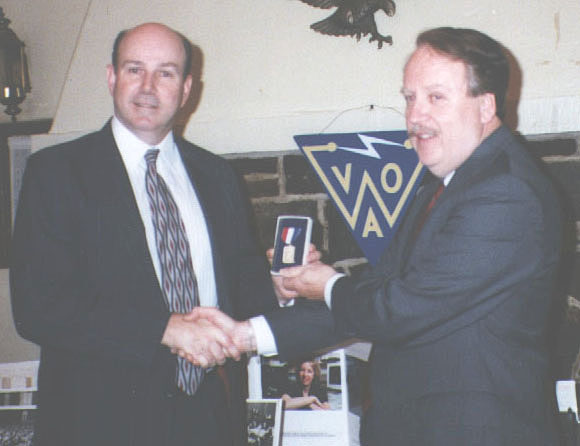
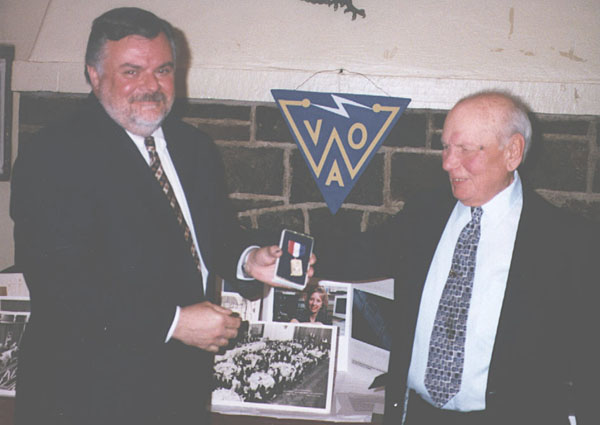
- VWOA honors two hams: The Veteran Wireless Operators Association has honored two hams for their contributions to the communications industry. The VWOA presented its Marconi Memorial Gold Medal of Achievement to Bob McNamara, N1KHF, and Alex Zimny. McNamara, the former chief of the FCC's Private Wireless Division (within the Wireless Telecommunications Bureau), now is director of regulatory technology and compliance for NEXTEL. Zimny directs the FCC's Compliance and Information Bureau in New York City. The Marconi Gold Medal has been presented annually since 1928 to those who have made significant contributions to the communications industry for advancement or promotion of the radio art. Both presentations were made at the VWOA awards banquet last May. --J. Michael Shaw, K2LRE
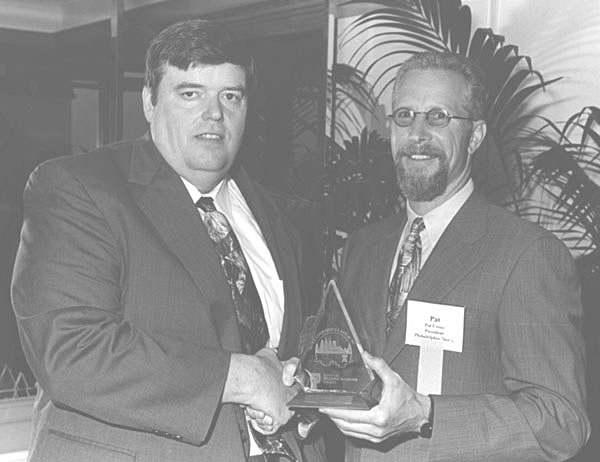
Russ Stafford, AA3CH (left), receives the Leadership Class of 1997 award from Pat Croce, president of the Philadelphia 76ers basketball team.
- MS Society honors ham: The Greater Delaware Valley Chapter of the National Multiple Sclerosis Society has honored volunteer Russ Stafford, AA3CH (ex-WB3JVX), of Linwood, New Jersey, as a member of its Leadership Class of 1997. Stafford was recognized for donating "his time and energies to the organization through his Amateur Radio activities" over the past 15 years. Stafford was cited for recruiting hams to assist in the MS 150 City to Shore Bike Tour, which attracts hundreds of cyclists for the overnight ride from Philadelphia, Pennsylvania, and Ocean City, New Jersey, and back. In addition to the bike tour, Stafford also organized coverage for seven of the Greater Delaware Valley's MS WALK sites in April. Stafford, who heads a security service, comes from a ham radio family. Both his grandfather and his father were hams.
- New England DXCC Convention: The New England DXCC Convention and dinner will be held October 12, 1997, 8 AM until 5 PM, Elks Hall, Rt 110, Chelmsford, Massachusetts (near the junction of I-495 and Rt 3 ). The program includes presentations on J3 and Spratly with K1XM and KQ1F, plus Heard Island with N6EK. Tickets are $22.50 in advance and $25 at the door. Seating is limited. Send an SASE and check payable to Patriot DX Association, Box 8, Prides Crossing, MA 01965. For more information, call Mel Cole, WZ1Q, 508-927-1953. --Bill Bithell, N1BB
- Linenger, MIREX lauded in Congressional Record: Ham astronaut Jerry Linenger, KC5HBR, and MIREX were recognized in the pages of the Congressional Record earlier this year. The Congressional Record of May 23, 1997, contains the remarks of Sen Carl Levin (D-Michigan) marking the occasion of Linenger's return after 5 months aboard the Mir space station. During his tour of duty aboard Mir, Linenger and his crewmates experienced a fire and problems with the station's oxygen-generating systems, lost of power and coolant system leaks. Also mentioned was Linenger's use of ham radio to speak to a fifth-grade class in Charlevoix, Michigan, during his time on Mir. Levin recognized Linenger, an Eastpoint, Michigan, native, for "courage, perseverance and professionalism" in the face of adversity and congratulated him on "a mission heroically accomplished." --thanks to Will Marchant, KC6ROL
- Moonbounce requiem: : Elaine Fortin, VE3UXZ, will air a eulogy today (August 8) for the late moonbounce enthusiast Dennis Mungham, VE3ASO, via 1296 MHz moonbounce. Mungham died in March. The on-air gathering will also recognize Munghams 50th birthday. The moonbounce will originate from the station of Ted Sparrow, VE3BQN, in Elmvale, Ontario. Sparrow and Fortin were close friends of Munghams. VE3UXZ and VE3BQN have invited other stations to join in the remembrance on 1296.05 MHz starting at 1600 UTC on August 8 and continuing until 0245 UTC on August 9. Fortin will transmit her eulogy at 2200 UTC on August 8. --Elaine Fortin, VE3UXZ
- Balloon-based repeater to launch: The North Okanagan Radio Amateur Club (NORAC) of Vernon, British Columbia, Canada, plans to launch a balloon August 9 that has a crossband repeater aboard. Dubbed VBX (for Vernon Balloon eXperiment), the launch will take place during the sixth annual Sky High Hamfest on Silver Star Mountain. Launch time has been set for 11 AM PST. The input frequency will be 446.00 MHz and output will be 146.52 MHz. Sponsors will be looking for stations in British Columbia, Alberta, the northern US and points east to help track the balloon's course. NORAC is offering a $50 reward plus free admission to next year's Sky High Hamfest to the lucky finder. For more information, contact Wilfried, VE7OHM, gwmulder@junction.net or Michael, VE7TFD, michaeli@junction.net. --RAC
- RSGB ends D-I-Y Magazine: The Radio Society of Great Britain has ceased publication of D-I-Y (for "do it yourself") Magazine. The RSGB says publication ended with the July-August issue. The decision was made for financial reasons. The RSGB said that in light of the demise of D-I-Y, it will expand the "Down to Earth" pages in RadCom, the Society's journal. --RSGB
- DJ5RT honored: Dr. Fred Ruppert, DJ5RT, has received the Bundesverdienstkreuz (Federal Cross of Merit) for "continuous and outstanding efforts by ham radio in medical services in African Countries and on the air." The award was made by German President Roman Herzog on June 20. DJ5RT is a member of the DL0MAR Medical Assistance Radio program, the German equivalent of MARCO. The MAR net meets daily at 0625 UTC on 14.332 MHz.
| The ARRL Letter |
The ARRL Letter is published by the American Radio Relay League, 225 Main St, Newington, CT 06111; tel 860-594-0200; fax 860-594-0259. Rodney J. Stafford, KB6ZV, President; David Sumner, K1ZZ, Executive Vice President.
Circulation, Kathy Capodicasa, N1GZO, e-mail kcapodicasa@arrl.org.
Editorial, Rick Lindquist, N1RL, e-mail elindquist@arrl.org.
Visit the ARRLWeb page at http://www.arrl.org.
The purpose of The ARRL Letter is to provide the essential news of interest to active, organizationally minded radio amateurs faster than it can be disseminated by our official journal, QST. We strive to be fast, accurate and readable in our reporting.
Material from The ARRL Letter may be reproduced in whole or in part, in any form, including photoreproduction and electronic databanks, provided that credit is given to The ARRL Letter and The American Radio Relay League.
| How to Get The ARRL Letter: |
The ARRL Letter is distributed directly from ARRL HQ only to elected League officials and certain ARRL appointees and to paid subscribers of the now-defunct hard-copy edition of The ARRL Letter . For members and nonmembers alike, The ARRL Letter is available free of charge from these sources:
- The ARRLWeb page (http://www.arrl.org/arrlletter/). This version of The ARRL Letter includes any photographs.
- The HIRAM BBS: 860-594-0306.
- The ARRL Technical Information Server (Info Server): Send an e-mail message to info@arrl.org. The subject line should be blank. In the message body, type send ltrmmdd.txt, where mm represents two digits for the month and dd represents two digits for the day (The ARRL Letter is published every Friday). For example, to request The ARRL Letter file for Friday, January 3, 1997, you'd type send ltr0103.txt. Then, on a separate line, type quit.
- CompuServe and America Online subscribers, as a downloadable text file in the services' ham radio libraries
- The Netcom server, run by the Boston Amateur Radio Club and Mike Ardai, N1IST: Send e-mail to listserv@netcom.com (no subject needed). The body of the message should say subscribe letter-list.