Address Changes: Kathy Capodicasa, N1GZO, e-mail kcapodicasa@arrl.org.
Editorial: Rick Lindquist, N1RL, e-mail elindquist@arrl.org.
| IN THIS EDITION: |
- Texas hams help in tornadoes' wake
- Hams in Bangladesh link stricken areas after cyclone
- Queen Elizabeth II to talk via ham radio
- Long-distance rescue
- RS-10/11 reported silent
- New regulations in Poland, Finland
- W6JZU gets 1996 Humanitarian Award
- Solar update
- In Brief: Vanity call sign update; Address updates; Thanks, ICOM! Phase 3D Ariane 5 vehicle heads for launch site; KB5UAC to do more packet; Newsline's YHOTY nominations due; Special event honors VOA; Special event marks Lansing's 150th; Circus train special event; Disaster preparedness workshop set; Amateur Radio Supply closes; Western Samoa QSL bureau closes; NE602A replaced by SA602A
| HAMS HELP IN WAKE OF DEVASTATING TEXAS TORNADO |
Last fall, it was just a test, but on May 27, nearly 100 hams in Travis and Williamson counties in Texas faced the real thing when devastating tornadoes swept through central Texas, killing more than two dozen, injuring many others, and causing extensive property damage. Hams from Waco to Austin were involved as the killer storms tore through the heart of the Lone Star State. District Emergency Coordinator Joe Fisher, K5EJL, of Austin, Texas, says the earlier training activity paid off. Back in November, ARES groups from the two counties and Red Cross participated jointly in a 6 to 7-hour-long drill. Hams tested their communication capabilities, and the Red Cross tested its disaster response effectiveness in the event of floods and tornadoes.
After the tornadoes struck for real, Fisher said the limited range of Red Cross radios made it necessary for some hams to shadow Red Cross officials and help with communication when needed. At one point, the Austin emergency medical services director was unable to reach the hospital in Georgetown, Texas, on the telephone to find out the condition of the hospital and if it could receive and treat storm victims. Fisher says a ham was sent to the hospital and was able to relay the needed information back to Austin.
National news reports focused on the town of Jarrell, nearly flattened by one of the several tornadoes that struck the region during a 24-hour period. Weather forecasters say that a stationary front was responsible for the severe weather. "You can't imagine the devastation until you see it," said Williamson County EC Dan Poggemiller, KB5TWO, of Round Rock. Just eight years ago, another tornado killed one person and badly damaged Jarrell -- located north of Austin.
Poggemiller said a two-meter repeater installed in Wallberg after the last tornado in Jarrell "worked flawlessly" this time around, after ham radio became the primary link to the outside world for a time when the cellular telephone network went down. "We were basically the only communications that they had for approximately two hours," he told Amateur Radio Newsline.
Williamson County Emergency Services Director John Sneed had high praise for Amateur Radio. "The hams were very instrumental in continuing to provide us the communications throughout the entire county during the tornado. They were able to help us as far as getting information from the tornado scene," he said. --Jennifer Gagne, N1TDY; Amateur Radio Newsline
| BANGLADESH HAMS ASSIST IN CYCLONE RELIEF EFFORT |
Ray Gerrard, G3NOM, was on business in Bangladesh recently when a major cyclone hit the coastal areas, killing 130, injuring 2000 and leaving 1 million people homeless. Telecommunication links with the stricken areas were cut for four days. To fill the gap, Gerrard reports, members of the Bangladesh Amateur Radio League (BARL) set up HF radio links (40-meter SSB) to help the Bangladesh Red Crescent Society and the Bangladesh CARE organization with their relief operations.
Two teams set off May 19 from the capital city of Dhaka to set up stations at Chittagong, Chokaria and Cox's Bazaar in the coastal disaster areas to keep in touch with the capital. The BARL leaders were Manzu, S21AM; Anwar, S21L; Rana, S21R; and Dipu, S21D. All radio equipment had to be carried in, including generators and batteries for fixed and mobile installations. At the Dhaka end, Saif, S21A, and Nizam, S21B (BARL president and vice president respectively), plus S21AS, S21AR, S21S, and S21X, and others operated the control stations.
An article in the Bangladesh Independent newspaper described the BARL effort as "a laudable role." --thanks to G3NOM; via the Internet DX Mailing List
| ROYALTY ON THE RADIO |
Great Britain's Queen Elizabeth II will take to the ham bands ever so briefly later this month while on a visit to Canada. Paul J. Piercey, VO1HE, president of the Society of Newfoundland Radio Amateurs (SONRA) reports that on June 25, 1997, the Queen will visit Cabot Tower on historic Signal Hill in St. John's, Newfoundland, to commemorate the 500th anniversary of John Cabot's "Voyage of Discovery." (This is also the 100th anniversary of Cabot Tower, built in 1897 to commemorate the 400th anniversary of Cabot's voyage.) But there's also an historic radio connection to the site. SONRA operates a ham station in this building to commemorate Marconi's reception of the first transatlantic wireless signal in 1901 at a location some 300 feet from the tower.
SONRA arranged the contact between VO500JC, the Cabot Tower station, and GB500JC, in Bristol, England "in order for Her Majesty to make a brief statement using Amateur Radio," Piercey said. Bristol was the port from which Cabot began his voyage in 1497. Piercey and Dan Goodwin, VO1MX, will be the operators for the event.
Although all arrangements for the radio schedule are in place, Piercey says the exact time and frequency will not be announced ahead of time "because of obvious reasons of the possibility of interference." The QSO will be recorded on audio and video for historical purposes, however. Piercey said it's believed that this will be the first time a reigning British monarch has participated in this type of event using Amateur Radio. "We in SONRA are honoured to be a part of it," he added.
Coincidentally, Prince Philip will be opening Admiralty House--another historic site and now a museum--at roughly the same time, Piercey said. Admiralty House--just outside of St John's in Mt Pearl--was a North Atlantic listening post during both world wars. Piercey said SONRA is helping to install a modern ham station there "with a primary focus on satellite and SAREX communications" (see http://www.ucs.mun.ca/~brads/sonra), but the station might not be ready for use when the big day arrives. As the Patron of the Radio Society of Great Britain (RSGB), Prince Philip is no stranger to ham radio, but there are no plans for him to go on the air during his Admiralty House visit.
| LONG-DISTANCE RESCUE SUCCESSFUL |
Mervyn Dennis, VE3URN, of Toronto says he recently ran across a highway accident -- on 20 meters! Dennis said he was in QSO with his long-time friend Rupert Walford, 6Y5RW, of Montego Bay, Jamaica, last month when Walford was involved in a head-on collision and found himself trapped inside his vehicle on a lonely highway. Dennis reports he contacted emergency services and Walford's spouse in Jamaica via telephone, while staying on frequency to offer comfort and assurance to the injured ham, whose radio amazingly was still operational.
Although Walford was extricated and hospitalized overnight, one passenger in the car died and three were hospitalized with serious injuries. Dennis said the accident occurred when another vehicle attempting to pass two other cars ended up in Walford's path and the two cars collided. He says Walford is still recovering from his injuries but has been active on the air. "I was speaking to him a few days ago," he said.
| RS-10/11 REPORTED SILENT |
The RS-10/11 satellite seems to have gone silent since late May, according to various reports. Jess Burmeister, KB0VUU, reports making two contacts on RS-10 on May 25 (with KB4LCI at 1745 UTC and N0IBT at 1930 UTC). But, on May 26 at 1630 UTC, ARRL staffer Steve Ford, WB8IMY, reported hearing "nothing, not even the beacon." Since May 26, AMSAT News Service says it has received several other reports from around the world confirming RS-10 is silent. Mark Behrens, W4GP, states he checked all of the A, K, and T beacon frequencies for RS-10 and 11 and heard nothing. That particular pass started in eclipse and came into the Sun about half way through. There is no official word as yet on what has caused the silence of RS-10/11. --AMSAT News Service
| HAM RADIO OVERSEAS: NEW REGULATIONS FOR POLAND, FINLAND |
New ham radio rules announced in Poland and Finland give some insight into how ham radio is licensed and regulated outside the US. For example, how many US hams know that Poland has a code-free ticket and a minimum age to be licensed? The National Radiocommunications Agency of Poland announced two new classes of Amateur Radio license in that country, effective January 1, 1997. Class 3 includes a 5-WPM Morse code test and authorizes operation on 3.550-3.750, 28.050-28.500, 144-146, and 430-440 MHz. Class 4 has no Morse code examination and authorizes operation only on 144-146 MHz. Morse code and voice operation is permitted using an output power of no more than 15 W. IARU band plans are to be observed. The minimum age is 12 years. Call signs begin with the prefix SQ, followed by the usual call-area numeral and a three-letter suffix.
The Finnish Amateur Radio League, SRAL, advises new regulations for Finnish amateurs, effective April 1, 1997. The main changes are: (1) 135.7-137.8 kHz is available to all holders of general or technical (CEPT 1 or CEPT 2) licenses, with an output power limit of 100 W. (2) 3400-3408 MHz is available to holders of general or technical licenses. (3) The 160-meter band is expanded to 1810-1855, 1861-1906, and 1912-2000 kHz. (4) Output power is increased to 1 kW on HF and 150 W CW or 600 W PEP on VHF. (5) Telecommunications class ("VHF Novice Class") licensees have gained 144-MHz privileges plus all microwave bands allocated to the Amateur Service on a primary basis. (6) The numeral in a Finnish call sign will no longer be tied to the station's location, except for the Aland Islands (OH0). SRAL encourages amateurs to continue the use of district numbers to indicate their location. (7) Any available call sign may be requested, for a one-time fee of 2000 FIM (approximately $390 US!). (8) Keeping a log book is no longer mandatory. (9) Third-party traffic rules have been eased.
| W6JZU RECEIVES ARRL INTERNATIONAL HUMANITARIAN AWARD |
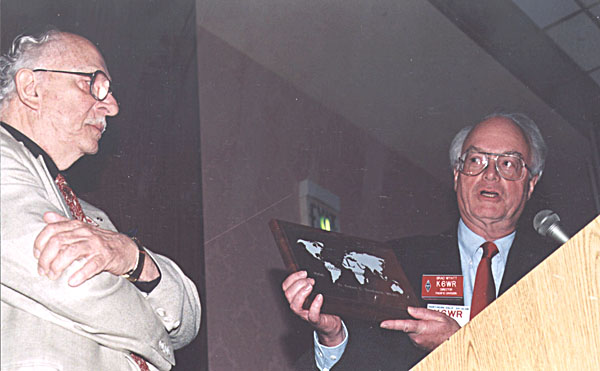
Pacific Division Director Brad Wyatt, K6WR, right, presents the ARRL International Humanitarian Award for 1996 to Dr Robert C. Smithwick, W6JZU, co-founder of MediShare International, a program of the Medical Amateur Radio Council (MARCO), at the International DX Convention, in Fresno, California, April 5, 1997. Smithwick shares the award with MediShare co-founder Ken Kirk-Bayley, GJ0KKB. For further details, see The ARRL Letter, Vol 16, No 4, and QST, Feb 1997, page 41. --Rick Palm, K1CE
| SOLAR FLUX, SPOT COUNT DOWN BUT NOT OUT |
Sun watcher Tad Cook, K7VVV, in Seattle, Washington, reports: Average solar flux was down about 3 points last week compared to the previous week. The sunspot count was down also. Geomagnetic conditions were stable, with the only unsettled period on June 3 when the planetary A index was 10 and the K index rose to 4.
Looking out over the next few weeks, the solar flux should rise to around 80 by mid-month, then drift back to the mid-70s. Geomagnetic activity should stay stable.
Dr. George C. Rybicki, KE8YX, of the NASA Lewis Research Center wrote to say that a recent article in a journal of the American Geophysical Union reports that the next solar cycle is predicted to have a mean smoothed sunspot maximum of 160, about the same as the last cycle. He also pointed to a popular theory which states that even numbered cycles are followed by a bigger odd numbered cycle, and this has been observed without exception for the past 150 years. The next cycle is number 23, and he says it may be a record, like cycle 19 in the late 1950s.
Sunspot numbers for May 29 through June 4 were 27, 35, 29, 33, 35, 20 and 16, with a mean of 27.9. The 10.7-cm flux was 75.6, 75.1, 72.5, 77.3, 76.9, 75.2 and 73.9, with a mean of 75.2, and estimated planetary A indices were 3, 7, 9, 6, 7, 10, and 5, with a mean of 6.7.
| In Brief: |
- Vanity call sign update: The FCC office in Gettysburg reports it received a total of 682 vanity call sign applications during May--more than two-thirds of them filed electronically. As of June 6, the FCC had run vanity applications received through May 30 (the last business day of the month). The FCC granted 161 new call signs in the latest run. Another 207 applications were put aside in the work in process (WIPs) stack for special handling. The FCC has not said when vanity Gate 3 will open. --FCC
- Address, call sign updates: Vermont's new Section Manager, Bernie Capron, N1NDN, now is available via e-mail at n1ndn@arrl.org. Capron succeeded Justin Barton, WA1ITZ, as Section Manager late last month. Northern New Jersey Section Manager Roy Edwards Sr, formerly KB2LUO, is now AB2RE. His official e-mail address has changed to ab2re@arrl.org.
- Thanks, ICOM! ICOM America has donated a new IC-756 MF/HF/6-meter transceiver to the Maxim Memorial Station W1AW at ARRL Headquarters. In a letter to ICOM America President Robert Brunkow, K7NHE, W1AW Station Manager Joe Carcia, NJ1Q, expressed "deepest appreciation" for the donation. The IC-756 will be available for use by hams visiting W1AW. (Remember: If you plan to visit W1AW this summer and would like to operate, you must bring along your Amateur Radio license.)
- Phase 3D Ariane 5 vehicle heads for launch site: The second Ariane 5 qualification vehicle was shipped on June 2 from Le Havre, France, toward Kourou, French Guiana, aboard a freighter. Later this month, ESA and CNES officials are expected to decide the beginning of the launch campaign. On September 16, the Ariane 5 is scheduled to loft AMSAT's Phase 3D Amateur Radio satellite, a small science piggyback satellite, plus two "dummy" payloads. (AMSAT's Keith Baker, KB1SF, says Phase 3D efforts continue in preparation for the September launch.) --Orbital Report On-Line
- KB5UAC to do more packet: Ham-astronaut Mike Foale, KB5UAC, now settling in for his stay aboard the Russian Mir space station, says he'll try to do more packet while he's on board. "I am a neophyte at packet," Foale conceded in a recent packet posting in which he asked Earthbound hams to pass along any packet pointers. He also said he has no manuals on board to guide him in using the equipment. An improved power supply recently was connected to the Mir packet station. Foale said they plan to run 10 W output "until we have confidence in it," and might increase power later. QSLs for contacts with R0MIR go to Serge Samburov, RV3DR, Box 73, Kaliningrad-10 city, Moscow Area, 141070, Russia.
- Newsline's YHOTY nominations due: Nominations for Newsline's 1997 Young Ham of the Year Award closes June 30. Newsline--in cooperation with Yaesu USA and CQ--presents this award annually to a young ham who has contributed to his or her community or the nation using ham radio. This year's winner gets an expense-paid trip to the Huntsville Hamfest, a week at Spacecamp Huntsville and other surprises. To qualify, a nominee must be 18 or younger, be an FCC-licensed radio amateur and reside in the continental US. More information on the award and an official nominating form is available at http://www.arnewsline.org (click on Young Ham of the Year Award) or by sending an SASE to 1997 Young Ham of the Year Award, Newsline, 28197 Robin Ave, Santa Clarita CA 91350. --Amateur Radio Newsline
- Special event honors VOA: Special event station K3VOA will be on the July 4, 1997, 1200 to 2200 UTC, on or around 7.240 and 14.240 MHz, SSB. The Maryland Apple Dumpling Radio Amateur Society (MADRAS) and the Voice of America Amateur Radio Club are sponsoring the operation from VOA headquarters in Washington, DC to celebrate the Fourth of July and VOA's 55th anniversary. Send QSLs (with SASE) to MADRAS, Box 2468, Wheaton, MD 20902.--Leo Boberschmidt, KA3TGY/MADRAS
- Special event marks Lansing's 150th: Amateur Radio will be on hand to help celebrate the Lansing (Michigan) Capital Sesquicentennial on June 14. The Central Michigan Amateur Radio Club, W8MAA, will be on the air that day from 1500 to 2100 UTC on 80, 40, 20 and 10 meters, plus some demonstration operation on 2-meter FM. The station will be set up on the lawn of the Michigan State Capitol in Lansing. Gov John Engler has been invited to take part. Dave Humphreys, N8WTH, says operation on 20 meters will be "mostly CW," while operation on 40 will be "mostly SSB." Specific frequencies were unavailable. Certificates will be available for those who QSL by July 24, 1997. Contact N8WTH, 7790 Jon Scott Dr, Grand Ledge, MI 48837-09279.
- Circus train special event: Talk to a circus train July 7, 1400 to 0100 July 8, and July 8, 1400 to 2000 UTC. Frequencies, 7.240 or 14.240 MHz SSB; 21.350 MHz SSB, and 146.55 FM. A color certificate is available. Send a 9 × 12 SASE and three units of postage (overseas hams should enclose four IRCs) to K9ZZ, 412-1/2 Ash St, Baraboo, WI 53913. --Jim Romelfanger, K9ZZ
- Disaster preparedness workshop set: The Disaster Emergency Response Association's Disaster Resource Center in Denver, Colorado, will hold a DERA Regional Workshop July 17-18, 1997, at Asheville, North Carolina. The workshop will focus on disaster preparedness in communities throughout the southeastern US, the Gulf states and the Caribbean. Amateur Radio response teams are welcome. The fee is $79 if received before June 15, 1997. For more information, a complete agenda or registration, write DERA Regional Workshop, Box 6558, Asheville, NC 28816; http://www.netcom.com/~n3dak/asheville.html.
- Amateur Radio Supply closes: Amateur Radio Supply in Seattle, Washington, has closed. All parts and inventory have been purchased by Radio Depot, Bremerton, Washington; tel 360-377-9067.
- Western Samoa QSL bureau closes: Phil Williams, 5W1AU, reports the 5W QSL bureau is being shut down due to a lack of finances and forwarding information for visitors to Western Samoa who are now being issued 5W0 call signs (there are four active permanent 5W1 stations, according to Williams). Williams says that while there is no formal reciprocal licensing agreement, a visitor who shows a valid ham license from his or her home country can get a 5W0 call sign for $15 and "about five minutes" of time.
- NE602A replaced by SA602A: Dan Wissell, N1BYT, reports that Phillips is dropping the commercial range (0-70 degree C) NE602A and replacing it with the extended temperature range SA602A. "This is because 99% of the volume production is in the SA602 part," he said. Wissell said that Phillips has no plans to stop production of the part, and the key specifications are the same.--Dan Wissell, N1BYT
| The ARRL Letter |
The ARRL Letter is published by the American Radio Relay League, 225 Main St, Newington, CT 06111; tel 860-594-0200; fax 860-594-0259. Rodney J. Stafford, KB6ZV, President; David Sumner, K1ZZ, Executive Vice President.
Circulation, Kathy Capodicasa, N1GZO, e-mail kcapodicasa@arrl.org.
Editorial, Rick Lindquist, N1RL, e-mail elindquist@arrl.org.
Visit the ARRLWeb page at http://www.arrl.org.
The purpose of The ARRL Letter is to provide the essential news of interest to active, organizationally minded radio amateurs faster than it can be disseminated by our official journal, QST. We strive to be fast, accurate and readable in our reporting.
Material from The ARRL Letter may be reproduced in whole or in part, in any form, including photoreproduction and electronic databanks, provided that credit is given to The ARRL Letter and The American Radio Relay League.
| How to Get The ARRL Letter: |
The ARRL Letter is distributed directly from ARRL HQ only to elected League officials and certain ARRL appointees and to paid subscribers of the now-defunct hard-copy edition of The ARRL Letter . For members and nonmembers alike, The ARRL Letter is available free of charge from these sources:
- The ARRLWeb page (http://www.arrl.org/arrlletter/). This version of The ARRL Letter includes any photographs.
- The HIRAM BBS: 860-594-0306.
- The ARRL Technical Information Server (Info Server): Send an e-mail message to info@arrl.org. The subject line should be blank. In the message body, type send ltrmmdd.txt, where mm represents two digits for the month and dd represents two digits for the day (The ARRL Letter is published every Friday). For example, to request The ARRL Letter file for Friday, January 3, 1997, you'd type send ltr0103.txt. Then, on a separate line, type quit.
- CompuServe and America Online subscribers, as a downloadable text file in the services' ham radio libraries
- The Netcom server, run by the Boston Amateur Radio Club and Mike Ardai, N1IST: Send e-mail to listserv@netcom.com (no subject needed). The body of the message should say subscribe letter-list.