Address Changes: Kathy Capodicasa, N1GZO, e-mail kcapodicasa@arrl.org.
Editorial: Rick Lindquist, N1RL, e-mail elindquist@arrl.org.
| IN THIS EDITION: |
- Upbeat Dayton crowd enjoys new toys!
- First VP Mendelsohn defends League in Dayton debate
- Theft-deterrent system maker seeks expanded MF/HF use
- "Rockoon" launch a success
- FCC issues new Form 610
- FCC revises on-line vanity application
- Central States VHF Society Conference set
- Jock White, ZL2GX, SK
- A. C. Gee, G2UK, SK
- In Brief: This weekend on the radio; Vanity update; New Vermont SM; Outgoing QSL Service reminder; Swarm greets flea marketers; DXers inducted; Atlantic Division Convention award winners; NJDXA 40th anniversary event
| NEW HAM TOYS DEBUT AT DAYTON HAMVENTION 1997 |
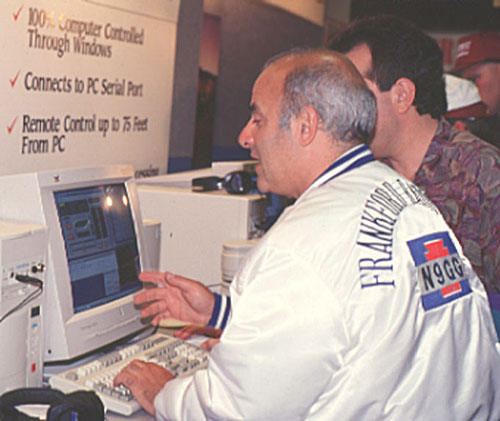 Bob Penneys, N9GG, tries his hand at the PC controls of the new Kachina 505DSP HF transceiver at Dayton. |
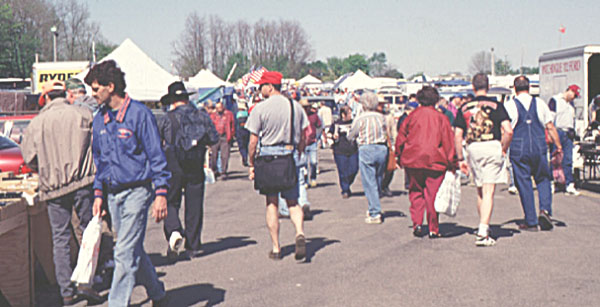 Dayton Hamvention flea marketers enjoy the fine spring weather. |
It most definitely did not rain during the Dayton Hamvention! An upbeat crowd reveled in three days of beautiful spring weather May 16, 17 and 18 at the Hamvention -- the world's largest annual ham radio gathering. Hamvention Chairman Dick Miller, N8CBU, estimated that between 27,000 and 28,000 people attended Dayton this year, and many vendors reported brisk sales (some even ran out of available stock and had to have new units rushed to Dayton), reflecting an overall brighter outlook within the hobby.
For many hams, Dayton is an annual pilgrimage -- an opportunity to renew on-the-air acquaintances face-to-face, to seek out flea market bargains, or to be the first on their block to see the hobby's newest toys in the flesh as manufacturers and vendors hope to wow the crowds with their latest offerings.
One of the more intriguing pieces of gear that attracted the curious came from Kachina, a company largely unknown to most hams. The Kachina 505DSP computer-controlled HF transceiver, which its manufacturer calls "a new approach to Amateur Radio," has no knobs, buttons or meters -- nor a front panel for that matter. It's a compact box you interface with and control via a Windows-capable PC! Kachina, a US firm based in Arizona, has been well known in commercial radio circles for more than two decades. Under development for almost three years, the 505DSP offers 100 W output on all MF and HF bands and DSP filtering in the second 40-kHz IF. (The only crystal filter is a six-pole crystal "roofing" filter in the front end that has a 20-kHz bandwidth. All other receive filtering is done using DSP techniques.) Operator control is via the PC mouse and keyboard using on-screen icons and pull-down menus. A microphone, key or keyer paddle plug into a panel that fits into a standard hard-drive or CD-ROM bay on your PC. The Kachina 505DSP will sell for just under $2000 (not including the PC). It's scheduled to be available in July.
Ten-Tec, Collins and ICOM also demonstrated panel-less DSP PC-controlled HF receivers at the Hamvention.
Tiny hand-held VHF, UHF and dual-band H-Ts captured the imagination of the Dayton crowd. Yaesu, Alinco and Standard debuted diminutive H-Ts. Yaesu describes its new VX-1R as the "world's smallest dual-band hand-held with wide receiver coverage." It offers 500 mW output (or 1 W with external power), a rechargeable lithium ion battery, and 290 memories. It will be available July 1. Alinco debuted its DJ-S11T economically priced, pocket-sized 2-meter H-T--a companion to its DJ-S41T for 440 MHz. Pending FCC approvals, Alinco also hopes to have its "revolutionary" DJ-C1 2-meter "micro-transceiver" on the market later this year. The super-thin transceiver is only slightly larger than a credit card and about as thick as a typical pocket calculator. Both the DJ-S41T and the DJ-C1 put out about 300 mW. (A DJ-C4 for 70 cm also is in the offering.) Standard introduced its flexible and very compact C510 dual-band hand-held that provides 1 W output by itself and up to 50-W output when coupled with an optional accessory unit.
Potential buyers and the just-plain-curious also got their first look at Yaesu's new FT-920 transceiver that covers HF and six meters. The 100-W transceiver incorporates DSP features on both receive and transmit.
Kenwood rolled out its new Sky Command system that permits remote control of its TS-570 or TS-870 transceivers via two H-Ts and an interface box.
Drake returned to the Amateur Radio market with the TR270, a desktop two-meter FM transceiver that includes a built-in AC power supply and independent, dual-band receive capability in the 420 to 470 MHz and 136 to 174 MHz ranges. The Drake TR270 puts out 25 W.
Ham radio manufacturers said they sensed greater optimism about the hobby among those that stopped by, coupled with an upswing of interest in HF transceivers. As Chip Margelli, KJ7A, of Yaesu put it: "Overall, it was a tremendous weekend which exceeded our most lavish expectations." Doug Wynn, KB6YZD, of Alinco, also was ecstatic. "We were very impressed with the size of the crowd and the interest they showed in our products," he said. Dayton Hamvention 1998 is May 15-17.
| FIRST VICE PRESIDENT MENDELSOHN DEFENDS LEAGUE IN DAYTON DEBATE |
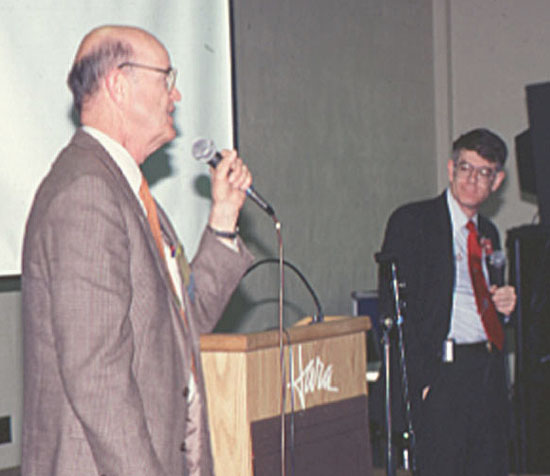 Debater Joe Schroeder, W9JUV (l), makes a point while ARRL First Vice President Steve Mendelsohn, W2ML,(r), listens. |
ARRL First Vice President Steve Mendelsohn, W2ML, debated former HR Report editor Joe Schroeder, W9JUV, as part of a "ham radio town meeting" broadcast live via the Internet as part of the Dayton Hamvention. The Saturday afternoon face-off was the first of four during a forum addressing the future of ham radio. Ham Radio & More radio host Len Winkler, KB7LPW, was the moderator.
Responding to the question, "Is the ARRL doing all it can to promote the future of ham radio?" Schroeder -- who made it clear he was a League member and critic and not a League basher -- asserted that the League wasn't doing enough to fend off challenges to our bands and has not been effective in assimilating no-code licensees and newcomers to the hobby.
Mendelsohn assured the gathering of some 150 onlookers that the ARRL was working -- sometimes quietly and behind-the-scenes -- to "educate those in Congress who would sell our frequencies" about ham radio and its contribution. Focusing specifically on the Little LEOs issue, Mendelsohn said ARRL representatives were, at that moment, in Geneva, Switzerland, "promoting the idea that [low-Earth-orbiting satellites] are a good idea for some other band," while other League efforts promote the hobby's public service contribution to local decision makers.
Mendelsohn said the League is "only the sum of the input of its members," and he encouraged individual hams to approach newcomers and "show them the magic" of ham radio. "It's called Elmering -- one on one," he said. Mendelsohn explained that a system is in place to alert section managers and club coordinators to all newly licensed individuals in each section, but he said that Headquarters has not gone out and directly sought newcomers. "One hundred people in Newington cannot do what 172,000 members can do," he said.
When Winkler took questions from the audience, Schroeder supported a call from one ham for direct membership election of the ARRL's president. Mendelsohn declined to offer an opinion on the suggestion, but pointed out that it would require action by the League's Board of Directors and a change in the by-laws.
Long-time League member Larry Roll, K3LT, urged those on hand to support the League and to get involved. "It's the organization we have. We must steer it," he said.
Mendelsohn concluded that the League was "doing all that it can, within financial constraints, to promote the future of ham radio," while Schroeder maintained that there were "still a few areas that need improvement."
Other issues debated during the two-hour long forum included whether to set aside band segments where contesting would be banned, whether the Internet was killing ham radio, and whether the CW requirement for HF privileges should be abolished. The forum Internet broadcast was produced by Amateur Radio Newsline's Bill Pasternak, WA6ITF (who also participated in one debate). TAPR's Greg Jones, WD5IVD, arranged the Internet hookup.
| LEAGUE TO COMMENT ON THEFT-DETERRENT SYSTEM MAKER'S PETITION |
The ARRL will file comments in response to an FCC Petition for Rulemaking from Checkpoint Systems Inc -- a manufacturer of electronic article surveillance (EAS) systems that use frequencies in the 1.7 to 10-MHz range. EAS systems are used to deter theft in retail stores and other locations. Checkpoint has asked the FCC to change its Part 15 rules to expand the frequency range and power level of EAS systems. The company wants the Commission to permit EAS operations in the 1.705 to 30-MHz band at a maximum radiated emission level of 1000 uV per meter (measured at a distance of 30 meters) and a maximum conducted emission level of 3000 uV. Current rules permit a maximum radiated emission level of 30 uV per meter (measured at a distance of 30 meters) between 1.705 and 30 MHz, or 100 uV per meter between 1.705 and 10 MHz. The current conducted emission limit for such devices operating between 1.705 and 10 MHz is 250 uV.
Checkpoint says its EAS system can detect tags concealed within or attached to protected articles by using an RF sweep over the frequency range of operation. Typically, systems are set up so that customers can only exit via an EAS-equipped gate. Checkpoint's EAS equipment currently operates within the 1.705 to 10 MHz band and is regulated as an unlicensed intentional radiator under Subpart C of Part 15. Under Part 15 rules, such devices may operate without restrictions on bandwidth, duty cycle, modulation technique or application, but must comply with specified radiation and emission limits and protect licensed services from harmful interference. Checkpoint says it needs the higher power levels to overcome "increasing levels of ambient RF noise in commercial establishments." The expanded frequency range, the company says, will allow for greater flexibility in deploying EAS systems and reduce the potential for false alarms.
The company already holds an experimental authorization to operate EAS equipment within the 7.4 to 9 MHz and 8.2 to 10-MHz bands at up to 1000 V per meter and says it has received no complaints of interference.
Checkpoint's Petition for Rulemaking was received by the FCC on April 28.
| "FIRE THAT ROCKET NOW!" ROCKOON LAUNCHED WITH JUST SECONDS TO SPARE |
A team of space enthusiasts that includes several hams managed to launch a rocket bearing ATV and APRS systems from a high-altitude balloon off the coast of North Carolina on May 11. But the launch of the so-called "rockoon" almost didn't happen, according to Bill Brown, WB8ELK, of the Huntsville Alabama L5 Society -- a chapter of the National Space Society. When it arrived at the launch site in Hamstead, North Carolina in the early morning hours of May 11, it was frosty and still. "Perfect conditions for a balloon flight!" Brown said. The first glitch occurred when the team found two nearly empty tanks in its helium supply. Concerned they would not have enough to lift the rocket payload, team members scoured Hamstead and nearby Topsail Beach and finally were able to purchase two tanks from a local supermarket that used them to fill party balloons. "This saved the day," Brown said. The team managed to get the balloon and rocket payload off the ground with just five minutes left before its FAA launch window closed.
But it would get a lot more tense before the day was out.
Brown said the team got "spectacular color video" from the balloon, but the GPS telemetry -- downlinked via packet radio in APRS format -- started to get weak after the rockoon topped 23,000 feet. "The signal faded completely into the noise and we unable to record any more usable position and altitude reports from that point onward," Brown said. "We think that the internal antenna for the packet transmitter put most of the radio signal up and down, but very little signal made it towards the horizon as the payload headed out nearly 120 miles out over the Atlantic."
Almost an hour and a half into the balloon launch, the team estimated the balloon's altitude to be around 60,000 feet. This meant the barometric rocket safety switches would be armed and the rocket could be fired at any time, although the team had hoped to reach at least 100,000 feet before launching. Then, Brown reports, near disaster! "I happened to be looking at the video of the balloon envelope and thought that the balloon looked pretty full. Just then, one of the seams tore wide open, dumped out all of the helium and the balloon just folded up into a long streamer of plastic!"
"Fire that rocket now!" Brown says he shouted to Ed Myszka, KE4ROC, as the rocket and gondola dropped rapidly toward the ocean below. The team had just over one minute to issue the fire command before the safety switch disarmed the rocket at 49,000 feet.
As Brown relates: "Ed keyed down the 2-meter transmitter and anxiously entered the firing code via touchtones. Nothing happened! He tried another time. Nothing!" With seconds left, Myszka tried a third time. "All of a sudden there was a bright flash and a cloud of smoke and the rocket leaped out of the gondola and off towards space," Brown said. "Bits of plastic tape and the plastic covering shredded off and fluttered past the camera view as the gondola continued its rapid descent." Miraculously, the balloon camera survived the rocket exhaust blast and continued to work flawlessly until the gondola splashed into the Atlantic.
Brown said the team was treated to flashes of video from the rocket for about 30 seconds, "showing tantalizing views of the curve of the Earth." The rocket's spin caused the ATV signal to flutter in and out and make it difficult to lock onto a good picture. The rocket and the balloon gondola ended up in the Atlantic, but lacking GPS signals, the team was unable to recover them.
Brown estimated that the rocket reached a peak altitude of 38 miles -- not quite "space" as the team had hoped (space is defined as 51 nautical miles in altitude). "We did set several records," Brown said. "The first amateur launch of a rockoon (rocket launched from a balloon), the highest launch of a hybrid rocket (hybrid referring to the nitrous oxide/asphalt fuel combination), and the highest flying hybrid rocket to date."
| FCC ISSUES NEW FORM 610; OLD VERSIONS STILL VALID |
The FCC has just released a new Form 610, dated March 1997, that -- among other minor changes -- now includes a space for your Internet address. The new form is available via the FCC's Internet site (http://www.fcc.gov) and via the FCC's fax-on-demand service (202-418-0177; to obtain Form 610, the form number to request is "000610;" Form 610A is "006101;" Form 610B is "006102;" and Form 610V is "006108." Form 159, of interest to some vanity filers, is "000159").
The form is much the same as the previous Form 610, dated March, 1995, except that item 3A asking for the applicant's "Internet Address" is included on the same line as the street address. The environmental impact question, formerly item 6, has instead become a statement in the applicant certification section where the applicant certifies that "the construction of the station would not be an action which is likely to have a significant environmental effect (see the Commission's Rules 47 CFR Sections 1.1301-1.1319 and 97.13a)." The former item 7 has become item 6 on the new Form 610.
According to staff members at the Gettysburg FCC office, the FCC will continue to accept any of the three Forms 610 (dated November 1993, March 1995 and March 1997) until further notice.
| REVISED VANITY CALL SIGN ELECTRONIC APPLICATION AVAILABLE |
On May 19, 1997, a revised version of the electronic Amateur Station Vanity Call Sign Request form (FCC Form 610-V) was made available on the Internet at http://www.fcc.gov/wtb/amradsrv.html. Under "Amateur Station Vanity Call Sign System" choose "Interactive Vanity Call Sign Application." This version allows a user to file multiple applications using one FCC Form 159 (Remittance Advice), thus permitting several applicants to file vanity applications at the same time and combine their fee payments. The fee will calculate and preprint on the FCC Form 159, depending on the number of applications submitted. Detailed instructions are available by clicking on the item number on the Internet form. Previously, applicants had to complete a separate FCC Form 159 for each application submitted electronically.
Electronic payment is not yet available, and applicants must mail a completed FCC Form 159 with payment to FCC, Box 358994, Pittsburgh, PA 15251-5994, immediately after submitting any electronic application(s).
For technical assistance, contact the FCC Technical Support Group, 202-414-1250. For general questions regarding the application or fee, call the Wireless Telecommunications Bureau Consumer Assistance staff, 800-322-1117. --FCC
| CENTRAL STATES VHF SOCIETY CONFERENCE IS JULY 25-26 |
The 31st annual Central States VHF Society Conference is set for July 25-26, 1997, in Hot Springs, Arkansas. The conference will be held at the Clarion Resort Hotel on Lake Hamilton. A CSVHF conference rate is available. (Call 800-432-5145 or 501-525-1391 for information and reservations.)
The technical program covers a range of topics, from satellite and VHF contesting, to high-power amplifier design, antennas and propagation, and even a look at the extraterrestrial communication. In addition, antenna gain measurement and a noise figure workshop will be available, plus a display of vintage VHF and UHF equipment.
Those interested in presenting a paper, a short talk or an article for the proceedings are invited to contact Al Ward, WB5LUA. Papers are due by June 6. A family program begins Thursday, July 24, with a two-hour dinner and sightseeing riverboat cruise aboard the Belle of Hot Springs. Other sightseeing and entertainment activities also are on the family program schedule. --Joel Harrison, W5ZN
| JOCK WHITE, ZL2GX, SK |
The New Zealand Association of Radio Transmitters (NZART) reports that its former Contest and Awards Manager Jock White, ZL2GX, died May 17, 1997. He was an NZART life member. In 1948, White became one of the first ZLs to attain DXCC. In June 1960, he became the first amateur to receive the DXCC 300 award and was on the honor roll in the late 50s and early 60s. In 1959, White was among the group of three hams that QST jointly designated as top DXers. --Jim Meachen, ZL2BHF, President NZART
| A. C. GEE, G2UK, SK |
The former chairman of AMSAT-UK, A C "Doc" Gee, of Oulton Broad, Suffolk, died May 19, 1997. He was 84. Licensed in 1935, Dr Gee was a charter member of AMSAT UK and served as its chairman from 1979 until 1992. He wrote the satellite column in Radio Communications for several years and was active on the satellites until a few weeks before his death. He was a member of the Royal Naval Wireless Auxiliary Reserve, which led to a life-long interest in Amateur Radio, and a member of the London Wireless Club (now RSGB). His wife, Marjory, and a son and daughter survive. A service will be held May 29 in Oulton Broad. --Ron Broadbent, G3AAJ
| In Brief: |
- This weekend on the radio: For your contesting enjoyment, there's the CQ WPX CW contest. Also on tap: the QRP ARC International Hoot Owl Sprint.
- Vanity update: On May 20, the FCC's Gettysburg office processed vanity call sign applications received between April 1 and May 14. Of the 919 applications, 456 resulted in new call signs and 463 wound up in the work in process (WIPs) stack for special handling. The FCC has not indicated when vanity Gate 3 for Advanced Class operators will open.
- New Vermont SM: The Green Mountain State has a new Section Manager. He's Bernard "Bernie" Capron, N1NDN, Route 1, Box 2086A, Northfield, VT 05663; tel 802-485-7400; e-mail bernie@drbs.com. Capron succeeds Justin C. Barton, WA1ITZ, of Randolph, who resigned recently for health reasons. --Rick Palm, K1CE
- Outgoing QSL Service reminder: Rates for the ARRL's Outgoing QSL Service have increased. The current rate for members is $4 per each pound of cards or portion thereof (one pound equals approximately 150 cards). A package of 10 or fewer cards sent in a single shipment costs $1. Add $1 for each additional 10 cards or portion thereof. Checks or money orders are preferred (please write your call sign on all checks). Do not send postage stamps or IRCs. DXCC credits cannot be applied toward any QSL Service fees. --Martin Cook, N1FOC
- Swarm greets flea marketers: The Dayton Hamvention flea market almost became a "bee market" late Sunday morning when a swarm of several thousand honeybees, apparently from a nearby hive, descended onto a vendor's table. Dave Lindquist, N1YMK, a former apiarist who lives in Newfane, Vermont, happened upon the scene just as another man -- obviously knowledgeable about bees and possibly a ham -- already had isolated the queen bee in a cardboard box and was scooping the swarm off the table's edge into the box. "There were lots of bees still in the air -- more than half -- but they had detected the smell of the queen in the box, so were happily joining her," he said. Lindquist said he'd been told the fire department already had been called to "blow the swarm out of the air" by freezing it with carbon dioxide, but that didn't appear necessary, and no one reported getting stung. Onlooking hams appeared unfazed, said Lindquist. "While swarming bees are normally docile due to the fact that they fill themselves up with honey reserves before they leave the hive, they still have the ability to sting if agitated." Lindquist's friend, Charlie Geib, N4AV, of Fort Lauderdale, Florida didn't take any chances. "Dave was a few feet from the scene, but I backed off about 40 feet away and still got hit by flying bees," he said.
- DXers inducted: John Dorr, K1AR; John Devoldere, ON4UN; Carl Cook, AI6V; Gordon Marshall, W6RR; and Jorge "Arturo" Bozzo, LU8DQ (SK), were inducted into the CQ Contest Hall of Fame by Bob Cox, K3EST, at the CQ Contest dinner, held in conjunction with the 1997 Dayton Hamvention. Inductees were chosen for outstanding contribution to Amateur Radio contesting. Nominations for induction are submitted by clubs or individuals. ON4UN, AI6V, and K1AR were on hand to accept their awards. W7RM accepted for W6RR who was unable to attend. LU8DQ became a Silent Key several years ago. --Charlie Morrison, N1RR
- Atlantic Division Convention award winners: Joseph Nunemaker, KD3VR, will receive the Atlantic Division Amateur of the Year award at the 63rd annual Atlantic Division Convention May 30-June 1 at Rochester, New York. Gerald Gavin, NU3D, will receive the Atlantic Division Grand Ol' Ham award, and Ron Raposo, N2JAW, will receive the Atlantic Division Technical Achievement award. For more information, see May QST, page 92 or check http://www.vivanet.com/~rochfst/hf/main96.html on the Internet. --Harold Smith, K2HC
- NJDXA 40th anniversary event: As part of its 40th anniversary celebration, the North Jersey DX Association is sponsoring a year-long operating event. Member stations will identify using the club call, W2JT/40. Each station operator will announce his or her call sign and name. The same station may be worked on different modes. Work as many W2JT/40 stations as possible by December 1, 1997. The station with the most W2JT/40 member call signs will receive an engraved plaque at the association's annual gathering. Logs go to North Jersey DX Association, Box 599, Morris Plains, NJ 07950. --Bill Hudzik, W2UDT
| The ARRL Letter |
The ARRL Letter is published by the American Radio Relay League, 225 Main St, Newington, CT 06111; tel 860-594-0200; fax 860-594-0259. Rodney J. Stafford, KB6ZV, President; David Sumner, K1ZZ, Executive Vice President.
Circulation, Kathy Capodicasa, N1GZO, e-mail kcapodicasa@arrl.org.
Editorial, Rick Lindquist, N1RL, e-mail elindquist@arrl.org.
Visit the ARRLWeb page at http://www.arrl.org.
The purpose of The ARRL Letter is to provide the essential news of interest to active, organizationally minded radio amateurs faster than it can be disseminated by our official journal, QST. We strive to be fast, accurate and readable in our reporting.
Material from The ARRL Letter may be reproduced in whole or in part, in any form, including photoreproduction and electronic databanks, provided that credit is given to The ARRL Letter and The American Radio Relay League.
| How to Get The ARRL Letter: |
The ARRL Letter is distributed directly from ARRL HQ only to elected League officials and certain ARRL appointees and to paid subscribers of the now-defunct hard-copy edition of The ARRL Letter . For members and nonmembers alike, The ARRL Letter is available free of charge from these sources:
- The ARRLWeb page (http://www.arrl.org/arrlletter/). This version of The ARRL Letter includes any photographs.
- The HIRAM BBS: 860-594-0306.
- The ARRL Technical Information Server (Info Server): Send an e-mail message to info@arrl.org. The subject line should be blank. In the message body, type send ltrmmdd.txt, where mm represents two digits for the month and dd represents two digits for the day (The ARRL Letter is published every Friday). For example, to request The ARRL Letter file for Friday, January 3, 1997, you'd type send ltr0103.txt. Then, on a separate line, type quit.
- CompuServe and America Online subscribers, as a downloadable text file in the services' ham radio libraries
- The Netcom server, run by the Boston Amateur Radio Club and Mike Ardai, N1IST: Send e-mail to listserv@netcom.com (no subject needed). The body of the message should say subscribe letter-list.