Address Changes: Kathy Capodicasa, N1GZO, e-mail kcapodicasa@arrl.org.
Editorial: Rick Lindquist, N1RL, e-mail elindquist@arrl.org.
| IN THIS EDITION: |
- SAREX hopes to reschedule missed QSOs
- FCC offers beta-testing access to databases
- Minnesota hams deal with weather disaster
- Hams earn praise during Kentucky flooding
- Index Labs' Bruce Franklin and SGC collaborate on new transceiver
- RS-16 not yet ready for use
- M-O 30 declared dead
- Solar update
- Canadian awards announced
- Richard C. Keller, K5WA, SK
- Bruce M. Karr, KN6QN, SK
- In Brief: This weekend on the radio; Vanity call sign update; FCC proposes electronic comments; HAARP test results; New frequency for Ham Radio & More; Call sign database moving; George Jacobs, W3ASK, wins award
| SAREX/ARISS WORKING GROUP ATTEMPTING TO RESCHEDULE QSOS |
When the space shuttle Columbia prematurely came back to Earth on Tuesday, April 8, so did the soaring hopes of students and teachers at 18 schools that had been scheduled to talk via Amateur Radio with the astronauts aboard the shuttle as part of the Shuttle Amateur Radio EXperiment, or SAREX. NASA decided to bring the Columbia back early after one of the spacecraft's three fuel cells malfunctioned and had to be shut down early in the STS-83 mission. The flight began a day late on Friday, April 4, and had been scheduled to last 16 days. Although the shuttle can function on one fuel cell, NASA flight rules specify that the shuttle must have three operational fuel cells. The primary payload for STS-83 was the microgravity science lab, or MSL. The astronauts were able to complete only a fraction of their scientific experiments during the curtailed flight. Three hams were aboard STS-83: Jim Halsell, KC5RNI, the mission commander; Janice Voss, KC5BTJ; and Donald Thomas, KC5FVF. The SAREX schedule had included contacts with schools in the People's Republic of China and Okinawa, Japan.
It's not yet known if or when any of the SAREX contacts might be rescheduled on other missions, although NASA has indicated it would like to "refly" the entire STS-83 mission--with the same crew--at a later date, possibly as early as July. The SAREX/ARISS Working Group (SAWG) has requested that SAREX be included if the mission is reflown. In the meantime, the SAWG will be in contact with NASA to find ways to give each school every possible chance to be assigned to future flights.
To help assuage some of the disappointment, NASA Payload Specialist Ron Parise, WA4SIR, took time out from his work schedule Monday at Goddard Space Flight Center to speak with some 300 thrilled students at the County College of Morris in New Jersey, one of the schools on the STS-83 SAREX schedule. Other schools might get a chance at special QSOs with the STS-83 crew members via ham radio (W5RRR) once the crew is back at Johnson Space Center.
At least one of the hams aboard STS-83 managed a few spare moments to turn on the ham gear aboard the shuttle. Al Lark, KD4SFF, of Greenville, South Carolina, was able to chat with Don Thomas, KC5FVF, aboard Columbia on Saturday, April 5. "I told him that I was the one that sent him the talking Woody QSL on his last mission. He said he remembered! It was great to speak with a fellow Cleveland boy in space!!" Lark said. Rusty Hack, NM1K, in Enfield, Connecticut, also reported hearing KC5FVF aboard the shuttle on the same day, apparently a few minutes after the QSO with KD4SFF. April 5 QSOs also were reported by KA3HPQ and N1JEZ during the same pass.
The SAWG continues to be optimistic about establishing a permanent ham radio presence aboard the International Space Station, although the ISS assembly schedule has been extended by six months. NASA announced this week that it will begin its on-orbit assembly of the International Space Station no later than October 1998. However, the schedule extension means that NASA will schedule additional shuttle missions, and the working group hopes that at least some of those flights will include SAREX. The SAWG has requested that SAREX be included in four more flights in 1997 and 1998.
In the meantime, four out of a scheduled round of ten MIREX school contacts have taken place so far with ham-astronaut Jerry Linenger, KC5HBR, aboard the Russian Mir space station. At least three more school contacts remain on the schedule--Alaiedon Elementary School in Mason, Michigan, Holy Angels School in Dayton, Ohio, and Jerling Junior High School in Orland Park, Illinois. The remaining QSO schedule may be pared back in deference to Linenger's heavy research workload, but efforts are under way to carry out as many of the previously schedule school contacts as possible. Linenger is engaged in ongoing investigations of the effects of prolonged exposure to weightlessness on the human body.
Last month, Linenger assured students at two Texas schools that all aboard the space station were in good shape after a fire aboard Mir in late February. But ensuring a continuous supply of oxygen for the Mir crew has preoccupied the crew in more recent days. The primary oxygen-generating "Elektron" system, which uses electrolysis to extract oxygen from onboard waste water, has been inoperative for the past three weeks. So the crew has been igniting lithium perchlorate canisters--the same type that caused the February fire--to generate oxygen for the three-man crew while Russian flight controllers formulate a repair strategy for the Elektron system. A Progress resupply vessel, scheduled to arrive at Mir April 8, was to carry replacement parts, food, clothing, and other supplies for the crew members. In the meantime, preparations are underway for the expected delivery of a replacement Elektron unit to Mir on the shuttle Atlantis when it visits in mid-May, retrieving Linenger and delivering astronaut Mike Foale, KB5UAC. Current plans call for that system to be installed on Mir during docked operations on STS-84.
Foale was scheduled to conclude his training at the Gagarin Cosmonaut Training Center in Star City, Russia, outside Moscow, this week and return to the Johnson Space Center to train with his STS-84 crewmates prior to their targeted launch to Mir in mid-May and the start of Foale's tour of duty aboard Mir. Foale is scheduled to be replaced in September by astronaut Wendy Lawrence, KC5KII. The last US astronaut scheduled for a tour of duty on the Mir is David Wolf, KC5VPF, in early 1998. --Thanks to NASA
| FCC OFFERS BETA-TESTING ACCESS TO HAM DATABASE |
For a limited time, hams and others will have real-time access to the FCC's amateur database under a beta-testing program begun this week. The FCC's Wireless Telecommunications Bureau has made available to the public three of its database applications--at no charge--for approximately 30 days on a beta-test basis. Among them is the amateur application, which allows real-time query capability of the ham radio database. Users can enter queries based on name, call sign, ZIP Code, state, club name, license issuance or expiration date or date ranges, and the native country of an alien operator living in the US.
The other programs include the frequency search program for the 929 and 931 MHz databases and the database transaction downloads. The frequency search program does a radius search for a given latitude and longitude on 929-MHz or 931-MHz stations. The database transaction download allows users to download from among a choice of seven transactions for each WTB database. Various database tables are extracted into flat files. Documentation may be downloaded, and each day's data are overwritten every seven days. At the end of the beta test period, a complete offload of the databases will be available on CD-ROM from ITS, the FCC's public access contractor (CD-ROMs are produced quarterly).
The three applications will be available from April 8 until May 12 at http://gullfoss.fcc.gov/beta.htm. Comments on the three applications go to betacomm@fcc.gov. After the beta-testing period, the FCC will make the applications available for a charge of $2.30/minute (the first two minutes of access will be free). The FCC plans to add additional applications to its beta-testing program as they become available. To enroll as an official beta tester and receive e-mail notifications about the program, send e-mail to khoutz@fcc.gov. For more information, call the FCC's Consumer Assistance Branch, 800-322-1117 or Technical Support, 202-414-1250. --FCC
| MINNESOTA HAMS BRAVE WEATHER EMERGENCY |
Hams geared up to help after communities in western Minnesota faced severe flooding this past week along the Minnesota River and in the Red River Valley. "To top off an already serious flooding problem, we were faced with blizzard conditions in NW Minnesota around Fargo/Moorhead and received as much as a foot and a half of heavy wet snow," said Minnesota's SM, Randy "Max" Wendel, N0FKU. The upper Mississippi River was expected toward the end of this week and work its way southward.
Additionally, those frantically trying to save their communities from flooding also had to deal with high winds--as high as 60 mph in some locations--and low temperatures over the past weekend as a low-pressure system moved across Minnesota. In southwestern Minnesota along the Minnesota River Valley, several communities were evacuated. Electricity and telephone service in the Granite Falls area was lost. The hope is that the floodwaters will recede before the ice melts and worsens the situation.
Wendel reports that an official statewide ARES HF net was activated on 3990 kHz to assist the Salvation Army in Minneapolis-St Paul. The Salvation Army is bringing in relief supplies for the Granite Falls area. "Hams have generally been providing some isolated communications for their local chapters of the Salvation Army providing communication for relief efforts and supplies to affected areas," Wendel said. A lot of volunteers have turned out in support of sandbagging efforts. One small area along the Minnesota River in towns of Montevideo and Granite Falls has laid down some 400,000 sandbags in an effort to minimize flooding in their neighborhoods. Other hams have been busy reporting new flooding areas to the National Weather Service. An informal ARES HF flood net was being activated each evening (5 PM CST) on 3990 kHz to gather flood-related information.
Wendel says The Associated Press has been referred to various hams around the state to get reports from the Amateur Radio community. SEC Gary Peterson, N0ZOD, was among those contacted by AP. --Randy "Max" Wendel, N0FKU, Minnesota SM
| HAMS PROVIDE VITAL LINK DURING KENTUCKY FLOODING |
More than three dozen Kentucky hams helped to fill a communication void when parts of the Bluegrass State were struck by flooding during the first few days of March that knocked out conventional communication systems and blocked highways. Members of the Northern Kentucky Amateur Radio Club--42 in all and a lot of them retired--found themselves spread pretty thinly when flooding along the Licking River cut off the town of Falmouth. Among them was John Meyers, N4GNL, the DEC for Kentucky's seventh district (which includes Boon, Campbell, Carroll, Gallatin, Grant, Kenton, Owen and Pendleton counties). The hams provided emergency backup communication (and in some instances the only communication) for several Kentucky counties, earning the praise of local officials. "We couldn't have done what we did without them," is how Craig Peoples, the Pendleton County disaster and emergency services director put it in a story in the March 31, 1997, edition of The Kentucky Enquirer newspaper. Falmouth Police Chief Greg Reis was more direct. "Those Amateur Radio operators were the only communication we had," he's quoted as saying in a report in The Kentucky Post of March 22, 1997.
Hams participated in flood recovery operations for several days after the disaster struck. In addition to handling messages, amateurs helped call in ambulances to handle health-related emergencies, traveled with the National Guard and other recovery teams in boats to emergency operations sites, helped deliver food and supplies, and helped tabulate lists of the missing. Meyers said he could have used twice as many hams, but he and the community were grateful for those who volunteered their time, effort and equipment to help others.
Fifteen hams from the Dayton, Ohio, area spent the weekend assisting the Red Cross with damage assessment in the wake of the flooding along the Ohio, Licking and Kentucky Rivers. In addition, the Dayton Amateur Radio Association communications van was stationed in Falmouth, Kentucky, on March 8, and in the Brooksville, Kentucky, area on March 9.
In addition to the hams from Kentucky and Ohio, amateurs from Florida, Georgia and Alabama also are reported to have pitched in during the flooding emergency. At least 75 hams have been cited to receive ARRL Public Service certificates in recognition of their efforts, according to Paul Mitchell, N4DUE, Kentucky's SEC. --Thanks to John Meyers, N4GNL; Bev Priest, N8VZV; and Steve McCallum, W2ZBY
| INDEX LABS' BRUCE FRANKLIN AND SGC COLLABORATE ON NEW TRANSCEIVER |
A collaboration between Index Laboratories president Bruce Franklin and SGC of Bellevue, Washington is expected to result in a new transceiver roughly based on the now-discontinued Index QRP Plus. The new transceiver will have a new name, several improvements and a smaller package. Franklin said Thursday that SGC has contracted with him, personally, for engineering design services to develop the new transceiver, to be called the SGC 2020. It's scheduled to debut later this year.
In a statement, Franklin made it clear that SGC has not acquired Index, its product line or its customer service obligations. He said Index, located in Gig Harbor, Washington, will continue to provide warranty service for the QRP Plus transceiver, which Index no longer manufactures. Index also no longer provides retrofit service to upgrade QRP Plus transceivers to New QRP Plus transceivers. Franklin said he's doing his best to handle customer service, but he conceded that running a one-man shop sometimes means that he is difficult to reach.
Franklin said the new SGC 2020 will retain "the basic architecture" of the QRP Plus, but with some significant differences. For one thing, plans call for the new transceiver to have up to 20 W output (continuously adjustable down to 20 mW). The new transceiver also will have an improved synthesizer design, bipolar PA transistors, better output filtering, a backlighted display (which can be turned off) and a smaller size (2.5x6x6 inches) through the use of surface-mount components. The SGC 2020 will retain the SCAF filters used in the QRP Plus design. Franklin said the idea was to market a radio with broader appeal than the QRP Plus. "We wanted to go beyond the QRP community without losing them," he said, suggesting that the SGC 2020 would also be attractive to those interested in mobile or portable operation.
The SGC 2020 will retain the low receiver current drain of the QRP Plus--about 200 mA, Franklin said. The transmitter will draw approximately 4 A on peaks. The unit is expected to weigh just 1.5 lb and will carry an introductory price tag of $595--$100 less than the QRP Plus sold for.
Franklin said SGC will be responsible for manufacturing, sales and customer support of the SGC 2020. SGC anticipates that the SGC 2020 will be available around September 1, 1997. Among other products, SGC manufactures the SG 2000 transceiver, the Power Talk and Power Clear control units and the Smartuner line of antenna tuners. SGC Sales Director Robert Gregg said that the latest details and updates regarding the SG-2020 transceiver will be posted regularly at http://www.sgcworld.com.
| RS-16 STILL UNDERGOING TESTING |
The newest Amateur Radio satellite, RS-16, should be ready for prime time in about two months or so. That's the word from Leo, UA3CR, in Russia. He says RS-16 is undergoing testing now. It's believed the Mode-A transponder will be switched on after testing is complete.
RS-16 was launched as part of a compound satellite package called Zeya--named after a new launch site at the Svobodny Cosmodrome by the banks of the Zeya River (the Zeya was the site's maiden launch). In addition to the RS-16 package, the Zeya spacecraft consists of an experimental navigation system, a number of experimental reflectors, solar panels and batteries. RS-16 has high speed telemetry as well as CW, but it is proving to be difficult to copy due to the satellite's tumbling. In fact, Amateur Radio operators are reported to be doing somewhat better than Russian space officials, whose receivers are said to be less sensitive than those of the amateurs. Two members of the RS group, Alex Papkov, RA3XBU, and Victor Samkov, are working at the Ground Control Center near Moscow. UA3CR is asking hams to check for possible spurious signals 30 kHz either side of the beacon. --SpaceNews
| FATE OF MEXICO-OSCAR 30 CLARIFIED |
MEXICO-OSCAR 30 (MO-30) project managers have concluded that MO-30 has been lost, apparently for good. Tom Clark, W3IWI, has been able to confirm unofficial reports that the satellite failed on orbit and has now been declared lost. The satellite, which also contained a 40-MHz meteor radar, was built at UNAM (The Autonomous University of Mexico) in Mexico City by David Liberman, XE1TU, and his students and launched from Plesetsk late last summer. The new satellite attained orbit and transmitted telemetry for about one day. Unfortunately, a crystal oscillator in the uplink receiver's first local oscillator (LO) never started oscillating, so the satellite was totally "deaf." Because there was no functioning uplink, battery-charging parameters suitable for the unanticipated cold temperatures could not be loaded, and the satellite ran out of power. Later attempts to revive it were unsuccessful. --AMSAT News Service
| SOLAR FLARE ERUPTS; FLUX UP |
Solar observer Tad Cook, KT7H, in Seattle, Washington, reports: Solar activity was up last week. Flux went as high as 80, and then on the morning of Monday, April 7, a big eruption on the Sun ejected a large amount of matter toward Earth. It was originally thought that this might cause a big disturbance here on Wednesday, April 9, but effects weren't really felt until Thursday, April 10. As this report was being written Friday morning UTC, the K index was 7 at the 0300 UTC and 0600 UTC readings. Images of this eruption from the Solar and Heliospheric Spacecraft (SOHO) satellite mentioned here a few weeks ago can be seen at http://pao.gsfc.nasa.gov/gsfc/newsroom/flash/flash.htm on the Web. "The eruption seemed to blow open a hole in the Sun's corona," said Barbara Thompson, a SOHO scientist.
(In a lengthy posting to the AMSAT bulletin board, David Gordon of the National Radio Astronomy Observatory [NRAO] described the flare as "quite large, but of only average brilliance" and "really not that unusual or spectacular" in terms of its X-ray output. "Over the next three to six years, we can expect to see some solar flares 100 to 1,000 times more powerful than this one," he wrote. --Ed)
Watch for solar flux to drop soon to the low 70s but then jump back to 80 by the end of the month. Sunspot numbers for April 3 through 9 were 46, 36, 36, 28, 16, 27 and 30, respectively, with a mean of 31.3. The 10.7-cm flux was 78.8, 78.5, 80.2, 78.1, 76.8, 76.1 and 78.1, respectively, with a mean of 78.1, and estimated planetary A indices were 7, 12, 8, 11, 7, 4, and 5, respectively, with a mean of 7.7.
The JA CW DX Contest is this weekend. Here are some path projections to Japan:
- From Seattle check 80 meters from 0930-1330 UTC, 40 meters from 0830-1500 UTC, 20 meters at 2100-0000 UTC and 0300-0700 UTC, and 15 meters for marginal conditions at 2230-0000 UTC.
- From Los Angeles check 80 meters fro 0900-1400 UTC, 40 meters at 0800-1430 UTC, 20 meters at 0200-0800 UTC, 15 meters at 2230-0300 UTC.
- From Salt Lake City check 80 meters at 0930-1300 UTC, 40 meters at 0830-1400 UTC, 20 meters at 2030-0700 UTC and 15 meters for marginal conditions at 2200-0200 UTC.
- From Chicago check 80 meters at 0930-1100 UTC, 40 meters at 1000-1200 UTC, and 20 meters at 2100-0000 UTC.
- From Atlanta check 80 meters at 0930-1100 UTC, 40 meters at 0930-1130 UTC, and 20 meters around 1330 UTC and 0300 UTC.
- From Cleveland check 80 meters at 0930-1030 UTC, 40 meters t 0900-1130 UTC, and 20 meters at 2100-2300 UTC.
- From Dallas check 80 meters at 0930-1200 UTC, 40 meters t 0830-1300 UTC, and 20 meters at 0330-0600 UTC, and 15 meters for marginal conditions at 2230-0130 UTC and 0330-0600 UTC.
| CANADIAN AWARDS ANNOUNCED |
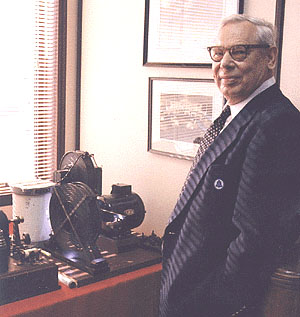 |
The Canadian Amateur Radio Hall of Fame awards for 1996 were announced this week. Frederick Oliver Hammond, VE3HC, was made a Member of the RAC Hall of Fame, and Ernest Harold Savage, VE7FB, received the RAC Award of Honour. The Hammond Museum of Radio in Guelph, Ontario, with its collection of equipment and tubes depicting over 80 years of wireless and radio progress, has been a labor of love for Fred Hammond.
For more information on the Hammond Museum, see "Thrills, butter Churns and Honeycombs: A Visit to the Hammond Museum of Radio," QST, Sept 1995, page 29. The Hammond Museum of Radio is now on-line at http://www.kwarc.on.ca/hammond/index.html.
Ernie Savage, a patriarch of the Amateur Radio community in Western Canada, served faithfully as Section Communications Manager and Section Manager for more than 30 years. --Jacques d'Avignon, VE3VIA
| RICHARD C. KELLER, K5WA, SK |
Rich Keller, K5WA, Houston, Texas, died unexpectedly March 16. He was 47. Keller was one of the earliest members of the American Red Cross Emergency (Radio Club) Communication Service/WB2QBP and served in numerous appointed and elected capacities. He maintained the club's affiliation with the CAP and both Army and Navy MARS. Keller was an ARRL life member, active in ARES and RACES, and a member of the Texas DX Society. He also was a diving instructor and involved in the Boy Scouts. An avid DXer, he was featured on the August 1991 cover of CQ. His wife, Mary Ann, and several relatives, survive. The family suggests memorial contributions to the American Heart Association, Houston Chapter, Box 20448, Houston, TX 77225 or Divers Alert Network, 3100 Tower Blvd No. 1300, Durham, NC 27707. --Larry Lutzak, WA2CNV/The Hudson Loop
| BRUCE M. KARR, KN6QN, SK |
Bruce M. Karr, KN6QN, of Fresno, California, died April 6. He had recently been diagnosed with bone cancer. After his retirement as a county director of communications, Karr served as the California Office of Emergency Services Inland Region chief radio officer, a volunteer position. Three daughters survive.
| In Brief: |
- This weekend on the radio: The DXYL NAYL CW, European EME, His Majesty the King of Spain, Japan International CW DX and International HF Grid Location Contests, and the QRP ARCI Spring QSO Party, CW, are all on tap for this weekend.
- Vanity call sign update: Between March 5 and March 31, the FCC granted 435 new vanity call signs. Another 477 vanity applications ended up in the work in process (WIPS) stack for special handling. The FCC has not announced when Gate 3 will open, to permit vanity applications from Advanced-class amateurs. --FCC
- FCC proposes electronic comments: The FCC has proposed to allow electronic comments to be filed in all FCC informal notice and comment rulemaking proceedings conducted under Section 553 of the Administrative Procedure Act, except for broadcast allotment proceedings. The Commission adopted a Notice of Proposed Rulemaking April 3 (Docket GC 97-113) to permit filing comments via the World Wide Web and e-mail. --FCC
- HAARP test results: Ed Kennedy, K3NS, reports that preliminary HAARP listening test results and reports are available at http://server5550.itd.nrl.navy.mil/projects/haarp/hhtest.html on the Web. The reports suggest that best reception of the 6.99-MHz signal was on the West Coast and in Alaska.
- New frequency for Ham Radio & More: The Ham Radio & More show celebrates six years on the air on April 20. Due to the change to Daylight Saving Time, the program's shortwave broadcast frequency on WWCR has changed to 12.160 MHz. Ham Radio & More airs live Sundays at 2200 UTC. Tape-delayed broadcasts air on WWCR Tuesdays, 0800 UTC, on 3.210 MHz, and Sundays, 0500 UTC, on 5.070 MHz. For more information, check out http://www.goodnet.com/~lenwink/hrm.htm on the Web.
- Call sign database moving: Mark Downing, WM7D, is moving his Web pages to http://www.rdatasys.com/~wm7d/. This includes his call sign database. For more information, contact him at mdowning@rdatasys.com.
- George Jacobs, W3ASK, wins award: Propagation guru George Jacobs, W3ASK, has won the National Association of Broadcasters' 1997 Radio Engineering Achievement Award. Jacobs, who was instrumental in developing and launching the Voice of America and modernizing the facilities of Radio Free Europe and Radio Liberty, received the award April 9 during the NAB's technology luncheon. Jacobs is president of George Jacobs and Associates Inc and is recognized worldwide in shortwave broadcasting, having represented the US at a number of international telecommunications conferences. Jacobs has written the monthly propagation report for CQ since 1951 and is the magazine's longest-tenured columnist.
| The ARRL Letter |
The ARRL Letter is published by the American Radio Relay League, 225 Main St, Newington, CT 06111; tel 860-594-0200; fax 860-594-0259. Rodney J. Stafford, KB6ZV, President; David Sumner, K1ZZ, Executive Vice President.
Circulation, Kathy Capodicasa, N1GZO, e-mail kcapodicasa@arrl.org.
Editorial, Rick Lindquist, N1RL, e-mail elindquist@arrl.org.
Visit the ARRLWeb page at http://www.arrl.org.
The purpose of The ARRL Letter is to provide the essential news of interest to active, organizationally minded radio amateurs faster than it can be disseminated by our official journal, QST. We strive to be fast, accurate and readable in our reporting.
Material from The ARRL Letter may be reproduced in whole or in part, in any form, including photoreproduction and electronic databanks, provided that credit is given to The ARRL Letter and The American Radio Relay League.
| How to Get The ARRL Letter: |
The ARRL Letter is distributed directly from ARRL HQ only to elected League officials and certain ARRL appointees and to paid subscribers of the now-defunct hard-copy edition of The ARRL Letter . For members and nonmembers alike, The ARRL Letter is available free of charge from these sources:
- The ARRLWeb page (http://www.arrl.org/arrlletter/). This version of The ARRL Letter includes any photographs.
- The HIRAM BBS: 860-594-0306.
- The ARRL Technical Information Server (Info Server): Send an e-mail message to info@arrl.org. The subject line should be blank. In the message body, type send ltrmmdd.txt, where mm represents two digits for the month and dd represents two digits for the day (The ARRL Letter is published every Friday). For example, to request The ARRL Letter file for Friday, January 3, 1997, you'd type send ltr0103.txt. Then, on a separate line, type quit.
- CompuServe and America Online subscribers, as a downloadable text file in the services' ham radio libraries
- The Netcom server, run by the Boston Amateur Radio Club and Mike Ardai, N1IST: Send e-mail to listserv@netcom.com (no subject needed). The body of the message should say subscribe letter-list.