| IN THIS EDITION: |
- Gate 2 call signs issued!
- IARU club station NU1AW
- Update: SAR threat on 70 cm band
- IOY nominations open
- Ukrainian packet network
- "The Phantom" jailed
- In Brief: ARRL National Exam Days; ARRL catalog on Web; ARRL/VEC test fee to rise; New Outgoing QSL Service fee; Electronic processing; DXCC processing status; Another H-T QSO with Mir; Youngest Extra redux; Happy Birthday, Walter; W1B; Shannon Lucid plugs ham radio; STSORBIT PLUS Ver 9643; SAYLARC Net; Aurora '97
| BONFIRE OF THE VANITIES: GATE 2 CALL SIGNS FINALLY ISSUED! |
After an approximately six-week wait, most of the hams who got their applications to the FCC on the opening day of vanity call sign Gate 2 were rewarded with one of their new call sign choices. The logjam broke on Election Day, just before the close of business at the FCC's Gettysburg, Pennsylvania, office, where the amateur computer system had been down for more than a week. A spokesman at the FCC said the computer system was finally fixed that morning, and most of the approximately 4500 first-day vanity applications were successfully run. According to the KI4HN (now K4MA) call sign database, 3790 new call signs were issued.
For the most part, hams were ecstatic. "The wait is over. I, for one, am very pleased with the results!" said Joe DiPaolo, W2DI (ex-AA2LZ), in a message of thanks to the ARRL. "Christmas came early," messaged Lawrence Macionski, W8LM (ex-WA2AJQ). Several other enthusiastic hams--eager to tell the world about their new Amateur Radio identities--posted their new call signs to various Web groups and broke them in on the air. But one veteran Midwestern ham--apparently bitter that he did not get one of his three choices and that the FCC did not base its selection system on seniority in the hobby--wrote HQ to say he was getting out of the hobby altogether.
While some applicants got their initials for call sign suffixes, others obviously applied their imaginations. For example, W4FEZ was issued to the Yaarab Shrine Temple Communications Unit in Atlanta, Georgia (get it?). The call sign NS4DX went to the North Shenandoah DX Association in Boyce, Virginia. NU1AW is the new call sign of the International Amateur Radio Union club station (see NU1AW story below). As of Thursday, November 7, some 200 first-day vanity applications were being held up due to unspecified problems or errors on the application. The FCC indicated it would process these soon. A spokesman in Gettysburg estimated that "between 500 and 550" applications were dismissed because the FCC was unable to grant a new call sign. Applicants who did not get one of their choices will have to apply in writing for a refund of the $30 filing fee. The FCC will mail to all unsuccessful applicants a copy of the application (including FCC processing numbers) and a copy of their check. To request a refund, applicants then must send a letter to the FCC, 1270 Fairfield Rd, Gettysburg PA 17325-7245, along with their taxpayer ID number (Social Security number).
Applicants can check for their new call signs via the ARRLWeb page at http://www.arrl.org/fcc/fccld.html. The site has proved to be extremely popular with the Amateur Radio community, and it recorded more than 12,000 call sign lookups within seven hours after word hit the streets that the first batch of Gate 2 call signs had been processed.
The earlier computer problems had not only affected the vanity program but caused the FCC to rescind all call sign grants after October 24 because of widespread errors. In some cases, the FCC's Gettysburg office had reissued call signs that had already been issued. An FCC spokesman said that the unspecified computer problems were not related to the vanity call sign program.
The FCC says it wants to see how the day-one processing fared before it attempts to process vanity call sign applications for subsequent days. This should happen within "a few days," a spokesman at Gettysburg said this week. Day-one applicants also can check the popular database programs on the Internet to find out if they got one of their call sign choices. Check the WM7D call sign server, http://www.rdatasys.com/~mdowning/fcc/callsign.html or the CallBook Server (CBS) Summary at http://www.lantz.com/htbin/cbs_today. The K4MA (formerly KI4HN) call sign server is again available at http://www.webbuild.com/~ki4hn; it will soon move to http://www.mindspring.com/~k4ma/.
The FCC has not announced opening dates for vanity Gates 3 and 4.
| NU1AW: INTERNATIONAL AMATEUR RADIO UNION CLUB STATION |
Anyone who browses for interesting vanity call signs may have spotted the one for NU1AW, the International Amateur Radio Union club station. Trustee and ARRL Executive Vice President David Sumner, K1ZZ, relates the story behind this call sign:
Last year, when the FCC resumed issuing club call signs, IARU Secretary Larry Price, W4RA, and I thought it was time for the IARU to have one of its own. I applied for and received a "plain vanilla" KB1 call for the IARU. When Gate 2 opened, I submitted an application for a vanity call to replace the original call, paying the fee out of my own pocket. Why NU1AW? Glad you asked. When transoceanic amateur communication became commonplace by 1924, a problem immediately became apparent: typical call signs consisted of one numeral and two or three letters and no built-in means of determining who was where. At first, hams used an informal system of prefixes (called "intermediates" at the time), where "A" stood for Australia, "B" for Belgium, "C" for Canada, "F" for France, "G" for Great Britain, "J" for Japan, "U" for United States, "Z" for New Zealand, and so on. The single-letter system worked fine until it became apparent that Amateur Radio was spreading to too many countries for this system to accommodate. The January 1927 QST unveiled a new intermediate list--the work of the Executive Committee of the International Amateur Radio Union. It was a two-letter system with the first letter indicating the continent ("E" for Europe, "A" for Asia, "N" for North America, "F" for Africa, etc.) and the second letter indicating the country (mostly following the old system). Thus, stations in the 48 United States used the intermediate "NU." The new system was soon overtaken by events. Regulations adopted by the Washington International Radiotelegraph Conference later that same year included the allocation of a series of "call signals" such as K, N, and W for the United States, and mandated that stations have a call signal from the series. August 1928 QST noted that Canadian amateur calls had changed to VE in April, and September 1928 QST announced the effective date of October 1, 1928, in the US for the W prefix (K outside the 48 states). Thus, United States amateurs sported voluntary NU prefixes for just 20 months before they became Ws. The founding president of the International Amateur Radio Union was, of course, Hiram Percy Maxim, 1AW, who remained in that office until his death in 1936. The call sign NU1AW commemorates HPM and the IARU's creative--if short-lived--solution to the problem of international identification of stations.
Sumner said that he intends NU1AW to be a "permanent special-event station," operating in connection with World Telecommunication Day, significant IARU anniversaries, the IARU HF World Championship, and other events that will call attention to the contributions of the IARU to organized Amateur Radio.
| ANOTHER THREAT? SYNTHETIC APERTURE RADAR SYSTEMS |
As reported in The ARRL Letter, Vol 15, No 6, NASA/JPL and other space agencies are eyeing the 70-cm Amateur Radio band for a satellite-carried Synthetic Aperture Radar (SAR) system, but ARRL is working to ensure that amateur interests are taken into account as the process moves forward. In addition to the US, The Netherlands and Japan want to use the 430-440 MHz band for SARs to scan tropical rain forests and desert sand. The proposed NASA/JPL radar will reportedly result in a very high-power flux density at the Earth's surface and could interfere with amateur operation, although SAR transmissions would be brief, not continuous. In other words, SARs will interfere with terrestrial systems whenever they are in view and the equipment is turned on.
WRC-97 likely will be asked to allocate the band 430-440 MHz to the earth-exploration satellite (EES) service and upgrade the status of EES in the bands above 1 GHz, which include amateur secondary allocations at 1240-1300 MHz; 10-10.025 GHz; 24.05-24.25 GHz; and 78-79 GHz. Current proposals to consider support for SARs at WRC-97 have studied compatibility between space services and other services.
Proponents would also like to scan temperate forests but operators of surveillance radars (such as military systems) have objected that even infrequent interference would be unacceptable. That could rule out SAR operations over North America and Europe, the areas with the greatest number of amateurs and probably those most active in the 70-cm band. Even for those amateurs in the tropical regions, any interference would be infrequent and limited by the need to avoid interference to terrestrial radar.
International Telecommunications Union Radiocommunication Sector Joint Working Party 7-8R (JWP 7-8R) was formed to study compatibility between SARs and terrestrial radar. (Another working party, 7C, has been tasked to study compatibility between space services and other services, so there is some overlap.) Wording in a JWP 7-8R draft that addresses sharing with the amateur services states:
There would be periods where some impact on reception by amateur receivers would be likely. However, due to the nature of the amateur service and the long duration between times that an amateur receiver is exposed to transmissions by a SAR, it appears that SARs and the amateur service can coexist. Further study is needed to determine the duration and frequency of interference between the earth exploration-satellite service and the amateur services.
The document later points out, however, that "compatibility has not been established between spaceborne SARs and the radiolocation service and the amateur services in this band,." and that sharing and/or compatibility may require geographical or time limits on the EES service, publication of operational data, and technical measures that include antenna designs to minimize sidelobe coupling between the EES service and terrestrial services.
The document draft also states: "To enable frequency sharing and/or compatibility, operational and technical measures have to be taken to minimize potential interference from active spaceborne sensors to terrestrial services. Additional studies are necessary to determine the feasibility of operation by geographical separation."
The bottom line on the 430-440 MHz band is that JWP 7-8R studies have not shown compatibility with any terrestrial service, but there could be circumstances where tropical areas could be scanned for short periods with the permission of affected governments. Interaction between active spaceborne sensors and the amateur services at frequencies higher than 1 GHz have not been studied. The next step in this process is the Conference Preparatory Meeting (CPM-97) next May.
| NOMINATIONS OPEN FOR 1996 ARRL INSTRUCTOR OF THE YEAR AWARDS |
By Glenn Swanson, KB1GW, Educational Programs Coordinator
It's a great way to say, "Thanks!" Consider for a moment the role of the Amateur Radio instructor or recruiter. Think about what they do for the hobby. I can recall several individuals who selflessly gave of their own time to teach license classes, distribute information and help newcomers. Fact is, I probably would not be a ham were it not for the dedicated people who took me under their wings and, after a false start or two, allowed me to fly on my own. I am forever grateful to these volunteers--heroes to me--who supported Amateur Radio through teaching or recruitment.
Here's your chance to thank someone who may have given you a helping hand. This is the 18th year that the ARRL Board of Directors have recognized volunteer instructors and professional teachers through two awards. And there are two newer honors: The Professional Instructor of the Year and the Excellence in Recruiting awards. Here's the complete lineup:
- The ARRL Herb S. Brier Instructor of the Year Award--presented to a nonpaid volunteer instructor.
- The ARRL Professional Instructor of the Year Award--presented to a paid, noncertified, instructor.
- The ARRL Professional Educator of the Year Award--presented to a professional teacher.
- The ARRL Excellence in Recruiting Award--presented to hams who exemplify outstanding recruiting enthusiasm and technique.
To nominate an individual for one of these awards, send an SASE to the ARRL Educational Activities Department, 225 Main St, Newington, CT 06111, and ask for an Instructor of the Year nominating form or print out and fill in the online application. (You can request a copy of the "Terms of Reference" for a given award via fax at 860-594-0259, or by e-mail to ead@arrl.org.) Send all nominations to your ARRL section manager (see page 12 of any QST for the address) by January 31, 1997.
All winners receive cash stipends and beautifully engraved plaques. Two clubs stepped forward to cosponsor two awards in 1995: The Lake County Amateur Radio Club of La Porte, Indiana--a long-time supporter of the Herb S. Brier Instructor of the Year award--and the Central Michigan Amateur Radio Club (CMARC), of Lansing, Michigan, cosponsor the 1995 Professional Educator of the Year award.
Plaque sponsorship is a perfect opportunity for your club members to help give recognition to instructors, recruiters and to your club! It's very simple. Your club contributes $80 (tax-deductible) to the cost of the plaque, which is purchased by the ARRL. The plaque is sent to the ARRL official who will present it to the winner, usually at a convention or hamfest. In turn, your club is honored by being named along with nominees and winners, in QST and other ARRL publications. Of course, your club's name appears on the plaque as well. To sponsor a plaque for the 1996 winners, contact the ARRL Educational Activities Department, 225 Main St, Newington, CT 06111.
Cash stipends are another way to help out. Last year, the ARRL Foundation Inc granted $250 cash stipends to winners of the three 1995 ARRL Instructor of the Year awards, and to the winner of the 1995 ARRL Excellence in Recruiting award.
For the 1996 awards, we're asking for your support. Please consider a tax-deductible donation to the ARRL's "IOY Award Fund." It's another way you can show your support for those who unselfishly give their time and energy to our hobby. An award of $250 may not seem like much, but it helps award winners defray some of the costs of education and recruitment (gasoline, photocopying, stationery supplies, and a cup of coffee or two).
Please help us continue this "final touch" that the ARRL Foundation so generously seeded in 1995. Make checks payable to the ARRL IOY Award Fund and send donations to the ARRL Educational Activities Department, 225 Main St, Newington, CT 06111. Any amount you can give will make a difference. Show your support for those who gave so much to all of us!
FAIRS MONITORS PROGRESS OF UKRAINIAN DIGITAL GRID 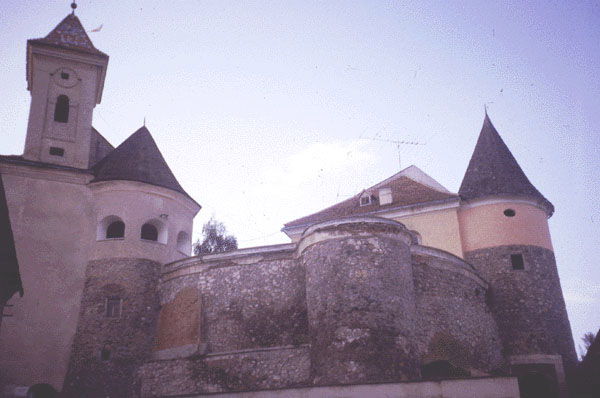
UR0DXX, the well-known European contest station, operates from this ancient castle in Mukachevo, Ukraine. The antenna farm is extensive. The 8-element 10-meter monobander is just visible above the rooftop. The castle is located high on a hill, some 300 feet above the town. It commands a clear view in all directions.David Larsen, KK4WW, of Floyd, Virginia--director of the Foundation for Amateur International Radio Service Ltd (FAIRS)--reports that he and his wife, Gaynell, KD4GMV, recently traveled to Ukraine to monitor the progress on the installation of the Ukrainian Digital Amateur Radio Network, being set up there using a $25,000 grant from the US Agency for International Development (USAID). FAIRS is administering the grant, and Larsen and Victor Goncharsky, US5WE, are the project directors. The grant will provide a packet network from the western Ukraine to Kiev, with links into the Western European network, HF Aplink and an Internet gateway, plus a 2-meter voice repeater for the city of Lvov. As Larsen reports:
Gaynell and I were able make many hundreds of contacts from Lvov, but our operation from the Castle of Mukachevo was certainly the most interesting for us. A wonderful location to look out and see not only the town of Mukachevo, but also the countries of Romania, the Czech Republic, Hungary and--on a really clear day--Poland. the antenna farm there is most impressive and, of course, all the equipment is homebrew, with the exception of one military amplifier.
We were hosted by the town's vice mayor, and they all gave us a great party at the castle with about 15 hams from the area. Mukachevo is not far from one of the major packet nodes in the new network, which will have direct links from a high Carpathian mountain into Hungary, Poland and the Czech Republic.
Larsen said the system should be operational by next year. He believes this could be the first time an Amateur Radio group has been successful in getting US Agency for International Development funding for a project like this.--David Larsen, KK4WW/FAIRS
"THE PHANTOM" PULLS JAIL TIME IN INTERFERENCE CASE Interfering with police radios has resulted in a four-month jail term for Bobby Lee Aguero, KE6VNU--a Sacramento, California, area ham who now lists a Mead, Washington, address. Aguero, who is said to have identified himself as "The Phantom" while interfering with police calls, was convicted of jamming and interfering with Roseville, California, police communications. He was ordered to serve 120 days in jail and pay more than $1400 in fines. In April, Roseville Police said they caught Aguero, 18, "essentially red-handed" while interfering with police calls there. Similar charges were pending against Aguero as a result of another incident in June in Seaside, Oregon on June 2 (see The ARRL Letter Electronic Update, June 7, 1996).
As a result of a plea bargain, Aguero pleaded guilty to three misdemeanor counts: Interfering with communications, delaying a police officer, and destroying evidence. A witness at the sentencing said Aguero--who showed no remorse--was additionally ordered to stay away from radio equipment. His sentence was reduced by the 52 days he'd already served, and Aguero is reported to have left the courtroom in tears. He'll be on probation after he's released from jail.
Local hams present at the sentencing had presented the judge with background information regarding the defendant's behavior within the Amateur Radio community. Several hams said they were gratified that Aguero got a stiff sentence and expressed hopes that the case would set an example in efforts to crack down in other cases of malicious interference. Aguero began his 68 continuous days of jail time on November 1.
In Brief: - ARRL National Exam Days: ARRL-sponsored National Exam Days now will encompass two full weekends, in the spring and fall. Dates for 1997 will be the last full weekends of April and September: April 26-27, 1997 and September 27-8, 1997 (January 1997 QST "Exam Info" will carry a detailed announcement. If your VE team is interested in scheduling exams for either of these two weekends, please contact ARRL/VEC at vec@arrl.org.--Bart J. Jahnke, W9JJ
- ARRL catalog on Web: The ARRL Publications Catalog--on the Web at http://www.arrl.org/catalog/--now includes on-line ordering capability. Check it out!
- ARRL/VEC test fee to rise: The ARRL/VEC has set its 1997 Amateur Radio test fee at $6.25. This is in accordance with an October 31, 1996, FCC Public Notice setting the maximum volunteer examiner expense reimbursement at $6.26 for 1997. The current maximum is $6.07. The new figure is based on a 3.13% increase in the Department of Labor Consumer Price Index (CPI) over the period September 1995 to September 1996. As an ARRL/VEC policy, examinations which include only Elements 1(A) (5-wpm code test) and/or Element 2 (Novice written examination) will not be charged the standard fee in 1997. Morse code exemption applicants will be charged the standard $6.25 fee in 1997. For 1997, ARRL VEs may retain up to $4 for each applicant they serve in order to offset their necessary and prudently-incurred expenses. ARRL VEs who retain such expense reimbursements are required by the ARRL/VEC to retain income and expense records for three years. For more information, contact the ARRL/VEC, tel 860-594-0300; e-mail vec@arrl.org.--Bart J. Jahnke,W9JJ
- New Outgoing QSL Service fee: The fee for the ARRL Outgoing QSL Service is going up. Effective January 1, 1997, the fee for the Outgoing QSL Service will be $4 per pound or any portion of a pound. The fee remains at $1 for ten cards or fewer.--Joe Carcia, NJ1Q
- Electronic processing: The ARRL/VEC will process--for members only--an FCC Form 610 for a renewal, address change, name change or call sign change for electronic submission to the FCC. There is no charge. An original, signed Form 610 must be mailed or otherwise delivered to the ARRL/VEC. Fax is not acceptable. Any questions or transfers should be directed to the VEC at 860-594-0300.--Bart Jahnke, W9JJ
- DXCC Processing Status: The DXCC Desk reports that the number of unprocessed applications at the end of October 1996 was 604 (46,284 QSLs). It received 340 applications (25,602 QSLs) for endorsements and new awards during the month. Applications being sent out at the end of October were received less than a month earlier. A few applications received prior to that time were in the process of being audited, and so had not yet been completed. For more information, contact Bill Kennamar, K5FUV, tel 860-594-0291; e-mail bkennamer@arrl.org.
- Another H-T QSO with Mir: Ed Tenhulzen, WH6CXQ, in Pearl Harbor, Hawaii, reports he worked Valeri Korzun operating on 145.55 MHz as R0MIR aboard the Mir space station on October 28. Ed was on his lunch hour at the time running 2.5 W to a Yaesu FT-208R and a mobile 5/8-wave antenna. Ed's Friend, Ted Brattstrom, NH6YK, also worked R0MIR. As Ed commented: "As you can see, it doesn't take all that much muscle to work Mir. It just takes persistence."--Ed Tenhulzen, WH6CXQ
- Youngest Extra redux: Responding to our recent news brief about Thomas Coffee, AC6XC, who got his Extra ticket at age 10, another proud papa--Mike Siegel, WB2FCP, in Staten Island, New York--reports that his daughter, Debra, N2SIJ, passed her Extra class test in June 1993, some two weeks before turning 10. Debra is the youngest member of an all-ham family. Her mother, Elaine, is N2GET. Her brother, Jeffrey, is N2IPU. "We were all very proud of Debra's accomplishments," Mike says.--Mike Siegel, WB2FCP
- Happy Birthday, Walter: Former CBS Evening News anchor Walter Cronkite, KB2GSD, celebrated his 80th birthday November 4. Cronkite holds a Novice class ticket.
- W1B: The FCC has granted special temporary authority for John R. Fowler, N1PDV, to use the 11 call sign W1B on February 8-9, 1997, from Jericho, Vermont, to honor the 132nd anniversary of the birth of Wilson Alwyn "Snowflake" Bentley, the man credited with determining that no two snowflakes are alike, Fowler said. According to Fowler, Bentley--a Jericho, Vermont, native--photographed more than 5000 individual snowflakes using a camera rigged to a microscope. He also analyzed the density and shape of individual raindrops. Fowler said the W1B operation will include SSB and CW in the general portions of as many HF bands as the group can muster.
- Shannon Lucid plugs ham radio: NASA Mission Specialist Shannon Lucid, who used the Mir Amateur Radio equipment during her six-month stay aboard the Russian space station doesn't have her ham license--yet. But she used ham radio aboard Mir and said some very nice things about Amateur Radio during her several NASA post-flight press conferences. She spoke about how great it was to QSO her daughter, KC5UAR, and son-in-law, KC5UAQ. She spoke about how some of her fellow astronauts often went to Johnson Space Center's ham station, W5RRR, to speak to her. She also mentioned that K4GCC at Kennedy Space Center, phone-patched the NASA commentary of the STS-79 launch (the mission that brought her back home) to Mir. She also discussed the ham radio activities Mission Specialist Jay Apt, N5QWL.--Rosalie White, WA1STO
- STSORBIT PLUS Ver 9643: David H. Ransom Jr. announces the release of STSORBIT PLUS Ver 9643, which now includes a user-selected complementary (ie, inverted) tracking option for Amateur Radio use. The program may be commanded to swap the azimuth and elevation rotor angles with a single keystroke to allow continuous tracking throughout a pass. STSORBIT PLUS is available from the RPV Astronomy BBS at 310-541-7299 or from http://www.ozemail.com.au/~dcottle/files/. --SpaceNews/David H. Ransom Jr
- SAYLARC Net: The Second Area Young Ladies' Amateur Radio Club (SAYLARC) is looking for new members (YL-XYL). The group meets Fridays and Saturdays at 0900 Eastern Time on 3950 kHz, plus or minus QRM. Stations are welcome to join in. For more information, send e-mail to aa2jojh@northnet.org.--Roberta Newman, AA2JO
- Aurora '97: The Northern Lights Radio Society presents Aurora '97, the 14th annual upper midwest VHF/UHF/Microwave Symposium, Saturday, April 19, 1997, at the Village North Professional Building, Brooklyn Park, Minnesota. This year's conference is being moved from its former date in February and expanded to a full day. For more information, check the NLRS web page, http://www.tc.umn.edu/nlhome/m374/husby002/, or contact Donn Baker, WA2VOI, 3128 Silver Lake Rd, Minneapolis, MN 55418, tel 612-781-1359 or send e-mail to Rich, N0HJZ, at n0hjz@aol.com.--Paul Husby, W0UC
The ARRL Letter The ARRL Letter is published by the American Radio Relay League, 225 Main St, Newington, CT 06111; tel 860-594-0200; fax 860-594-0259. Rodney J. Stafford, KB6ZV, President; David Sumner, K1ZZ, Executive Vice President.
Electronic edition circulation, Kathy Capodicasa, N1GZO, e-mail kcapodicasa@arrl.org.
Editorial, Rick Lindquist, N1RL, e-mail rlindquist@arrl.org.
Visit the ARRLWeb page at http://www.arrl.org.
The purpose of The ARRL Letter is to provide the essential news of interest to active, organizationally minded radio amateurs faster than it can be disseminated by our official journal, QST. We strive to be fast, accurate and readable in our reporting.
Material from The ARRL Letter may be reproduced in whole or in part, in any form, including photoreproduction and electronic databanks, provided that credit is given to The ARRL Letter and The American Radio Relay League.