 The ARRL Museum of Amateur Radio at Headquarters has received
a clock that's emblematic of a time when transatlantic QSOs via
Amateur Radio were still a dream. Past League Secretary K. B. Warner, as
1BHW, won the clock in a wager over the transatlantic contacts.
The specific nature of the bet is not clear, but an inscription
on a brass plaque affixed to the top of the timepiece says: "Kenneth
B. Warner. From W. Witt Burnham. To settle a bet on the success
of the Anglo-American Amateur Transmissions. December 1923. F.B.O.M."
Warner served as secretary (and later as managing secretary, editor)
from before 1920 until 1948. The first transatlantic two-way ham
radio contact took place on November 27, 1923, when ARRL Traffic Manager Fred Schnell, 1MO, West
Hartford, Connecticut, communicated for almost two hours with
Léon Deloy, 8AB, in Nice, France. Later that same night, John
L. Reinartz, who held the call signs 1XAM and 1QP in South Manchester,
Connecticut, also worked 8AB. The contacts were on 110 and 115
meters (just below 3 MHz), then considered "a short wave."
This milestone in Amateur Radio history was documented in QST
for January 1924.
The ARRL Museum of Amateur Radio at Headquarters has received
a clock that's emblematic of a time when transatlantic QSOs via
Amateur Radio were still a dream. Past League Secretary K. B. Warner, as
1BHW, won the clock in a wager over the transatlantic contacts.
The specific nature of the bet is not clear, but an inscription
on a brass plaque affixed to the top of the timepiece says: "Kenneth
B. Warner. From W. Witt Burnham. To settle a bet on the success
of the Anglo-American Amateur Transmissions. December 1923. F.B.O.M."
Warner served as secretary (and later as managing secretary, editor)
from before 1920 until 1948. The first transatlantic two-way ham
radio contact took place on November 27, 1923, when ARRL Traffic Manager Fred Schnell, 1MO, West
Hartford, Connecticut, communicated for almost two hours with
Léon Deloy, 8AB, in Nice, France. Later that same night, John
L. Reinartz, who held the call signs 1XAM and 1QP in South Manchester,
Connecticut, also worked 8AB. The contacts were on 110 and 115
meters (just below 3 MHz), then considered "a short wave."
This milestone in Amateur Radio history was documented in QST
for January 1924.
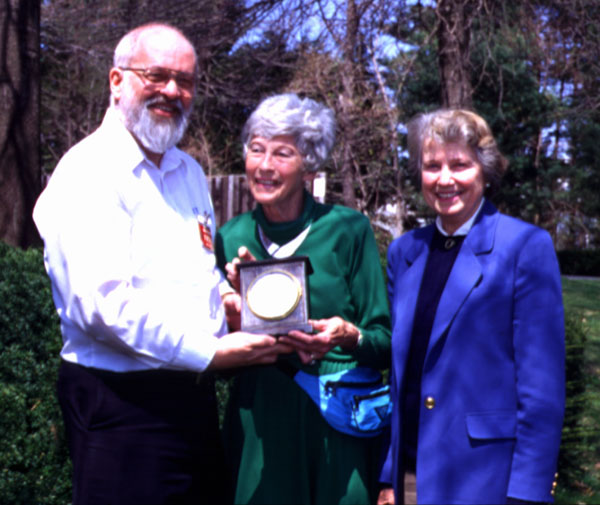
The clock, made by Hamilton & Co of London, has remained in Warner's family. His daughter, Bettyjean "Bj" Warner Averitt of Lakewood, Colorado, recently presented it to Membership Services Manager Chuck Hutchinson, K8CH, for display in the ARRL Museum. She also gave the museum her father's station guest book. Among those who had signed when they visited were such ham radio luminaries as Byron Goodman, W1DX; Don Mix, W1TS; Ed Tilton, W1HDQ; Don Wallace, W6AM; ARRL co-founder and QST editor Clarence Tuska; and The Old Man himself, Hiram Percy Maxim, W1AW.
Bj said she recalls a very exciting childhood in a household where visitors from other countries were commonplace. Although interested in ham radio, she never got her license, although her son once did. Her brother's middle name, Maxim, reflects the family's ham radio associations.
"We are very pleased to accept the clock, and are grateful for the generosity of Mr Warner's family," Hutchinson said. The clock will join other K. B. Warner memorabilia. The museum also has on display other items associated with the 1921 and 1923 transatlantic tests. Hutchinson says he'd like to pair the clock with the Royal Order of Transatlantic Brass Pounders certificate issued to Warner for the historic radio contact with 8AB in France.
Accompanying Bj was Frances Beekley Haviland, the daughter of past QST advertising manager F. Cheyney Beekley, W1GS. He developed the original QST advertising policy that, for the most part, still remains in effect. Hiram Percy Maxim's rolltop desk remains in Beekley's family.
FCC RELEASES MORE DETAILS ON 5-GHZ NII/SUPERNET PROPOSAL
The FCC has released some specifics on its proposal to make available
350 MHz of spectrum at 5.15-5.35 GHz and 5.725-5.875 GHz for use
by so-called NII/SUPERNet devices. The spectrum includes part
of the shared Amateur Radio allocation at 5.65-5.925 GHz. The
unlicensed, Part 15 devices would provide short-range, high-speed
wireless digital information transfer and could support new wireless
local area networks (LANs) and facilitate access to the Internet
or other facets of the National Information Infrastructure. The
proposal responds to Petitions for Rule Making from Wireless Information
Networks Forum (WINForum) and Apple Computer Inc.
Among other things, the FCC proposes to limit peak effective isotropic
radiated power (EIRP) for the NII/SUPERNet devices to -10 dBW
(0.1 W). "We believe this power level should provide typical
communications distances of 50 to 100 meters," the FCC said
in its notice in ET Docket 96-102. The rules state the NII/SUPERNet
devices "must accept any interference caused by licensed
services." The petitioners had asked for higher power, longer-range
communication links, but the FCC, expressing concerns about "unacceptable
interference risks to other services," decided to put forth
the more modest proposal for now. But the Commission also didn't
close the door to considering higher power operation at up to
1 W for community networking, as the petitioners proposed, and
seeks additional comments on the issue.
The FCC also proposes a basic "listen-before-talk" protocol.
Unlicensed devices would have to monitor their frequencies for
at least 50 ms to determine if they are unused and available,
limit transmit time to 10 ms and wait at least 50 ms after transmitting
before resuming monitoring. (This so-called "deference time"
would double each time an attempt to access the band fails, up
to an upper limit of 12 ms.) Out-of-band emissions would typically
have to be at least -50 dBc. Typical bandwidths could be 25 MHz
or greater.
The proposed rules state that the NII/SUPERNet devices "will
not be deemed to cause interference to licensed services provided
the devices operate in accordance with the output power, out-of-band
emissions limits and spectrum etiquette requirements" provided
the devices are indoors or use an outdoor antenna mounted no more
than 15 meters above ground. (Any outside antenna mounted higher
than 15 meters would have to make other accommodations, such as
reduced power, to eliminate harmful interference to licensed services.)
The FCC said it would establish "clear technical operating
parameters" for the new service so NII/SUPERNet devices "may
operate without risk of being considered sources of harmful interference."
The FCC is encouraging industry to develop additional standards
it believes necessary.
In comments filed earlier with the Commission, the ARRL opposed
the allocation, contending it was unnecessary and duplicative
of other services, including microwave and licensed and unlicensed
personal communication services. In particular, the League said
that Apple's allocation proposal for the 5.8-GHz band failed to
sufficiently address the potential for harmful interference to
amateur operations. The ARRL also said the company did not address
the issue of coordination between unlicensed users and incumbents.
Left unexplained, the League asserted, was why spectrum above
40 GHz would not be more appropriate. The Southern California
Repeater and Remote Base Association also opposed the allocation,
expressing concerns that hams would be overpowered by commercial
use and driven from the band.
The FCC declined to go along with the petitioners' proposal to
create a Part 16 regulatory regime to accord such devices a higher
status than is afforded unlicensed devices under Part 15. ARRL
opposed this request, arguing that the Communications Act of 1934
did not provide legal authority and that it would be unfair to
licensed users to give unlicensed devices the protected status
afforded licensed services and the advantages inherent in unlicensed
operations.
The complete text of the NPRM in ET Docket 96-102 is available
via the FCC's Web site at http://www.fcc.gov/.
FCC ISSUED CALL SIGN UPDATE
The following is a list of the FCC's most recently
issued call signs as of May 1, 1996.
Despite marginal signals from an onboard ATV transmitter, the
May 4 launch from Sheboygan, Wisconsin, of an ATV-carrying rocket
is being considered at least a qualified success by Bryan Suits,
WB8WKN, who was in charge of the payload. The 11-foot-long Super
Loki sounding rocket was sent into the air over Lake Michigan,
as part of the Wisconsin Rockets for Schools Project, a program
to stimulate interest and excitement in mathematics and science.
Launch-day weather began as "very iffy," said Suits,
a physics professor from Houghton, Michigan. But, he said the
sky cleared up and winds abated by the 2 PM (CDT) launch time.
"The payload worked as planned," Suits said, although
received signals were "on the poor side." Suits speculates
the noisy signal was the result of antenna damage that occurred.
"But we did indeed get signals," he said. Before the
launch, Suits had said he'd consider the project a success if
the transmitted just one good frame back to earth. A frame-by-frame
analysis of the video indicates the starlute (a special high-altitude
parachute-type device) connection was probably severed during
ejection. As a result, "we got a lot of rapid tumbling motion,"
Suits explained. He said the payload was tumbling a few rotations
per second. The video Suits received on the ground showed the
horizon and some of Earth's curvature, but "no identifiable
features" because of the rapid rotation of the payload, he
explained.
Audio telemetry signals received on the ground indicated that
all the electronics survived the mistreatment on the way up. "I
am very pleased that the payload worked so well on the first try!"
he said. Onboard devices measured battery voltage as well as internal
and external temperatures. The devices reported an internal temperature
of 0 C and an external temperature of -50 C. Prior to the launch,
Suits had worried about overheating of the batteries. An altimeter
failed to operate, however, so Suits is not sure if the rocket
actually reached the planned altitude of nearly 50 miles.
The payload was not recovered. "It's probably at the bottom
of Lake Michigan by now," Suits said. "We will be doing
some digital analysis of the signals and compiling the telemetry
from our different receiving stations," Suits said, adding
that some already are talking about attempting another launch
next year.
Overall, Suits reports "a good time was had by all and students
of all ages enjoyed the event. A lot of dignitaries were there
as well, and saw what Amateur Radio could do." An ATV balloon
launch was under way at the same time, and Suits says quite a
few who were looking at the balloon signal thought they were seeing
the signal from the rocket. Amateur Radio also played a role in
ground communication, range safety and tracking on both VHF and
HF.
The Aerospace States Association sponsored the launch. "We're
grateful to the ASA for giving us this opportunity to help with
this project," Suits said.
SEE YOU AT DAYTON!
ARRL members will have the opportunity to meet League officials
and staff members at the annual Dayton Hamvention, May 17-19 at
Hara Arena in Dayton, Ohio. Several ARRL volunteers and staff
members will present programs during the three-day event.
Jay Mabey, NU0X, will lead the ARES/Emergency Communications and
the Repeater Coordination forums at Dayton this year. The ARES/Emergency
Communications forum is Saturday, May 18, 9 AM in Hara Arena Room
2. The Repeater Coordination forum is 11:15 AM, Sunday, May 19,
in Hara Arena Room 3. Jay also plans to attend the Mid America
Coordination Council's (MACC) Board of Directors meeting Friday,
May 17, at the Holiday Inn Dayton-North.
ARRL Educational Activities Manager Rosalie White, WA1STO, will
discuss SAREX during the AMSAT Forum Friday, May 17, 1-2 PM, in
Hara Arena Room 1, with Frank Bauer, KA3HDO, and Matt Bordelon,
KC5BTL, both of the SAREX Working Group. Her program will highlight
a preview of future SAREX activities, including the exciting space
station plans, and a summary of recent SAREX successes. Rosalie
also will be on hand for the ARRL segment of "Ham Radio in
the Classroom," Friday, 3-4 PM, in Room 1, with Carole Perry,
WB2MGP. The program will share ideas for people who want to use
Amateur Radio in school or try new ham radio-related activities
in their classrooms.
The ARRL forum, typically an open question-and-answer session,
is set for Sunday, May 19, 11 AM. The location will be announced.
ARRL President Rod Stafford, KB6ZV; Great Lakes Division Director
George Race, WB8BGY; and ARRL Secretary and Executive Vice President
David Sumner, K1ZZ are among the League officials expected to
be on hand for the forum.
We look forward to seeing all Dayton Hamvention visitors at the ARRL booth!
ARRL FOUNDATION NAMES 1996 SCHOLARSHIP RECIPIENTS
The ARRL Foundation Scholarship Committee has announced recipients for its 1996 academic scholarship awards. We congratulate these scholarship winners and wish them continued success:
Individual scholarships
Barton W. Mabry, KB0MJI, Clarksville, Missouri: The Paul and Helen L. Grauer Scholarship ($1000)
James S. Sikorski, Jr., N3PBH, Wapwallopen, Pennsylvania: The You've Got A Friend In Pennsylvania Scholarship ($1000)
Anthony L. Long, KC6QHP, San Diego, California: The Charles N. Fisher Memorial Scholarship ($1000)
Harry E. White, N1QVE, Southington, Connecticut: The K2TEO Martin J. Green Sr. Memorial Scholarship ($1000)
Susan M. Caulfield, N0PBP, Leawood, Kansas: The Irving W. Cook, WA0CGS Scholarship ($1000)
Brian T. Kuehn, KB0ETT, Emporia, Kansas: The PHD Scholarship ($1000)
David A. Arthur, N2ISB, Charlton, New York: The F. Charles Ruling, N6FR Memorial Scholarship ($1000)
Clayton L. Juckett, KF4EYL, Atlanta, Georgia: Charles Clarke Cordle Memorial Scholarship ($1000)
Steven B. Moore, KB9FBD, West Terre Haute, Indiana: The Edmond A. Metzger Scholarship ($500)
Andrea N. Funk, KB9CEQ, Liberty, Illinois: The NEMAL Electronics Scholarship ($500)
Steven M. Berkowitz, KC5GSC, Norman, Oklahoma: The Tom and Judith Comstock Scholarship ($500)
Seth H. Hitching, KD1VQ, West Falmouth, Massachusetts: The Dr James L. Lawson Memorial Scholarship ($500)
Jason A. Rice, KC5HTX, Houston, Texas: The Fred R. McDaniel Memorial Scholarship ($500)
Jonathan T. Niehof, N9RUJ, Highwood, Illinois: The Six Meter Club of Chicago Scholarship ($500)
Jaroslaw Stopczyk, KB9IIZ, Wheeling, Illinois: Chicago FM Club Scholarship ($500)
Timothy D. Mah, N9JYM, Buffalo Grove, Illinois: Michael J. Flosi Memorial Scholarship ($500)
Leann P. Foss, KB9HHB, Washington, Indiana
Daniel R. Case, KB0JUL, Beamon, Iowa
James W. Gregory, AD4GN, Paducah, Kentucky
Elayne D. Cotton, N0ZDV, Tonkawa, Oklahoma
Hendrik M. Gruteke, KA1LHC, Derby Line, Vermont
Holly Weymouth, N1RHB, Abbot, Maine
Adam B. David, N1VGL, Feeding Hills, Massachusetts
David W. Snyder, N1LBZ, Cavendish, Vermont
Jonathan L. Martell, KA1VOB, Sanford, Maine
Swami Kumaresan, KD1QV, Wakefield, Rhode Island
LACK OF SUNSPOTS MAKES PREDICTIONS CHANCY
Propagation forecaster Tad Cook, KT7H, in Seattle, Washington,
reports no sunspots during the period April 25-May 1, except for
April 28, when the number rose to 13. Solar flux on each day was
below the average value for the previous 90 days, which was 71
at the start of the reporting period, and 70 at the end. "All
of this shows a continued downward trend in solar activity,"
he said.
But, because activity is so flat, it's difficult to predict changes
in activity over the next few weeks, since such predictions are
always based on a solar rotation with activity recurring every
28.5 days. Cook says solar flux is expected to increase slowly
to the mid-70s around May 11, and drop below 70 after May 18.
Look for disturbed conditions around May 11 to 16, with the worst
conditions centered around May 14 and 15. Because of lengthening
days, low-frequency DX is declining, and 20 meters should be better
for DX, even with the low solar activity.
SAREX SCHOOLS SELECTED FOR STS-78
Schools have been selected for Space Shuttle Amateur Radio EXperiment
(SAREX) QSOs during the 14-day STS-78 shuttle mission. The mission
is set to launch on June 20, 1996. The 11 sites on the list for
SAREX QSOs include locations in the US, Canada, Australia and
France. They include Bethlehem Central Sr. High School, Delmar,
New York; Eisenhower Middle School, San Antonio, Texas; Heritage
Middle School, Collyville, Texas; Anacortes Middle School, Anacortes,
Washington; Valley Heights Junior-Senior High School, Blue Rapids,
Kansas; Monroe Elementary School, Santa Barbara, California; Maple
Grove Education Centre, Hebron, Nova Scotia, Canada; Saskatoon
Public AerospaCe Education (S.P.A.C.E.), Saskatoon, Saskatchewan,
Canada; Toowoomba State High School, Toowoomba, Queensland, Australia;
Catholic Ladies College, Eltham, Victoria, Australia; and CENG-Nuclear
Center of Grenoble, Grenoble, France (which will invite area school
students to visit during the contact).
Three hams will be aboard STS-78. They include Flight Engineer
Susan J Helms, KC7NHZ, Mission Specialist Dr. Charles E. Brady
Jr, N4BQW and Payload Specialist Dr. Robert B. Thirsk, VA3CSA.
Terence T. Henricks is the mission commander.
ARRL REPRESENTED AT HURRICANE CONFERENCE
Field Services Manager Rick Palm was in Orlando, Florida, April
2-5 for the National Hurricane Conference and took part in a training
session, "The Role of Amateur Radio in Hurricane Communications."
The session, attended by about 50 people--many of them hams--was
moderated by Dr. Michael Carter, N3PDK, of the National Hurricane
Conference's executive committee.
Palm opened the session with an overview of Amateur Radio's role
in disaster operations. He discussed the FCC's charge to Amateur
Radio licensees in providing a service to the public in times
of emergency and disaster, addressed the reasons why Amateur Radio
is such an important resource to emergency planners and also talked
about training and licensing, equipment considerations, tasks
that should and should not be assigned to amateurs, ARES, non-ARRL
wide-area nets, principles of disaster communication and other
aspects.
Steve Richbourg, KO4TT, District Emergency Coordinator for the
Florida West Panhandle District, discussed his district ARES organization's
response to hurricanes Opal and Erin. Northern Florida Section
Emergency Coordinator, George Thurston, W4MLE, presented a detailed
discussion of his section's emergency operations plan and organization.
Virgin Islands Section Manager Ron Hall, KP2N, discussed the challenges
of meeting the communications needs on St Thomas following the
devastation there from Hurricane Marilyn. Southern Florida SEC
Manny Papandreas, W4SS, who also has extensive ARES and RACES
experience, discussed RACES operations, principally during the
Hurricane Andrew disaster.
Hurricane Watch Net Manger Jerry Herman, N3BDW, presented an overview
of the role and operation of the Hurricane Watch Net during the
1995 hurricane season. Working from slides, he explained the operation
of the net and its special relationship with the staff and station
at the National Hurricane Center. He also said he needs more net
control stations as well as more stations to report in from affected
areas during storms and in their wake.
Joe Schmidt, W4NKJ, coordinator of the station W4EHW at the National
Hurricane Center discussed his operation, and how the forecasters
use information from Amateur Radio observers. Outfitted with new
equipment donated by major manufacturers, the station is located
in a room adjacent to the main forecasting room (see Public Service,
QST, May 1996).
Palm also discussed the role of ARRL Headquarters in supporting
local Amateur Radio disaster operations, including the function
of the Public Service Branch, League services and publications,
training and programs. "I reviewed our functions during actual
hurricane events, which consist of gathering and processing information,
and composing and transmitting W1AW bulletins and distributing
situation reports," he said. Palm also conducted a roundtable
discussion involving Northern Florida SM Rudy Hubbard, WA4PUP,
and Southern Florida SM "Rip" Van Winkle, AA4HT, as
panelists. "We answered questions, and Rudy and Rip gave
their perspectives on their respective section's activities in
support of disaster relief in hurricane situations," he reported.
In Brief . . .
Electronic edition circulation/address changes, Kathy Capodicasa,
kcapodicasa@arrl.org.
Editorial, Rick Lindquist, Assistant Technical Editor, rlindquist@arrl.org.
The purpose of The ARRL Letter is to provide the essential news
of interest to active, organizationally minded radio amateurs
faster than it can be disseminated by our official journal, QST.
We strive to be fast, accurate and readable in our reporting.
Material from The ARRL Letter may be reproduced in whole or in
part, in any form, including photoreproduction and electronic
databanks, provided that credit is given to The ARRL Letter and
The American Radio Relay League.
District    Group A     Group B     Group C      Group D
            Extra       Advanced    Tech/Gen     Novice

0           AB0BS       KI0CS        ++          KB0WHV
1           AA1PY       KE1EO       N1XFI        KB1BXY
2           AB2AW       KG2GV        ++          KB2YSX
3           AA3OF       KE3WL       N3XHP        KB3BOP
4           AE4TZ       KT4PM        ++          KF4JEE
5           AC5HR       KK5ZR        ++          KC5UHB
6           AC6UL       KQ6FX        ++          KF6DMG
7           AB7QN       KJ7XJ        ++          KD7AAC
8           AA8WV       KG8WW        ++          KC8DNZ
9           AA9SA       KG9GG        ++          KB9NNQ
Hawaii       ++         AH6OO        ++          WH6DAW
Alaska       ++         AL7QI        ++          WL7CSZ
Virgin Is   WP2X        KP2CJ       NP2JF        WP2AID
Puerto Rico  ++          ++          ++          WP4NLY

++All  call  signs in this group have been  issued  in  this
area.
WISCONSIN "ROCKETS FOR SCHOOLS" LAUNCH A SUCCESS
David J. Williams, KK4AJ, Catoosa, Oklahoma: The ARRL Scholarship to Honor Barry Goldwater ($5000)
The General Fund Scholarships ($1000 each) to:
Nita L. Lindfors, AA1DU, Needham, Massachusetts
The New England FEMARA Scholarships ($600) to:
Lisa M. Nelson, N1JOF, Wilbraham, Massachusetts
To apply for 1997 scholarships, write: The ARRL Foundation Inc, 225 Main St, Newington, CT 06111. The deadline for applications and transcripts is February 1, 1997.
The ARRL Letter is published by the American Radio Relay League,
225 Main St, Newington, CT 06111, tel 860-594-0200; fax 860-594-0259.
Rodney J. Stafford, KB6ZV, President; David Sumner, K1ZZ, Executive
Vice President.