You can email this page's content administrator at rlindquist@arrl.org.
IN THIS UPDATE . . ..
- W3A is a musical hit
- League pitches in for Phase 3-D
- ARRL says new rules unneeded in PR rulemaking
- First Colvin Award grant
- World-class foxhunt
- In Brief: No sunspots; special 9K5 prefix; Amateur Radio Week
The ARRL has sent a check for $126,129 to AMSAT-NA, thereby fulfilling the League's financial commitment to the Phase 3-D satellite project. In all, the ARRL has contributed $523,703 to the project. This includes $363,022 raised from members during two fund drives and $161,681 from the ARRL itself to match individual contributions received during 1995.
"While the Phase 3-D project could not exist without funding, the real heroes are the AMSAT volunteers in a number of countries who are donating their time and talents to the satellite's construction," said ARRL Executive Vice President David Sumner, K1ZZ. "If it were not for their dedication, Phase 3-D would still be a dream."
As it now stands, Phase 3-D is anywhere from 8 to 12 months away. The satellite is being assembled and tested in Orlando, Florida. (See "Phase 3-D Update," QST, Apr 1996, p 93).
The League is among the Phase 3-D project's six major financial contributors. The others are Deutscher Amateur Radio Club, the German Ministry of Science and Technology, AMSAT-DL, AMSAT-NA and AMSAT-UK. Each has committed approximately $360,000 to the project. The six organizations comprise the Phase 3-D Program Council, the steering group for the project. Once the satellite is in operation, the Program Council will determine the operating policy. Sumner attended the February 27 meeting of the Program Council in Marburg, Germany, at which the League was voted into membership. ARRL President Rod Stafford has designated Vice President Joel Harrison, WB5IGF, as the League's representative at future meetings.
In all, 14 countries are participating in Phase 3-D. The L Band Antenna Reflectors, produced in France, arrived at the Phase 3-D Integration Laboratory site in Orlando, Florida, last month. Also arriving recently were the completed flight-ready solar panels from Germany, one of the X-Band horns from Finland and the two SBSs from Utah. The flight main battery and the X-Band TWTA, are in Germany awaiting shipment.
Individual contributions to the Phase 3-D effort are encouraged and welcome. Call AMSAT-NA, 301-589-6062.
W3A AUGMENTS "RADIO MUSIC" PERFORMANCE
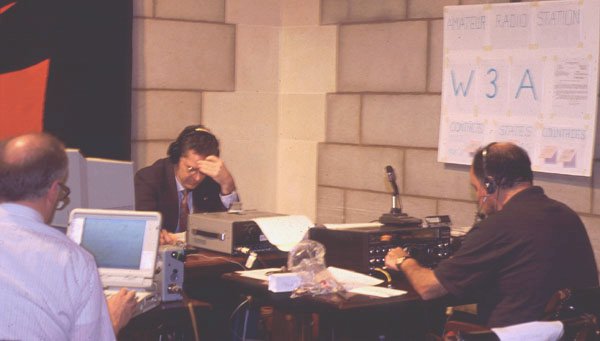 The operating positions at W3A in the
Great Hall of the National Academy of Sciences in Washington, DC.
Bob Bruninga, WB4APR, operates the packet station, while Nobel
laureate Joe Taylor, K1JT, (middle) and Valery "Larry"
Agabekov, UA6HZ/WJ1R work HF. Larry is past president of the
Union of Radio Amateurs of Russia.
The operating positions at W3A in the
Great Hall of the National Academy of Sciences in Washington, DC.
Bob Bruninga, WB4APR, operates the packet station, while Nobel
laureate Joe Taylor, K1JT, (middle) and Valery "Larry"
Agabekov, UA6HZ/WJ1R work HF. Larry is past president of the
Union of Radio Amateurs of Russia.
More than 1500 stations in the US and abroad got into the logbook of special event station W3A the weekend of April 13-14. Activated by members of the Potomac Valley Radio Club, W3A operated from the National Academy of Sciences in Washington, DC, as part of a combination musical and historical event commemorating the 95th anniversary of Marconi's first transatlantic transmission and the 75th anniversary of NBC.
W3A had two HF positions plus VHF and UHF packet set up in the academy's Great Hall. Antennas included a tribander and inverted Vs for HF. W3A was the first 11 call sign authorized by the FCC in many years. Robert Teitel, W3IDT, a George Washington University professor from Chevy Chase, Maryland, organized the special event station; Michael Cizek, KO7V, of Severn, Maryland, recruited most of the operators. Guest operators included Joseph Taylor Jr, K1JT, of Princeton, New Jersey, who won the Nobel prize for physics in 1993. Teitel reports the Special Temporary Authority from the FCC to use W3A arrived just five days before the event.
In addition to Taylor and Teitel, composer Peter Schickele (otherwise known as P.D.Q. Bach); FCC Chairman Reed Hundt; and NAS Vice President Jack Halpern, a former ham, were among those participating as performers in a special musical piece entitled "Radio Music." The work employed eight vintage radios as "musical instruments" Leonard Schachter, N3RPQ, and the ARRL donated the radios used in the performance.
ARRL Media Relations Assistant Jennifer Gagne, N1TDY, also was on hand to talk with concertgoers about Amateur Radio.
ARRL SAYS NEW RULES UNNEEDED IN PUERTO RICO RULEMAKING
An FCC proposal to require applicants for new or modified ham radio repeaters or beacons within 10 miles of Puerto Rico's Arecibo Observatory to provide the observatory with technical parameters before operating has drawn fire from the ARRL. Responding to the FCC notice, the ARRL said a cooperative atmosphere already exists between the Arecibo Observatory--operated by Cornell University--and the Puerto Rico Amateur Radio League. Creating additional regulations "drives a completely unnecessary wedge in the middle of a perfectly good working relationship without the slightest technical justification," the League said.
The ARRL's filing said the FCC proposes more narrow restrictions on hams in Puerto Rico than the observatory originally requested. Cornell had asked that the Observatory be permitted to determine within 20 days of notification of a new Amateur Radio repeater or beacon whether or not to oppose the plans based on interference potential. The League expressed concern about the response of the observatory to the notifications and questioned the standards the observatory would use to evaluate a proposed repeater or beacon. The ARRL said a valuable emergency communication system in a hurricane-susceptible area should not be restricted "on the strength of no more than an inchoate, unquantified fear of possible future interference [to the Observatory]." The ARRL noted that the FCC does not propose to regulate Civil Air Patrol repeaters, even though "they are indistinguishable from amateur repeaters in many cases." The FCC's notice also fails to mention the Military Affiliate Radio System. The proposed regulations would exempt frequencies above 15 GHz.
The League asserted that since there is no evidence of interference and, because all parties involved can coordinate new or modified facilities informally, no new regulations are needed. The PRARL and the observatory already have tentatively agreed to cooperate in notifying the observatory about new Amateur Radio facilities. "Amateur Radio should have no regulatory restrictions, other than those already contained in the amateur rules, to protect the observatory from spurious emissions outside the amateur bands," the League said.
FIRST COLVIN AWARD GRANT TO WRTC
The first ARRL Colvin Award grant has been made to the World Radiosport Team Championship 96 Inc. The $5000 award will help support the WRTC event to be held in the San Francisco area July 13-14. The event, featuring HFcompetition among 52 two-member teams, is being held in conjunction with the IARU HF World Championship Contest. ARRL Executive Vice President Dave Sumner, K1ZZ, plans to deliver the grant to the WRTC-96 officers and directors at Visalia, California, this weekend.
The Colvin Award was established in 1994 with the proceeds of a life insurance policy purchased by Lloyd Colvin, W6KG, that named the ARRL as beneficiary. The award is conferred in the form of grants in support of Amateur Radio projects that promote international goodwill in the field of DX.
The first WRTC competition, with 22 competing teams, was held in Seattle, Washington, in 1990. Eleven competitors in this year's event, including defending champions K1AR and K1DG, are returning for this year's event.
WORLD-CLASS FOXHUNT COMING TO CALIFORNIA
An international-style foxhunt on May 5, 1996, will be part of the 1996 West Coast VHF/UHF Conference in La Mirada, California. ARRL Lab Supervisor Ed Hare, KA1CV, is among those scheduled to speak at the conference. He'll discuss TVI and the Amateur Radio operator.
"Foxhunting" or "foxtailing" for hidden radio transmitters is a very popular radio sport around the world, but it's done differently from the typical US hidden-transmitter or "T-hunts," which often are conducted from vehicles, with perhaps a short on-foot search (called a "sniff") at the end. International-style foxhunts are done on foot in big wooded parks. Five or more "foxes" transmit in sequence for a minute each. The first hunter to locate all foxes wins. Youngsters in many European and Asian countries do foxtailing as part of their physical education programs in school. A world foxhunting championship takes place in Europe or Asia every 3 years.
For the California event, all transmitters will be on two-meter FM. There will be separate divisions for various age groups, with prizes for individual winners in each division. There also will be team prizes. All entrants must compete independently, and each entrant must bring his or her own RDF equipment. For more information and ideas, check out the VHF/UHF Conference Web site at http://ourworld.compuserve.com/homepages/kc6yhm, provided by Mike Cramer, KC6YHM.
The foxtailing contest offers cash prizes and trophies to winners. The event is open to anyone who has registered at the conference. It's being organized by the Southern California Six Meter Club. For more information, contact Joe Moell, K0OV, at HomingIn@aol.com or at 75236.2165@compuserve.com.
IN BRIEF . . .
- Tad Cook, KT7H, reports no visible sunspots for April 5-10. He predicts this is the start of the sunspot minimum and that solar flux should bottom out later this year, instead of in early 1997 as previously estimated. The new cycle is projected to peak in April 2000 with an average solar flux of 192. Flux numbers, which have dipped below 70 in recent days, should rise above 70 for April 18-24, but drop below 70 after May 3.
- A special 9K5 prefix will be in use for Kuwaiti amateurs until May 7, 1996. The number 5 in the prefix is to call attention to the fact that POWs from Kuwait have been held in Iraq for more than five years.--Hamad Al-Nusif, 9K2HN
- June 16-23 is Amateur Radio Week! This annual event is an excellent opportunity to create public awareness, generate media interest and of course, publicize the culminating event: Field Day! Setting up demonstrations, giving talks, or having your town mayor or state governor proclaim the week are just some of the activities hams typically do leading up to Field Day. Letting people know what the hobby is all about and the valuable service hams provide in times of disaster is the name of the game, and it's not too late to get started. To get your Amateur Radio Week/Field Day publicity kit, call ARRL's Public Relations department at 860-594-0328 or send e-mail to jgagne@arrl.org.
The ARRL Letter is published by the American Radio Relay League, 225 Main St, Newington, CT 06111; tel 860-594-0200; fax 860-594-0259. Rodney J. Stafford, KB6ZV, President; David Sumner, K1ZZ, Executive Vice President.
Electronic edition circulation, Kathy Capodicasa, N1GZO, e-mail kcapodicasa@arrl.org.
Editorial, Rick Lindquist, KX4V, e-mail rlindquist@arrl.org.
The purpose of The ARRL Letter is to provide the essential news of interest to active, organizationally minded radio amateurs faster than it can be disseminated by our official journal, QST. We strive to be fast, accurate and readable in our reporting.
Material from The ARRL Letter may be reproduced in whole or in part, in any form, including photoreproduction and electronic databanks, provided that credit is given to The ARRL Letter and The American Radio Relay League.