February 23, 1996
You can email this page's content administrator at rlindquist@arrl.org.
IN THIS UPDATE . . .
- At Deadline: League seeks new VEC question pool committee; Solar activity edges lower; Stepanenko disqualified from DXCC; RM number assigned to ARRL's PRB-1 filing
- HTs not welcome at Atlanta Olympics
- CD-ROM QST available in March
- PA hams help snowbound nurses
- Volunteers to represent ARRL at SAREX conference
- James E. McKim, W0CY, SK
AT DEADLINE . . .
- League seeks new VEC question pool committee:
ARRL Executive Vice President David Sumner, K1ZZ, advised FCC
Private Wireless Division Chief Robert H. McNamara on February
23, 1996 that the mechanism to maintain question pools for FCC
Amateur Radio examination elements has broken down and no longer
operates as FCC rules require. ARRL wants the FCC to issue a public
notice to that effect, clearing the way for the creation of a
substitute mechanism.
The League's request stems from last year's decision by a majority of the Volunteer Examiner Coordinators to incorporate a previously informal organization as National Conference of Volunteer Examiner Coordinators Inc. ARRL/VEC and some other VECs chose to not participate in the corporation. At that time, Sumner emphasized that ARRL Volunteer Examiner Department Manager Bart Jahnke, KB9NM, would continue to participate with other VECs on issues of common interest, and that the League did not want to change the cooperative relationship that existed between the ARRL and other VECs. NCVEC Inc later removed Jahnke from the question pool committee (QPC), which had been the mechanism for VECs to cooperate in maintaining question pools for written ham radio examination elements.
In October, FCC Wireless Telecommunications Bureau Deputy Chief Ralph Haller confirmed that the NCVEC has no recognition in the Communications Act or the FCC Rules, and that the FCC views each VEC individuaIly. He said the FCC expected all VECs to be able to participate in question pool activities. In December, the FCC's McNamara asked NCVEC Inc president, Dalton H. Tunstill, WB4HOK, to immediately reinstate the ARRL/VEC to a seat on the QPC. The conference so far has refused, but stated that, if certain conditions were met, Jahnke would be eligible for election to the QPC when the conference meets in July. The League now formally requests the FCC to advise Tunstill that the question pool committee operating exclusively under the NCVEC Inc is no longer the mechanism through which question pools for Amateur Radio Service examinations are maintained and to issue public notice to that effect.
The League asks the FCC to terminate its agreement with any VEC that took part in the decision to exclude the ARRL/VEC or other VEC from cooperating in the maintenance of the question pools, as their action violated Section 97.523 of the FCC's rules. The League has invited all VECs to cooperate in creating a replacement Question Pool Committee, which would be open to all FCC-recognized VECs.
The ARRL said its exclusion from the QPC caused material appropriate for study by prospective Technician Class applicants to be left out of the Novice (element 2) and Technician (element 3A) syllabi the committee released February 1, 1996. The present syllabi are not acceptable to the ARRL because study guides prepared for these examinations won't include the missing material, and applicants won't be tested on it.
The ARRL said its exclusion also resulted in errors in the revised question pool for the Amateur Extra Class written examination, element 4B, released by the Question Pool Committee December 1 for use starting July 1, 1996. The League said VECs can correct this by simply not using the defective questions in their examinations.
The ARRL/VEC coordinates approximately two-thirds of all FCC Amateur Radio examinations.
- Solar prognosticator Tad Cook, KT7H, reports:
It may be hard to believe, but solar activity has edged even lower.
There have been no visible sunspots since the beginning of the
month, and the sunspot number was zero for the period February
8-14. Solar flux was at or below 70 each day also. We should expect
more periods of no sunspots as the current cycle bottoms out over
the next year. Unfortunately, the geomagnetic field has been acting
up a little. The worst period was around 0900Z on February 13,
when the K index was 5. The 160 and 80 meter bands are really
best when the solar flux is low, but an active geomagnetic field
can disturb those low bands greatly. Cook predicts the flux should
peak at or just below the mid-70s from February 25 through March
1. No big geomagnetic upsets are foreseen.
- The ARRL Awards Committee met recently
to review submitted documentation for the 1992-93 P5RS7 operation
submitted by Romeo Stepanenko. After a review of all material
available, the Awards Committee voted unanimously to disqualify
Stepanenko from participation in the DXCC program. This disqualification
was based upon Rule 12, Operations Ethics, and Rule 13. The disqualification
means that Stepanenko is not eligible to participate in the DXCC
program in any manner. This includes--as provided for under Rule
12, paragraph (b)--disallowance of contacts made with any station
or DXpedition operated by him from the time of this action.
- The FCC has assigned RM-8763 to the ARRL's petition requesting modification and clarification of PRB-1 (see ARRL Letter Electronic Update, February 16, 1996). In brief, the ARRL wants the FCC to go further in compelling state and local governments to reasonably accommodate Amateur Radio and apply the least restrictive means to regulate amateur antennas and activity. The requested rules changes would expand and clarify PRB-1, the Federal preemption of state and local regulation. Comments on the petition should be filed within the next 30 days.
LEAVE THE H-T BEHIND IF YOU'RE OLYMPICS-BOUND
Andrew Funk, KB7UV, a member of the Olympic Broadcast Frequency
Coordination Committee, has issued a word of warning for hams
coming to Atlanta for the Olympics: Leave your H-Ts at home!
"To say things are going to be tightly controlled is an understatement,"
Funk said, adding that all broadcast-related RF gear will be required
to pass an Olympic certification inspection in addition to that
required by the FCC. "And I once found Amateur repeater coordination
difficult!" joked Funk, who's Assistant News Operations Manager
at WAGA-TV in Atlanta.
Funk said the policy will "unfortunately have an impact upon
Radio Amateurs attending the games." Since VHF and UHF handheld
radios are known to be easily modified for wideband use, security
officers will not permit amateur H-Ts at Olympic venues, he said.
"Some may argue that this policy is unreasonable. It may
or may not be, but it will be in effect and enforced," Funk
emphasized.
Michael Smalls, the co-chair of the Olympic Broadcast Frequency
Coordination Committee was sympathetic: "We wish it was different,"
he said. "But, Atlanta is already pretty crowded."
NEW CD-ROM VERSION OF QST AVAILABLE
IN MARCH
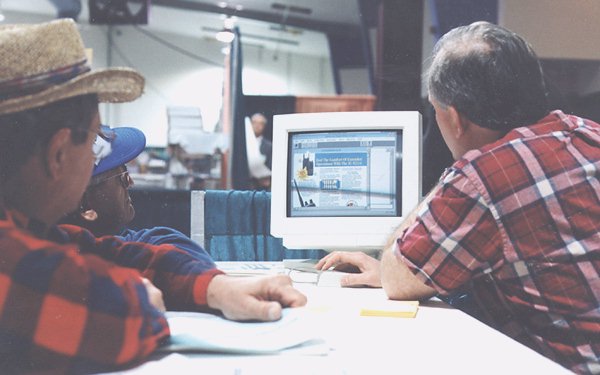 The
new CD-ROM version of QST was the hit of the ARRL booth
at the Miami Tropical Hamboree February 3-4. Here, QST
Editor Mark Wilson, AA2Z, right, runs the demonstration disk through
its paces for a pair of interested visitors. The CD-ROM--to be
available in mid-March--features an entire year's worth of QST,
plus QEX and NCJ (1995 issues for the initial offering),
including full text, photographs, schematics and other graphics,
and advertisements. Among other things, users can search for text
and zoom in to schematics and diagrams to enhance detail. The
text includes hypertext links. (Copies are $19.95 for members
and $29.95 for nonmembers, plus $4 shipping. To order one, e-mail
pubsales@arrl.org or, read more about it at http://www.arrl.org/ads/cdrom/.)
The
new CD-ROM version of QST was the hit of the ARRL booth
at the Miami Tropical Hamboree February 3-4. Here, QST
Editor Mark Wilson, AA2Z, right, runs the demonstration disk through
its paces for a pair of interested visitors. The CD-ROM--to be
available in mid-March--features an entire year's worth of QST,
plus QEX and NCJ (1995 issues for the initial offering),
including full text, photographs, schematics and other graphics,
and advertisements. Among other things, users can search for text
and zoom in to schematics and diagrams to enhance detail. The
text includes hypertext links. (Copies are $19.95 for members
and $29.95 for nonmembers, plus $4 shipping. To order one, e-mail
pubsales@arrl.org or, read more about it at http://www.arrl.org/ads/cdrom/.)
HAM RADIO CLUBS HELP NURSES IN WEATHER EMERGENCY
In Pennsylvania, Delaware-Lehigh Amateur Radio Club members lent
a helping hand to some 30 nurses during the so-called "Blizzard
of '96" in early January. Using four-wheel-drive vehicles
and keeping in touch via mobile radios, club volunteers transported
nurses to work at hospitals and nursing homes in the Allentown-Easton-Bethlehem
(Pennsylvania) area. "In this day of cellular phones and
beepers, Amateur Radio may be less critical, but it provides us
with a way to stay in touch," said Dave Blankenship, N3EYT,
who was quoted in a report in The Express-Times newspaper.
Clarence Snyder, W3PYF, a club member for more than 50 years,
served as the contact point to coordinate the ride service. Snyder,
of Easton, put out the calls for drivers as they were needed.
Others in the 450-member club pitched in by keeping in contact
to report road conditions and problems. "It was nice to have
someone keep track of you," Blankenship said of Snyder's
role. A half dozen or so club members with four-wheel-drive vehicles
did the driving, and the effort drew plaudits from Easton Hospital
and Northampton County's Department of Human Services. Club members
said they were only too happy to help.
MORE SPECIAL CANADIAN PREFIXES
Industry Canada has authorized all Canadian Radio Amateurs to
use special prefixes to mark the 50th anniversary of UNICEF, the
United Nations agency concerned with the protection of children
victimized by war. From 0000 UTC March 30 until 2359 UTC May 30,
1996, Canadian amateurs may replace their normal callsign prefix
with a special prefix as follows:
Regular Prefix      Special Prefix
    VE1-9               VD1-9
    VA2                 VC2
    VA3                 VC3
    VA7                 VC7
    VO1                 VO7
    VO2                 VO8
    VY1                 VY7
    VY2                 VY8
--Dave Goodwin VE2ZP/VE9CB
AMATEUR RADIO DEMONSTRATES NASA EMPHASIS ON
TELECOMMUNICATIONS
The ARRL has made arrangements with two Amateur Radio volunteers
to represent the Shuttle Amateur Radio EXperiment (SAREX) at the
Technology and Learning Conference in Dallas, in October.
Donna McKinney, N5WOE, and her husband Randy, N5SVW, will take
part in a presentation with NASA representatives, called "NASA
Teaching from Space--Multimedia Links to NASA at No Cost."
Donna and Randy are parents who were both instrumental with preparing
Benbrook (Texas) Elementary School students for their successful
ham radio contact with the astronauts during shuttle mission STS-71,
in July 1995. They'll discuss the how-to's of SAREX, from the
application process--to establishing a successful radio contact
with the shuttle.
The conference will be attended by school administrators. NASA,
who approached ARRL about the conference, feels SAREX is an excellent
project to include, because it helps reinforce the US government's
heightened emphasis on telecommunications. The presentation will
also cover NASA Spacelink, a telephone/Internet-accessible information
system for school teachers, and NASA TV.--Bob Inderbitzen,
NQ1R
Jim McKim, W0CY, of Salina, Kansas, died February 14. He was 80. A life member of AMSAT, ARRL and QCWA, McKim had been involved in satellites since the launch of Sputnik I in 1957 and was regarded as a pioneer on the VHF and UHF bands. He had been a ham equipment dealer in Salina, operated a heating and air-conditioning business, and helped put Salina's first FM broadcast station on the air in 1960. McKim was active on the 75-meter AMSAT Net and was a member of the Central States VHF Society. McKim received a QST Cover Plaque Award for an article he authored on the early OSCAR satellites.--Lew Gordon, K4VX; AMSAT News Service; Buzz Baer, W0ME.
The ARRL Letter is published by the American Radio Relay League, 225 Main Street, Newington, CT 06111, tel 860-594-0200; fax 860-594-0259. Rodney J. Stafford, KB6ZV, President; David Sumner, K1ZZ, Executive Vice President.
Electronic edition circulation, Kathy Capodicasa, N1GZO, e-mail: kcapodicasa@arrl.org.
Editorial, Rick Lindquist, KX4V, e-mail: rlindquist@arrl.org.
The purpose of The ARRL Letter is to provide the
essential news of interest to active, organizationally minded
radio amateurs faster than it can be disseminated by our official
journal, QST. We strive to be fast, accurate and readable
in our reporting.
Material from The ARRL Letter may be reproduced
in whole or in part, in any form, including photoreproduction
and electronic databanks, provided that credit is given to The
ARRL Letter and The American Radio Relay League.