You can email this page's content administrator at rlindquist@arrl.org.
INSIDE
- At deadline: Hams help test Bosnia-bound Army AM station
- Miami Tropical Hamboree
- Solar cycle near bottom
- KV4FZ license renewal denied
- 70, 60 and 50-year ARRL members
- K3ZJW to head AWA
- RACES helps in NY floods
- QRP-ARCI symposium set
- New UK prefixes
- This Week in Amateur Radio is back
- AMSAT-DOVE team forges ahead
- WB2HKU is APCO's 1995 International Telecommunicator of the Year
- ByteMark seeks beta testers
At deadline . . .
- Hams helped a Bosnia-bound US Army mobile AM radio station at Fort Meade, Maryland, test its broadcasting capabilities in early February. The station, assisted by a group of Amateur Radio AM enthusiasts in the Washington, DC, area, sought reception reports. Fred Cresce, KC4MOP; Steve Ickes, WB3HUZ; Ken Moffat, N3EAR; and Paul Courson, WA3VJB, staffed the new Army Broadcast Service station on 1670 kHz, which at first used the call letters KTRK (already assigned to a Texas TV station), but later identified itself simply as "ABS Radio." The frequency is in the newly expanded Standard Broadcast Band. Courson, a broadcaster with Dow Jones Broadcasting, says the station began broadcasting around the clock February 5 and received reports from as far away as California (from an FCC monitoring station). He said he and the other hams were brought in to help "specifically because of our AM activity on the amateur bands." The 5000-W transmitter was working into a 150-foot vertical antenna the hams helped set up and tune. Courson said the portable station broadcast "an eclectic mix of music" from Fort Meade until February 8, when it was scheduled to be packed up for transport to Bosnia. Once there, it will be set up to entertain and inform US troops stationed there. Reception reports go to the Army Broadcast Service, 601 North Fairfax St, Alexandria, MD 22314. Write "DX" on the outside of the envelope.
Miami Tropical Hamboree: Something for Everyone
The weather might have been the biggest hit of the 1996 Miami Tropical Hamboree February 3-4. Several HQ staffers quit the frozen
North and braved opening-day temperatures in the 80s to join volunteers
in representing the League at the event. The Hamboree drew some
12,000 visitors from the US, Canada and elsewhere (perhaps especially
the upper Midwest, where the mercury had slumped well below zero
for several days). 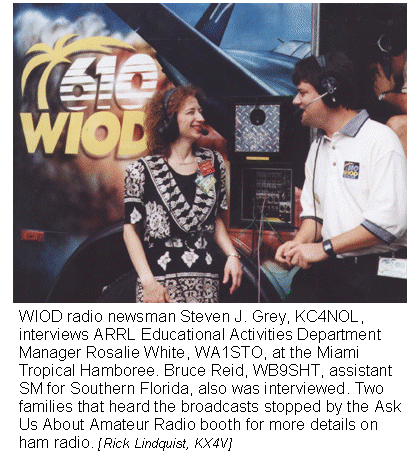 Among the field officials on hand to help man the ARRL booth were Southeastern Division Director Frank Butler,W4RH; Assistant Director Sandy Donahue, WA4ABY, Southern FloridaSM Robert "Rip" Van Winkle, AA4HT; and InternationalAffairs Vice President Larry Price, W4RA. HQ staffers includedQST Editor Mark Wilson, AA2Z; ARRL Field Services ManagerRick Palm, K1CE; ARRL Educational Activities Manager Rosalie White,WA1STO; QST Senior Assistant Technical Editor Dean Straw,N6BV; QST DX Editor Bill Kennamer, K5FUV; QST AdvertisingManager Brad Thomas, KC1EX, and QST Assistant TechnicalEditor Rick Lindquist, KX4V.
Hamboree general chairman Evelyn Gauzens, W4WYR (who's also ARRLSoutheastern Division Vice Director), says the hourly tours ofthe nearby National Hurricane Center, a few blocks away from theconvention site, turned out to be the highlight of the Hamboreefor many who showed up. "We had 600 to 800 the first day,"she says. "Everybody was asking about it." Turbulentweather in Northern Florida, where severe thunderstorms erupted,helped lend an air of reality to National Hurricane Center visits.By the Hamboree's final day, much cooler air moved into SouthernFlorida, pushing temperatures sharply downward and helping tocompensate for the earlier sultry weather and a lack of air conditioningin the exhibit areas. Evelyn says she hopes that problem willbe resolved by next year's hamfest.
Rick Palm, K1CE, reports that a meeting of primary hurricane disasterrelief net representatives and other interested amateurs--cosponsoredby the Hurricane Watch Net and ARRL Field Services Department--wasa big success. The session, also held at the National HurricaneCenter, "laid the groundwork for better coordination forthe upcoming hurricane season," he says. In past years, netsoften were not coordinating their activities with each other,Rick explained. He says the meeting encouraged setting up netliaisons or even a "net of nets" to keep everyone onthe same tune.
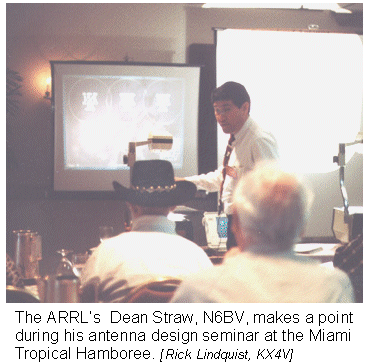 Dean Straw, N6BV, had a good turnout for his technical workshop, "Computer-Aided Antenna/System Design of HF/VHF Stations,"held February 2. The workshop focused on a "system approach"to antenna design and reviewed the basics of computer modelingof HF and VHF Yagis and other gain antennas. Dean demonstrateda number of computer programs, showing how to model not only antennasbut also the effects of irregular terrain on ionospheric propagation."Lots of discussion on the uses and abuses of modeling, withprobing questions throughout, made for a lively session!"he says. Dean also spoke February 3 on local terrain and its effecton HF signal takeoff.
Bill Kennamer, K5FUV, filled an auditorium for his colorful slidepresentation and discussion of the recent XZ1A DXpedition to Myanmar(formerly Burma), on which he was one of the operators.
The new CD-ROM version of QST was the hit of the ARRL booth.QST Editor Mark Wilson, AA2Z, ran the demonstration diskthrough its paces for dozens of visitors, a number of whom placedorders. The soon-to-be-available CD-ROM features an entire year'sworth of QST, plus QEX and NCJ (1995 forthe initial offering), including full text, all photographs, schematicsand other graphics, and advertisements. Among other things, userscan search for text and zoom in to schematics and diagrams toenhance detail. The text includes hypertext links. (Copies are$19.95 for members and $29.95 for nonmembers, plus $4 shipping.The CD-ROM will be available in mid-March. To order one, e-mailpubsales@arrl.org or set your browser to http://www.arrl.org/on the World Wide Web.)
The International Amateur Radio Union's booth, next to the ARRL'salong the main drag of the hamfest, also got a lot of attention,especially from foreign hams. "The people from other countriesseemed very happy to see IARU," Evelyn observed. 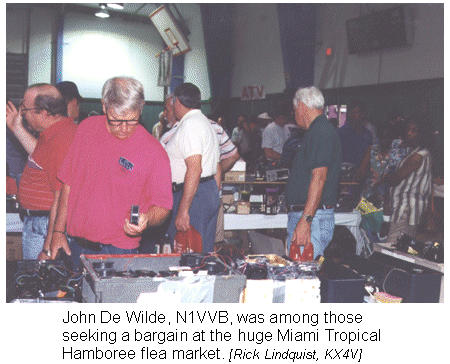 IARU Region 2 President Tom Atkins, VE3CDM; Vice President Ron Szama, LU2AHand Secretary Pedro Seidemann, YV5BPG, all were there to lenda hand.
Other activities included an FCC forum, SkyWarn and AMSAT sessions, a presentation on searching for life among the stars (by PaulSchuch, N6TX, of the SETI League) and an instructor-to-instructorforum with Rosalie White, WA1STO. Local all-news radio stationWIOD (610 AM) also snagged Rosalie for a live interview.
Well over 100 equipment dealers and other exhibitors--plus a hugearray of individual flea marketers--also turned out for the 36thannual Hamboree, billed as the "ARRL Hamfest of the Americas."Evelyn Gauzens has chaired every one of them, starting in 1960when the event was held in the old Bayfront Auditorium. She'salready well into preparations for the 1997 Hamboree, which willbe an ARRL Southeastern Division Convention and the 50th anniversaryof the sponsoring Dade Radio Club of Miami's affiliation withARRL.
Despite some earlier reports that the current sunspot cycle hadbottomed out, it could be another year before things start lookingup, depending on which data you use. Solar prognosticator TadCook, KT7H, reports that solar activity is still very low, and"we are very close to the solar minimum." The latestprojections show 10.7-cm solar flux--actually a radio measurementof the amount of energy at that wavelength--reaching minimum arounda year from now, during January and February 1997. Solar fluxseems to correlate with density of ionization in the ionosphereand consequent HF propagation.
But other projections, based on direct telescopic observationsof sunspots, show the sunspot number reaching minimum during Aprilthrough June of this year, and a big increase startinglate in 1997. The sunspot number is derived by counting visibledark spots on the sun and factoring in their area. Last summer,astronomers observed what they believe to be the first spots ofthe new cycle on the sun's polar regions. Spots shift in magneticpolarity from one cycle to another, Cook says, making it possibleto differentiate the "new" spots from the current ones.In any case, just when Cycle 23 begins often is not "officially"determined until well after the event transpires. "There'ssome overlap" between cycles, he explains.
From Cook's point of view, the solar flux is a more reliable indicatorof how solar activity will affect HF propagation on Earth. Asmost hams know already, solar disturbances, primarily solar flares,can disrupt radio (and other) communication. "These throwout huge amounts of protons," Cook explains about the flares."If they're aimed right at the earth, they can be very disruptive."Among the most disturbed days in recent weeks was January 29,when the A index reached 18, and the K index was as high as five.Otherwise geomagnetic conditions were quiet over this period,Cook says. Solar flux should head down toward 70 by February 12and then back above the mid-70s late in the month. Sunspot numbersin late January had a mean of 13.7.
An FCC Administrative Law Judge has determined the Commissionshould not renew the Amateur Radio license of Herbert L. Schoenbohm,KV4FZ, of Kingshill, Virgin Islands. In late 1992, Schoenbohm,now 56, was found guilty in US District Court of using a "counterfeitaccess device" to make long-distance telephone calls. Whilehis initial conviction did not specifically involve breaking FCCregulations, Schoenbohm eventually ran directly afoul of the commission,which said his conviction "is relevant to evaluating thelikelihood that he will comply" with the FCC's Amateur Radiorules. In early 1994, the FCC designated his application to renewhis ham radio license for a hearing, but extended the expirationdate of the license until the matter could be settled. The hearingwas August 8, 1995.
Administrative Law Judge Edward Luton concluded on January 26that Schoenbohm's 1992 felony conviction plus his subsequent "knowingviolation" of the FCC's ex parte rules "providesfurther evidence that the Commission will not be able to relyon him to be truthful or to comply" with FCC rules and policies.Schoenbohm was accused of improperly encouraging other peopleto intervene on his behalf with the FCC and of using ham radioto do so in at least one instance. The ex parte rules prohibitanyone in Schoenbohm's situation from directly soliciting suchpolitical intervention.
FCC documents show that Schoenbohm fraudulently obtained long-distancetelephone service by using illicitly obtained telephone accesscodes. Schoenbohm, then the communications chief for the VirginIslands Police Department, was sentenced to two months in prison(later suspended) and two years probation and was fined $5000.He lost his job as a result of his conviction.
FCC documents also show KV4FZ had a distinguished record of AmateurRadio public-service and had helped provide emergency communicationin several hurricanes. However, the decision's Conclusions ofLaw found that, at the August hearing, Schoenbohm mischaracterizedthe facts concerning his conviction in "a conscious effortto influence and mislead the trier of fact" and that his"altered testimony about the facts of his conviction wasdeliberately false." Luton reached a similar conclusion withregard to Schoenbohm's claims that his on-air efforts to get aroundthe ex parte rules were innocent attempts to explain thoserules, contained in Section 1.1210.
Unless an exception is filed within 30 days or the FCC reviewsthe case on its own motion, the decision becomes effective in50 days.--FCC
CONGRATULATING OUR 70, 60 and 50-YEAR MEMBERS
Hard as it might be for some of us younger hams to believe, threeamateurs have been recognized for logging 70 years as League members!Others recently hit the 60 and 50-year marks. ARRL Executive VicePresident David Sumner, K1ZZ, recently sent letters of congratulationto these and other long-time members, including a lengthy listof 40-year members. In addition to certificates of membership,the 70-year members receive an engraved plate. Congratulations!
70-year members:
Howard Crosby, W2CCG, Syracuse, New York
Francis Walton, W9ACU, Browning, Illinois
Robert Reid, W4TK, Jacksonville, Florida
60-year members:
George S. Van Dyke Jr, W3HK, Philadelphia, Pennsylvania
David D. Kennedy, N4SU, King, North Carolina
Robert E. Lowrey Jr, W4DQW, Bradenton, Florida
50-year members:
Bradley W. Wyatt, K6WR, Los Gatos, California (Brad is the PacificDivision Director--Ed.)
Thomas W. Gloystein, W8BO, Cincinnati, Ohio
Frank L. Gantz, W4ICE, Boca Raton, Florida
Frederick L. Schneider, W0ECE, Cape Girardeau, Missouri
K3ZJW TO HEAD ANTIQUE WIRELESS ASSOCIATION
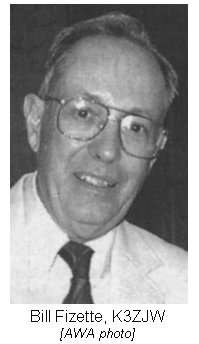 William B. Fizette, K3ZJW, of Henryville, Pennsylvania, is the new president of the Antique Wireless Association Inc, headquartered
in Bloomfield, New York. At its November 5 meeting, the AWA board
elected Fizette, the AWA's second vice president, for a two-year
term to succeed Bruce D. Roloson, who had been both AWA president
for eight years and was publisher of The Old Timer's Bulletin,
the association's quarterly membership publication. Fizette, who's
a pharmacist by profession, writes and edits The Communication
Receiver column in the OTB and edits The AWA Review,
now at Volume 9. He's also president of the AWA Museum board of
trustees.
William B. Fizette, K3ZJW, of Henryville, Pennsylvania, is the new president of the Antique Wireless Association Inc, headquartered
in Bloomfield, New York. At its November 5 meeting, the AWA board
elected Fizette, the AWA's second vice president, for a two-year
term to succeed Bruce D. Roloson, who had been both AWA president
for eight years and was publisher of The Old Timer's Bulletin,
the association's quarterly membership publication. Fizette, who's
a pharmacist by profession, writes and edits The Communication
Receiver column in the OTB and edits The AWA Review,
now at Volume 9. He's also president of the AWA Museum board of
trustees.
The Old Timer's Bulletin also has a new editor. He's Marc F. Ellis, N9EWJ. The AWA operates a museum of early wireless equipment. Bruce Kelley, W2ICE, is the museum's curator.--AWA Old Timer's Bulletin
RACES HELPS OUT IN NEW YORK STATE FLOODING
The Ulster County (New York) RACES was activated January 24 to assist the National Guard in the Delaware County, New York, flood disaster area to provide equipment and personnel necessary to establish communication between the flood area and the National Guard headquarters in Kingston, New York. RACES was able to set up a complete communication system and make contact within 15 minutes following activation at the Kingston Armory, reports Don Koeppen, N2WCY, of Woodstock, New York. (Don is a sergeant in the Ulster Police Department.)
He says the National Guard utilized the Margaretville repeater on 146.985 MHz as a link between the disaster area and the National Guard Headquarters in Kingston, New York. Working four and eight-hour shifts, RACES members remained on the scene around the clock throughout the emergency, January 23-26. Other RACES members also worked with personnel at the disaster site to help provide food and clothing for stricken families. Koeppen did not have a damage estimate, but he says many homes were flooded and bridges washed away.
N2WCY reports that after RACES stood down following the Delaware County flooding, "we then had our own problems in the Ulster County area with flooding in the Sawkill area." He says residents almost had to be evacuated, "but the water receded quickly." He says RACES members monitored flooded roads in the Ellenville area and the quickly rising waters through the Esopus creek and Roundout areas. Officials had worried because the reservoirs above the county were filled to capacity. But in the end, the weather itself spared the region. "Thanks to the extreme cold, the snow in our mountains did not melt which would have had a devastating effect on the creeks and definite flooding," N2WCY explains. "All told, I think we were very lucky."
QRP AMATEUR RADIO CLUB INTERNATIONAL SYMPOSIUM SET
QRP Amateur Radio Club, International (QRP-ARCI) will hold its first QRP Symposium Thursday, May 16, just as the 1996 Dayton Hamvention gets under way. QRP-ARCI has dubbed it "Four Days in May--the QRP Event of 1996," and hopes to make it an annual event. Conference presentations, meetings and workshops on "everything you wanted to know about Amateur Radio QRP" will be part of the full-day event, to be held at the Days Inn Dayton South. Activities start with a coffee social and include presentations by renowned QRPers and QRP equipment manufacturers. Exhibits of QRP projects from around the world will be available during nightly hospitality suite sessions. The event culminates with the Friday night banquet May 17.
Advance registration ends May 1, and the fee is $30 (US check or money order), payable to FDIM QRP Symposium. Send registrations to Paulette Quick, N9OUH, FDIM registration, PO Box 145, Madison, WI 53701-0145. For more information only, e-mail plquick@facstaff.wisc.edu.
Don't think it's the latest DXpedition when the new M-prefix call signs start showing up on the bands this spring. The United Kingdom is running out of the familiar G-series call signs the government there has issued since the 1920s for most UK stations. The Radiocommunications Agency will begin issuing the M-series calls starting April 1 to all new full licenses (both Class A and B). The first call sign, M0AAA, has already been awarded to the Reading and District Amateur Radio Club (on behalf of the Reading Novices Amateur Aerial Association). RADARC reports it will use the club-station version of the call, MX0AAA, beginning April 1 and offer a special QSL card to mark the occasion.
RADARC says the UK's Radiocommunications Agency will follow the same prefix pattern it's used for the G-series calls over the years: MW stations will be in Wales, MM will be Scotland, MI for Northern Ireland, etc. Existing G stations are not affected by the move to the new call sign block.
Peter Swynford, G0PUB, of RADARC explains that the RA in the United Kingdom issues four classes of "licence": A Class A Full Licence holder may operate all amateur HF and VHF bands with a maximum of 400 W, while a Class B Full Licence station may operate all bands above 50 MHz with a maximum of 400 W. A Class A Novice Licence holder has limited access to the HF and VHF bands with 3 W, while a Class B Novice License station has limited access to VHF bands only with 3 W. Novice station prefixes (issued since 1992) have call signs in the 2-series. So, an English Novice call might be 2E1AAA while a Scottish Novice call might be 2M1AAA.
In Brief
- This Week in Amateur Radio--an audio news magazine--returned to the satellite airwaves as planned on January 27. But executive producer Stephan Anderman, WA3RKB, reports one glitch. Due to a winter storm, the uplink station in Knoxville, Tennessee, was knocked out when the uplink dish iced up. "Everything is now back in order, and we expect a long, smooth ride on Anik E2!" Anderman reports. TWIAR airs Saturdays at 8 PM Eastern on Anik E2's transponder 18.
- The AMSAT-DOVE team is still trying to get things right on the crippled DOVE-OSCAR 17 research and educational satellite, which crashed first in early December, then again during software reloading efforts in late December. The satellite is in MBL (Microsat Boot Loader) mode while controllers sort out what's wrong and attempt another reloading. Jim White, WD0E, of the DOVE team says the most recent computer system failure suggests a hardware problem aboard the spacecraft. The packets that can seen in the 145.825 MHz downlink are short telemetry frames sent from 'DOVE' to 'MBLCTL', which is MBL Control. They are sent at more or less random intervals from a few seconds to several minutes.--AMSAT News Service/Jim White, WD0E
- Frank R. Casey, WB2HKU, has been named the 1995 International Telecommunicator of the Year by the Association of Public-safety Communications Officials. Frank, who's blind, is senior telecommunications supervisor at the Albany County (New York) Sheriff's Department, where he's worked for 27 years. He's also active in RACES and ARES. Frank received the award at APCO's 61st International Conference and Exposition in Detroit last fall. Congratulations!--APCO Bulletin
- The ByteMark Corporation seeks 250 beta testers for its new CoreCalc for Windows program, which helps users select and use Amidon toroid cores. The program looks up the AL value of the powdered-iron toroid, calculates the number of turns needed for the desired inductance, suggests wire size and even calculates prices associated with Amidon parts orders. Test subscriptions are $29.95. For details, contact ByteMark Corporation, 7714 Trent St, Orlando, FL 32807; tel, 407-679-3184; fax, 407-673-2083.
The ARRL Letter is published by the American Radio Relay League, 225 Main Street, Newington, CT 06111, tel 860-594-0200; fax 860-594-0259. Rodney J. Stafford, KB6ZV, President; David Sumner, K1ZZ, Executive Vice President.
Electronic edition circulation/address changes, Kathy Capodicasa, kcapodicasa@arrl.org.
Printed edition circulation, Mark Dzamba, 860-594-0253.
Editorial, Rick Lindquist, Assistant Technical Editor, rlindquist@arrl.org.
The purpose of The ARRL Letter is to provide the essential news of interest to active, organizationally minded radio amateurs faster than it can be disseminated by our official journal, QST. We strive to be fast, accurate and readable in our reporting.
Material from The ARRL Letter may be reproduced in whole or in part, in any form, including photoreproduction and electronic databanks, provided that credit is given to The ARRL Letter and The American Radio Relay League.