You can email this page's content administrator at rlindquist@arrl.org.
INSIDE:
At deadline . . .
- FCC playing catch-up ball: The budget impasse is over for now, but FCC issuance of new ham radio licenses was further delayed this month by bad weather and a Monday holiday. The FCC reopened Thursday, January 11, but closed Friday, January 12, as more snow hit Washington, DC. Monday, January 15, was a Federal holiday, Martin Luther King Day. While open on January 11, the FCC accepted electronic amateur license application files for processing from VECs, including more than 1800 records from ARRL/VEC. The FCC was planning to expedite the application backlog, but needed to make some temporary software adjustments before granting licenses. It was expected to take several days after the January 15th holiday for the FCC to get back up to speed. Applicants wanting to check on license application status may call ARRL at 860-594-0300, 8 AM to 5 PM EST. Call sign and license upgrade information also is available on Internet sites, including the University of Arkansas, Little Rock, Web site at http://www.ualr.edu/~hamradio/index.html --Bart Jahnke, KB9NM
- Spectrum-policy hearings: The ARRL hopes to be able to participate in the Federal Communications Commission's en banc hearings on spectrum allocation. The FCC says that since spectrum issues have been arising in numerous contexts and affecting several services, it has decided to hear oral presentations and "allow a direct exchange of viewpoints." The hearings will address future spectrum demand and user needs, trends in technology, and approaches to spectrum allocation and assignment, including licensing and uses. The FCC is seeking comments from individuals and representatives of affected industries. Originally scheduled for January 31, the actual date of the hearings now is in doubt because of the Federal furloughs triggered by the congressional budget deadlock and heavy snow which extended the shutdown.--Steve Mansfield, N1MZA
FCC proposes to suspend amateur use of 76-77 GHz
In a Second Notice of Proposed Rulemaking (NPRM) in ET Docket 94-124, issued just before the Federal shutdown in mid-December, the Federal Communications Commission has proposed amending Part 97 of its rules to "temporarily disallow amateur use of the 76-77 GHz band," which the FCC hopes to open for commercial development along with other "millimeter wave" frequency bands above 40 GHz. The band in question is part of the 75.5 to 81 GHz allocation, which the amateur and amateur satellite services share with other users--on a primary basis from 75.5-76 GHz, and on a secondary basis from 76-81 GHz. The primary allocation of 76-81 GHz is assigned to radiolocation, including radar.
The commission says the change will permit development of Part 15 vehicle radar systems in the 76-77 GHz band that could be used in conjunction with Intelligent Transportation Systems (ITS). Restricting amateur use of 76-77 GHz will prevent potential interference to these developing systems, the FCC says. The NPRM says the "temporary" restriction could be relaxed if it can be shown that other in-band transmissions would not compromise vehicle radar system safety or if sharing guidelines can be worked out. The FCC says it will revisit the issue within five years.
At the same time, "to balance any perceived harm" to amateur operators, the FCC proposes to upgrade amateur status in the 77.5-78 GHz band from secondary to co-primary with government and nongovernment radiolocation services. "This will ensure that amateur access to spectrum near 77 GHz is maintained without the threat of preemption by higher priority services," the NPRM states.
In its comments, the ARRL objected to limiting the 76-77 GHz band to vehicle radar systems. The League said it wanted to maintain existing ham allocations from 75.5 to 81 GHz to spur development of short-range, high-speed data links.
Automobile manufacturers differed on the issue of continued Amateur Radio use of the 76-77 GHz segment. Ford Motor Company opposed continued use of the band by hams while General Motors Research Corporation said vehicle radar systems would not be adversely affected by continued amateur use of the band. GM said the anticipated power densities on public roads from amateur use would be well below levels that would affect reliable vehicle radar system operation. GM submitted the Petition for Rule Making to provide the 76-77 GHz band for vehicle radar systems. Japanese automakers prefer 60-61 GHz for these systems.
SUMMERS RECEIVES ARRL LIFETIME ACHIEVEMENT AWARD
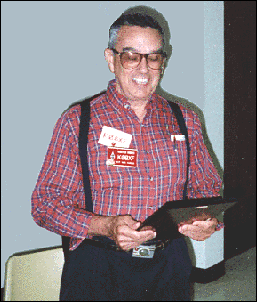 Bob Summers, K0BXF, has
received the ARRL Lifetime Achievement Award plaque upon his retirement
after more than 30 continuous years as Kansas section manager and
section communications manager. Midwest Director Lew Gordon, K4VX, made
the presentation at the Kansas State Convention in Wichita September 30
(one day after Bob turned 67). First licensed in 1955, Summers has held
a variety of ARRL appointments, including OO, ORS and OBS as well as SEC
for Kansas. He was appointed acting section communication manager for
Kansas in 1965 and was successfully elected for every term up until his
retirement last November. Summers says his next real challenge is
"to learn how to say 'no!'"--Lew Gordon,
K4VX.
Bob Summers, K0BXF, has
received the ARRL Lifetime Achievement Award plaque upon his retirement
after more than 30 continuous years as Kansas section manager and
section communications manager. Midwest Director Lew Gordon, K4VX, made
the presentation at the Kansas State Convention in Wichita September 30
(one day after Bob turned 67). First licensed in 1955, Summers has held
a variety of ARRL appointments, including OO, ORS and OBS as well as SEC
for Kansas. He was appointed acting section communication manager for
Kansas in 1965 and was successfully elected for every term up until his
retirement last November. Summers says his next real challenge is
"to learn how to say 'no!'"--Lew Gordon,
K4VX.
FAR OFFERS SCHOLARSHIPS FOR HAMS
The nonprofit Foundation for Amateur Radio Inc--an ARRL-affiliated federation of radio clubs in the Washington, DC, area--plans to administer 57 scholarships for the 1996-97 academic year to help licensed radio amateurs with their post-secondary education. Eight of the scholarships are fully funded with income from grants and the foundation's annual hamfest in Gaithersburg, Maryland.
Licensed hams are eligible if they plan to pursue a full-time course of study beyond high school and are enrolled or have been accepted at an accredited university, college or technical school. Awards range from $500 to $2000, with preference given in some cases to those pursuing certain courses of study or to residents of specific geographical areas (Delaware, Florida, Maine, Maryland, New Jersey, Ohio, Pennsylvania, Virginia and Wisconsin). Application forms and information are available by letter or QSL postmarked prior to April 30, 1996, from FAR Scholarships, 6903 Rhode Island Ave, College Park, MD 20740. Contributions to FAR are tax-exempt.
THIS WEEK IN AMATEUR RADIO TO RETURN
This Week in Amateur Radio, a weekly audio news magazine service, is scheduled to return to the air early this year on Telesat Canada's Anik E2 satellite. The program's executive producer, Stephan Anderman, WA3RKB, says the show should return by late January. A beacon was scheduled to be on the transponder (18). The satellite switch was made necessary as a result of the shutdown of Telstar 302, which is nearing the end of its useful life. This Week in Amateur Radio has been off the air since Thanksgiving weekend. The program, which averages 75 minutes of news, carries ARRL and RAC bulletins, contest and convention information, propagation forecasts, Radio Amateur Information Network, the Amateur Radio Newsline and other features on over 100 nets and repeaters throughout North America.
Anik E2 is at 107º W longitude in geosynchronous orbit. This Week in Amateur Radio is scheduled to air, on transponder 18, Saturdays at 8 PM Eastern Time. The satellite provides excellent coverage of North America and has spot beams aimed at Alaska and Hawaii. The program lineup is available on the ARRL's HIRAM BBS at 860-594-0306 and at various Internet sites. For more information, call George Bowen, N2LQS, 518-283-3665, (e-mail: kxkvi@delphi.com), or Stephan Anderman, WA3RKB, 518-664-6809 (e-mail: sanderman@delphi.com).
The DOVE-OSCAR 17 satellite has failed again after some eight days of being back on 2 meters during late December broadcasting a holiday greeting message. The unexpected crash occurred December 29 at approximately 0500Z as the AMSAT DOVE team continued to reload the spacecraft's software in the wake of the initial failure December 3. Jim White, WD0E, of the AMSAT DOVE team says the latest crash suggests a hardware problem aboard the spacecraft. The team had been hoping to fix the problem by reloading the satellite's software, which White describes as "a complex process" that can be very difficult and risky.
White said the team has created some software to allow the spacecraft to dump memory and has dumped the housekeeping data for analysis. The team has begun to load the first stage software again. As of early January, the spacecraft's S-band transmitter was on. The 2-meter transmitter is still sending telemetry packets infrequently, and White says it's acknowledging the loading of packets.
DOVE-OSCAR 17 is used for educational and research purposes.
In what appears to be a "first" for ham radio and for the space program, astronauts Steve Nagel, N5RAW, and Linda Godwin, N5RAX, were married December 29. Steve and Linda flew together on STS-37 in April 1991. Both have appeared as speakers for ARRL at conventions. Steve conducted a SAREX forum at the 1994 Dayton Hamvention, and Linda helped ARRL Educational Activities Department head Rosalie White, WA1STO, with youth forums in Dallas in 1992 and Tulsa in 1994. Linda also has done public service announcements about ham radio for ARRL, and she appears in the ARRL videotape, Ham Radio in Space.
Nagel was the commander aboard space shuttle mission STS-55 in April 1993, operating the SAREX radios and thrilling hundreds of hams listening from Earth. Godwin, a NASA Mission Specialist, operated the SAREX radios during mission STS-59 in April 1994, and especially enjoyed the school QSOs. She flies next on STS-76 in March 1996.
"These two folks are super wonderful people!" White said, expressing her best wishes for the newlyweds.--Matt Bordelon, KC5BTL
BEARS PROVIDE COMMUNICATION DURING BLIZZARD
As the first blizzard of 1996 hit New England the weekend of January 6-7, the BEARS--members of the Bethel Educational Amateur Radio Society of Bethel (Connecticut) Middle School--got the call to action from the Bethel Office of Emergency Management. The students operated around the clock to provide backup communication for the town and acting as a net control station for 34 surrounding towns in the greater Fairfield County area. The BEARS team maintained vital communication links with the Area 1 Office of Emergency Management in Bridgeport, relaying weather information and preparing materials if emergency shelters were activated. Using the call sign of their coordinator, Peter Kemp, KZ1Z, the group operated from the local fire department on both HF and VHF. The BEARS also have a club station at their school. A dozen students--boys and girls--participated in the effort. Kemp says he's been involved in emergency communication for years, and when the middle school--which also serves as an evacuation center--was built, the radio room was designed in and the building equipped with emergency power.--BEARS/Peter Kemp, KZ1Z
CANADIAN CALLS COMMEMORATE HOLOCAUST'S END
Industry Canada Quebec Region has authorized all Canadian hams to use special prefixes through February to mark the 50th anniversary of the end of the Holocaust:
Regular Prefix  Special Prefix
     VE1             CF1
     VA2             CG2
     VE2             CF2
     VA3             CG3
     VE3             CF3
     VE4             CF4
     VE5             CF5
     VE6             CF6
     VA7             CG7
     VE7             CF7
     VE8             CF8
     VE9             CF9
     VO1             CZ1
     VO2             CZ2
     VY1             CK1
     VY2             CK2
QST COVER PLAQUE AWARDS FOR 1995
On a regular basis throughout the year, the 15 ARRL division directors vote to select their favorite QST articles in each month's issue. The authors receive a handsome QST Cover Plaque, which consists of a cover from the issue containing their article and an inscription of the author's name and call sign. Here are the monthly winners for 1995 and the titles of their articles:
January: Jim Reynante, KD6GLF, for "A Five-Element Quad Antenna for 2 Meters."
February: Darrel Emerson, AA7FV, for "Radio Observations of Two Solar Eclipses."
March: David E. Laag, WA6OWD, for "The San Bernardino Microwave Society Turns 40."
April: Michael L. Ardai, N1IST, for "Building a Digital Voice Recorder for Less Than $15."
May: Lauren Rudd, KD8PZ, for "Let Your PC Do the Logging."
June: Steven Bible, N7HPR, and Greg Pool, WH6DT, for "Amateur Radio on the World Wide Web."
July: Rudy Severns, N6LF, for "A Wideband 80-Meter Dipole."
August: Dan Davis, W8LUX, for "Amateur Radio and World War II."
September: Thomas M. Webb, WA9AFM/5, for "Holocaust in Oklahoma City."
October: Robert Wilson, AL7KK, for "The Offset Multiband Trapless Antenna (OMTA)."
November: Floyd A. Koontz, WA2WVL, for "Broadband Transmitting Wire Antennas for 160 through 10 Meters."
December: Roger Sparks, W7WKB, for "The Super Sloper."
A group of Boy Scouts and their leaders, including several hams, lived up to the Scouts' motto, "Be Prepared," during a wilderness outing last summer, and heart attack victim Dave Smith of Saratoga, California, is glad they did. Smith and his wife Janet were accompanying their younger son and other scouts in Troop 566 on an eight-day backpacking trip into California's Yosemite high country in late August when Dave Smith experienced chest pain one day into the outing.
Scoutmaster Paul Wesling, KM6LH, took Smith's vital signs and used ham radio to relay the information to the Yosemite emergency response staff. Subsequently, Smith was transported by helicopter to Yosemite Valley and then to Modesto, California, where doctors determined he'd suffered a mild heart attack.
Wesling says ham radio "is a standard part of our troop's outings." Both Wesling and Eagle Scout Rajeev Goel, KD6MXV, had VHF handheld radios along for the trip. As a result of the experience, Dave and Janet Smith are making plans to take one of the troop's Amateur Radio licensing classes and get their tickets. "They see clearly how this can be a great benefit in the backcountry, and Dave fully intends to be on our 50-miler next summer," Wesling says.
ATTORNEY-HAM CITES OHIO TVI ARREST AS POSSIBLE WARNING
In the wake of the December arrest of a Moraine, Ohio, CBer for causing TVI at his neighbor's apartment, Dayton attorney and Amateur Radio operator Ron Pretekin, AB8K, says "hams should take note of what such problems ultimately can lead to." Pretekin pointed to an article in the Dayton Daily News describing the circumstances under which the CBer, Steven Holbrook, wound up in jail on a third-degree felony charge of disrupting public services for interfering with his neighbor's reception of cable television programs. According to the report, Holbrook and the neighbor had feuded over the problem for several months. His arrest came after the neighbor tape-recorded Holbrook's CB chatter as it came over his TV. The newspaper said the conversation included profanity and threats against the neighbor. If convicted, Holbrook faces a maximum $5000 fine and 10 years in jail, the paper said.
ARRL Executive Vice President David Sumner, K1ZZ, observed: "The FCC has exclusive authority to regulate RF interference, which is not subject to state or local law." Sumner says an attorney representing an ARRL member facing charges based on RF interference would be able to look to the League for some help. "However, we would hope that any licensed amateur would have the good sense to not inflame the situation in the manner described by the newspaper," Sumner added.
JOHN BROWNING, W6SP, SK. WAS AMSAT BOARD CHAIRMAN
Former AMSAT chairman of the board John W. Browning, W6SP, of Rancho Palos Verdes, California, succumbed to kidney cancer January 3, 1996. He was 71. W6SP was elected Chairman of the Board of AMSAT in 1982 and led the organization during early Phase 3 satellite development. He was an ARRL life member, prominent in many California DX associations and an avid HF operator from Palo Alto and later Los Angeles.
Following his retirement from the Air Force in 1982, John worked as a consultant to aerospace firms such as COMSAT and Sundstrand under his own company, Altaspace. He was also active in the Armed Forces Communications Electronics Association (AFCEA), a trade group, where he was regional vice president and was a member of SCAPR, the Southern California Association of Professional Representatives. A highly decorated veteran (Legion of Merit with one oak leaf cluster, Distinguished Flying Cross, Meritorious Service Medal, Air Medal with two oak leaf clusters, Air Force Commendation Medal with one oak leaf cluster and Purple Heart), John received the Distinguished Service Medal, the highest peacetime medal awarded in the US, when he retired as a Colonel in 1982.
Burial will be in Arlington National Cemetery January 16. The family invited donations in John's memory to the Torrance (California) Memorial Medical Center. John is survived by his wife, Myrnie, a daughter and a brother.
SID E. MOLEN, VK2SG, SK, ANARTS CO-FOUNDER
Sid E. Molen, VK2SG, passed away in late December following a heart attack. He was 76 and had been in failing health for a couple of years. Along with Bill Storer, VK2EG, Sid was a co-founder of the Australian National Amateur Radio Teleprinter Society (ANARTS) in the early 1970s. Sid and Bill subsequently started the weekly RTTY DX Notes (renamed the VK2SG RTTY Notes in 1993). Sid's byline, "DX1," reflected the fact that he held Australia's first RTTY DXCC certificate.--Jules Freundlich, W2JGR
FRANCES ELIZABETH B. "PAT" HUNTOON
Pat Huntoon, the wife of former ARRL General Manager John Huntoon, W1RW, passed away December 26, 1995, in Hartford, Connecticut. She was 76. Pat was a lifelong resident of East Hartford and, before retiring, she was employed by Connecticut General Life Insurance Company and as a part-time receptionist for Christ Church Cathedral, both of Hartford, and volunteered in many community organizations. Besides her husband, three daughters survive. A service for Pat Huntoon will be Saturday, January 27, 2 PM, at Christ Church Cathedral, 45 Church St, Hartford. John Huntoon was the League's General Manager from 1961 until 1975.
In Brief
- Five schools have been selected for participation in
SAREX during space shuttle flight STS-76, tentatively set to launch
March 21 for a nine-day mission that will include the third docking
mission with Mir some 196 to 245 miles above Earth. The
schools are Artesia (New Mexico) Public School; Troy (New Mexico)
Middle School; S J Davis Middle School, San Antonio, Texas; Bethlehem
Central Senior High School, Delmar, New York; and The University
of Colorado College of Engineering and Applied Science in Colorado
Springs. Two or more students at each of the selected schools
will get to ask the astronauts questions during their scheduled
radio contacts.
- Ted Rappaport, N9NB, has been promoted to full professor
at Virginia Polytechnic Institute & State University (Virginia
Tech) in Blacksburg, Virginia. Rappaport founded the Mobile and
Portable Radio Research Group within Tech's Bradley Department
of Electrical Engineering. He specializes in wireless communication
and has contributed to research into radio wave propagation within
buildings and in local areas. A graduate of Purdue University,
Rappaport joined Virginia Tech's faculty in 1988. A profile of
Rappaport appeared in July 1994 QST.--MPRG Propagator
- NASA Astronaut Scott Parazynski, KC5RSY, earned his
ham ticket in November. Parazynski has not yet been assigned to
a shuttle mission. During 1995, a record 11 NASA astronauts earned
their Amateur Radio licenses. Right now, the total number of hams
who are NASA career astronauts or payload specialists is 41.
- Ralph Haller continues as one of the principal deputies
of the FCC's Wireless Telecommunications Bureau in the wake of
a bureau-wide reorganization. Haller will oversee private wireless,
public safety and enforcement, as well as serve as the bureau's
principal liaison with industry. Michele Farquhar is acting Chief
of the bureau.
- Henry Tait, VE7FYU, is the new secretary of Radio Amateurs
of Canada (RAC), effective January 1. Tait, a British Columbia,
native, replaces Kenneth Pulfer, VE3PU, who remains as RAC treasure
and a member of the national executive. Pulfer also continues
as a member of the Amateur Radio Working Group negotiation with
Industry Canada.
- Rick Lindquist, KX4V, has been assigned to edit Happenings
and The ARRL Letter following the departure from the ARRL
staff of Jim Cain, K1TN. Rick, an assistant technical editor,
joined the League staff in September, 1995.
- The ARRL QSL Service mailed a total of 1,428,850 QSL
cards during 1995. That approaches five tons of members' cards.
- Section manager election ballots went out December
29 to members in the Eastern Pennsylvania, Louisiana, North Carolina
and San Diego Sections.
- Kantronics now has an e-mail account for customers
to get technical support and service. Questions go to service@kantronics.com.
Company representatives will respond via e-mail. Kantronics now
includes RF Concepts.
- Roy Welch, W0SL, has uploaded three .WAV files to the AMSAT FTP site on the Internet that contain recordings of radio signals received from OSCAR 1 (OSCAR1.ZIP), Explorer 1 (EXPLORE1.ZIP) and Sputnik 1 (SPUTNIK1.ZIP). The files each are around 100 kB each in size and play about 10 seconds of audio. They are in the /amsat/misc/sounds directory at ftp://ftp.amsat.org/ and on the AMSAT web page at http://www.amsat.org/. Each satellite file at the FTP site has a corresponding text file explaining circumstances of the recording.--AMSAT News Service
- Because of an editor's oversight, the Highlights of the Year
1995 in Amateur Radio listing in Vol. 14, No. 24 of The ARRL
Letter failed to mention the important role Amateur Radio
played in providing communication and assisting in recovery efforts
in the wake of the Oklahoma City federal building bombing. Articles
in the August and September 1995 issues of QST detailed
this commendable public service effort.
- Because of an editor's error, an item in Vol 14, No. 24 of
The ARRL Letter incorrectly listed the offices held by
Vivian Douglas, WA2PUU. Vivian is an assistant director in
the Atlantic Division, public information coordinator for the
Western New York Section, emergency coordinator in Onondaga County,
Central New York Traffic Net manager and a local club official.
- The call sign for the Edison Amateur Radio Network (EARN) club station was listed incorrectly in a news brief in Vol. 14, No. 24 of The ARRL Letter. The correct call sign is WB6UCD.
The ARRL Letter is published by the American Radio Relay League, 225 Main Street, Newington, CT 06111, tel 860-594-0200; fax 860-594-0259. Rodney J. Stafford, KB6ZV, President; David Sumner, K1ZZ, Executive Vice President.
Editorial, Rick Lindquist, Assistant Technical Editor, rlindquist@arrl.org. Electronic edition circulation, Kathy Capodicasa, kcapodicasa@arrl.org.
The purpose of The ARRL Letter is to provide the essential news of interest to active, organizationally minded radio amateurs faster than it can be disseminated by our official journal, QST. We strive to be fast, accurate and readable in our reporting.
Material from The ARRL Letter may be reproduced in whole or in part, in any form, including photoreproduction and electronic databanks, provided that credit is given to The ARRL Letter and The American Radio Relay League.